







Executive Overview
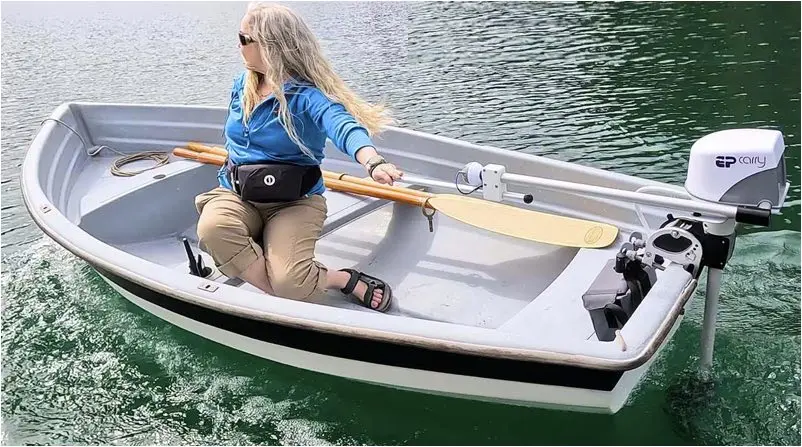
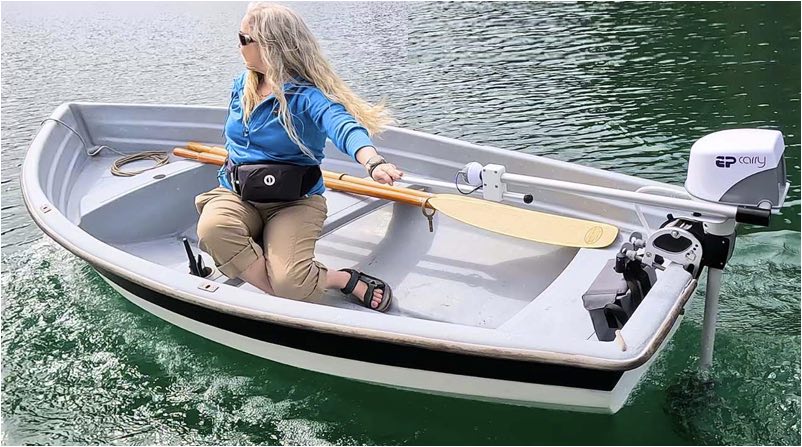
The global transition toward sustainable maritime propulsion has largely focused on high-powered inboard systems, luxury electric yachts, and commercial watercraft. Yet, a quiet revolution is happening at the grassroots level of recreational boating—specifically within the niche of dinghies, tenders, and small recreational watercraft. Enter the EP Carry Gen2, a lightweight electric outboard that addresses the foundational frustrations of small-boat handling: heavy, foul-smelling gasoline motors, cumbersome maintenance, and safety concerns for young passengers.
Designed by Joe Grez—an experienced consumer product developer with a physics degree and a portfolio of US patents—the EP Carry line is the result of applying high-volume consumer product engineering to marine propulsion. Following the commercial success and field-tested reliability of its predecessor, the Gen2 builds upon more than 73,000 hours of cumulative customer use across a vast array of global waterways.
Weighing a mere 14 pounds (6.4 kg), the EP Carry Gen2 package bridges the gap between ultra-portability and dependable output. Featuring advanced Lithium Iron Phosphate (LFP) battery compatibility, a newly integrated boost mode yielding 280 watts of power, smartphone-enabled wireless firmware updates, and Bluetooth battery monitoring, this next-generation outboard positions itself as a masterclass in modern, efficient engineering. Whether deployed on a 9-foot rowing dinghy for a quick trip to a moored yacht or powering a solar-driven micro-cruiser over hundreds of miles of open water, the Gen2 demonstrates that clean marine mobility can be both accessible and remarkably resilient.
Detailed Chronology: From a Granddaughter’s Boat Ride to Gen2 Innovation
The Catalyst: 2008 and the Spark of Inspiration
The story of the EP Carry does not begin in a corporate boardroom, but on a quiet body of water in 2008. Joe Grez, an inventor and consumer product developer, was preparing to take his young granddaughter out for a routine afternoon of fishing in their small dinghy. While readying the boat, Grez was confronted with a mandatory carbon dioxide (CO2) warning label plastered onto the conventional gasoline outboard.
The mandate forced a moment of critical reflection. As the small gas motor sputtered to life, Grez became acutely aware of the exhaust fumes, unburnt hydrocarbons, and toxic vapor drifting backward into the enclosed space where his granddaughter sat. The sensory reality of internal combustion engines—noise, vibration, smoke, and chemical smells—seemed entirely out of place in a serene natural setting. Furthermore, the mechanical unreliability of small two-stroke and four-stroke gas motors often turned a relaxing day on the water into a stressful exercise in pull-cord frustration.
Grez began to explore whether modern battery and electric motor technologies could be harnessed to create a clean, quiet, and completely reliable alternative for small watercraft.
Assembling the Engineering Dream Team
Recognizing that marine environments present unique mechanical challenges—saltwater corrosion, constant vibration, thermal management, and impact risks—Grez knew a standard off-the-shelf electric motor would not suffice. He assembled a specialized design team boasting hundreds of years of combined expertise in electromechanical device technology.
Crucially, this team brought backgrounds rooted in high-volume consumer product manufacturing, having previously designed precision hardware for global powerhouses such as beauty care giant L’Oréal and Sonicare electric toothbrushes. This cross-industry pollination brought a consumer-centric design philosophy to the marine sector: products had to be lightweight, intuitively ergonomic, remarkably durable, and virtually maintenance-free.
Market Introduction and 73,000 Hours of Field Testing
In 2017, after years of rigorous prototyping and iterative testing, the original EP Carry electric outboard officially launched to the public. Rather than relying solely on controlled laboratory metrics, the company allowed its product to be stress-tested in the wild by everyday boaters.
To date, hundreds of customers have collectively logged over 73,000 hours of operating time using the EP Carry across a diverse ecosystem of watercraft, spanning calm freshwater lakes, tidal estuaries, and choppy coastal environments. Joe Grez himself has personally piloted the motor over 800 nautical miles (approximately 920 miles or 1,500 kilometers) during demanding Salish 100 cruises and solar-powered micro-cruiser expeditions. This immense repository of real-world operational data directly informed the engineering breakthroughs embedded within the new Gen2 release.
Supporting Context & Metrics: Inside the EP Carry Gen2
The release of the Gen2 model is not merely a cosmetic update; it represents a comprehensive architectural overhaul encompassing mechanical design, power electronics, battery chemistry monitoring, and user-interface integration.
Power, Weight, and Performance Metrics
Despite maintaining the exact same featherlight physical profile as its predecessor—weighing a mere 14 lbs (6.4 kg)—the Gen2 extracts significantly higher performance from its core architecture:

- Nominal Output: 220 Watts (matching Gen1 baseline efficiency).
- Boost Mode Output: 280 Watts (a 22% power boost enabled by an advanced new controller system).
- Propulsion Capability: Designed primarily for dinghies and small tenders, its unique electronically impact-protected propeller can effortlessly drive vessels up to 1,000 pounds (455 kg) and 19 feet (5.8 m) in length.
Battery Chemistry and Runtime Dynamics
The EP Carry Gen2 Complete Integrated Package centers around a high-performance 24-volt Lithium Iron Phosphate (LFP) battery boasting 288 Watt-hours of energy storage. Tested rigorously on a standard 9-foot (2.75-meter) rowing dinghy, the performance metrics demonstrate remarkable efficiency across various throttle settings:
| Throttle Setting | Speed (Knots / MPH / KMH) | Runtime Duration |
|---|---|---|
| Half Power | 3.4 kt / 3.9 mph / 6.3 km/h | 140 Minutes (2 hours, 20 mins) |
| Full Power | 4.0 kt / 4.6 mph / 7.4 km/h | 70 Minutes (1 hour, 10 mins) |
| Boost Mode | 4.2 kt / 4.8 mph / 7.8 km/h | 50 Minutes |
Battery Flexibility and Extended Range Options
Recognizing that different cruising itineraries demand varied energy reserves, the Gen2 system offers modular battery configurations. Users can easily integrate a secondary battery to instantly double their cruising range. Furthermore, the Gen2 motor can be purchased as a standalone unit and paired with any compatible 12V, 24V, or 36V LFP battery from a third-party supplier.
Depending on the vessel hull design and battery bank configuration, cruising ranges at full throttle can comfortably exceed 20 miles (32 km) on a single charge. The industry-wide shift toward LFP chemistry—heralded for its thermal stability, safety, extended lifespan, and declining cost curve—ensures that EP Carry users are well-positioned for future energy density upgrades.
Official Statements & Technological Innovations
The engineering team behind the Gen2 focused heavily on refining the human-machine interface, mechanical adaptability, and security.
Smart Integration and Wireless Connectivity
In an era where digital connectivity is expected across all consumer electronics, the EP Carry Gen2 brings smart-device integration to the transom. The proprietary EP Carry battery—alongside most mainstream off-the-shelf LFP units—features built-in wireless monitors. These integrate seamlessly with an optional wireless Bluetooth battery monitor app, allowing operators to track real-time state-of-charge levels directly on their smartphones.
Beyond battery telemetry, the smartphone interface acts as a gateway for wireless, free firmware updates, ensuring the motor’s internal logic remains optimized as software improvements are developed.

Mechanical Versatility and Ergonomics
Small-boat owners frequently contend with awkward transoms, cramped seating positions, and the eternal fear of motor theft at public docks. The Gen2 introduces a suite of mechanical enhancements to neutralize these pain points:
- Shaft Configurations: Available in both long- and short-shaft versions to match varying transom heights.
- Transom Adjust System: Specifically engineered to accommodate boats featuring severe transom rakes.
- Pivot and Tilt Options: Users can choose between a patented automatic release pivot clamp module or a traditional tilt latch fitting.
- Tiller Flexibility: The tiller handle is now completely detachable and can be paired with an optional extension arm for operators who must sit further forward in lightweight vessels. A dedicated remote throttle kit is also available for specialized installations.
- Enhanced Connectivity & Security: A newly engineered snap-lock battery connector provides faster, more robust cable attachment while enduring the rigors of marine moisture. Additionally, an integrated security lock helps deter theft when the dinghy is left unattended at a dock.
Future Outlook: The Horizon of Micro-Mobility on the Water
As urban centers adopt electric scooters, e-bikes, and electric vehicles to curb emissions and noise pollution, the recreational marine sector is undergoing a parallel decentralization. The introduction of the EP Carry Gen2 signals a broader market acceptance that clean electric propulsion is not just for multi-million-dollar yachts, but is equally vital for the everyday dinghy owner, kayaker, and tender operator.
The ability to easily recharge LFP batteries via standard 5-hour AC wall outlets—or supplement them indefinitely via portable solar panels—creates a closed-loop energy ecosystem. As demonstrated by founder Joe Grez’s annual 100-nautical-mile expeditions powered exclusively by two small, onboard lightweight solar panels, off-grid marine micro-cruising is entirely viable today.
By combining the precision engineering of consumer appliance design with rugged marine durability, the EP Carry Gen2 sets a new benchmark for lightweight electric outboards. It eliminates the toxic fumes, ear-splitting noise, and mechanical headaches of yesterday’s gas motors, offering a clean, quiet, and profoundly intelligent alternative for the next generation of water-goers.