






Executive Overview
The maritime corridor connecting Singapore with the neighboring Riau Archipelago of Indonesia is one of the busiest and most competitive passenger ferry routes in the world. To maintain operational dominance, capture shifting commuter demographics, and address pressing environmental and economic demands, operators must continuously innovate.
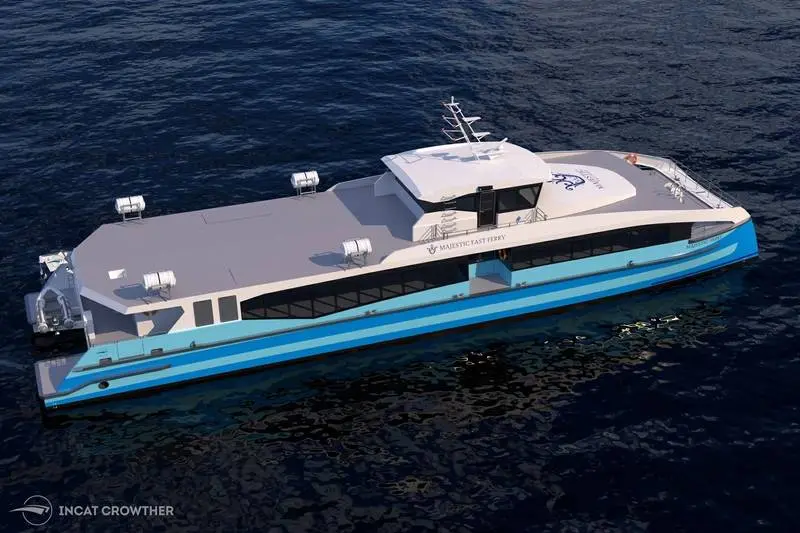
In a significant development for regional maritime transit, construction has officially commenced on a new 39-meter passenger ferry designed by the acclaimed digital shipbuilder and naval architecture firm Incat Crowther for Singapore’s Majestic Fast Ferry.
This vessel marks the debut of Incat Crowther’s third-generation 39-meter catamaran platform, representing a major evolution in high-speed ferry design. Built by the prominent Indonesian shipyard PT Cahaya Samudra, the new vessel builds upon the commercial success of its first- and second-generation predecessors.
By integrating cutting-edge hydrodynamic styling, advanced lightweight structural engineering, and optimized interior layouts, this third-generation vessel sets a new benchmark for efficiency, speed, and passenger comfort.
The start of construction on this vessel initiates an ambitious fleet renewal and expansion program. Up to twenty (20) of these third-generation vessels are projected to be constructed under the current framework, with the inaugural vessel slated for delivery and commissioning by 2027.
This massive multi-vessel pipeline underscores the deep trust and highly integrated tripartite partnership between designer Incat Crowther, operator Majestic Fast Ferry, and shipbuilder PT Cahaya Samudra.
Detailed Chronology: Evolution of a Maritime Partnership
The genesis of this third-generation platform lies in a decade-long collaborative history between Majestic Fast Ferry and Incat Crowther. To understand the innovations embedded in the new 39-meter design, one must examine the iterative chronology of their partnership, which has consistently pushed the boundaries of high-speed aluminum catamaran design.

[Early Partnership] ────────► [Mid-Generation Fleet Expansion] ────────► [Third-Generation Launch (2026/2027)]
• Launch of 29m & 33m vessels  • Introduction of 39m & 42m designs      • Raked bow & lightweight extrusions
• Focus on regional transit    • Optimized passenger flow & capacity    • 20-vessel program initiated
The Early Years: Establishing the Fleet Foundation
The partnership began with the commissioning of a series of highly reliable 29-meter and 33-meter fast catamarans. These initial vessels were designed to provide reliable, high-frequency service across the Singapore Strait, navigating challenging, congested waterways while maintaining tight operational schedules. The success of these early vessels established Majestic Fast Ferry as a premier operator, known for punctuality, safety, and passenger comfort.
The Second-Generation Transition: Upscaling and Optimization
As passenger volumes grew, the operator identified a need for larger vessels that could offer greater economies of scale without sacrificing speed or maneuverability. This led to the co-development of Incat Crowther’s first- and second-generation 39-meter and 42-meter platforms.
These vessels introduced wider beams, optimized passenger boarding systems, and refined hull forms that reduced drag and fuel consumption. Over years of intensive, daily service, these platforms generated vast amounts of operational data. Every engine hour, fuel log, and maintenance record was analyzed to identify areas for incremental improvement.
The Third-Generation Initiative: Co-Design and Tripartite Collaboration
In the years leading up to the late 2026 construction announcement, Incat Crowther, Majestic Fast Ferry, and PT Cahaya Samudra entered into deep technical consultations. The objective was clear: design a vessel that retained the proven stability and capacity of the earlier 39-meter platforms while achieving superior fuel efficiency, higher top speeds, reduced structural weight, and simplified manufacturing processes.
By bringing the Indonesian builder, PT Cahaya Samudra, into the design loop early, Incat Crowther’s naval architects could tailor the vessel’s structural details to the shipyard’s specific fabrication capabilities, ensuring a streamlined and cost-effective build cycle.
Technical Deep-Dive: Engineering Innovations and Metrics
The third-generation 39-meter ferry is not merely an aesthetic update; it is a complete ground-up re-engineering of the mid-sized passenger catamaran. Every aspect of the vessel’s naval architecture has been scrutinized to maximize performance, reduce environmental impact, and lower operational expenditure (OPEX) for Majestic Fast Ferry.
       [Traditional Bow Form]                     [New Raked Bow Form]
                 |
                 |  <-- Higher Wave Resistance                <-- Pierces Waves Cleanly
                 |
      =======================                     =======================
Hydrodynamic Optimization: The Raked Bow
The most visually striking and functionally significant change in the third-generation design is its newly developed raked bow form. Unlike traditional vertical or plumb bows, the engineered raked bow optimizes wave-piercing characteristics and reduces resistance across a broad spectrum of sea states.
This hull form allows the vessel to cut cleanly through choppy coastal waters, minimizing vertical acceleration and pitching. The result is a smoother ride for passengers and a substantial reduction in the thrust—and therefore fuel—required to maintain high service speeds.

Structural Weight Reduction through Advanced Material Science
Weight is the ultimate enemy of high-speed vessel efficiency. To combat this, Incat Crowther’s engineering team utilized advanced finite element analysis (FEA) to minimize structural weight while maintaining compliance with rigorous international classification society standards. Key strategies included:
- Extensive Use of Lightweight Marine-Grade Alloys: Strategically selecting specific aluminum alloys that offer superior strength-to-weight ratios and high corrosion resistance.
- Extruded Aluminum Sections: By expanding the use of custom-designed, large-scale extruded aluminum profiles, the designers minimized the number of individual plates and welds required. Extruded sections consolidate structural stiffeners directly into the plating, reducing structural weight, eliminating stress concentration points, and dramatically accelerating the shipyard’s fabrication schedule.
- Composite and Lightweight Interior Materials: From honeycomb-core paneling in the bulkheads to ultra-lightweight seating structures and floor coverings, every interior component was selected based on its weight-saving performance.
Enhanced Performance and Speed Metrics
Thanks to these extensive weight-saving measures and hydrodynamic refinements, the third-generation ferry boasts a maximum speed of 32.5 knots. This represents a marked improvement over previous generations of 39-meter vessels under equivalent load conditions. This speed capability gives Majestic Fast Ferry greater schedule flexibility, allowing them to shorten transit times or run main engines at lower, more efficient RPM levels while still maintaining their historical timetables.
| Technical Specification | Metric / Value |
|---|---|
| Overall Length | 39.0 Meters |
| Passenger Capacity | 312 Passengers (including VIP section) |
| Maximum Speed | 32.5 Knots |
| Hull Configuration | Catamaran |
| Structural Material | Marine-grade Aluminum (featuring extruded sections) |
| Key Amenities | VIP seating area, 5 washrooms, kiosk, expanded luggage storage |
| Projected Fleet Size | Up to 20 vessels |
| First Delivery Date | 2027 |
Passenger Experience and Interior Architecture
While technical efficiency drives the economic viability of the vessel, passenger satisfaction drives ticket sales. The third-generation ferry features a thoughtfully planned interior layout designed to accommodate 312 passengers in a spacious, quiet, and highly ergonomic environment.
+-------------------------------------------------------------------------+
| [Luggage]   [Main Passenger Cabin: 312 Pax]   [VIP Oasis]   [Kiosk] [WC] |
+-------------------------------------------------------------------------+
|                        Optimized Flow & Accessibility                   |
+-------------------------------------------------------------------------+
Cabin Layout and Ergonomics
The main deck features high-backed, ergonomic seating arranged to maximize legroom and shoulder space. Large, anti-glare panoramic windows line the cabin, flooding the interior with natural light and offering passengers unobstructed views of the sea, which significantly reduces the incidence of motion sickness.
The VIP Oasis
Recognizing a growing demand for premium travel options among business commuters and high-end tourists traveling between Singapore and resort destinations in Batam and Bintan, the vessel features an exclusive VIP seating area. Separated from the main cabin, this zone offers wider, plush seating, enhanced privacy, dedicated power outlets, and a quieter acoustic profile, allowing passengers to work or relax in comfort.
Amenities and Onboard Logistics
To ensure seamless operations during high-capacity voyages, the vessel is equipped with five spacious, modern washrooms. A centrally located kiosk provides food and beverage services, designed with high-capacity refrigeration and storage to handle rapid turnover between voyages.
Furthermore, luggage management has been optimized based on operator feedback. The vessel includes expanded, secure luggage racks near the entry doors, facilitating rapid, orderly boarding and disembarking—a crucial factor in minimizing port turnaround times.
Strategic Significance for the Regional Maritime Industry
The announcement of this 20-vessel shipbuilding program carries profound implications for the maritime sector in Southeast Asia and beyond.
The Batam-Singapore Shipbuilding Synergy
The tripartite relationship highlights a highly successful regional economic model. By combining Australian design expertise (Incat Crowther), Singaporean capital and operational experience (Majestic Fast Ferry), and Indonesian skilled manufacturing (PT Cahaya Samudra), the project demonstrates how cross-border collaboration can produce world-class maritime assets.
PT Cahaya Samudra’s shipyard in Batam has established itself as a premier hub for aluminum vessel construction, and this multi-vessel contract solidifies its position as a global leader in high-speed catamaran fabrication.
Environmental Stewardship and Fleet Modernization
As the International Maritime Organization (IMO) tightens regulations on carbon emissions and energy efficiency for domestic and international shipping, regional ferry operators face mounting pressure to decarbonize.
While alternative propulsion systems like pure-electric or hydrogen fuel cells are still developing for high-speed, long-distance regional routes, the most immediate and effective way to reduce emissions is through hull and structural optimization.
By reducing hull resistance and structural weight, the third-generation Incat Crowther design significantly lowers fuel consumption per passenger-kilometer. This directly aligns with global decarbonization goals, providing an immediate reduction in the fleet’s carbon footprint.
Future Outlook: A New Standard for High-Speed Ferry Transit
As construction progresses on the first hull at the PT Cahaya Samudra shipyard, the maritime industry will watch the performance of this third-generation platform closely. With the first vessel expected to enter active service by 2027, the subsequent rollout of up to 20 vessels will gradually transform Majestic Fast Ferry’s fleet into one of the youngest, most efficient, and most cohesive operations in the world.
This project proves that even highly optimized vessel classes have room for improvement when designers, operators, and builders work in close alignment. Through iterative design, advanced materials, and a deep understanding of operational realities, Incat Crowther and Majestic Fast Ferry are not only prepared for the future of regional maritime transit—they are actively building it.