








Executive Overview
When the conversation turns to microplastic pollution, the human mind almost instinctively conjures up images of discarded single-use plastics: brightly colored fragments of fractured bottles, weathered grocery bags fluttering in the wind, or tangled clumps of microscopic synthetic fibers shedding from our fleece pullovers in the washing machine. For decades, these visible and semi-visible vectors of pollution have dominated headlines, environmental advocacy campaigns, and regulatory frameworks.
However, a massive, highly pervasive source of plastic pollution has been hiding in plain sight—literally right beneath our feet. Every time a motor vehicle accelerates, navigates a turn, or applies its brakes, microscopic remnants of rubber are ground away from tires and cast into the environment. Known as tire wear particles (TWPs), these chemical-laden microplastics have quietly emerged as one of the most significant and insidious environmental threats of our time.
Vehicular tires are complex engineering feats, manufactured from a proprietary blend of natural and synthetic rubbers, heavy metals, reinforcing fillers, and chemical additives. As vehicles traverse billions of miles of asphalt and concrete daily, the mechanical friction generates trillions of microscopic particles per mile. While some of these particles drift into the atmosphere as fugitive dust, the vast majority settle onto roadways, where seasonal rains sweep them into municipal storm drains, untamed creeks, and ultimately, the world’s oceans.

Because reforming the global transportation infrastructure or completely redesigning tire chemistry will take decades, scientists and policymakers are racing to find effective, near-term interventions. Chief among these practical solutions is green infrastructure—engineered natural systems such as bioswales, rain gardens, permeable pavements, and vegetated roadside buffers. By slowing, filtering, and biologically treating urban stormwater runoff before it reaches sensitive aquatic habitats, green infrastructure offers a vital shield against the invisible tide of tire-derived microplastics.
Detailed Chronology: From Roadway Friction to Marine Devastation
To fully grasp the magnitude of the tire wear particle crisis, it is essential to trace the chronological pathway of these microplastics from the moment of their creation to their ultimate deposition in fragile aquatic ecosystems.
1. The Friction Point: Generation and Release
The lifecycle of a tire wear particle begins on the microscopic interface where tread meets pavement. As a car, bus, or truck moves down the highway, the rubber compounds experience intense mechanical stress, thermal buildup, and abrasive wear. Under this pressure, microscopic treads shear off.
Recent laboratory tests and field studies have revealed staggering production metrics: a single vehicle can emit upwards of two trillion particles per mile driven. Scaled globally across billions of passenger cars and heavy-duty freight trucks, this continuous erosion results in millions of tons of rubber dust deposited directly onto the world’s transportation corridors every single year.

2. Atmospheric Dispersion and Terrestrial Accumulation
Once liberated from the tire, these particles embark on two distinct environmental pathways:
- Airborne Transport: The smallest and lightest fraction of tire wear particles becomes suspended in the air, creating a plume of urban particulate matter that contributes significantly to air pollution and can be inhaled by pedestrians and wildlife alike.
- Surface Deposition: The heavier particles settle directly onto roadways, highway shoulders, and parking lots. Here, they accumulate over days and weeks, mixing with heavy metals, motor oil residues, brake pad dust, and atmospheric fallout to form a toxic surface film.
3. The Stormwater Conduit
The critical turning point in the tire particle lifecycle occurs during precipitation events. When heavy rains hit impervious urban surfaces—concrete, asphalt, and rooftops—they create massive volumes of stormwater runoff. Acting as a hydraulic conveyor belt, this runoff flushes the accumulated layers of tire dust off the roads and into municipal drainage systems. In many municipalities, these storm systems discharge untreated runoff directly into local urban streams, rivers, and estuaries.
4. Aquatic Inundation and Bioaccumulation
Once introduced to aquatic environments, tire wear particles begin to degrade physically and chemically. Because they are dense and hydrophobic, many settle into riverbed sediments, where benthic organisms ingest them. Others remain suspended in the water column, where filter-feeding bivalves, crustaceans, and finfish consume them, mistaking them for organic detritus. As these particles move up the aquatic food web, their constituent chemicals bioaccumulate, posing severe physiological risks to marine life and freshwater species.
Supporting Context & Metrics: Unmasking the Invisible Pollutant
For years, tire wear particles successfully evaded comprehensive scientific quantification. Traditional microplastic separation and counting methodologies—such as visual sorting and basic spectroscopy—often struggled to identify heavily weathered, chemically altered rubber fragments mixed with organic debris and urban grime. It is only through recent advancements in analytical chemistry and pyrolysis-gas chromatography-mass spectrometry that researchers have been able to reliably unmask the true scale of the tire pollution problem.
Key Metrics Quantifying the Crisis
- Annual Personal Generation: Scientific data indicates that the average citizen indirectly generates approximately two pounds (nearly one kilogram) of tire wear particles every year simply through modern mobility habits.
- Particle Count per Mile: Testing protocols show that standard passenger vehicle tires produce upwards of two trillion microparticles per single mile driven, highlighting the relentless, high-volume nature of this pollution source.
- Environmental Dominance: Environmental agencies and marine researchers now classify tire wear particles as one of the single largest sources of microplastics entering global waterways, often rivaling or exceeding macroplastic breakdown products in sheer particle count.
The Chemical Time Bomb: The Case of 6PPD
The threat posed by tires extends far beyond the physical presence of microplastics clogging the digestive tracts of marine life. Tires are chemical cocktails containing antioxidants, plasticizers, and vulcanization accelerators.
Chief among these is 6PPD (N-(1,3-dimethylbutyl)-N’-phenyl-p-phenylenediamine), a widely used chemical added to tires to prevent rubber degradation and cracking caused by ozone exposure. When 6PPD reacts with ozone in the environment, it transforms into a derivative known as 6PPD-quinone (6PPD-Q).
Research published in leading scientific journals has established that 6PPD-Q is acutely toxic to aquatic species, most notably coho salmon. In urban streams impacted by road runoff, even trace, parts-per-billion concentrations of 6PPD-Q have been shown to trigger rapid mortality events in migrating salmon populations—a phenomenon historically known as "urban runoff mortality syndrome." This chemical toxicity underscores the reality that tire particles are not merely inert physical debris; they are active chemical hazards.
Official Statements and Expert Perspectives
Tackling a pollution source as ubiquitous as transportation-related microplastics requires interdisciplinary collaboration between marine conservationists, policy experts, urban planners, and academic researchers.
Dr. Britta Baechler, Director of Ocean Plastics Research at Ocean Conservancy, powerfully encapsulated the deceptive nature of the crisis during an interview with Eos magazine:
"Driving a car or even riding in a bus is a bit like dragging an eraser across the planet, except the crumbs are microplastics. Toxic microplastics."
Dr. Baechler emphasizes that because transportation is woven into the very fabric of modern society, addressing tire wear requires shifting away from a posture of despair and toward proactive, localized interventions.
Complementing this perspective, Dr. Anja Brandon, Director of Plastics Policy at Ocean Conservancy, points to the necessity of structural innovation:
"While we must continue pushing manufacturers to reformulate tire chemistry and reduce shedding rates, we cannot afford to wait decades for the entire global vehicle fleet to turn over. We need immediate, physical defenses that can intercept these particles before they cross the threshold into our fragile marine ecosystems."
To bridge this gap, Ocean Conservancy’s plastics science and policy teams have forged a strategic partnership with the University of Toronto—with core funding provided by the Tire Industry Project. This collaborative research initiative is explicitly designed to evaluate the practical costs, spatial requirements, and capture efficiencies of scaling up green infrastructure at the municipal level specifically targeted at intercepting tire wear particles.
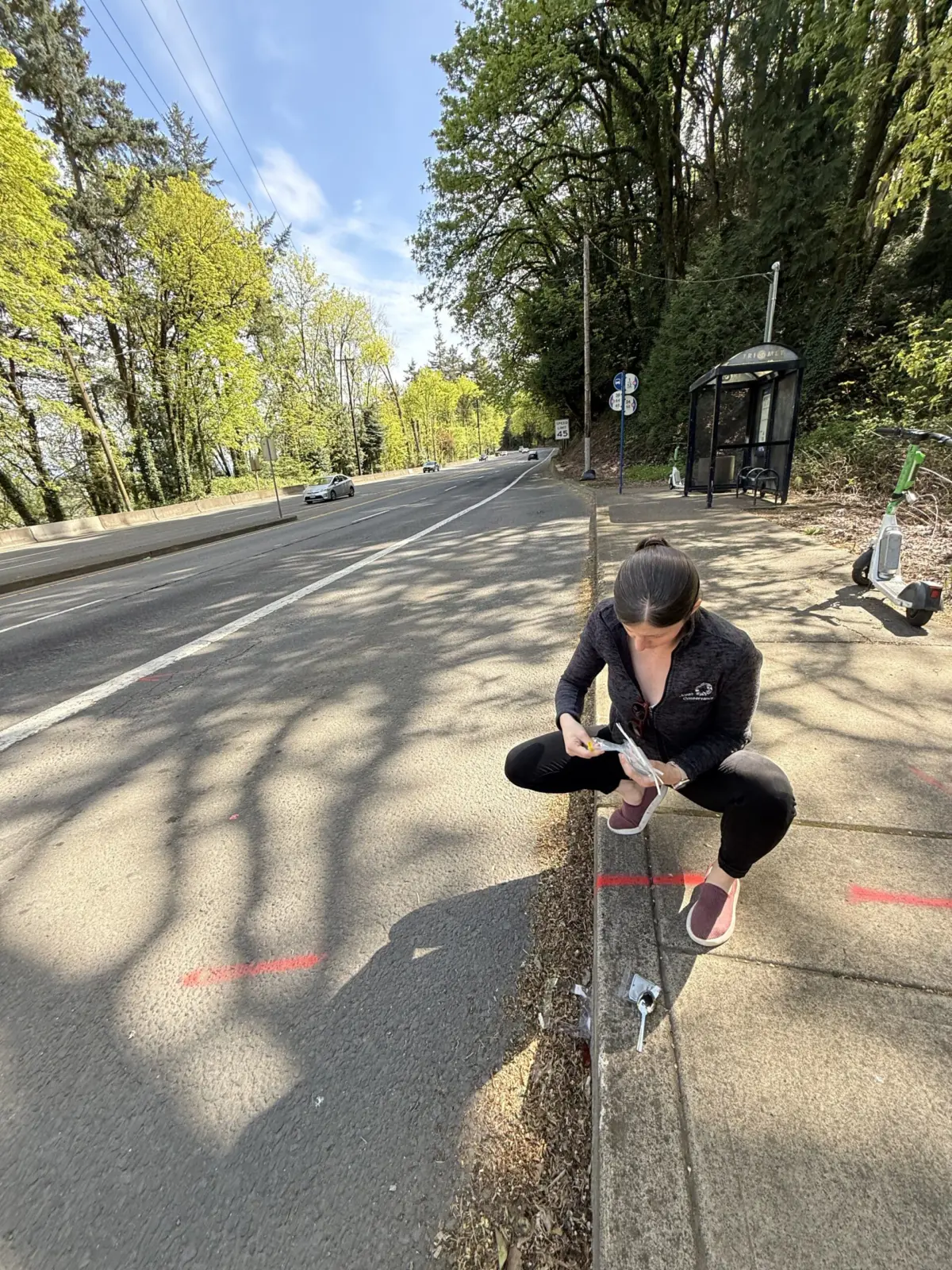
Field researchers engaged in this project can occasionally be observed in urban centers like Portland, Oregon—crouched over roadside bioswales, carefully collecting soil and sediment core samples with spoons. While these unorthodox field methods might draw curious glances from passing motorists, they represent the rigorous, boots-on-the-ground science required to generate actionable data for city planners.
Future Outlook: Engineering Resilience Through Green Infrastructure
As urban populations swell and vehicle miles traveled continue to climb globally, relying solely on future technological breakthroughs in tire manufacturing is a perilous gamble. The transition to non-shedding, non-toxic tires will take generation-length development cycles, rigorous safety testing, and massive industrial retooling.
Therefore, the immediate future of microplastic mitigation lies in green infrastructure.
How Green Infrastructure Works
Unlike traditional "grey infrastructure"—which relies on concrete culverts, underground pipes, and high-speed drainage networks to rush stormwater away from cities as fast as possible—green infrastructure mimics natural hydrological cycles. Key components include:
- Bioswales and Rain Gardens: Engineered depressions planted with native vegetation and layered with specialized soil, compost, and gravel matrices. As runoff flows through these systems, the dense root networks and microbial communities slow the water down, encouraging sedimentation and trapping microplastic particles in the root zone.
- Permeable Pavements: Porous asphalt and interlocking concrete pavers that allow rainwater to infiltrate directly into subsurface storage beds rather than pooling and washing across toxic surface roadways.
- Roadside Vegetated Buffers: Strategic strips of trees, shrubs, and grasses planted between roadways and storm inlets that act as physical and biological interceptors for both airborne and waterborne tire debris.
Bridging the Gap from Theory to Practice
The ongoing research partnership between Ocean Conservancy and academic institutions is breaking new ground by answering critical operational questions:
- What is the optimal spatial configuration of green infrastructure required to protect a major metropolitan watershed?
- How do maintenance requirements (such as sediment removal and plant harvesting) affect the long-term retention of trapped tire particles?
- How can cash-strapped municipal governments prioritize green infrastructure investments to maximize microplastic capture per dollar spent?
By coupling empirical scientific data with pragmatic policy guidance, this initiative aims to help cities transition from theoretical discussions ("Could green infrastructure work here?") to confident, large-scale implementation.
A Path Forward for Everyday Citizens
It is entirely normal for individuals to feel overwhelmed when confronting a pollution source as vast and systemic as tire wear. Because modern life makes vehicular transportation an everyday necessity, waiting for the entire transportation grid to reinvent itself is not a viable strategy for ocean protection.
Instead, the path forward relies on supporting targeted research, advancing municipal green policies, and staying actively engaged with conservation organizations working on the front lines of the plastic crisis. By tackling the problem one roadway, one bioswale, and one city at a time, we can intercept toxic tire wear particles before they ever reach the sea—securing a cleaner, safer, and healthier ocean for generations to come.