










Executive Overview
For decades, the global automotive playbook was predictable. Legacy automakers from century-old Western markets treated emerging, high-growth economies as captive audiences—cash cows capable of stabilizing bloated balance sheets and funding aging corporate structures. However, as the center of gravity in the global automotive industry violently shifted toward electrification, traditional original equipment manufacturers (OEMs) found themselves caught flat-footed.
Nowhere was this transformation more pronounced than in China. While legacy giants hesitated, domestic Chinese automakers embraced the electric vehicle (EV) revolution with agility, vision, and scale, rapidly capturing their home market. But as the hyper-competitive Chinese auto market matures, stabilizes, and in some sectors contracts, these titans are looking outward.
At the vanguard of this international expansion is BYD. The world’s leading new-energy vehicle manufacturer is no longer content with dominating the domestic landscape. Buoyed by staggering international sales figures, a growing fleet of transport vessels, and aggressive localized manufacturing strategies designed to sidestep punitive global tariffs, BYD has set its sights on an extraordinary milestone: shipping and selling 2.5 million vehicles outside of China by 2027.
This deep-dive investigative report examines the strategic machinations driving BYD’s global blitz, analyzing the macroeconomic forces, supply chain hurdles, regulatory trade barriers, and aggressive domestic ambitions that are rewriting the rules of the modern automotive industry.
Detailed Chronology: From Domestic Dominance to Global Expansion
To understand BYD’s current trajectory, one must trace the rapid evolution of the Chinese automotive sector over the past decade.
Phase 1: The Electric Awakening
Years ago, Western legacy automakers relied heavily on the Chinese market to drive revenue growth. As traditional markets in North America and Europe matured, China’s booming middle class provided an insatiable appetite for internal combustion engine (ICE) vehicles. However, the Chinese government recognized early on that electrification offered a unique strategic pathway to leapfrog legacy Western industrial capabilities.
When Beijing aggressively incentivized New Energy Vehicles (NEVs), domestic companies pivoted with breathtaking speed. While legacy Western automakers viewed EVs through a lens of incremental compliance, Chinese startups and established giants like BYD viewed them as digital, high-tech consumer electronics on wheels. They integrated battery technologies, software ecosystems, and supply chains at a pace that traditional boardrooms simply could not match. Consequently, domestic Chinese brands swiftly eroded the market share of legacy foreign joint ventures, cementing total dominance over their home turf.

Phase 2: Domestic Saturation and the Need for Export
By the mid-2020s, the Chinese EV market began to experience the growing pains of hyper-competition and saturation. Price wars erupted, profit margins compressed, and overall market growth began to plateau or dwindle. For companies manufacturing millions of electric vehicles month after month, maintaining high factory utilization rates required a new strategy.
Just as Western automakers had turned to China decades prior for growth, Chinese EV manufacturers turned their gaze outward. BYD emerged as the standard-bearer of this movement. Month after month, the company posted record-breaking export figures, transforming from a domestic powerhouse into a formidable multinational contender.
Phase 3: The Global Blitz and Localization
Today, BYD’s expansion is entering a critical third phase: localized manufacturing. Recognizing that shipping vehicles halfway across the world is both costly and vulnerable to geopolitical crosswinds, BYD is aggressively establishing localized assembly plants and maritime logistics networks. By building vehicles closer to its end consumers in Europe, South America, and beyond, BYD is positioning itself to bypass steep international trade barriers and cement its status as a permanent fixture of the global automotive ecosystem.
Supporting Context & Metrics: Breaking Down BYD’s Phenomenal Growth
The sheer velocity of BYD’s ascent is best illustrated by the numbers. The company’s financial and sales metrics reveal an enterprise operating at an unprecedented scale.
August Sales Performance: A Masterclass in Momentum
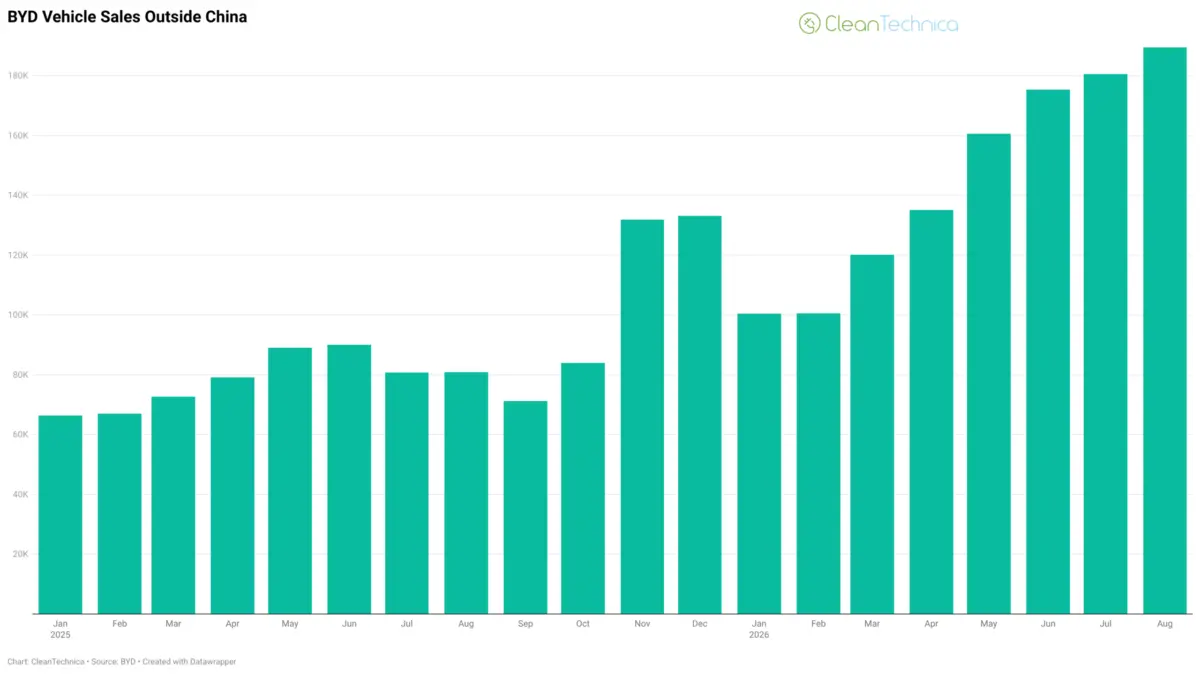
In August, BYD reported a staggering 189,466 vehicle sales outside of China. This figure represents an astronomical 134.5% year-over-year increase compared to August of the previous year. On a month-over-month basis, the company sustained a steady 5% growth rate.
This continuous upward trajectory marks yet another milestone in a multi-year streak of record-breaking overseas months. The compounding effect of this growth has fundamentally altered the company’s revenue distribution, lessening its reliance on the domestic market and insulating it against local economic fluctuations.
The 2027 Target: Scaling to 2.5 Million Overseas Units
Building upon these monthly records, BYD management has established an ambitious long-term objective: selling 2.5 million vehicles outside of China by the year 2027.
To contextualize this target, consider the company’s performance leading into the final stretch of 2026. BYD has already sold 1,162,260 vehicles outside of China so far this year, averaging an impressive 145,282.5 units per month. Extrapolating that performance over a standard 12-month period yields an annualized run rate of roughly 1.74 million vehicles.
Reaching 2.5 million overseas sales by 2027 will require a dramatic acceleration, yet industry analysts note that BYD has consistently over-delivered on its strategic capability expansions.
Official Statements and Industry Insights
Behind these hard numbers lie critical operational adjustments, supply chain hurdles, and calculated strategic maneuvers revealed through financial disclosures and management briefings.
Navigating Shipping Constraints
According to notes provided to clients by Deutsche Bank—following a strategic group meeting with BYD management—the automaker had originally targeted between 1.9 million and 2 million overseas sales for 2026. Achieving this would have represented an astonishing 100% year-over-year increase compared to 2025 totals.
However, external bottlenecks intervened. As Reuters reported, “Management indicated that shipping constraints limited overseas sales this year and that export volumes could otherwise have been higher.”
To solve this physical bottleneck, BYD has invested heavily in proprietary maritime logistics, commissioning a fleet of dedicated roll-on/roll-off (RoRo) car carrier vessels to bypass the tight commercial charter market and ensure predictable delivery schedules to global ports.

Overcoming Tariffs Through Localization
Beyond maritime transport, BYD is fundamentally reshaping its manufacturing footprint. Relying solely on Chinese assembly plants exposes the company to the shifting winds of international trade policy.
Deutsche Bank notes that BYD’s Hungary plant is expected to start assembly in November or December, marking a crucial beachhead inside the European Union. Furthermore, management is actively evaluating additional overseas manufacturing locations to bring production closer to major consumer bases.
The financial incentive for localized production is immense. According to analysis from Citi, producing vehicles within target markets allows BYD to systematically avoid punitive trade barriers:
- The European Union’s roughly 27% tariff on battery electric vehicles (BEVs).
- Brazil’s 34% import tariff.
Avoiding these duties represents direct cost savings of more than 40,000 yuan (approximately $5,961) per vehicle. Citi’s research notes that management views these savings as more than enough to offset initial factory ramp-up costs, preserving healthy profit margins while keeping retail prices competitive against local legacy offerings.
Future Outlook: The Battle for the Home Front and Global Markets
Even as BYD aggressively pursues international expansion, the company has not lost sight of its foundational battleground: the domestic Chinese market.
Conquering the World’s Largest Auto Market
BYD’s ambitions within China remain aggressively expansionist. In 2025, the company commanded nearly 15% of the total Chinese auto market. By July of this year, that figure had climbed to approximately 18%.
However, executive leadership has made it clear that they are far from satisfied. BYD’s ultimate domestic target is to capture a staggering 25% market share in China. Securing a quarter of the world’s largest, most fiercely competitive, and technologically advanced automotive market would provide an unshakeable financial foundation, generating the capital required to fund its global conquests.
The Road Ahead
The transformation of the global automotive industry over the next five years will be defined by how legacy Western automakers respond to this dual-front offensive. As BYD accelerates its overseas shipping capacity, brings European and international manufacturing plants online, and continues to squeeze costs through vertical integration, the traditional moats protecting domestic auto industries are rapidly evaporating.
Will regulatory bodies erect higher walls, or will consumers vote with their wallets for more affordable, high-tech electric mobility? The outcome remains uncertain, but one reality is immutable: the era of Western automotive hegemony is over, and BYD is aggressively writing the next chapter.
Stay tuned to CleanTechnica as we continue to track BYD’s milestone-driven march toward its ambitious 2027 global targets and the evolving dynamics of the clean energy transition.