








Executive Overview
In a milestone achievement for sustainable maritime engineering, Indian solar boat pioneer Navalt has successfully shipped one of its flagship luxury tour boats nearly 13,000 kilometers from Kerala, India, to Halifax, Canada. The vessel, a state-of-the-art 10-meter solar-electric catamaran known as the "Limo," has been integrated into the fleet of Halifax Harbour Tours.
This transcontinental journey represents far more than a routine commercial sale; it is a watershed moment for the global decarbonization of water transport. By engineering a high-end passenger vessel capable of being disassembled into a "knock-down kit" and reassembled thousands of miles away, Navalt has unlocked a scalable blueprint for exporting sustainable marine architecture worldwide. Furthermore, the project required a radical re-engineering of Navalt’s tropical energy systems to withstand the biting rigors of an Atlantic Canadian winter.
This alliance between an award-winning Indian clean-tech innovator and a boutique Canadian tour operator signals a shifting paradigm in maritime tourism—proving that luxury, reliability, and zero-emission operations are no longer bound by geography or climate.
Detailed Chronology: From Kerala Backwaters to Halifax Harbour
To understand the magnitude of this transatlantic delivery, one must look at the distinct trajectories of the two entities that made it possible: Navalt, founded in India, and Halifax Harbour Tours, operating out of Nova Scotia.

The Rise of Navalt
Navalt’s roots trace back to 2009, when naval architect Sandith Thandassery established the company with a singular mission: to "electrify the oceans" and eliminate fossil fuel dependency in marine transit. Thandassery’s early innovations quickly turned heads. The company’s inaugural vessel, the Sunrider, earned a spot in the Limca Book of Records as the fastest solar boat ever built.
In 2017, Navalt achieved a monumental breakthrough by designing and building Aditya, India’s first solar-electric ferry. Operating in the serene backwaters of Kerala, the Aditya proved that commercial electric ferries could be intensely practical. Carrying roughly half a million passengers annually—surpassing four million lifetime passengers—the ferry eliminated 225,000 liters of diesel fuel and prevented over 500,000 kilograms (1.25 million pounds) of carbon dioxide emissions. The vessel’s global impact was recognized in 2020 when it won the inaugural Gustave Trouvé Electric Boat Award, an accolade Navalt secured again in 2024 for its Srav solar-electric workboat. To date, Navalt has built over 80 commercial and recreational vessels across 18 distinct models, cementing its status as India’s leading solar-electric boatbuilder.
Halifax Harbour Tours and the Legacy of the Violet Mac
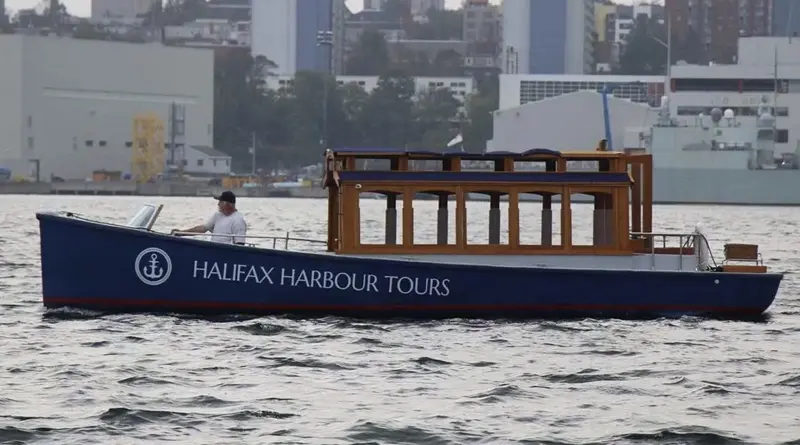
Thousands of miles away on the coast of Nova Scotia, Colin Smith was charting a different course. Having previously captained a diesel-powered tour boat in Halifax Harbour, Smith grew weary of the noxious exhaust fumes, relentless engine noise, and heavy environmental footprint. Inspired to offer a cleaner alternative, he acquired a historic hull—a former British Thames River tow barge that had traveled a winding global path through Puerto Rico, the Florida Everglades, and Lake Erie before sitting neglected in a nearby barn.
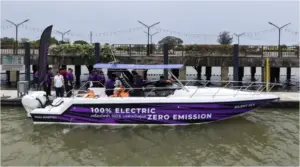
Recognizing the barge’s ultra-efficient displacement hull, Smith stripped out its old diesel motor and retrofitted it with an 8kW Lynch axial-flux motor powered by a 7kWh battery. He crowned the vessel with a solar roof and restored its historic charm, naming it the Violet Mac. Halifax Harbour Tours was officially launched in 2018.

Operating the Violet Mac proved that zero-emission harbour tours could be extraordinarily economical—with daily "fuel costs" hovering around 60 cents. More importantly, passengers lauded the silent, intimate cruising experience. However, the business faced a persistent limitation: Halifax’s famously unpredictable, volatile coastal weather. Smith needed a vessel that could provide robust passenger shelter against inclement conditions and operate reliably across extended seasonal windows.
After discovering Navalt’s advanced vessel designs via industry publications, Smith reached out to Thandassery. The choice was clear: Navalt’s luxury enclosed model, the Limo, was the ideal fit.
Supporting Context & Metrics: Engineering for the Extreme
Transporting a 10-meter commercial passenger vessel halfway across the globe presented immense logistical and technical hurdles. Navalt’s solution required a masterclass in modular manufacturing and winter-resilient engineering.
The Logistics of a "Knock-Down Kit"
Standard maritime shipping methods struggle with the physical dimensions of modern catamarans. A 10-meter-long, 3.5-meter-wide dual-hull vessel cannot simply slide into a standard Forty-Foot Equivalent Unit (FEU) shipping container.

Rather than paying exorbitant rates for heavy-lift deck cargo, Navalt engineered the Limo for complete structural disassembly. The boat’s anatomy was systematically mapped into modular components designed to fit snugly inside five standard shipping containers.
- The Modular Breakdown: The twin catamaran hulls, structural deck, superstructures, interior furnishings, and propulsion systems were packed flat.
- On-Site Reconstruction: Upon arrival in Halifax, Colin Smith and his local team transformed the five containers back into a water-ready cruiser. The meticulous process involved rejoining the hulls, mounting the superstructure, and integrating the battery arrays.
Winterizing the Tropics: Surviving the Canadian Climate
A boat built for the tropical backwaters of Kerala cannot simply be dropped into the freezing Atlantic waters of Nova Scotia without major modifications. The most critical challenge lay in the vessel’s thermal and energy management systems.
Lithium-ion batteries—specifically Lithium Iron Phosphate (LFP) chemistries—suffer severe performance drops, reduced capacities, and charging restrictions in sub-zero temperatures. To ensure the Limo could withstand harsh Atlantic Canadian winters, Navalt engineered a customized energy architecture:
- Heated LFP Battery Packs: The Limo is equipped with a dual 20 kWh marine-grade LFP battery system. Crucially, each pack features an integrated, automated heating system designed to maintain optimal thermal thresholds during freezing weather.
- Propulsion Redundancy: The vessel is driven by dual 15 kW inboard electric motors configured with Navalt’s signature independent dual battery-and-motor architecture. This built-in redundancy ensures that a single mechanical or electrical fault will never leave the vessel stranded on the water—a vital safety feature for volatile harbour environments.
Official Statements and Perspectives
Reflecting on the milestone, Navalt founder Sandith Thandassery shared his insights on the company’s official blog regarding the historic export:

"There are projects that move a business forward, and then there are projects that redraw the map. For us, shipping a Limo to Halifax, Canada is firmly the second kind. It is our first vessel headed to North America—and it travelled there in a way no Navalt boat has before: as a knock-down kit, packed flat into five containers, ready to be reborn on Canadian shoreline."
Thandassery emphasized that the project successfully resolved both environmental adaptation and heavy export logistics:
"Halifax is not Kerala. A boat that performs beautifully in tropical backwaters has to be re-engineered to survive—and thrive—through an Atlantic Canadian winter… Each of these is a milestone on its own. Together, they mark a real step-change in what Navalt can build and where we can take it."
Colin Smith, founder of Halifax Harbour Tours, highlighted the profound impact that electric propulsion has on passenger satisfaction and daily operations:

"When we first started, our ‘fuel costs’ were about 60¢ a day. They’re not an awful lot more now, but the thing isn’t the cost for me, it’s the passenger experience. It’s quiet, there’s only 8 people on board, and the Guides are told to let people know about all of the historic sites in the harbour, but not get in the way of the passengers having a chance to talk among themselves and get to know each other. We often get reviews with people saying it’s the best experience they had on their visit to Canada."
Future Outlook & Industry Implications
With assembly well underway in Nova Scotia, the newly minted Navalt Limo is slated to make its official maiden voyage in Halifax Harbour this July. This launch introduces a new era of high-end, weather-resistant, zero-emission marine tourism to North America.
The broader implications of this project extend far beyond a single tour boat in Nova Scotia:
- Validated Scalability: By demonstrating that a complex commercial vessel can be cleanly exported as a knock-down kit inside standard shipping containers, Navalt has drastically lowered the economic and logistical barriers of deploying green maritime technology globally.
- Cold-Climate Electric Mobility: The successful winter-proofing of Navalt’s LFP battery architecture proves that high-performance electric watercraft are viable far beyond equatorial and temperate zones, opening up massive markets across Northern Europe and North America.
- The Blueprint for Global Decarbonization: As cities worldwide face mounting pressure to eliminate harbour pollution and carbon footprints, collaborations between international clean-tech pioneers and local operators offer a viable, highly replicable blueprint for sustainable urban mobility.
From the sun-drenched backwaters of India to the rugged, historic harbours of Atlantic Canada, the mission remains unwavering: oceans, electrified.