




Executive Overview
In the shallow, silt-laden waters of the Thames Estuary, one of the maritime world’s most precarious legacy hazards is finally being addressed. Resolve Marine, a global leader in salvage and emergency response, has officially commenced the highly delicate operation to remove the decaying masts of the SS Richard Montgomery. This World War II Liberty ship, which ran aground and sank in 1944, remains packed with an estimated 1,400 tons of active, unexploded military ordnance.
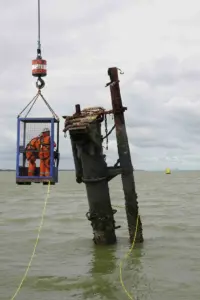
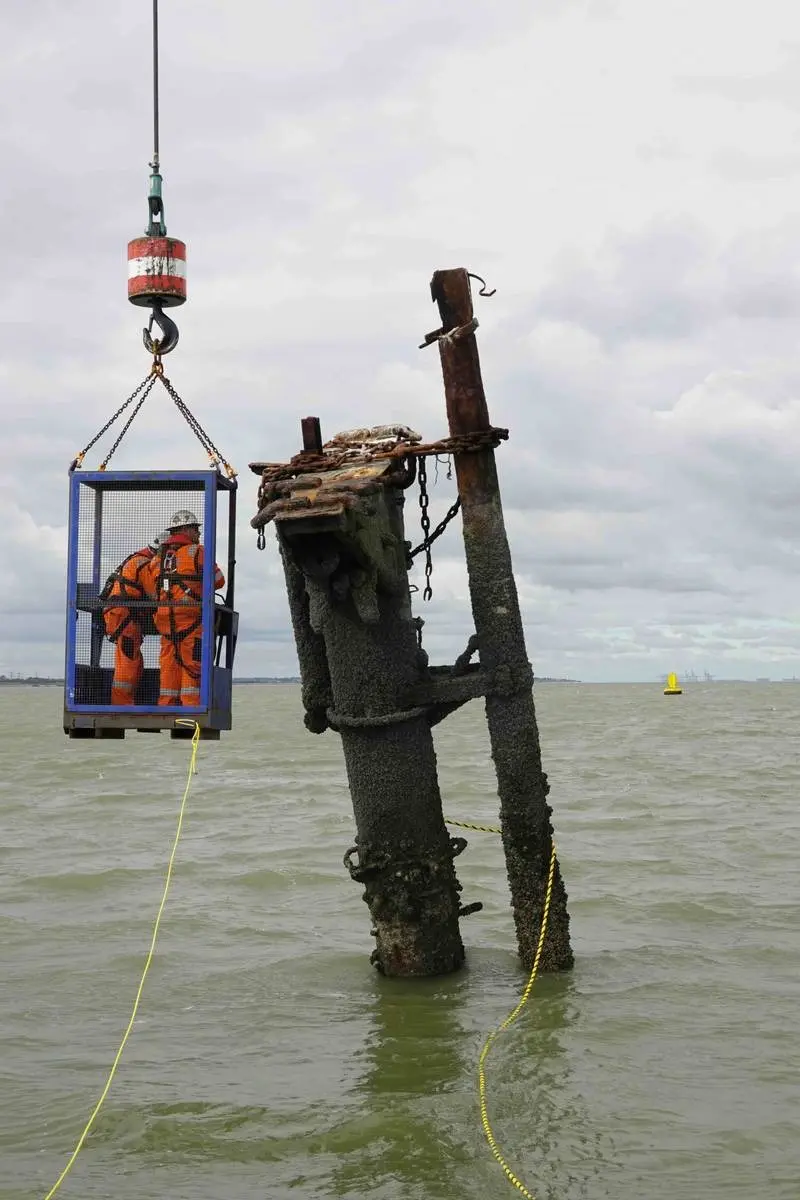
For over eighty years, the wreck has sat just off the coast of Sheerness, Kent, its three rusted masts protruding above the waterline as a stark reminder of wartime history and a constant source of anxiety for local communities. The decision to intervene comes after years of intensive structural monitoring, bathymetric surveys, and expert consultations. These assessments revealed that the structural integrity of the masts had degraded to a critical point. Should they collapse under their own weight or during a storm, the impact could trigger a catastrophic detonation of the volatile cargo resting in the holds directly below.
The salvage operation, commissioned by the UK Department for Transport (DfT) and overseen by the Maritime and Coastguard Agency (MCA), represents a major milestone in UK maritime safety. Utilizing specialized jack-up vessels, advanced underwater cutting technology, and rigorous safety protocols, Resolve Marine’s engineers and divers are tasked with surgically removing the steel masts without disturbing the highly sensitive explosives buried beneath the mud.
Detailed Chronology
The saga of the SS Richard Montgomery is a multi-decade narrative of wartime misfortune, bureaucratic hesitation, and engineering caution. To understand the gravity of Resolve Marine’s current mission, one must trace the timeline of this underwater powder keg.
+-----------------------------------------------------------------------------+
|                                  TIMELINE                                   |
+-----------------------------------------------------------------------------+
| July 1943      | SS Richard Montgomery is built in Jacksonville, Florida.   |
| August 1944    | Vessel runs aground on Sheerness Middle Sands.             |
| Sept 1944      | Hull snaps in two; salvage operations are abandoned.       |
| 1973           | Site designated as hazardous under Protection of Wrecks Act.|
| 2020 - 2022    | Structural surveys reveal critical mast deterioration.     |
| Sept 2026      | Resolve Marine begins the high-stakes mast removal.        |
+-----------------------------------------------------------------------------+
1943–1944: Construction, Mission, and Disaster
Built in Jacksonville, Florida, in 1943, the SS Richard Montgomery was one of thousands of Liberty ships constructed to form the logistical backbone of the Allied war effort. In August 1944, loaded with thousands of tons of munitions destined for the Allied advance in Western Europe following D-Day, the ship joined convoy HX-301 bound for the UK.
Upon arriving in the Thames Estuary, the ship was instructed by the local control tower to anchor in the shallow waters off Sheerness. On August 20, 1944, a fierce gale caused the heavily laden vessel to drag its anchor. It drifted onto Sheerness Middle Sands, a treacherous sandbank just outside the Medway approach channel.
As the tide fell, the immense weight of the cargo combined with the uneven support of the sandbank placed intolerable stress on the hull. Within days, the ship cracked open. Royal Navy and civilian stevedores worked frantically to discharge the cargo, successfully reclaiming approximately half of the munitions. However, by early September, the hull snapped completely in two, flooding the remaining cargo holds and forcing the abandonment of all salvage efforts.
1945–2020: Decades of Passive Monitoring
In the post-war era, the British government faced a daunting dilemma: attempt a high-risk recovery of the remaining munitions or leave the wreck undisturbed. Fearing that salvage attempts could trigger an explosion, authorities opted for a policy of passive containment.
In 1973, the wreck was designated as a hazardous site under Section 2 of the Protection of Wrecks Act. A strict 500-meter exclusion zone was established, monitored 24/7 by radar and local port authorities to prevent collisions with commercial shipping. Regular acoustic surveys, diver inspections, and laser scanning were employed over the subsequent decades to track the natural decay of the hull.
2020–2025: The Catalyst for Action
By the turn of the decade, advanced structural analysis revealed a worrying trend. The wreck’s three steel masts, which had stood as sentinels above the water for three-quarters of a century, were showing signs of severe accelerated corrosion.
A series of comprehensive technical assessments commissioned by the DfT concluded that the masts were placing significant leverage and stress on the weakened deck structures. If left to collapse naturally, the heavy steel structures could crash into the silt-filled holds, potentially detonating the thousands of sensitive fuzes and booster charges still contained within. The UK government realized that passive monitoring was no longer a viable option; active intervention was required.
September 2026: Resolve Marine Mobilizes
Following a rigorous international tendering process, Resolve Marine was awarded the contract to execute the mast removal. On September 30, 2026, the company officially commenced on-site operations, deploying specialized salvage barges and elite dive teams to the estuary to begin the delicate task of dismantling the masts.
Supporting Context & Metrics
The sheer scale of the potential hazard presented by the SS Richard Montgomery makes it one of the most heavily scrutinized shipwrecks in the world.
The Volatile Cargo
According to official historical manifests, the forward section of the wreck (Holds 1, 2, and 3) still contains approximately 1,400 tonnes (about 1,540 short tons) of high-explosive munitions. This deadly inventory includes:

- AN-M57 250lb General Purpose Bombs: Standard demolition bombs containing highly stable but deteriorated TNT or Amatol.
- AN-M17 Cluster Bombs: Packed with highly volatile incendiary elements.
- Fuzes and Primer Charges: The most sensitive components of the cargo, which have become increasingly unstable over decades of immersion in saltwater.
The Threat Matrix
If a major detonation were to occur, the consequences would be catastrophic for the surrounding region. Port authority assessments and independent hydrodynamic modeling have outlined the potential impacts:
| Metric | Estimated Impact Value |
|---|---|
| TNT Equivalent Blast Yield | ~1.4 Kilotons |
| Water Column Plume Height | Up to 1,000 meters |
| Generated Tsunami Wave Height | 1 to 5 meters (estuary-wide impact) |
| Critical Infrastructure at Risk | London Gateway Port, Sheerness Docks, Grain LNG Terminal |
| Population Center Proximity | Sheerness (approx. 2.5 km); Southend-on-Sea (approx. 8 km) |
                       [EXPLOSION METRICS]

        +-------------------------------------------------+
        | Blast Yield: 1.4 Kilotons                       |
        +-------------------------------------------------+
                                |
                                v
        +-------------------------------------------------+
        | Plume Height: 1,000 Meters                      |
        +-------------------------------------------------+
                                |
                                v
        +-------------------------------------------------+
        | Wave Height: 1 - 5 Meters (Estuary Tsunami)     |
        +-------------------------------------------------+
Engineering and Technical Challenges
To mitigate these risks, Resolve Marine cannot use conventional heavy salvage techniques, which rely on high-impact shearing or violent pulling. Instead, the team is employing a suite of specialized, low-impact engineering methodologies:
- Non-Thermal, Low-Vibration Cutting: Engineers are utilizing ultra-high-pressure water-abrasive jet cutting systems and diamond-wire saws. These technologies generate minimal heat and vibration, ensuring that the physical shock transmitted through the ship’s remaining structure is kept well below the threshold required to trigger aged explosives.
- Jack-Up Barge Stabilization: Rather than anchoring floating crane barges—which are subject to tidal sway and wave motion—the salvage team is utilizing a heavy-lift jack-up platform. This platform stands firmly on the seabed, providing a perfectly stable, motionless deck from which to conduct precision lifts.
- Tidal Window Management: The Thames Estuary experiences powerful tidal currents, often exceeding 3 to 4 knots, which severely limits diver visibility and safety. Operations must be meticulously timed to coincide with brief periods of slack water.
Official Statements & Perspectives
The launch of the salvage operation has drawn statements from government officials, salvage experts, and local community representatives, highlighting the delicate balance between historical preservation, public safety, and engineering reality.
The Salvage Operator’s Stance
A spokesperson for Resolve Marine emphasized the rigorous preparation that preceded the physical work:
"Our teams have spent months conducting detailed structural modeling, risk assessments, and simulation exercises. Every cut we make, every lift we execute, is backed by peer-reviewed engineering data. We understand the historical and environmental gravity of this project. Our primary objective is to execute this removal with zero unnecessary energy transferred to the hull of the Montgomery. Safety is not just a protocol on this job; it is the entire framework of our operational design."
The Government’s Position
A representative from the UK Department for Transport (DfT) reiterated the necessity of the intervention:
"The SS Richard Montgomery is a unique legacy challenge. While the wreck has remained stable for decades, we cannot ignore the inevitable toll of marine corrosion. This controlled intervention by Resolve Marine is a proactive measure to ensure the long-term safety of the Thames Estuary, its vital shipping lanes, and the communities of Kent and Essex. We are confident that this highly controlled operation represents the safest path forward."
Local Community Concerns
While the engineering community views the operation as a necessity, local residents and safety campaigners have expressed cautious optimism mixed with apprehension. Julian Dent, a local historian and resident of Sheerness, remarked:
"We have lived with the masts of the Montgomery on our horizon for as long as anyone can remember. They are a local landmark, but also a constant reminder of what lies beneath. While we are glad the government is finally taking the structural threat seriously, there is always a underlying sense of anxiety when work is carried out on the wreck. We trust the experts, but we will all breathe a sigh of relief when those masts are safely down."
Future Outlook
The successful removal of the masts of the SS Richard Montgomery will mark the end of an era, changing the physical horizon of the Thames Estuary forever. However, the completion of this operation does not mean the end of the vessel’s story.
Once the masts are safely removed, transported, and cataloged for historical preservation, the primary structural stressors on the wreck will be gone. The remaining hull, settled deep within the sandbank, is expected to experience a significantly reduced rate of structural shifting.
Long-Term Management Strategy
The UK government plans to continue its rigorous monitoring regime, utilizing advanced sonar, satellite tracking, and autonomous underwater vehicles (AUVs) to monitor the cargo holds. With the immediate threat of a mast collapse mitigated, scientists and engineers believe the remaining munitions can safely continue their slow, natural process of decomposition underwater, buried beneath layers of protective silt.
Furthermore, the lessons learned during this highly specialized operation will undoubtedly influence international maritime policy. Thousands of dangerous World War II-era wrecks lie scattered across the globe, from the Baltic Sea to the South Pacific, many containing oil and unexploded ordnance that are rapidly approaching critical states of decay.
The methodologies pioneered by Resolve Marine in the Thames Estuary—combining ultra-low-vibration engineering with precision heavy lifting in high-risk environments—will serve as a blueprint for global salvage operations in the decades to come. By safely defusing the immediate threat of the SS Richard Montgomery, the maritime industry is not only protecting the economic heart of the UK’s shipping lanes but is also establishing a new standard for managing the volatile legacies of 20th-century warfare.