











HANNOVER, Germany — In what may prove to be a watershed moment for the continental logistics industry, global electric vehicle (EV) titan BYD has officially declared war on Europe’s legacy heavy-duty truck manufacturers. Staging an aggressive debut at the biennial IAA Transportation show in northern Germany, the Chinese manufacturing powerhouse pulled the wraps off its flagship 44-metric-ton electric semi-truck, the ETT 44, alongside an ultra-fast commercial megawatt charging architecture.
By taking the fight directly to the home turf of titans like Daimler Truck, Volvo Group, Scania, and MAN, BYD is signaling that its ambitions in Europe extend far beyond passenger cars and municipal transit buses. Armed with deep vertical integration, a staggering 10-year battery warranty, and groundbreaking flash-charging capabilities, the company is aiming to dismantle the high-purchase-cost and infrastructure-hesitation barriers that have long plagued Europe’s zero-emission freight transition.
Executive Overview: A Paradigm Shift in European Freight
For years, Europe’s heavy-duty transport sector has moved at a measured, albeit pressured, pace toward decarbonization. Under the European Union’s tightening carbon dioxide emission standards, commercial vehicle manufacturers are legally bound to slash fleet-wide emissions by 45% by 2030, with a staggering 90% reduction targeted for 2040. These stringent regulations have forced legacy European brands to funnel billions of euros into battery-electric and hydrogen fuel-cell vehicle architectures.
Yet, despite these multi-billion-euro investments, mass adoption among commercial fleet operators has stalled. Haulers have justifiably cited exorbitant upfront vehicle purchase premiums, uncertain resale values, and a painfully underdeveloped public charging network along trans-European transport corridors.
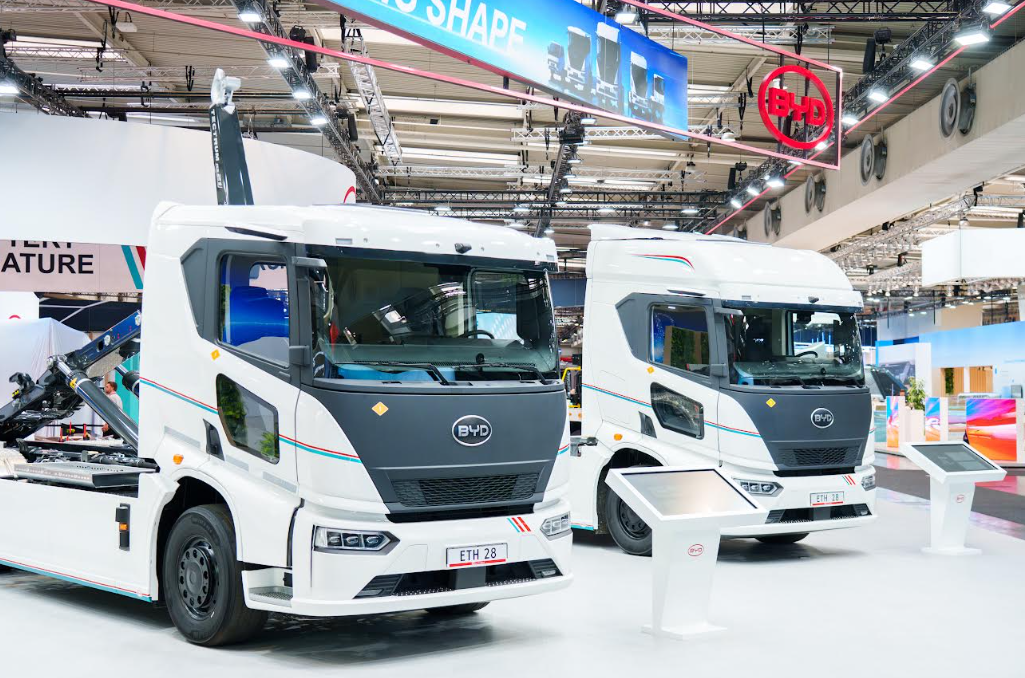
Enter BYD. Rather than simply introducing another electric truck to the showroom floor, the company used the Hannover fairgrounds to introduce a comprehensive, vertically integrated ecosystem. By coupling a 1,000-horsepower heavy-duty tractor with a 1.5-megawatt charging system and an all-encompassing logistics energy network—complete with on-site solar, stationary storage, and customized financing—BYD is offering a turnkey solution designed to systematically dismantle every historical excuse fleet managers have used to delay electrification.
Detailed Chronology: The IAA Transportation Unveiling
The rollout at the Hannover exhibition center unfolded with theatrical precision, underscoring the high stakes of the event.
The Flagship Unveiling: BYD ETT 44
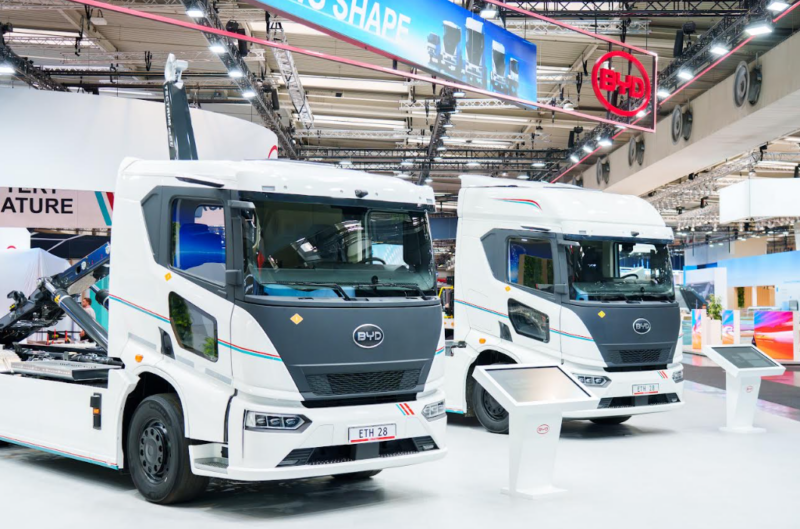
At the center of the company’s exhibition floor sat the BYD ETT 44, a 4×2 heavy-duty electric semi-truck engineered specifically to conquer the grueling demands of European regional and long-haul logistics. Built around BYD’s proprietary lithium iron phosphate (LFP) Blade Battery pack—boasting a massive 651 kilowatt-hours of energy capacity—the ETT 44 delivers up to 1,000 metric horsepower.

Despite its immense power and a Gross Combination Weight (GCW) rating matching its 44-metric-ton namesake, the truck achieves an operational range of up to 372 miles (approx. 600 kilometers) on a single charge.
The Breakthrough: 1.5-Megawatt Flash Charging
Addressing the Achilles’ heel of long-haul electric trucking—recharge times—BYD paired the ETT 44 with a proprietary commercial flash-charging architecture capable of drawing a blistering 1.5 megawatts of direct-current power.
During live demonstrations and technical briefings, executives detailed how this high-voltage infrastructure slashes downtime to a minimum. The system can replenish the massive 651-kWh Blade Battery pack from 20% to 80% capacity in approximately 20 minutes, instantly pumping roughly 248 miles (approx. 400 kilometers) of highway range back into the vehicle. For fleet operators running tight, time-sensitive schedules across European transport corridors, this performance profile bridges the gap between diesel convenience and electric sustainability.
Expanding the Medium- and Heavy-Duty Portfolio
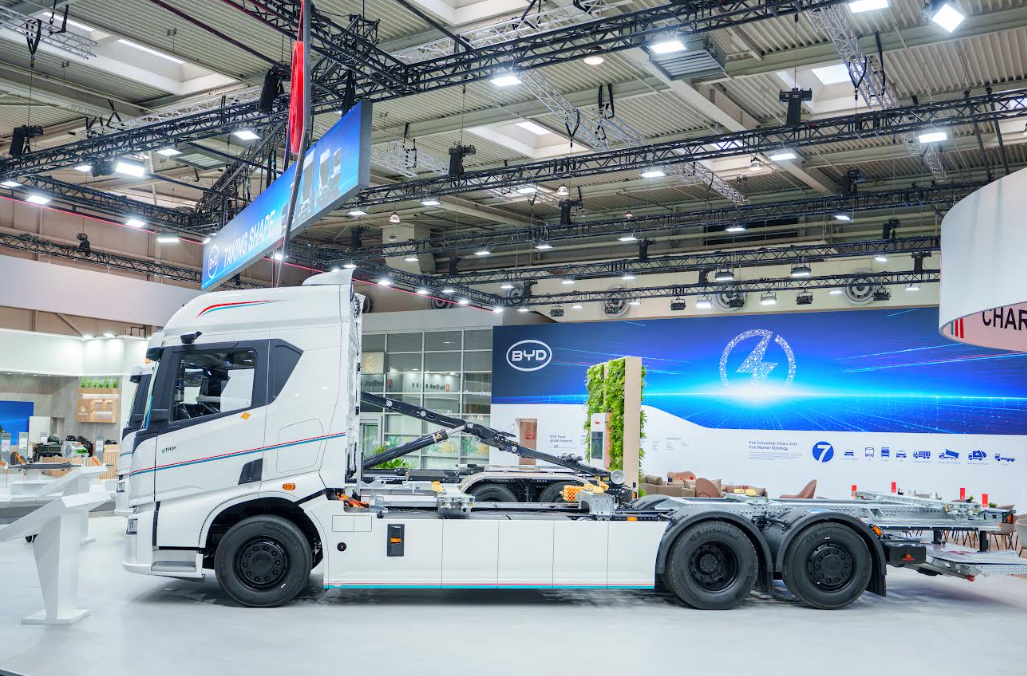
The ETT 44 was not showcased in isolation. BYD used the platform to systematically flesh out its European commercial vehicle lineup, introducing two new rigid models configured in 4×2 and 6×2 layouts.
Among these additions were a 26-metric-ton swap-body carrier and a specialized vocational hooklift unit. With these introductions, BYD’s commercial catalog now spans a comprehensive weight class spectrum—ranging from 3.5-metric-ton urban distribution vans up to the heavy-hitting 44-metric-ton regional and long-distance transport haulers.
Supporting Context & Metrics: Overcoming Market Hesitation
To truly understand the disruptive nature of BYD’s European onslaught, one must examine the hard metrics and financial pressures governing the heavy commercial vehicle market.
| Feature / Metric | BYD ETT 44 Specifications & Offerings | Industry Standard Baseline |
|---|---|---|
| Gross Vehicle Weight (GCW) | 44 Metric Tons (4×2 Heavy-Duty Tractor) | Varies (Up to 44 Metric Tons) |
| Powertrain Output | Up to 1,000 Metric Horsepower | ~400–600 HP (Typical Electric Segments) |
| Battery Capacity & Chemistry | 651 kWh / Lithium Iron Phosphate (LFP) Blade Battery | Varies (NMC/LFP chemistries, often smaller) |
| Maximum Operating Range | Up to 372 Miles (600 km) | ~250–310 Miles (400–500 km) |
| Peak Charging Capacity | 1.5 Megawatts (DC Flash Charging) | 350 kW – 400 kW (Typical CCS standards) |
| Recharge Time (20% to 80%) | ~20 Minutes | 60–90+ Minutes |
| Range Added per Quick Charge | ~248 Miles (400 km) | ~120–180 Miles |
| Standard Battery Warranty | 10 Years or 1.2 Million Kilometers | 2–3 years (Vehicle), 6–8 years (Battery) |
The Warranty Breakthrough
Beyond raw performance, the single most aggressive maneuver executed by BYD in Hannover was its warranty commitment. The company announced it will back the ETT 44’s battery with a standard 10-year or 1.2-million-kilometer warranty.
Across the European heavy truck market, base vehicle warranties traditionally span a mere two to three years. Battery coverage typically caps out at six to eight years, or requires fleet operators to purchase expensive, comprehensive secondary service extensions. By offering a 1.2-million-kilometer guarantee out of the gate, BYD is directly neutralizing residual value anxiety—historically the number-one deterrent for fleet managers calculating the total cost of ownership (TCO) for electric semi-trucks.
Official Statements: The Vision Behind the Strategy
Addressing the press and industry stakeholders in Hannover, Stella Li, Executive Vice President of BYD, framed the commercial vehicle push as a natural extension of the company’s unmatched manufacturing ecosystem and deep technological integration.

"We have already put FLASH Charging into practice in passenger vehicles," Li told the audience during the keynote presentation. "Today, we are bringing this technology to commercial vehicles, starting with our trucks. With 1.5 megawatts of charging power, it can charge from 20 percent to 80 percent in about 20 minutes, delivering up to 248 miles of range. Less time charging. More time on the road."
Li went on to emphasize that BYD’s go-to-market strategy is fundamentally different from traditional truck manufacturers. Rather than selling isolated hardware, BYD is positioning itself as an energy solutions provider.
"From batteries and solar power to energy storage, FLASH Charging and commercial vehicles, we provide a one-stop solution for sustainable commercial transport," Li explained.
This ecosystem approach means fleet operators can buy into a proprietary, closed-loop network encompassing on-site photovoltaic generation, stationary battery buffer systems, dynamic energy pricing management, and tailored fleet financing packages directly from BYD.

Future Outlook: Geopolitical Realities and Competitive Pressures
The arrival of BYD’s heavy-duty fleet in Europe has sent shockwaves through boardrooms in Stuttgart, Gothenburg, and Munich. While legacy European makers have introduced capable long-haul battery models—such as the Mercedes-Benz eActros 600 and the Volvo FH Electric—none can match the sheer vertical integration that underpins BYD’s operations. Because BYD manufactures its own battery cells, semiconductors, and software systems in-house, it commands a cost structure and production scale that legacy European brands struggle to rival.
This technological and financial edge comes against a backdrop of escalating geopolitical friction. Trade tensions between Brussels and Beijing over electric vehicle subsidies have created a complex operating environment. While the European Commission has thus far concentrated its import tariffs and anti-subsidy investigations primarily on passenger cars, Chinese commercial vehicle manufacturers are reading the tea leaves.
To insulate themselves against impending regulatory barriers and potential trade protectionism, companies like BYD are rapidly accelerating plans to anchor local assembly operations, distribution agreements, and technical service partnerships directly inside European borders.
The Road Ahead
The battle for Europe’s zero-emission freight corridors has officially entered a new, high-stakes phase. Legacy European truck manufacturers can no longer rely on brand loyalty and geographical advantage to protect their home markets. With the debut of the ETT 44, a 1.5-megawatt charging infrastructure, and an unprecedented 1.2-million-kilometer battery warranty, BYD has laid down a formidable gauntlet. For European logistics operators, the future of heavy transport has arrived—and it is moving faster, and charging harder, than the establishment anticipated.