









Executive Overview
The rapid, largely unregulated expansion of the artificial intelligence (AI) industry has triggered a massive infrastructural gold rush. Tech giants, data center developers, and enterprise conglomerates are scrambling to secure the immense energy required to power next-generation computing clusters. However, the grid is fundamentally unready to supply this unprecedented demand cleanly or quickly.
To bridge the power gap, developers are increasingly turning to dirty, decentralized power sources—primarily methane-fired portable generators, fossil-fuel peaker plants, and delayed-retirement coal facilities. The consequences of this dash for power are profound.
A landmark report by the Environmental Protection Network (EPN)—compiled by former high-ranking officials from the Environmental Protection Agency (EPA)—reveals that the localized air pollution generated by expanding AI data centers could lead to roughly 600,000 new asthma symptom cases, 1,300 premature deaths, and more than $20 billion in annual public health costs by 2028 alone.

This unfolding public health crisis is being actively facilitated by federal regulatory rollbacks. In the name of accelerating the deployment of digital infrastructure, government agencies are weakening the very environmental safeguards designed to protect human health. This dynamic mirrors historical corporate greenwashing scandals, such as the automotive industry’s infamous "Dieselgate" era. Ultimately, society is sleepwalking into an era of elevated toxic exposure, trading human biological resilience for computational capacity.
Detailed Chronology: From Diesel Deception to Digital Smoke
To understand how corporate interests routinely subvert environmental science for profit, one must look back at the playbook established by the global auto industry more than a decade ago.
The Dieselgate Precedent (2012–2018)
In 2012, the World Health Organization (WHO) formally classified diesel engine exhaust as a Group 1 carcinogen, placing it in the same hazardous category as asbestos and plutonium. This scientific verdict sent shockwaves through the European automotive sector. For decades, manufacturers like Volkswagen, Mercedes-Benz, and BMW had aggressively marketed diesel-powered vehicles as fuel-efficient marvels. Following the OPEC oil embargoes of the 1970s, European nations had artificially lowered taxes on diesel fuel, creating a massive consumer market fueled by Adam Smith’s "invisible hand."
Facing existential threats to their core product lines, German automakers formed a lobbying front called the European Research Group on Environment and Health in the Transport Sector (EUGT). Tasked with protecting the reputation of internal combustion, EUGT commissioned the Lovelace Respiratory Research Institute in Albuquerque, New Mexico, to conduct animal testing designed to prove that inhaling diesel fumes was benign.

Executive Overview
In a chilling exercise in corporate malfeasance, researchers sequestered ten macaque monkeys in airtight chambers for four hours, forcing them to inhale the exhaust of a manipulated Volkswagen Beetle diesel while watching cartoons. The vehicle’s emissions control software had been secretly calibrated to pass laboratory tests while spewing illegal levels of pollutants during actual road use.

When the deception collapsed during the broader "Dieselgate" scandal, automotive executives feigned profound shock, scapegoated low-level engineers, dismantled the EUGT, and promised wholesale reform. Yet, the damage was done. Diesel’s market share in Europe plummeted from dominant heights down to roughly 7 percent today. The lesson of Dieselgate was clear: when confronted with hard scientific limits, powerful industries will deploy obfuscation, manufactured science, and political lobbying to delay accountability.
The Modern Parallels: Powering the AI Gold Rush
Today, that exact playbook is being rerun on a planetary scale, this time by the tech industry and its infrastructure partners. The generative AI revolution demands unprecedented volumes of electricity. Major tech companies are racing to construct massive data centers across the United States.
Because traditional grid interconnections take years to secure, developers are bypassing regulatory oversight and environmental reviews by deploying fleets of portable methane-fired turbines. Even prominent figures who once championed sustainable technology—most notably Elon Musk—have embraced these dirty stopgaps. Musk’s xAI utilized dozens of portable gas generators to power its massive "Colossus" data center clusters in Memphis, Tennessee, and northern Mississippi, bypassing local environmental permits and fueling intense community pushback. Musk has invested so heavily in this dirty generation model that he acquired the manufacturing apparatus behind these mobile generators to scale their distribution.
Concurrently, federal and state regulators are rewriting the rules of the energy transition. Rather than accelerating clean energy deployment to meet tech demands, the government has moved to mandate the continued operation of aging, carbon-heavy coal-fired power plants that were scheduled for permanent retirement. The rationale is explicit: data centers need continuous baseload power, and climate targets must take a back seat to computational supremacy.
Supporting Context & Metrics: The Human Cost of Compute
The environmental footprint of the AI boom is no longer theoretical; it is being quantified by atmospheric scientists, public health advocates, and legal experts.
Quantifying the Toxic Load
Research published in environmental and atmospheric journals demonstrates that data centers relying on fossil-fuel backstops or fossil-heavy regional grids inject staggering amounts of particulate matter ($PM_2.5$), nitrogen oxides ($NO_x$), and volatile organic compounds (VOCs) into local airsheds.
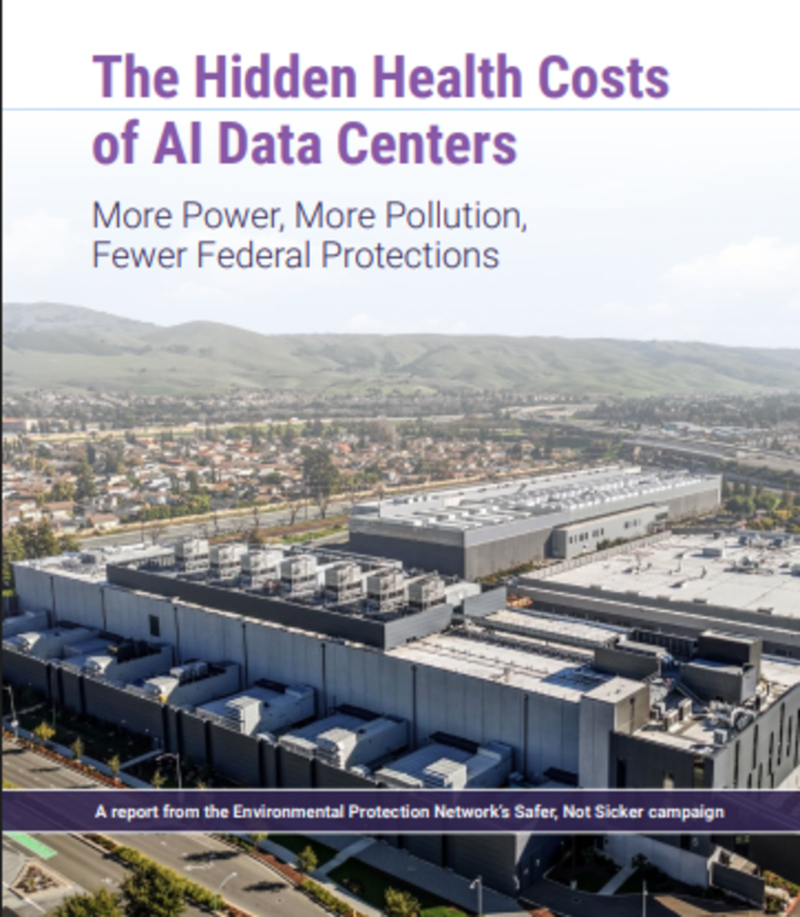
According to the Environmental Protection Network’s recent assessment, The Hidden Costs of AI Data Centers, the cumulative air quality degradation driven by this surge in fossil-fueled compute will inflict devastating public health consequences by 2028:
- Asthma Incidences: Approximately 600,000 new or exacerbated asthma symptom cases among vulnerable populations living downwind of data center corridors.
- Mortality: An estimated 1,300 premature deaths directly linked to prolonged exposure to elevated particulate and chemical pollution.
- Economic Burden: More than $20 billion annually in direct public health costs, including emergency room visits, hospitalizations, lost productivity, and long-term medical treatments.
These estimates are notably conservative. They do not fully account for the sweeping regulatory rollbacks enacted by the current federal administration. For instance, recent policy shifts have systematically relaxed automobile tailpipe emissions standards and delayed clean air compliance deadlines, compounding the total toxic burden bearing down on American communities.
The Regulatory Vacuum
Market intelligence trackers such as Cleanview report that approximately 1,300 commercial data centers currently operate across the United States, with an astonishing 2,000 additional facilities in active planning or construction phases.
Monitoring emissions across this sprawling digital infrastructure requires rigorous, well-funded regulatory oversight. However, deep staffing cuts and budget constraints at the EPA have severely crippled the agency’s capacity to conduct inspections, audit continuous emissions monitors, or enforce federal air quality standards. The EPN warns that the EPA has been effectively sidelined, transformed from an environmental guardian into a passive spectator—or worse, an active enabler—of industrial pollution.
Official Statements & Expert Perspectives
The erosion of environmental protections to accommodate tech sector expansion has drawn fierce condemnation from public health professionals, former regulatory officials, and independent watchdogs.
Dr. Lynn Goldman, a pediatrician, dean of the Milken Institute School of Public Health at the George Washington University, and former EPA assistant administrator during the Clinton administration, delivered a scathing critique of current federal policy in an interview with The New York Times:
"What concerns me now is the role EPA and other government agencies are playing—and proudly touting—weakening the very safeguards designed to protect people from the pollution in the name of helping tech and power companies accelerate these data center build-outs. These are decisions that can affect what Americans breathe, what gets into our water and, ultimately, what can make its way into our soil and food supply."
Echoing these concerns, the EPN’s public dossier explicitly states:
"AI data center pollution can make people sick. Instead of protecting Americans’ health, the EPA is making the health risks worse."
The network highlights over 30 distinct administrative actions taken over the past year that weaken clean air and clean water protections to fast-track energy infrastructure. These actions include granting emergency waivers for fossil-fueled generators, exempting specific industrial zones from National Ambient Air Quality Standards (NAAQS), and suppressing environmental impact statements under the guise of national security and economic competitiveness.

Tech industry representatives and utility executives defend these emergency measures as unavoidable growing pains. They argue that maintaining global leadership in artificial intelligence is a matter of geopolitical survival, requiring an "all-of-the-above" energy strategy until next-generation nuclear, advanced geothermal, and long-duration storage technologies can scale. Yet, critics note that this pragmatic defense treats human biology as a disposable input in a race for technological dominance.
Future Outlook: Closing the Circle
The trajectory of the AI infrastructure boom reveals a grim systemic irony. Just as the macaque monkeys in the Lovelace laboratory were trapped in an airtight chamber breathing Volkswagen exhaust to protect corporate balance sheets, modern human populations are finding themselves sealed inside a degraded planetary ecosystem.
Fine particulate matter ($PM_2.5$), heavy metals, and persistent chemical pollutants generated by fossil-fueled power generation do not respect corporate boundaries or data center perimeters. Recent biomedical studies have detected fine particulate pollutants and combustion byproducts inside human placentas, breast milk, and umbilical cord blood.
We are, quite literally, infusing our youngest generations with the exhaust of fossil-fuel combustion before they draw their first breath outside the womb.
Society appears strangely willing to accept this toxic bargain. The dominant cultural and political narrative treats ecological degradation as an acceptable collateral cost of technological progress. Under the banner of grid reliability, economic growth, and the holy grail of artificial intelligence, environmental safeguards are systematically dismantled.
The public cheers for faster data processing speeds, real-time video generation, and automated algorithmic conveniences, remaining largely blind to the physical smoke billowing from the backup generators just over the horizon. Unless civil society, regulatory watchdogs, and communities on the front lines demand a hard pivot toward genuinely clean, renewable-backed data infrastructure, the silicon smoke-screen will close around us entirely—proving that we have engineered our own downfall in the pursuit of artificial intelligence.