










Executive Overview
The global race toward electric aviation is frequently framed as a technological contest between scrappy aerospace startups. Analysts meticulously track every newly certified prototype, evaluate order books, and celebrate landmark test flights as defining moments for the industry. However, focusing solely on individual airframes mistakes the pieces for the puzzle. A prototype that successfully completes a test flight or a startup that amasses a backlog of non-binding orders has demonstrated a milestone, but it has not proven the existence of a viable commercial ecosystem.
True maturity in aviation requires far more than engineering cleverness. It demands an integrated operational framework: operators must be able to deploy hundreds of aircraft into scheduled passenger and cargo rotations, maintain them profitably, establish reliable charging infrastructure, manage and replace expensive battery packs economically, and ultimately secure repeat fleet orders before launching export campaigns.
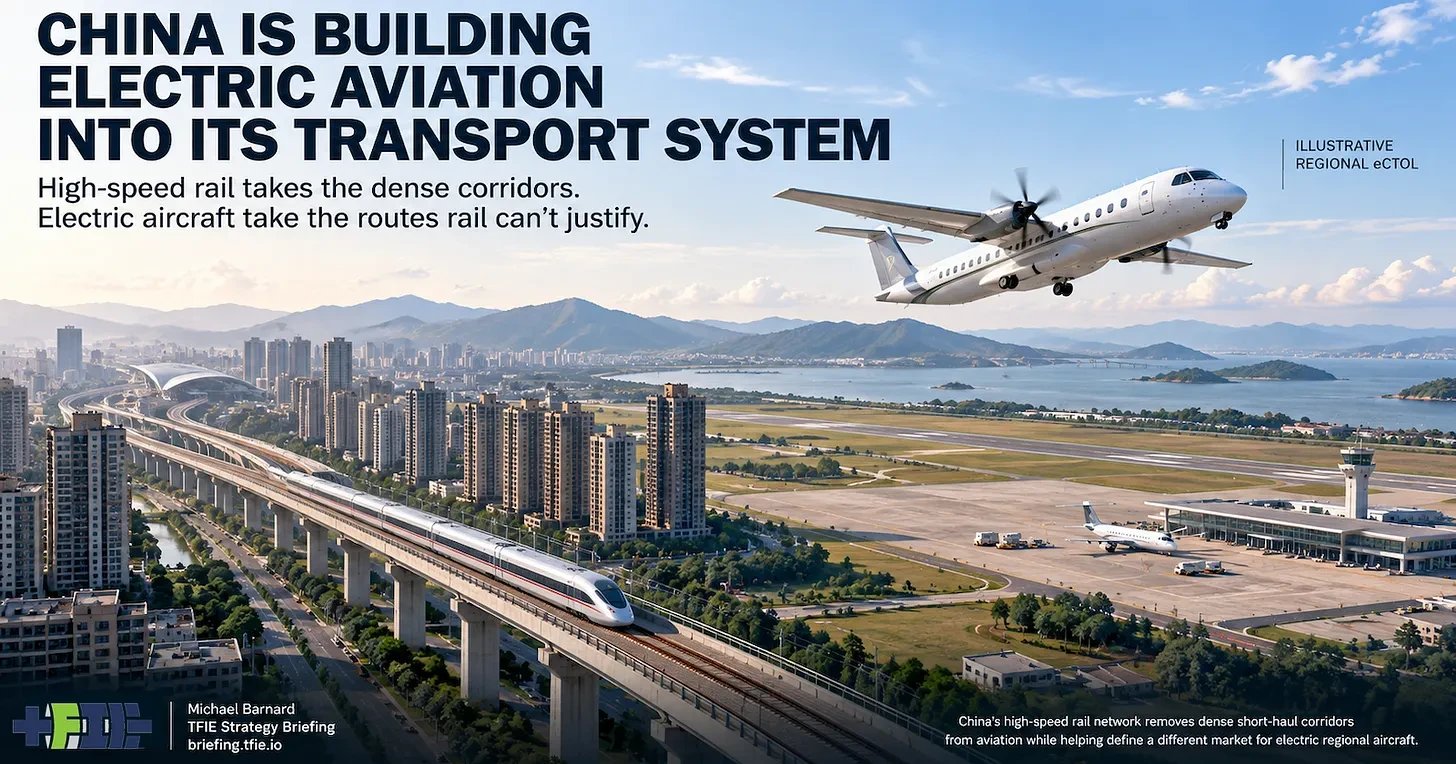
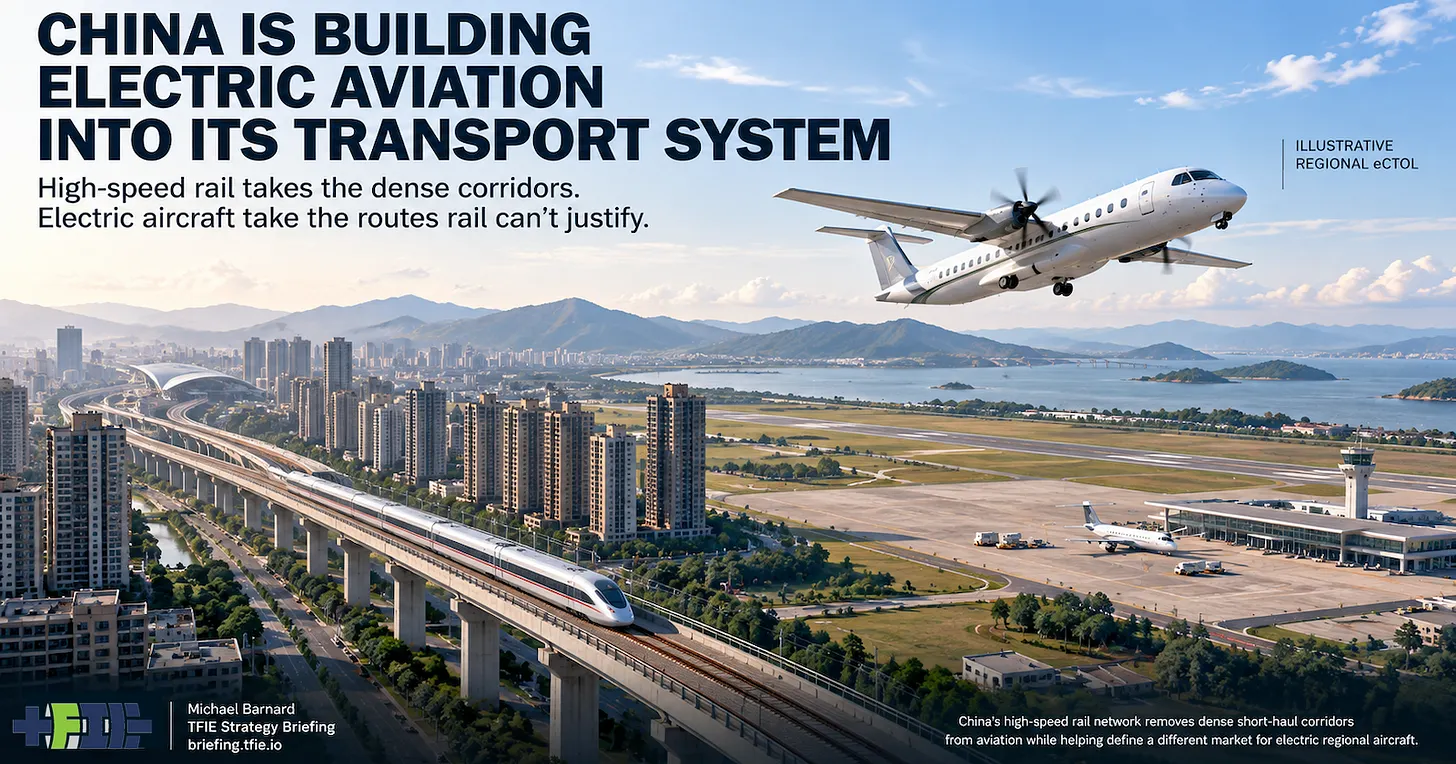
By this demanding standard, China is uniquely positioned to dominate the coming era of electric aviation—not merely because of its aircraft design capabilities, but because of how its broader transportation and industrial ecosystems interact. Rather than treating electric aviation as an isolated engineering problem, China is leveraging a pre-existing infrastructure masterclass. Its world-leading high-speed rail network absorbs the dense, short-haul corridors that traditionally bedevil regional aviation economics. By offloading high-capacity intercity travel to 350 km/h bullet trains, China has inadvertently carved out a pristine, well-defined market niche for electric and hybrid aircraft: thin regional routes, island hops, challenging terrain, cargo links, and remote communities.

When paired with a domestic battery manufacturing base that commands over 80% of global cell production, state-backed aerospace integration, and proactive regulatory frameworks, China possesses the systemic advantages required to transition from electric aviation prototypes to a functional, scaled industry.
Detailed Chronology: The Evolution of China’s Transport and Aviation Landscape
To understand why China is poised to lead the electric aviation sector, one must examine the chronological convergence of its high-speed rail expansion, battery manufacturing dominance, and aviation policy shifts over the past decade.
2010–2020: The Rail Foundation and the First Wave of Battery Dominance
For years, China’s primary transportation focus was the rapid construction of its national high-speed rail (HSR) grid. What began as regional arteries quickly evolved into a continental-scale marvel. By prioritizing rail for dense, high-volume city pairs, China solved the congestion problems plaguing highway and short-haul aviation networks in the West. Simultaneously, the explosive growth of the Electric Vehicle (EV) market catalyzed a massive domestic supply chain for lithium-ion batteries. By the late 2010s, Chinese firms had secured near-total dominance over critical material processing, cathode production, and cell manufacturing.
2020–2023: Certification Milestones and Policy Alignment
While Europe made headlines in 2020 when the European Union Aviation Safety Agency (EASA) certified the Pipistrel Velis Electro—the world’s first type-certified fully electric aircraft—China was quietly laying the regulatory and manufacturing groundwork to scale far beyond boutique demonstrators.

In late 2023, the Chinese Ministry of Industry and Information Technology (MIIT), alongside other state agencies, released the Green Aviation Manufacturing Development Outline for 2023–2035. This policy document explicitly linked electric propulsion, next-generation aviation batteries, and civil aircraft integration into national industrial planning. Concurrently, the Civil Aviation Administration of China (CAAC) began developing operating frameworks tailored specifically to short-haul aviation, focusing on the unglamorous yet vital mechanics of route planning, airport charging infrastructure, and maintenance oversight.
2024–2025: Rail Expansion and Battery Breakthroughs
By the end of 2025, China’s high-speed rail network reached an astounding 50,400 kilometers, with projections pointing toward 60,000 kilometers by 2030. This unprecedented rail density effectively vacuumed up short-haul passenger aviation between major metropolitan areas, leaving traditional airlines to abandon unprofitable domestic short routes.
On the energy front, major battery giants like CATL began pushing the boundaries of chemistry and physics. CATL publicized aviation-oriented condensed battery cells capable of achieving energy densities up to 500 Wh/kg. Crucially, rather than relying solely on laboratory metrics, Chinese firms began rigorous, certification-oriented safety testing on lower-specific-energy configurations designed to meet stringent aerospace thermal and structural requirements.
2026 and Beyond: Commercialization and Export Precedents
Entering 2026, the global electric aviation space saw notable Western advancements, such as Heart Aerospace’s X1 demonstrator completing its inaugural 27-minute flight in August 2026 at a takeoff weight exceeding 25,000 pounds with over one megawatt of electric propulsion.
However, China’s focus shifted firmly toward operational scaling. State aerospace entities, including the Commercial Aircraft Corporation of China (COMAC) and the Aviation Industry Corporation of China (AVIC/AECC), integrated hybrid-electric propulsion programs—such as AECC’s megawatt-class hybrid systems—into their core development pipelines. Furthermore, COMAC established a vital export precedent: by early 2026, domestically produced C909 aircraft were operating commercially across Southeast Asia, backed by a comprehensive package encompassing certification acceptance, leasing, pilot training, and maintenance support. This blueprint provides the exact commercial scaffolding needed when China’s electric aircraft transition from domestic fleets to international export markets.
Supporting Context & Metrics
Evaluating the viability of electric aviation requires a hard look at the underlying metrics of mass, energy density, infrastructure, and transport economics.
The Rail-Aviation Inversion
From the perspective of a Western aircraft manufacturer, the proliferation of high-speed rail is often viewed as a threat—a competitor that swallows potential passenger markets. In China, this dynamic represents a strategic inversion.
- HSR Milestone: China’s high-speed rail network stood at ~50,400 km at the close of 2025, tracking toward 60,000 km by 2030.
- Economic Realities: High-speed rail operating at 350 km/h effortlessly captures intercity travel between dense population centers. It is economically unviable for battery-electric aircraft to compete on these high-frequency, high-volume routes.
- The Defined Niche: By removing dense short-haul corridors from aviation, HSR leaves behind a perfectly scoped market for electric aircraft: thin regional routes, island archipelagos, mountainous terrain, and secondary cities where building railways is economically prohibitive and conventional regional jets are too expensive to operate frequently.
The Battery Manufacturing Advantage
Aviation batteries face vastly harsher operating conditions than automotive packs. They demand exceptional specific energy, rapid discharge and recharge capabilities, robust thermal management, structural load-bearing capacity, and guaranteed safety margins deep into a flight profile.
- Global Cell Dominance: According to the International Energy Agency (IEA), China produced more than 80% of global battery cells in 2025, alongside dominant market shares in active cathode and anode materials.
- Specialization at Scale: While Western startups must negotiate supply chains across fragmented international borders, Chinese electric aviation developers draw directly from an industrial base built for markets orders of magnitude larger than aviation.
- Energy Density vs. System Integration: While CATL’s 500 Wh/kg condensed cell headlines represent a technical tour de force, the industry’s real progress lies in balancing high energy density with rigorous containment, battery management systems (BMS), and electrical protection. Chinese firms are actively bridging this gap through concurrent safety and certification testing.
Official Statements and Strategic Frameworks
The transition from a collection of promising startups to an entrenched industrial powerhouse requires deep institutional alignment. In China, this alignment is anchored by government directives and regulatory frameworks that prioritize systematic execution over speculative hype.

The CAAC Short-Haul Operating Framework
The Civil Aviation Administration of China has approached electric aviation with a pragmatic focus on operational infrastructure. Through its specialized short-haul aviation operating frameworks, the CAAC addresses the critical operational pillars that frequently derail Western startups:
- Airport Integration: Ensuring regional airports possess adequate grid capacity for high-speed megawatt charging systems.
- Scheduling and Ground Turnaround: Establishing standardized windows for battery swapping or rapid recharging.
- Maintenance and Oversight: Developing regulatory protocols for battery degradation monitoring, thermal runaway containment, and propulsion failure modes.
Industrial Policy and State Aerospace Integration
Unlike the West, where electric aviation is driven almost entirely by venture-backed startups vulnerable to macroeconomic downturns and capital crunches, China’s state-owned aerospace giants are deeply embedded in the sector.
- COMAC’s Ecosystem Approach: Rather than focusing solely on airframe design, COMAC leverages its experience in regional jet commercialization (such as the C909 and C919 programs) to build out holistic support networks—including leasing, pilot training academies, and maintenance logistics.
- AECC’s Hybrid Propulsion Programs: The Aero Engine Corporation of China (AECC) has advanced development on megawatt-class hybrid propulsion systems. These powerplants bridge the gap between pure battery-electric short-hop aircraft and larger regional hybrid airliners, ensuring that legacy aerospace engineering expertise guides the electric transition.
Future Outlook: The Path to Global Leadership
As the global electric aviation sector looks toward the remainder of the decade, the criteria for success are clear. The era of celebrating single prototype flights, impressive initial order books, and preliminary certification milestones is drawing to a close.
The Threshold of True Scale
The litmus test for an electric aviation industry is not whether a handful of demonstrator aircraft can fly. The true test encompasses several rigorous metrics:
- Fleet Utilization: Hundreds of runway-based electric or hybrid aircraft flying repeated, daily commercial schedules.
- Lifecycle Economics: Batteries reaching their projected replacement intervals, allowing operators to accurately calculate long-term operating costs.
- Repeat Orders: Airlines and cargo operators placing second-generation fleet orders based on verified operational profitability rather than speculative subsidies.
- International Adoption: Foreign carriers integrating these aircraft and establishing parallel maintenance and regulatory regimes.
The Export Imperative
China’s ultimate proof of leadership will not be domestic deployment alone, but its ability to export complete electric aviation ecosystems. Just as COMAC demonstrated with the C909 in Southeast Asia, successful aerospace exports require far more than an airframe with an export certificate. They require a turnkey package: the aircraft, ground power charging stations, battery supply chains, localized maintenance support, pilot training simulators, and comprehensive financing structures.
While formidable Western contenders—such as Heart Aerospace, Airbus, Embraer, and established European regulatory bodies—maintain deep aerospace heritage and proven testing environments, China possesses an unmatched structural advantage. By harmonizing a dominant battery manufacturing apparatus, institutional regulatory foresight, state-backed aerospace integration, and a rail-rationalized transport map, China has constructed the most comprehensive deployment system in the world.
The debate over who will lead the electric aviation revolution is moving rapidly from industrial forecasting to empirical reality. If hundreds of commercial electric aircraft enter routine service, trigger substantial follow-up orders, and begin accumulating international operating history, the question will no longer be whether China can build an electric aviation industry—it will be whether the rest of the world can catch up.