









Executive Overview
The global energy storage landscape is locked in a fierce, multi-front war for technological supremacy, where innovations are constantly challenged by economic and material realities. Among the most innovative contenders to emerge in recent years is dense-fluid pumped hydro—a novel variation of conventional pumped storage hydropower designed to utilize liquids significantly heavier than water.
Proponents argue that by employing a fluid roughly 2.5 times the density of plain water, developers can generate identical amounts of gravitational energy using smaller reservoirs, compressed elevations, or lower hills. This theoretically opens up a universe of non-traditional sites that would otherwise be economically unviable for standard hydro installations.
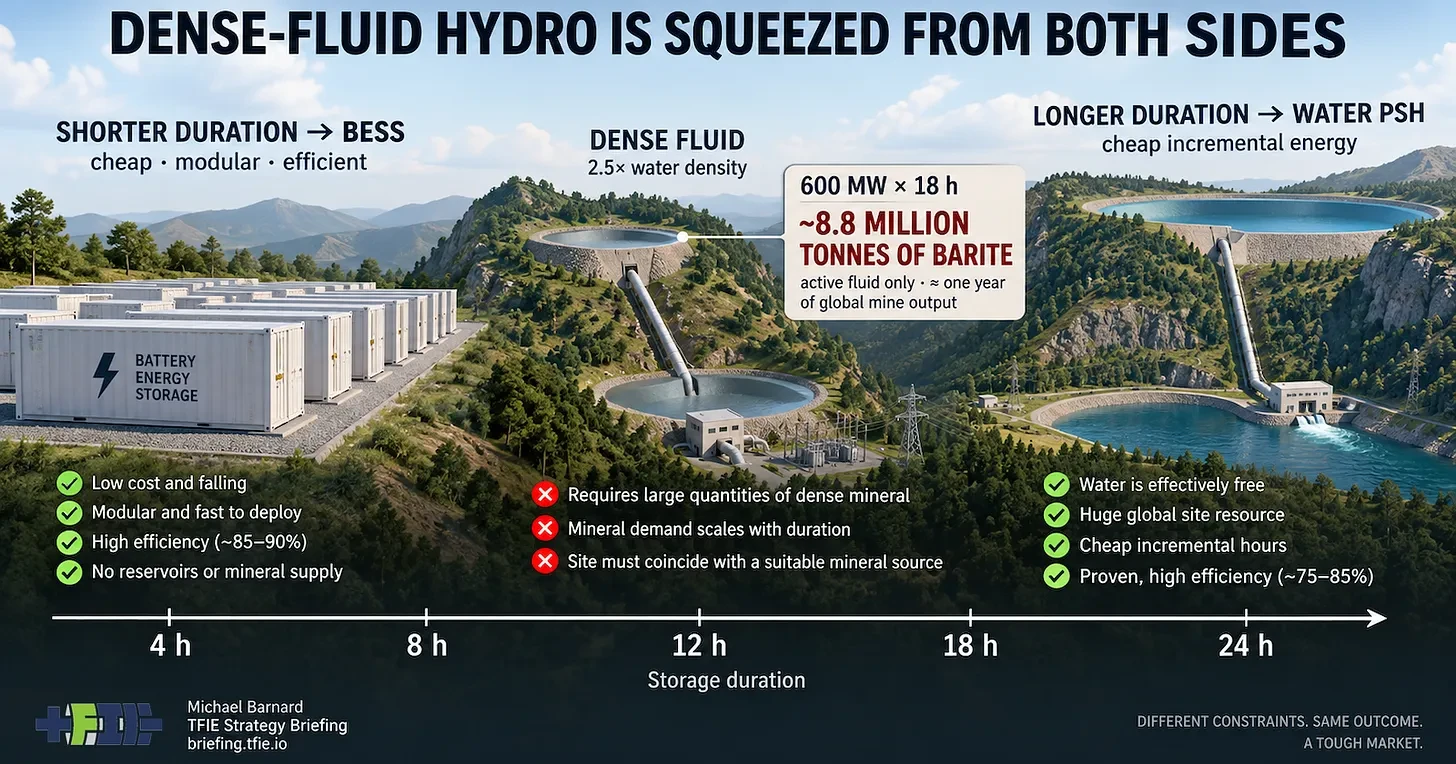
However, a comprehensive analysis of the technology reveals a profound commercial and structural paradox: dense-fluid pumped hydro is caught in a severe strategic squeeze. At shorter storage durations, it runs headfirst into the rapidly falling costs and surging dominance of lithium-ion battery energy storage systems (BESS). Conversely, as storage durations expand into the multi-hour and multi-gigawatt-hour (GWh) realms required for true long-duration energy storage (LDES), the technology triggers staggering mineral demand constraints, while inadvertently strengthening the economic case for conventional, water-based pumped hydro.

While recent real-world demonstrations—such as RheEnergise’s pioneering pilot project in Devon, England—have proven that dense-fluid systems can successfully function in a mechanical sense, the scaling mathematics expose deep friction between engineering feasibility and commercial viability.
Detailed Chronology: From Concept Rendering to the Cornwood Demonstrator
For years, dense-fluid pumped hydro existed primarily as a compelling pitch deck, CAD renderings, and laboratory scale tests. That changed definitively when energy storage startup RheEnergise constructed and operated its first physical demonstrator at Cornwood in Devon, marking a critical milestone for the sector.
Engineering Reality Hits the Ground
At the Cornwood site, the company successfully engineered a closed-loop system featuring upper and lower reservoirs, specialized pumps, distribution piping, and heavy-duty generating equipment. Crucially, the team manufactured hundreds of cubic meters of its proprietary high-density fluid—a barite-rich suspension—pumped that fluid uphill, and successfully routed it back down through a turbine to capture electricity. The installation successfully reached its 500-kilowatt (kW) design power rating.
This achievement moves dense-fluid pumped hydro out of the realm of theoretical physics and speculative venture capital pitches. It is now a physically validated technology. However, the path to validation laid bare the operational hurdles inherent in handling specialized working fluids.

The Performance Metrics of a First-of-a-Kind Facility
While reaching the 500 kW power threshold was a major win, energy storage value is fundamentally derived from energy capacity (storage duration) rather than instantaneous power output alone.
According to the final UK government demonstrator report evaluating the Cornwood project, the system was originally envisioned around a four-hour operational window at 500 kW. However, compounding difficulties in producing sufficient quantities of acceptable, homogeneous high-density fluid constrained the available working inventory. As a result, the completed demonstrator achieved roughly 15 minutes of full-power discharge in its integrated testing setup.
Furthermore, the system recorded a round-trip efficiency (RTE) of 59% before accounting for parasitic loads—energy consumed by auxiliary plant systems that had not yet been fully metered. For any first-of-a-kind (FOAK) engineering prototype, such outcomes are entirely normal and expected. Discovering moisture sensitivities in barite feedstocks, slow mixing rates, and chemical inconsistencies in replacement additives is precisely what pilot plants are designed to do. Yet, these findings underline a stark reality: proving a machine can operate in a controlled environment is fundamentally different from proving an energy architecture can scale economically across the global grid.

Supporting Context & Metrics: The Dual Squeeze of Duration and Materials
To understand the long-term viability of dense-fluid pumped hydro, one must examine the opposing pressures exerted by shorter and longer duration market segments. This dynamic creates what industry strategists refer to as the "duration trap."
The Short-Duration Squeeze: Competing with Collapsing Battery Prices
As commercial developers look to deploy early commercial modules—typically sized around 10 to 20 megawatt (MW) capacities with four to eight hours of storage duration—they enter territory dominated by chemical batteries.
The economic foundations of stationary storage have shifted dramatically over the past several years. BloombergNEF’s annual battery price surveys highlight a relentless downward trend in lithium-ion pack prices, driving stationary storage costs down to roughly $70 per kilowatt-hour. While pack price does not equate to total installed BESS costs, the trajectory is punishing for mechanical alternatives.
When dense-fluid hydro targets shorter durations (four to eight hours), it attempts to compete directly with a technology—lithium-ion batteries—that benefits from massive gigafactory economies of scale, global supply chains, and continuous modular cost reductions. At this scale, managing the complex rheology, pumping mechanics, and maintenance of a dense mineral suspension offers few cost advantages over established electrochemical options.
The Long-Duration Squeeze: The Mineral Supply Chokepoint
Conversely, when storage durations are pushed outward to 12, 18, or 24 hours, the battery comparison weakens, but an even more formidable obstacle emerges: the mineral inventory requirement.
At a fixed power output and head (elevation change), every additional hour of storage demands a proportionally greater volume of working fluid, which translates directly into massive quantities of weighting minerals. Consider a hypothetical utility-scale deployment modeled in long-duration briefs: a 600 MW facility operating for 18 hours.
Utilizing the barite-rich fluid formulations disclosed in RheEnergise’s foundational patents as a baseline, the active fluid inventory alone would demand roughly 8.8 million tonnes of barite. To put this in perspective, a single energy storage installation would consume raw mineral volumes roughly equivalent to current annual global mine production—before accounting for inactive inventory, pipeline hold-up volumes, processing losses, or long-term contingency reserves.
Sourcing commercial-grade barite on a multi-million-tonne scale is neither economically nor environmentally scalable. Recognizing this, innovators have pivoted toward locating projects near industrial mines, quarries, or aggregate operations where local waste streams or naturally dense materials might be harnessed.
While co-locating storage systems next to disturbed industrial land with existing grid connections is a clever strategic adaptation, it fundamentally shifts the siting constraint rather than eliminating it. Instead of merely requiring a suitable hill and elevation profile, a project now demands an immense, proximate source of mineral waste displaying exact density profiles, stable particle suspension behavior, low chemical reactivity, and acceptable local processing economics.
The Superiority of Water and Transmission
Compounding the mineral challenge is the sheer abundance of plain water. Water is chemically simple, exceptionally stable, universally available by the millions of tonnes, and requires no multi-stage industrial processing or specialized homogenization.

Furthermore, the potential site resource for conventional closed-loop pumped hydro is vastly larger than traditional river-dam debates suggest. Landmark research from the Australian National University identified roughly 616,000 prospective off-river closed-loop pumped hydro sites globally, translating to a theoretical storage potential of approximately 23,000 terawatt-hours (TWh). While only a tiny fraction of these sites will ever be developed, the sheer surplus of topographically viable terrain demonstrates that a lack of hills is rarely the primary bottleneck for gravity storage—especially when modern high-voltage transmission networks can bridge the distance between generation and demand centers.
As duration increases toward true multi-day storage, conventional water-based pumped hydro utilizes an essentially free working fluid. Dense-fluid systems, by contrast, require exponentially larger volumes of manufactured, chemically stabilized suspensions, exposing them to severe cost inflation.
Official Statements & Industry Perspectives
The debate surrounding dense-fluid pumped hydro has played out across technical briefings, regulatory filings, and direct executive responses.
Advocates for high-density hydro maintain that the engineering advantages of fluid density are too significant to ignore. In formal responses to prior technical assessments, RheEnergise leadership emphasized that the core value proposition of the technology lies in its ability to unlock geographic locations that are completely inaccessible to conventional water hydro. By reducing the required elevation drop or reservoir footprint by a factor of 2.5, developers can theoretically site energy storage projects closer to urban load centers or industrial clusters where tall mountains or deep valleys are absent.
Independent engineering analysts, however, urge caution against conflating a localized geographic workaround with a systemic grid solution. As highlighted in strategic reviews by energy analysis firms like TFIE, the transition from a successful 500 kW demonstrator to a commercial GWh-scale asset exposes a stark widening between modeling assumptions and physical realities.
While RheEnergise models commercial round-trip efficiencies approaching 80%—assuming larger, more optimized fluid-handling machinery—the integrated, real-world metrics recorded at the Cornwood facility settled at 59% prior to parasitic loads. Industry experts emphasize that bridging this efficiency gap requires treating the proprietary fluid not as a passive substitute for water, but as a complex, highly engineered chemical component of the power plant itself.
Future Outlook: Finding the Right Niche in a Crowded Market
Where does dense-fluid pumped hydro fit in the future clean energy mix? The evidence suggests that while the technology may not emerge as a dominant, broad-market storage winner capable of displacing both lithium-ion batteries and conventional water hydro, it holds the potential to carve out highly specialized, valuable niches.
- Industrial Co-Location: Projects built directly adjacent to active mines or quarries—where topography, disturbed land, grid access, and multi-ton mineral waste streams naturally intersect—could bypass traditional supply chain barriers. If developers can successfully manage fluid degradation and suspension maintenance over thousands of charge-discharge cycles, these localized installations could prove commercially viable.
- The Specialization Trap: Dense-fluid hydro will likely remain constrained by its unique material footprint. Shorter durations push it into direct, bruising competition with plummeting battery prices. Longer durations highlight its massive mineral requirements and underline the economic supremacy of plain water.
Ultimately, RheEnergise and other pioneers deserve immense technical credit. They set out to build an entirely novel class of mechanical energy storage, designed and manufactured a dense fluid from scratch, pumped it uphill, and successfully recovered electricity through a turbine. They have definitively proven that dense-fluid pumped hydro works.
Yet, as the scaling mathematics demonstrate, proving that a machine can operate is only the first step. For dense-fluid storage to escape the powerful technological forces squeezing it from both sides, it must prove that its material and economic constraints can be mastered on a scale that matches the monumental ambitions of the global energy transition.