






Executive Overview
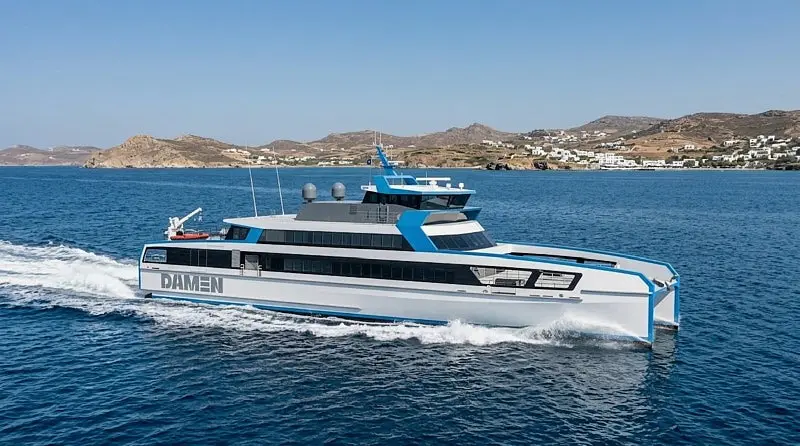
In an era defined by expanding coastal urbanization, heightened passenger expectations, and tightening maritime regulatory frameworks, Damen Shipyards Group has officially launched its newest flagship high-speed vessel: the Fast Ferry (FF) 5012. Developed as a direct evolutionary successor to the widely deployed Fast Ferry 4212, the FF 5012 represents a significant structural and commercial leap forward for modern waterborne transit operators.
Built around a 50-metre aluminum catamaran platform, the FF 5012 incorporates Damen’s proprietary Enlarged Ship Concept (ESC) to reconcile historically conflicting demands in naval architecture: maximizing passenger payload, enhancing seakeeping performance in adverse sea states, and maintaining optimal operating efficiency. The vessel expands total passenger capacity up to 450 passengers while retaining full compliance with the International Code of Safety for High-Speed Craft (HSC Code) Category A framework.
By increasing bridge deck tunnel height, shifting main passenger accommodation zones further aft, and optimizing internal space for revenue-generating amenities, Damen aims to offer ferry operators a high-yield vessel capable of navigating rougher coastal waters without compromising transit reliability or passenger comfort. This deployment comes at a crucial juncture for the commercial ferry industry, where operators face rising fuel costs, demand for ancillary revenue streams, and the operational requirement to maintain strict service schedules in open water environments.
+-----------------------------------------------------------------------------------+
|                        DAMEN FAST FERRY (FF) 5012 METRICS                        |
+----------------------+------------------------------------------------------------+
| Hull Length          | 50.0 Metres (Extended Catamaran Platform)                  |
| Baseline Design      | Evolved from Fast Ferry (FF) 4212 Platform                 |
| Hull Concept         | Damen Enlarged Ship Concept (ESC)                          |
| Max Passenger Count  | Up to 450 Passengers                                       |
| Deck Layout          | Dual Passenger Decks with Panoramic Forward Views          |
| Regulatory Framework | International Code of Safety for High-Speed Craft (HSC)    |
|                      | Category A Compliant                                       |
| Key Enhancements     | • Increased Tunnel Clearance for Rough Seas                |
|                      | • Aft-Shifted Accommodation (Reduced Accelerations)        |
|                      | • Expanded Onboard Retail & Concessions Area               |
|                      | • Dedicated Crew Quarters & Side-Loading Luggage Hold      |
+----------------------+------------------------------------------------------------+
Detailed Chronology: Design Evolution and Engineering Genesis
The Legacy of the 4212 Architecture
To understand the engineering priorities behind the FF 5012, one must analyze the operational footprint of its predecessor, the Fast Ferry 4212. The 42-metre platform established a strong global presence in medium-distance coastal transit, prized for its structural reliability, straightforward propulsion integration, and modest fuel consumption.
However, as passenger traffic grew along key coastal corridors—particularly across Southeast Asia, the Mediterranean, and South American coastal networks—operators increasingly reported operational bottlenecks:
- Capacity Constraints: Peak-hour demand often exceeded the physical footprint of 40-to-42-metre hulls.
- Rough-Sea Limitations: Moderate sea states frequently forced speed reductions to prevent hull slamming and wave impact on the bridge deck.
- Operational Turnaround: Fixed cabin layouts limited luggage handling speed and restricted on-board commercial offerings, capping ancillary revenue per passenger.
Recognizing these market shifts, Damen’s naval architecture teams in Gorinchem, Netherlands, initiated a dedicated design iteration program focused on lengthening the hull without incurring proportional penalization in hydrodynamic drag or structural weight.
FF 4212 Platform (42m Baseline)
       │
       ▼  [Enlarged Ship Concept Applied]
       ├── +8 Metres Hull Extension
       ├── Elevated Tunnel Clearance (Reduced Slamming)
       ├── Aftward Shift of Passenger Zone (Lower Vertical Accelerations)
       │
       ▼
FF 5012 Platform (50m Extended Catamaran)
Applying the Enlarged Ship Concept (ESC)
The structural realization of the FF 5012 relies on Damen’s Enlarged Ship Concept. Originally pioneered to optimize the seakeeping behavior of offshore supply vessels and patrol craft, the core principle of the ESC involves extending a hull’s length beyond the strict hydrodynamic requirement for static displacement.
By extending the catamaran demi-hulls to 50 metres, Damen engineers achieved several key physical advantages:
- Froude Number Optimization: The increased waterline length effectively lowers the vessel’s Froude number at equivalent operating speeds, reducing wave-making resistance and smoothing out wave-response characteristics.
- Elevated Bridge Deck Clearance: The vertical tunnel height between the twin hulls was increased significantly. This structural modification elevates the clearance above the waterline, dramatically reducing wave-slamming forces on the wet deck during operations in open sea conditions and higher sea states ($HS$).
- Longitudinal Center of Gravity & Inertia Realignment: Extending the forward hull section increases total longitudinal buoyancy reserves. This allowed designers to shift the primary passenger accommodation module further aft toward the vessel’s center of motion, where pitch and vertical acceleration forces are at their lowest.
Supporting Context, Technical Metrics, and Regulatory Dynamics
      LIGHTENING THE PASSENGER EXPERIENCE: STRUCTURAL LAYOUT OF THE FF 5012

    Forward Deck Zone                Midship/Aft Zone            Stern Loading Zone
 +------------------------+    +--------------------------+    +-------------------+
 | Forward-Facing Deck    |    | Primary Passenger Cabin  |    | Dedicated Cargo   |
 | Panoramic Sightlines   |    | (Shifted Aft for Low     |    | & Luggage Hold    |
 | Dual-Level Seating    |===>| Vertical Acceleration    |===>| External Side     |
 | Minimal Pitch Exposure |    | & Reduced Motion Sickness|    | Access Ramp       |
 +------------------------+    +--------------------------+    +-------------------+
                               | Integrated Retail Space  |
                               | & Dedicated Crew Rooms   |
                               +--------------------------+
Hydrodynamic Performance & Seakeeping Metrics
The primary challenge of operating high-speed catamarans in open coastal waters is controlling vertical accelerations, which directly drive motion sickness and passenger discomfort. The structural revisions of the FF 5012 alter these acceleration profiles.
- Tunnel Clearance: The raised clearance under the central bridge structure increases wave-passage margin, suppressing wet-deck slamming under adverse sea states.
- Accelerations at Seat Positions: Shifting the accommodation aft positions the bulk of passenger seating closer to the pitch axis of the vessel. The resulting decrease in vertical accelerations directly reduces motion-induced fatigue for passengers.
- Dual-Deck Visual Dynamics: Despite moving the bulk of seating aft, both upper and lower passenger decks incorporate forward-facing, uninhibited visual lines. Naval architecture research shows that maintaining visual contact with the horizon significantly attenuates sensory mismatch in passengers, lowering the incidence of motion sickness.
Onboard Revenue Space and Luggage Operations
Beyond pure hydrodynamics, the extended hull footprint of the FF 5012 unlocks interior volume, changing the yield economics for vessel operators.
- Passenger Payload: Up to 450 passengers can be accommodated in standardized high-density configurations, or fewer in premium multi-class layouts.
- Ancillary Revenue Infrastructure: The extra deck area allows for dedicated retail kiosks, expanded galley facilities, and enhanced concession areas. This structural addition enables operators to monetize mid-transit times through food, beverage, and duty-free retail without sacrificing passenger seats.
- Operational Efficiency: Ground-handling delays during port calls directly affect high-speed ferry schedules. The FF 5012 includes a dedicated, large-volume luggage hold as a standard feature, equipped with independent external side-access loading doors. This allows simultaneous passenger boarding and baggage handling, shortening turnaround times at dock.
- Crew Welfare Integration: The layout integrates a dedicated crew room, ensuring compliance with international labor and rest-period mandates for fast-ferry crews operating intensive multi-leg daily schedules.
The HSC Code Category A Framework Advantage
A central feature of the FF 5012’s commercial positioning is its full compliance with the International Maritime Organization’s (IMO) International Code of Safety for High-Speed Craft (HSC Code) Category A framework.
+-----------------------------------------------------------------------------------+
|                        HSC CODE CATEGORY COMPARISON METRICS                       |
+--------------------------+----------------------------+---------------------------+
| Feature / Parameter      | HSC Code Category A        | HSC Code Category B       |
+--------------------------+----------------------------+---------------------------+
| Primary Operational Area | Coastal / Short-to-Medium  | Open Ocean / Extended     |
| Route Limitations        | Must operate within safe   | Unrestricted distance     |
|                          | refuge availability        | from safe refuge          |
| Rescue Reliance          | Assumes external rescue    | Self-contained structural |
|                          | assistance is available    | redundancy mandatory      |
| Capital/Weight Overhead  | Optimized hull weight,     | Higher weight due to      |
|                          | streamlined redundancy     | duplicated systems        |
| Target Fleet Profile     | High-density regional      | Long-range inter-island   |
|                          | commuter/tourist routes    | deep-water connections    |
+--------------------------+----------------------------+---------------------------+
The distinction between Category A and Category B under the HSC Code carries operational and financial implications:
- Category A Craft: Defined as any high-speed passenger craft operating on routes where acceptable rescue facilities are readily available along the entire transit corridor. Category A status allows the vessel to maintain optimized structural weight ratios and streamlined safety installations.
- Category B Craft: Requires extensive structural redundancy, duplicated systems, and complex fire-protection boundaries to ensure self-sustained survival in remote offshore environments, adding dry weight, building cost, and operational maintenance overhead.
By optimizing the 50-metre platform to maximize passenger density (up to 450 passengers) while remaining strictly within the Category A framework, Damen offers operators a high-capacity hull without requiring the heavier, more costly capital investments associated with Category B certification.
Official Statements and Industry Perspectives
Analyzing the commercial balance of the new platform, Lodewijk van Os, Damen Product Manager Fast and City Ferries, emphasized the calculated engineering behind the vessel’s development:
"The FF 5012 allows operators to carry up to 450 passengers, and provides space for additional onboard services and comfort enhancements while remaining within the HSC Code Cat A framework. In our view, this new vessel provides the optimal balance between passenger comfort, operational capability and revenue potential."
                 DAMEN FF 5012 OPERATIONAL BALANCE TRIANGLE

                                     [ Revenue Potential ]
                                    /
                                   /    (Up to 450 Pax,
                                  /     Retail, Fast Turn)
                                 /
                                /      DAMEN FF 5012
                               /       OPTIMIZATION
                              /
                             /
  [ Operational Capability ] ----------------------------------- [ Passenger Comfort ]
   (HSC Cat A Compliance,                                       (Enlarged Hull, Aft Cabins,
    Increased Tunnel Clearance)                                  Panoramic Sightlines)
Industry Commentary and Economic Analysis
Maritime analysts point out that the mid-range high-speed ferry sector is shifting away from pure top-speed metrics toward total cost per passenger-nautical-mile and service reliability.
Earlier generations of fast ferries focused heavily on achieving speeds exceeding 40 knots, often at the cost of high fuel consumption and reduced reliability in rough weather. The FF 5012 signals a broader market recalibration toward operational uptime and yield optimization.
By minimizing wave-slamming incidents, operators can maintain scheduled service speeds in rougher sea conditions without exceeding structural stress thresholds or causing passenger discomfort. This seakeeping reliability helps prevent heavy-weather cancellations—a key source of revenue loss for coastal ferry companies.
Future Outlook and Strategic Industry Implications
Decarbonization and Modular Propulsion Adaptation
While the initial configuration of the FF 5012 focuses on conventional marine diesel engines paired with waterjet or controllable-pitch propeller propulsion, the enlarged hull volume provides a platform for future propulsion updates.
The additional space within the demi-hulls and aft engine compartments offers space reserves for alternative energy integrations, including:
- Hybrid-Electric Architectures: Space for battery banks to enable zero-emission port arrivals and departures.
- Alternative Fuel Integration: Structural margins capable of accommodating alternative fuel storage (such as methanol or compressed hydrogen) as marine supply chains mature.
- Advanced Hydrodynamic Coatings and Interceptors: Compatibility with active trim control interceptor systems to further lower resistance and cut greenhouse gas emissions per passenger-kilometer.
       PLANNED PROPULSION & DECARBONIZATION EVOLUTION PATHWAY

 [ Conventional Propulsion ]  ──►  [ Hybrid Readiness ]  ──►  [ Future Fuel Adaptability ]
  - High-Efficiency Diesels         - Battery Bank Space        - Methanol Integration
  - Optimized Waterjets             - Zero-Emission Ports       - Alternative Fuel Systems
Market Position and Competitive Dynamics
The introduction of the FF 5012 reinforces Damen’s competitive position against major global aluminum fast-ferry shipbuilders, particularly those in Australia and East Asia. Damen’s philosophy of standardization—building hulls to standardized designs to shorten delivery times—gives the FF 5012 a fast market entry route for operators looking to replace aging fleets.
As regional waterborne transit networks expand to relieve pressure on land-based transportation corridors, the Fast Ferry 5012 offers a practical operational benchmark. By pairing lengthened hull dynamics with standard Category A regulatory compliance, Damen has introduced a vessel engineered for the operational and financial realities of modern coastal transit.