






INVESTIGATIVE REPORT & SAFETY ANALYSIS
Published by Maritime Security & Safety Desk
Executive Overview
The recreational boating community is facing a renewed reckoning regarding maritime safety standards following the publication of a critical safety flyer and comprehensive investigation report. The documents detail the tragic allision of the rigid inflatable boat (RIB) Peaky Blinder with a stationary navigation beacon in Portsmouth Harbour, England, an accident on August 14, 2025, that resulted in the loss of two lives.
Issued alongside the official marine safety investigation, the new advisory places a sharp, unyielding focus on the fundamental, life-saving necessity of wearing personal flotation devices (PFDs)—commonly known as lifejackets—while underway. The incident, which has sent shockwaves through the UK maritime and leisure boating sectors, highlights the catastrophic consequences of high-speed impacts on the water and the often-overlooked vulnerabilities inherent in operating high-performance leisure craft within busy, regulated commercial waterways.

Portsmouth Harbour is one of the busiest and most complex maritime hubs in the United Kingdom, accommodating everything from massive Royal Navy aircraft carriers and international commercial ferries to a dense population of weekend sailors, kayakers, and high-speed RIBs. In this high-stakes environment, the margin for error is razor-thin. The Peaky Blinder tragedy has exposed systemic safety gaps within the recreational sector, prompting maritime authorities, investigators, and safety advocates to demand immediate behavioral and cultural shifts among boat handlers.
This comprehensive report examines the circumstances surrounding the Peaky Blinder allision, reviews the critical safety lessons highlighted by investigators, explores the broader metrics and socio-cultural contexts of recreational boating safety, and outlines the urgent preventative measures required to protect lives on the water.
Detailed Chronology
The Setting: Portsmouth Harbour’s Complex Waters
Portsmouth Harbour is a natural ria located on the south coast of England, characterized by narrow entrance channels, rapid tidal streams, and intense mixed-use traffic. On August 14, 2025, environmental conditions were typical for the peak of the British summer, featuring moderate weather and favorable visibility. However, the harbour’s physical infrastructure—comprising deep-water channels flanked by shallow mudflats, commercial shipping lanes, and fixed navigational aids—presents constant, dynamic hazards to any mariner lacking absolute situational awareness or vessel control.
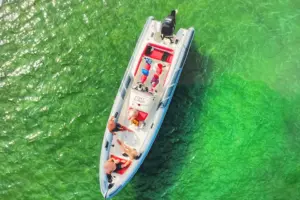
Rigid inflatable boats like the Peaky Blinder are exceptionally popular within the recreational and commercial sectors due to their speed, maneuverability, and buoyancy. Capable of high-speed transits and sharp turns, RIBs demand a high degree of seamanship, precision handling, and rigorous adherence to local bylaws and collision regulations (COLREGs).

The August 14, 2025 Incident
While specific split-second tactical movements of the Peaky Blinder prior to impact are detailed in the primary marine accident investigation report, the fatal outcome is starkly defined: the vessel violently allided with a fixed navigation beacon situated within the harbour.
An allision—the striking of a stationary object by a moving vessel—is particularly destructive at high speeds. Unlike collisions between two moving vessels, where kinetic energy is partially dissipated through mutual movement, striking a rigid, immovable navigational mark transfers the entirety of a vessel’s kinetic energy into the hull, its occupants, and the structure itself in a fraction of a second.
The force of the impact with the Portsmouth Harbour beacon catastrophic. The sudden deceleration threw occupants violently within and potentially out of the vessel. The severity of the trauma sustained during the impact, compounded by the immediate aquatic environment, resulted in the tragic fatalities of two individuals on board. Emergency response vessels and local harbour authorities rushed to the scene, but the speed and violence of the event left little window for intervention.
Immediate Aftermath and Investigation Launch
In the wake of the tragedy, the Marine Accident Investigation Branch (MAIB) immediately launched a rigorous statutory investigation to determine the exact sequence of events, human factors, environmental conditions, and mechanical states that led to the allision.
Investigators analyzed radar tracks, communication logs, witness statements, and the physical damage sustained by both the Peaky Blinder and the navigation beacon. The goal of this meticulous process was not to apportion blame, but to uncover systemic vulnerabilities and operational failures that could be addressed to prevent similar tragedies in the future. The publication of the primary investigation report, accompanied by the targeted safety flyer, marks the culmination of this exhaustive inquiry.
Supporting Context & Metrics
The Physics of High-Speed RIB Accidents
To fully understand the Peaky Blinder tragedy, one must examine the unique biomechanics of high-speed craft (HSC) operations. RIBs are engineered to plane across the water surface, generating high velocities that can easily exceed 30 to 40 knots. At these speeds, the human body is subjected to significant G-forces during turning, wave-slamming, and—worst of all—sudden deceleration.
When a vessel traveling at speed hits a stationary object:
- The Deceleration Curve: The vessel stops almost instantaneously, while unsecured occupants continue moving forward at the vessel’s original speed due to inertia (Newton’s First Law of Motion).
- Secondary Impact: Occupants collide with the vessel’s console, seating structures, gunwales, or each other, frequently sustaining severe blunt-force trauma to the head, chest, and limbs.
- Ejection and Immersion: Unsecured individuals are frequently thrown clear of the vessel into the water, often rendered unconscious or semi-conscious upon impact, severely compromising their ability to stay afloat or breathe.
Personal Flotation Devices (PFDs): The Statistical Lifeline
The core message of the MAIB safety flyer centers on an immutable maritime truth: lifejackets save lives, but only when they are worn.
According to historical marine safety data compiled across international maritime jurisdictions:
- The "Surprise" Factor: The vast majority of fatal recreational boating accidents happen suddenly and unexpectedly. Victims rarely have the time or physical capability to retrieve a stowed lifejacket from a locker, under a seat, or in a forward compartment once an emergency is underway.
- Cold Water Shock: Even in the summer months, UK coastal waters retain temperatures capable of inducing cold water shock within minutes. Cold water shock triggers an involuntary gasp reflex, hyperventilation, panic, and rapid loss of motor control. Without a properly fitted PFD or lifejacket keeping the airway clear above the water line, drowning can occur within 60 to 90 seconds—long before hypothermia sets in.
- Unconscious Survival: A modern, properly fitted automatic lifejacket is designed to roll an unconscious person onto their back, keeping their mouth and nose clear of the water. Without this mechanical assistance, an unconscious victim floating face-down will drown within minutes, regardless of swimming ability.
Despite these overwhelming statistics, compliance rates regarding continuous lifejacket wear within the recreational boating community remain stubbornly inconsistent. While commercial operators are heavily regulated and routinely audited under safety management systems, leisure boaters often rely on an informal culture of "it won’t happen to me," viewing lifejackets as cumbersome or unnecessary during benign weather conditions.
Official Statements and Safety Lessons
The safety flyer released alongside the Peaky Blinder investigation report is designed for wide dissemination across yacht clubs, training centers, marinas, and digital platforms. It translates complex investigative findings into direct, actionable guidance for the recreational boating community.
Key Safety Considerations Outlined by Investigators
- Mandatory Continuous Wear Policy: Boaters are strongly urged to establish a zero-tolerance personal culture regarding lifejackets. PFDs should be worn from the moment stepping aboard until stepping back onto the dock, regardless of weather, water temperature, or perceived skill level.
- Equipment Maintenance and Familiarization: Owning a lifejacket is insufficient; owners must inspect them regularly. Automatic inflation mechanisms rely on gas cylinders and firing heads (such as Hammar or Halkey-Roberts systems) that have strict expiration dates and require annual checks. Furthermore, users must ensure lifejackets fit securely and are equipped with crotch straps to prevent the device from riding up over the head upon water entry.
- Passage Planning and Local Hazard Awareness: Operating within complex marine environments like Portsmouth Harbour requires meticulous pre-passage planning. Skippers must familiarize themselves with local navigation marks, commercial shipping lanes, tidal constraints, and speed limits.
- Vessel Handling and Lookout Management: High-speed craft demand undivided attention. Distractions, fatigue, or complacency can blind a skipper to stationary hazards. Effective lookout management—often involving a dedicated crew member scanning ahead—is vital when operating in congested coastal waters.
- Emergency Preparedness: Every person on board must be briefed on emergency procedures, including how to use maritime radios (VHF), activate distress beacons (EPIRBs/PLBs), and deploy man-overboard recovery equipment.
Regulatory and Industry Response
Maritime safety bodies and harbour authorities across the United Kingdom are utilizing the Peaky Blinder report to reinforce existing safety campaigns. The Maritime and Coastguard Agency (MCA) and the Royal National Lifeboat Institution (RNLI) continue to advocate for enhanced education rather than immediate heavy-handed legislation for the leisure sector, relying instead on cultural transformation, peer-to-peer influence, and mandatory safety messaging at point-of-sale and marina facilities.
However, critics and safety experts increasingly argue that voluntary compliance has reached its limits. Calls for stricter accountability for skippers of high-speed recreational craft—including formal certification requirements and mandatory safety equipment carriage—are gaining traction within maritime policy circles.
Future Outlook
The tragedy of the Peaky Blinder in Portsmouth Harbour must serve as a watershed moment for the recreational boating community. While the allure of high-speed water sports and leisure navigation is undeniable, the inherent dangers of the marine environment demand a commensurate level of respect, preparation, and caution.
Moving Toward a Culture of Safety
Transforming the safety culture within leisure boating requires a multi-pronged approach:
- Education and Training: Expanding affordable, accessible powerboat handling and safety courses that emphasize risk assessment, navigation rules, and high-speed vessel dynamics.
- Technological Integration: Encouraging the adoption of engine kill-cord mandates, modern chartplotters with integrated hazard warnings, and wearable personal locator beacons (PLBs).
- Community Advocacy: Empowering yacht clubs, boating associations, and influencers within the marine community to model safe behaviors—principally, the non-negotiable wearing of lifejackets.
As the maritime sector reflects on the findings of the Peaky Blinder investigation report and distributes the accompanying safety flyer, the ultimate measure of this tragedy’s impact will be found in future outcomes. By honoring the memory of those lost through rigorous adherence to safety lessons, the recreational boating community can strive toward a future where every voyage ends safely at the dock.
For access to the full investigation report and printable PDF versions of the safety flyer, stakeholders and members of the public are encouraged to consult official government marine safety publication channels.