




By Special Correspondent
Published: September 3, 2026
Executive Overview
For decades, the narrative surrounding industrial automation has been dominated by a singular, persistent anxiety: the total erasure of the human worker. In the maritime sector, this vision has long been symbolized by the "ghost ship"—fully autonomous, uncrewed vessels navigating the high seas entirely detached from human oversight. However, as remote and autonomous technologies transition from experimental prototypes to commercial realities, a far more nuanced paradigm is emerging.
According to Carsten Haagensen, President of Data Services at Ocean Infinity, the fundamental objective of marine autonomy is not the wholesale elimination of human personnel, but rather a profound structural migration. The industry is witnessing a transition from vessel-centered operations to shore-enabled operations.
In this redefined landscape, "uncrewed" does not mean "unattended." Instead, control is being redistributed rather than removed. By moving the operational hub from the physical vessel to highly connected land-based facilities, maritime technology developers are rewriting the rules of safety, efficiency, and workforce sustainability.
This investigative report examines how this transition is being executed in real-world environments—from coastal surveillance in the Middle East to deep-water energy surveys in the Atlantic—and explores the systemic shifts in risk management, operational persistence, and human-machine collaboration that are reshaping the global maritime economy.
Detailed Chronology: The Evolution of Marine Autonomy
The journey toward shore-enabled operations has not been a sudden revolution, but a calculated, multi-stage evolution. To understand how the maritime industry arrived at this inflection point in late 2026, it is necessary to trace the operational shifts over the past decade.
+-----------------------------------------------------------------------------+
|                        THE EVOLUTIONARY TIMELINE                            |
+-----------------------------------------------------------------------------+
|                                                                             |
|  [PHASE 1: Traditional Crewed]                                              |
|  - All personnel, specialists, and decision-makers must be offshore.        |
|  - High operational risk, high carbon footprint, episodic missions.         |
|                                                                             |
|                                     v                                       |
|                                                                             |
|  [PHASE 2: Lean-Crewed & Hybrid]                                            |
|  - Integration of basic remote payload monitoring and satellite telemetry.  |
|  - Key specialists begin shifting to shore; core crew remains on vessel.    |
|                                                                             |
|                                     v                                       |
|  [PHASE 3: Shore-Enabled & Distributed]                                     |
|  - Remote Operations Centres (ROCs) act as the central operational hub.     |
|  - Real-time data loops connect multi-asset fleets to global specialists.   |
|  - Shift from episodic, vessel-centric tasks to continuous operations.      |
+-----------------------------------------------------------------------------+
Phase 1: The Vessel-Centric Era (Pre-2018)
Historically, marine operations were entirely defined by physical presence. Whether conducting hydrographic surveys, managing defense patrols, or performing subsea maintenance, the vessel was the absolute center of gravity. Decisions were made on the bridge; data was processed in onboard server racks; and specialized personnel—from geophysicists to marine mammal observers—had to be physically transported to the asset. This model carried inherent limitations:
- Human Endurance: Mission lengths were strictly capped by crew fatigue, food and water provisions, and regulatory limits on offshore rotations.
- Logistical Friction: Mobilizing large offshore crews required complex helicopter transfers, vessel port calls, and extensive safety certifications.
- Safety Exposure: Personnel were constantly exposed to the hazardous dynamics of frontline marine environments.
Phase 2: The Proof-of-Concept and Hybrid Era (2018–2023)
The introduction of high-bandwidth satellite networks, such as low-Earth orbit (LEO) satellite constellations, initiated a shift. Early pioneers, including Ocean Infinity, began experimenting with uncrewed surface vessels (USVs) and remote payload controls.
During this phase, the industry focused heavily on proving that a vessel could be safely steered from thousands of miles away. However, these early deployments were largely hybrid. While some technical specialists were successfully moved to shore, the operations still relied on conventional "mother ships" acting as localized command centers, keeping the physical vessel at the center of the operational loop.
Phase 3: The Shore-Enabled, Distributed Era (2024–2026)
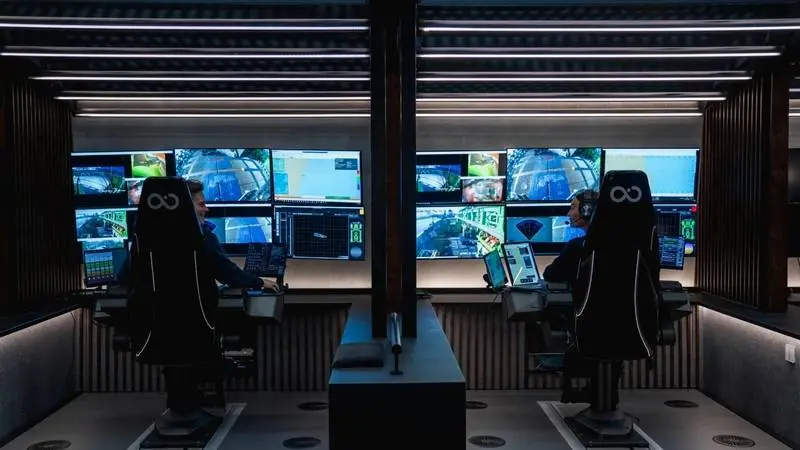
By 2026, the paradigm matured into a fully distributed model. The physical vessel has been decentralized. Control, data processing, and decision-making are now consolidated within Remote Operations Centres (ROCs).
Today, Ocean Infinity’s operations demonstrate this mature state. In coastal surveillance frameworks deployed across the Middle East, multiple uncrewed assets operate simultaneously under the oversight of a single, land-based control facility. Similarly, in the offshore energy sector, deep-water survey tasks—such as remote ocean bottom node (OBN) deployment and payload control—are managed by shore-based operators, signaling the complete decoupling of human expertise from physical offshore presence.
Supporting Context & Metrics: The Mechanics of the Distributed Model
To appreciate the scale of this shift, one must analyze the operational, safety, and logistical metrics that distinguish shore-enabled operations from legacy marine workflows.
+-----------------------------------------------------------------------------+
|                 OPERATIONAL METRIC COMPARISON MATRIX                        |
+-----------------------------------------------------------------------------+
| Metric / Parameter     | Traditional Crewed Vessel | Shore-Enabled USV Fleet|
+------------------------+---------------------------+------------------------+
| Personnel Offshore     | 30 to 100+ specialists    | 0 to minimal (lean)    |
| Mission Continuity     | Episodic (crew-limited)   | Persistent / Continuous|
| Data Processing Latency| Days to Weeks (post-port) | Near Real-Time (via ROC|
| HSEQ Exposure Level    | High (Physical Sea Risks) | Low (Onshore Office)   |
| Carbon Footprint       | 100% Baseline             | Reduced by up to 90%   |
+-----------------------------------------------------------------------------+
Redefining HSEQ (Health, Safety, Environment, and Quality)
The most compelling argument for the shore-enabled model lies in its impact on human safety. Traditional maritime operations expose crews to severe risks, including extreme weather, mechanical failures, and hazardous offshore transfers.
By transitioning specialists from the ocean to land-based ROCs, the exposure profile drops dramatically:
- Zero-Exposure Offshore Environments: Removing personnel from the physical vessel eliminates the risks associated with heavy sea states, onboard fires, and toxic gas exposure.
- Fatigue Mitigation: Onshore surveyors and operators work structured, predictable shift patterns. They return home to their families at the end of their shifts, bypassing the psychological strain and sleep disruption common to multi-week offshore deployments.
- Instantaneous Expert Access: In a traditional setup, if a complex technical issue occurs at sea, the vessel must either wait for a specialist to be flown out or rely on remote, low-bandwidth troubleshooting. In a shore-enabled model, subject matter experts, procedure owners, and client representatives can be integrated into the live operations loop instantly via secure, high-speed digital networks.
The Dynamics of Persistent Operations
A conventional crewed vessel is fundamentally episodic: it is deployed to a location, completes a task within the limits of its provisions, and returns to port. Remote and uncrewed systems break this cycle.
Without the constraints of crew endurance, USVs can remain on station for extended periods, maintaining continuous data acquisition and surveillance.
This persistence changes how scale is achieved. In the legacy model, scaling an operation required deploying more ships and hiring more offshore crew members. In the shore-enabled model, scale is achieved by optimizing the ratio of human operators to active digital assets.
Because routine tasks like pathkeeping and basic system monitoring are automated, a small, highly trained onshore team can supervise multiple vessels simultaneously, stepping in only when strategic intervention or complex decision-making is required.
                     +----------------------------+
                     |   Remote Operations Center |
                     |           (ROC)            |
                     +--------------+-------------+
                                    |
            +-----------------------+-----------------------+
            |                       |                       |
            v                       v                       v
    +---------------+       +---------------+       +---------------+
    | USV Asset A   |       | USV Asset B   |       | USV Asset C   |
    | (Surveillance)|       | (Hydrographic)|       | (OBN Survey)  |
    +---------------+       +---------------+       +---------------+
Official Statements: Perspectives from the Leadership
The transition to shore-enabled operations demands a fundamental shift in how the maritime industry views human expertise and operational resilience. Carsten Haagensen, President of Data Services at Ocean Infinity, emphasizes that the industry must move past the simplistic narrative of automation as a replacement tool.
"Autonomy is often described as removing people from operations. That’s not quite right," Haagensen states. "It’s not a case of people ‘simply’ being replaced by machines. It’s about the move from vessel-centered operations to shore-enabled operations. People still matter, but their roles, locations and relationships with the operation change fundamentally. Uncrewed doesn’t mean unattended."
Haagensen argues that the shift actually elevates the value of human intellect by stripping away the mundane, repetitive tasks that historically consumed an offshore specialist’s day.
"Control is redistributed, not removed. By taking on the repetitive and perhaps mundane tasks, technology gives people more capacity to focus on the work that genuinely requires their expertise, operational judgement, problem solving and technical oversight."
However, Haagensen is quick to point out that this model introduces its own set of rigorous demands. Moving humans away from the physical asset means that the engineering, communications, and data structures supporting them must be exceptionally robust.
"Systems must be more resilient because immediate physical intervention is not always possible. Recovery processes must be designed in advance, communications must be robust, and decisions must be made from integrated data rather than direct observation. In many ways, this is not a simpler way of working. It is a more demanding one… The further people are moved from the asset physically, the more important the structure around the operation becomes."
Ultimately, Haagensen views this evolution as an entirely new operational philosophy rather than a mere cost-saving measure:
"Keeping people in the loop is not a sign that the approach has fallen short. It is part of what makes it robust and fit for purpose… Operating without people at sea isn’t the destination. It is one expression of a broader shift towards an entirely new way of working: more resilient, distributed and shore-enabled."
Future Outlook: The Next Decade of Maritime Industry Operations
As the maritime industry looks toward the 2030s, the widespread adoption of shore-enabled models will likely trigger profound transformations across several key areas.
The Evolution of the Maritime Workforce
The profile of the maritime professional is undergoing a rapid transition. Future mariners, hydrographers, and marine engineers will need to be as proficient in data science, network diagnostics, and human-machine interface (HMI) protocols as they are in traditional seamanship.
Maritime academies are already beginning to adapt, offering curricula that balance classic navigation with remote-control operations and autonomous system oversight.
This shift also democratizes the maritime profession. By transitioning the primary working environment from offshore vessels to onshore ROCs, the industry can attract a more diverse talent pool—including individuals who may be unable or unwilling to endure months-long deployments at sea due to physical limitations or family commitments.
The Regulatory Landscape and the IMO MASS Code
The widespread commercialization of uncrewed and shore-enabled operations hinges on the evolution of international regulatory frameworks. The International Maritime Organization (IMO) is actively developing the Maritime Autonomous Surface Ships (MASS) Code, which aims to establish global safety, training, and operational standards for autonomous vessels.
The core challenge for regulators is defining accountability and safe manning requirements when a vessel’s master and crew are located in an onshore ROC.
The industry’s success in demonstrating that remote supervision can meet or exceed the safety standards of traditional crewed vessels will dictate the speed at which these regulations are formally codified.
AI Integration and Decision Support
Over the next decade, artificial intelligence and machine learning will play an increasingly vital role in shore-enabled operations. Rather than replacing human operators, AI will serve as a powerful decision-support tool.
In complex environments, such as busy shipping lanes or hazardous weather zones, predictive AI models will analyze real-time telemetry from thousands of sensors, highlighting potential risks before they materialize.
The onshore operator’s role will shift from active steering to high-level strategic management, overseeing intelligent, self-navigating systems and intervening only when anomalous scenarios require human judgment.
A New Standard of Operational Resilience
Ultimately, the transition to shore-enabled operations is redefining the concept of maritime resilience. By linking systems, data, and human expertise in a continuous loop unconstrained by distance or time, the industry is building an ecosystem capable of operating with unprecedented flexibility.
The success of this model will not be judged by how independently a machine can operate in isolation, but by how seamlessly humans, automated systems, and real-time data networks can work together to deliver safe, sustainable, and reliable outcomes at sea.