








Executive Overview
As the 2026–2027 academic year begins, millions of students returning to classrooms across the United States are stepping onto campuses that increasingly double as localized clean energy power plants. No longer confined to the fringe of institutional planning, solar photovoltaic (PV) arrays and battery energy storage systems (BESS) have officially entered the mainstream of educational infrastructure. According to data compiled by Generation 180, more than 7 million K-12 students—roughly one in every seven learners nationwide—now attend a solar-powered school.
For cash-strapped educational institutions navigating the lingering impacts of inflation, volatile fossil fuel markets, and rising operational costs, solar energy presents a compelling, common-sense financial strategy. By locking in predictable, long-term electricity rates through rooftop installations, ground mounts, and carport canopies, school districts and universities are redirecting millions of dollars away from utility companies and back into classrooms, teacher salaries, and student support services.
To mark the start of the new school year, the Solar Energy Industries Association (SEIA) has highlighted six diverse educational institutions—spanning from small-town elementary schools to massive multi-campus university systems—that are successfully transitioning to clean energy. This report examines how these campuses are reaping deep financial savings, enhancing campus resilience through energy storage, and using their clean energy transformations as living laboratories for the next generation of students.

Detailed Chronology: Six Institutions Leading the Clean Energy Transition
The integration of renewable energy into academic infrastructure is accelerating at an unprecedented pace. The following six case studies, highlighted by SEIA, illustrate the wide range of scales, financial models, and operational benefits driving this nationwide shift.
1. Andover Elementary School (Andover, Connecticut): Stabilizing Costs Through Innovative Partnerships
Smaller rural and suburban school districts often face significant hurdles when attempting to adopt capital-intensive clean energy technologies. Recognizing the need to improve environmental sustainability and energy efficiency without straining municipal taxpayers, Andover Elementary School in Connecticut successfully installed a rooftop solar system.
By structuring the project in collaboration with specialized clean energy partner companies, the school bypassed prohibitive upfront capital expenses, allowing the district to realize immediate benefits from solar generation. Local officials and district leadership view the installation not merely as a cost-cutting measure, but as a catalyst for broader environmental stewardship. The project serves as a tangible demonstration to students, faculty, and the wider Andover community of how financially responsible, long-term investments can yield enduring economic and ecological value.
2. Benjamin A. Friedman Middle School (Taunton, Massachusetts): Securing a Million-Dollar Lifeline
In Taunton, Massachusetts, the Benjamin A. Friedman Middle School has become the second educational facility in the district—following Chamberlain Elementary School—to harness the power of rooftop solar. The installation is projected to deliver approximately $35,000 annually in combined energy savings and localized incentives. Over the projected 20-to-25-year lifespan of the photovoltaic system, the school estimates a cumulative financial benefit exceeding $1 million.

Beyond the immediate fiscal relief, Friedman Middle School is actively integrating the solar array into its academic curriculum. Educators are utilizing the operating system as a real-world educational tool, giving students firsthand insight into how photovoltaic technology functions, how energy loads are balanced, and how communities can systematically reduce their carbon footprints.

3. McHenry High School (McHenry, Illinois): Slicing Operational Energy Costs by 30%
In northern Illinois, both campuses of McHenry High School are undergoing a major infrastructural upgrade designed to dramatically curb utility overhead. Set for full completion by December 2026, the installation features more than 2,000 solar panels strategically placed across the high school’s expansive rooftops.
According to Superintendent Dr. Ryan McTague, the massive array is anticipated to cut the district’s grid energy consumption and utility expenditures by a remarkable 30%. "We are setting a great example to students and to taxpayers while also saving money," McTague noted, emphasizing that the financial returns generated by the project will be reinvested directly back into the school community to enrich student programs.
4. Harlem Consolidated School District (Machesney Park, Illinois): Turning Land into Long-Term Scholarships
Innovative thinking regarding underutilized school assets is unlocking entirely new revenue streams for districts across the country. In Machesney Park, Illinois, the Harlem Consolidated School District took an unconventional approach by leasing surplus district land to commercial solar developer New Energy Equity.
The partnership resulted in the development of a substantial 5.5-megawatt community solar project. Rather than merely collecting a standard land lease fee, the district negotiated a landmark agreement that directly benefits its student body: New Energy Equity is funding $10,000 in dedicated student scholarships every single year for the entire 25-year duration of the lease. This creative deployment of real estate bridges the gap between clean energy development and direct, life-changing financial aid for graduating seniors.
5. Sonoma State University (Sonoma County, California): Achieving Parking Lot Shade and Grid Resilience
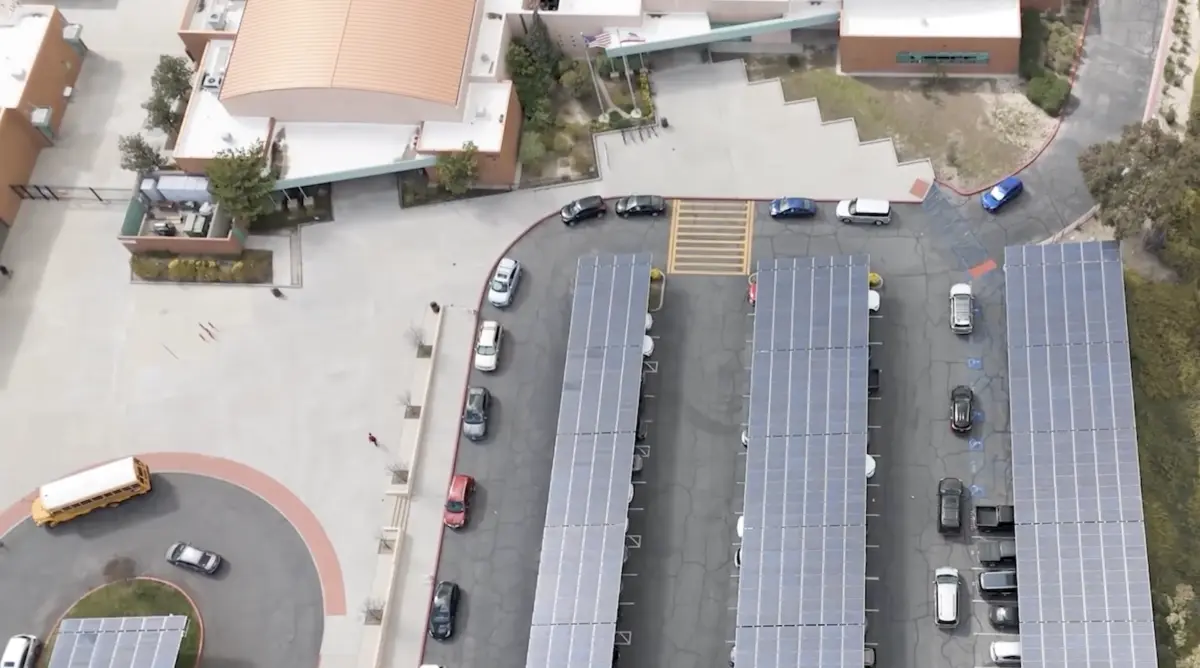
At the collegiate level, institutions are looking at holistic campus designs that address both energy generation and extreme weather adaptation. Sonoma State University in California has tackled its energy challenges by outfitting five campus parking lots with extensive solar canopy arrays.
These installations serve a dual purpose: they generate substantial clean electricity while providing much-needed shade that keeps students’, staff members’, and visitors’ vehicles cool during punishing midday heatwaves. Furthermore, the university paired its solar deployment with advanced onsite battery energy storage systems (BESS). This critical integration ensures that Sonoma State maintains uninterrupted access to power, safeguarding campus operations and critical research facilities even during rolling blackouts or regional grid failures.
6. University of Arkansas (Fayetteville, Arkansas): Pioneering a Statewide Energy Transformation
At the top of the scale, flagship research universities are executing mega-projects capable of reshaping entire regional energy landscapes. This spring, the University of Arkansas completed a major solar array at its primary campus in Fayetteville, marking a milestone in a sweeping, system-wide clean energy initiative.
With three additional campus sites scheduled to come online, the collective solar fleet is projected to save the University of Arkansas system over $100 million over 25 years. Upon final completion, this multi-site deployment will stand as the largest operational solar project in the entire state of Arkansas. Eric Boles, the university’s director of sustainability, highlighted the strategic importance of the endeavor: "It saves the university money, and that frees up resources for our core mission [of education and research]."

Supporting Context & Metrics: The Macroeconomics of Solar Schools
The individual success stories at Andover, Friedman, McHenry, Harlem, Sonoma State, and the University of Arkansas are part of a broader, nationwide economic movement. Across the United States, educational facilities represent some of the largest municipal and institutional real estate holders, characterized by massive, unshaded rooftops and expansive parking lots—making them prime candidates for solar integration.
State-Level Impact Studies
Rigorous economic analyses underscore the vast untapped potential remaining in the educational sector:
- Pennsylvania: A comprehensive study investigating statewide educational infrastructure found that if schools across Pennsylvania installed rooftop solar systems to their maximum viable capacity, the state’s K-12 districts could collectively save up to $342 million in utility expenditures.
- North Carolina: Similarly, research focusing on North Carolina’s school rooftops revealed that widespread adoption of solar power could generate enough annual clean electricity to power approximately 150,000 average American homes.
- National Scale: According to SEIA and market analysts, the convergence of federal incentives—including provisions from the federal clean energy transition laws allowing tax-exempt entities like schools and local governments to access direct pay incentives (equivalent to tax credits)—has lowered the barrier to entry lower than at any point in history.
Official Statements and Institutional Perspectives
The rapid pivot toward renewable energy within the education sector is driven by a shared alignment of fiscal responsibility, educational philosophy, and environmental urgency.
School superintendents, university sustainability directors, and energy policy experts increasingly view solar installations not as optional environmental add-ons, but as core components of fiscal management. As Superintendent Ryan McTague of McHenry High School observed, the ability to slash operating costs by nearly a third while simultaneously providing students with a living textbook is an unbeatable value proposition for local taxpayers.
At the university level, leaders like Eric Boles of the University of Arkansas emphasize the liberation of institutional capital. By neutralizing millions of dollars in volatile utility overhead over a 25-year horizon, universities can insulate their operating budgets from unpredictable fossil fuel price spikes, channeling those vital funds directly into academic instruction, faculty retention, and student financial aid.
Future Outlook: The Next Generation of Living Laboratories
As the 2026–2027 school year gets underway, the trajectory of clean energy in education points toward universal integration. The convergence of plummeting hardware costs, robust battery storage technology, direct-pay federal incentives, and creative financing mechanisms—such as power purchase agreements (PPAs) and community solar land leases—ensures that financial barriers will continue to shrink.
Looking forward, the educational solar movement is poised to expand beyond mere cost savings and carbon reduction. Schools are increasingly conceptualizing their microgrids, solar canopies, and battery storage arrays as "living laboratories." Students in STEM disciplines—spanning engineering, environmental science, data analytics, and public policy—are utilizing real-time campus energy production data to study grid dynamics, climate science, and sustainable economics.
By transforming their physical campuses into beacons of clean technology, educational institutions are not only safeguarding their financial futures against economic uncertainty; they are actively preparing millions of students to lead a decarbonized, resilient world.