





Executive Overview
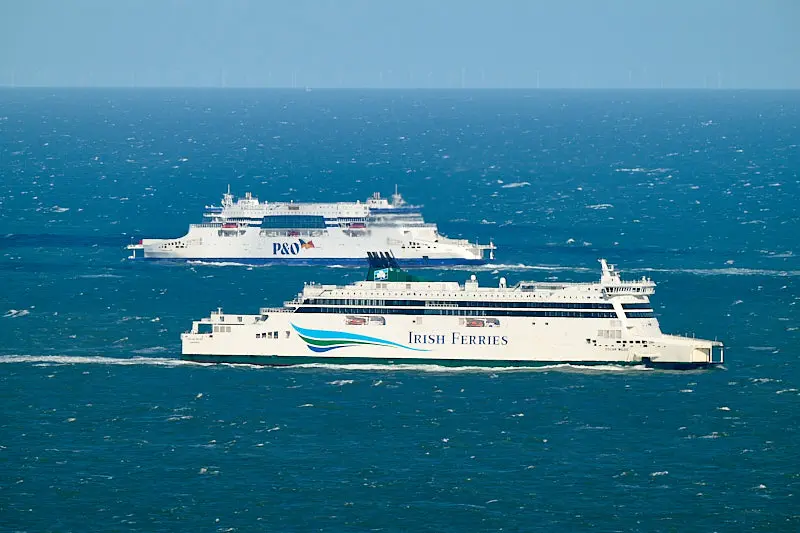
In a development that threatens to reshape the commercial dynamics of the English Channel’s busiest shipping corridor, P&O Ferries has formally served notice to terminate its space charter agreement with Irish Ferries on the Dover–Calais route. The strategic rift was publicly revealed in the Half-Year 2026 financial report published by Irish Ferries’ parent company, Irish Continental Group plc (ICG).
The announcement marks a critical juncture for cross-Channel maritime logistics. The space charter agreement, which allowed both operators to optimize vessel capacity and offer commercial freight customers a high-frequency "turn-up-and-go" departure schedule, served as a key buffer against port congestion and operational volatility on the Short Straits. With P&O Ferries initiating the dissolution of this alliance, the Dover–Calais corridor faces a return to fragmented operational structures at a time when European supply chains are already grappling with heightened regulatory scrutiny and evolving border control frameworks.
       +-----------------------------------------------------------+
       |                  DOVER–CALAIS CORRIDOR                    |
       |  High-density Ro-Ro Freight & Passenger Logistics Gateway  |
       +-----------------------------+-----------------------------+
                                     |
             +-----------------------+-----------------------+
             |                                               |
             v                                               v
   +-------------------+                           +-------------------+
   |    P&O FERRIES    |                           |   IRISH FERRIES   |
   | (DP World Group)  |                           |    (ICG Group)    |
   +---------+---------+                           +---------+---------+
             |                                               |
             +-----------------------+-----------------------+
                                     |
                                     v
                       +---------------------------+
                       |   SPACE CHARTER AGREEMENT |
                       |    (Notice to Terminate)  |
                       +-------------+-------------+
                                     |
             +-----------------------+-----------------------+
             |                                               |
             v                                               v
   +-------------------+                           +-------------------+
   | Operational Risk  |                           |  Strategic Review |
   |  Freight Friction |                           |   Option Eval.    |
   +-------------------+                           +-------------------+
ICG stated in its H1 2026 report that it is currently evaluating all strategic, legal, and operational options in response to the termination notice. However, neither party has publicly disclosed the precise effective date of the termination or the detailed transition mechanics, leaving logistics operators, haulage federations, and port authorities preparing for potential market realignments.
Detailed Chronology
The Arrival of Irish Ferries on the Short Straits (2021)
For decades, the Dover–Calais short-sea corridor was dominated by a traditional duopoly of maritime operators—P&O Ferries and DFDS Seaways—alongside the fixed-link rail operator Eurotunnel (Getlink). This status quo was dramatically altered in June 2021 when Irish Continental Group expanded outside its core Irish Sea routes to launch a standalone Irish Ferries service on the Short Straits.
Seeking to offset post-Brexit trade disruptions that saw direct Ireland–Mainland Europe sea routes gain market share at the expense of the traditional UK "Landbridge," ICG deployed the Isle of Inishmore to Dover. This was subsequently bolstered by the deployment of additional roll-on/roll-off (Ro-Ro) passenger and freight vessels, including the Isle of Innisfree and Isle of Inisheer. The expansion established Irish Ferries as a permanent third operator on the Short Straits, introducing price competition and additional deck space into the cross-Channel ecosystem.
Forging the Space Charter Accord
While competition initially intensified, operational realities on the Short Straits highlighted the necessity of schedule flexibility. To compete more effectively against Getlink’s high-frequency Eurotunnel Shuttle service, P&O Ferries and Irish Ferries subsequently established a mutual space charter agreement.
Under this framework, commercial freight drivers holding a ticket with either P&O Ferries or Irish Ferries could be loaded onto the next available departing vessel of either operator at Dover or Calais. This cooperative operational arrangement significantly reduced driver dwell times at port terminals, maximized vessel load factors, stabilized fuel consumption profiles through optimized sailing schedules, and provided a operational buffer during adverse weather conditions or technical disruptions.
+-----------------------------------------------------------------------------------+
|                            SPACE CHARTER MECHANICS                                |
+-----------------------------------------------------------------------------------+
|  [Freight Driver / Haulier]                                                       |
|            |                                                                      |
|            v                                                                      |
|  Arrives at Port Terminal (Dover or Calais)                                       |
|            |                                                                      |
|            +-------------------------------+----------------------------------+   |
|            |                               |                                  |   |
|            v                               v                                  v   |
|   P&O Ferries Booking             Shared Space Charter               Irish Ferries Booking
|            |                        Capacity Pool                             |   |
|            +-------------------------------+----------------------------------+   |
|                                            |                                      |
|                                            v                                      |
|                             Assigned to Next Available Deck                       |
|                             (Maximizes Capacity & Flow)                           |
+-----------------------------------------------------------------------------------+
The H1 2026 Disclosure and Notice of Termination
The equilibrium maintained by the space charter was formally interrupted in late summer 2026. Within the official release of its Half-Year 2026 interim financial report, Irish Continental Group included a brief disclosure confirming that P&O Ferries had served formal notice to end the space charter agreement.
The report noted:
- Issuer of Notice: P&O Ferries (a subsidiary of Dubai-based DP World).
- Target Entity: Irish Ferries (a subsidiary of Irish Continental Group plc).
- Subject: Space Charter Agreement on the Dover–Calais short-sea route.
- Status: Notice received; ICG currently evaluating operational, commercial, and legal options.
- Omissions: No precise termination date, transition timeline, or specific operational triggers were detailed within the financial filing.
Supporting Context & Metrics
The Economics of the Dover–Calais Corridor
The Dover–Calais route remains one of the world’s most densely traveled maritime freight arteries. Moving millions of Roll-on/Roll-off (Ro-Ro) freight units and millions of passengers annually, the route serves as the primary physical bridge for just-in-time supply chains connecting the United Kingdom with mainland Europe.
+-----------------------------------------------------------------------------------+
|                      DOVER–CALAIS ESTIMATED ANNUAL CAPACITY                       |
+-----------------------------------------------------------------------------------+
| Operator               Fleet Deployment (Short Straits)     Primary Market Focus  |
+-----------------------------------------------------------------------------------+
| P&O Ferries            Multiple Ro-Pax Vessels              Freight & Passenger   |
| DFDS Seaways           Multiple Ro-Pax/Ro-Ro Vessels        Freight & Passenger   |
| Irish Ferries          Multiple Ro-Pax Vessels              Freight & Passenger   |
| Getlink (Eurotunnel)   Fixed Link Rail Shuttles             High-Speed Freight/Pax|
+-----------------------------------------------------------------------------------+
For freight hauliers, schedule density is paramount. The primary commercial value of the space charter lay in its capacity to deliver high departure frequencies without requiring a single carrier to operate an inefficiently large fleet. By pooling capacity, P&O Ferries and Irish Ferries created a joint schedule that rivaled the turnaround speeds offered by Eurotunnel and DFDS.
Operational Impact of Agreement Termination
The dissolution of the space charter impacts several core operational metrics across the Short Straits ecosystem:
- Vessel Utilization Rates (Load Factors): Without mutual space sharing, both P&O Ferries and Irish Ferries must rely exclusively on their own booking pipelines to fill vehicle decks. This risks lowering average capacity utilization per sailing, particularly during off-peak windows.
- Port Gate Congestion and Terminal Dwell Times: Under the charter, freight vehicles were routed to the nearest departing vessel regardless of hull operator. The termination of mutual clearance will require stricter sorting of vehicles at port check-in gates, potentially increasing terminal queues at the Port of Dover (Eastern Docks) and the Port of Calais.
- Bunkering Efficiency and Emissions Profiles: Uncoordinated sailings operating at sub-optimal utilization can lead to higher fuel consumption per transported freight unit, impacting corporate scope 1 emissions targets and operational expenditure under the EU Emissions Trading System (EU ETS) for maritime transport.
+-----------------------------------------------------------------------------------+
|                      POST-TERMINATION RISK MATRIX                                 |
+-----------------------------------------------------------------------------------+
| Metric                      With Space Charter          Post-Termination Impact   |
+-----------------------------------------------------------------------------------+
| Departure Flexibility       High ("Turn-up-and-go")     Restricted to booked line |
| Average Vessel Fill Rate    Optimized via shared decks  Risk of sub-optimal loads |
| Port Dwell Times            Minimized                   Potential Gate Queues     |
| Price Competition           Stabilized                  Potential Price Volatility|
+-----------------------------------------------------------------------------------+
The Broader Trade Landscape: Landbridge vs. Direct Routes
The timing of the termination notice coincides with structural shifts in European freight flows. Following the UK’s departure from the European Union, a portion of maritime freight originating in Ireland transitioned away from the UK Landbridge (transit via Great Britain) in favor of direct maritime routes operating between Irish ports (such as Dublin and Rosslare) and continental ports (such as Cherbourg, Zeebrugge, and Rotterdam).
Despite these direct alternative routes, the Dover–Calais short-sea corridor remains essential due to its short transit duration (approximately 90 minutes). Consequently, strategic positioning on this route remains crucial for both ICG and DP World.
Official Statements & Corporate Positions
Irish Continental Group (ICG)
In its formal interim communication to shareholders within the H1 2026 report, Irish Continental Group stated:
"P&O Ferries has served notice to terminate the space charter agreement with Irish Ferries on the Dover–Calais route. ICG is currently evaluating its options."
The statement underscores a deliberate, measured posture by ICG leadership as the group assesses its strategic options. Retaining a resilient presence on the Dover–Calais route remains vital for ICG’s long-term revenue diversification strategies, which historically depended heavily on the Irish Sea corridors (Dublin–Holyhead and Rosslare–Pembroke).
P&O Ferries and DP World
P&O Ferries and its ultimate parent entity, Dubai-based DP World, have maintained a tight operational silence regarding the underlying motivations for issuing the termination notice. Industry analysts point to several potential strategic drivers behind DP World’s move:
- Commercial Autonomy: P&O Ferries may seek to reclaim total independent control over its commercial pricing, yield management strategies, and vessel departure slots.
- Fleet Rationalization: DP World may be looking to reconfigure its own Short Straits fleet deployments, operational cost structures, or digital booking infrastructure without being bound by charter obligations to a direct competitor.
- Competitive Squeeze: By severing the charter framework, P&O Ferries could be attempting to leverage its larger vessel scale to place operational pressure on Irish Ferries, forcing the relative newcomer to bear higher independent operating overheads to match schedule frequency.
Logistics Industry Perspectives
Freight and haulage advocacy bodies, including Logistics UK and the Road Haulage Association (RHA), view the potential breakdown of operational integration on the Channel with concern. Representative groups have noted that cross-Channel supply chains operate on narrow margins where minor delays translate directly into increased costs for importers and exporters. The loss of seamless "turn-up-and-go" flexibility between two of the route’s major operators represents an added friction point for international road transport firms.
Future Outlook & Strategic Implications
+-----------------------------------------------------------------------------------+
|                        STRATEGIC OPTIONS FOR IRISH FERRIES                        |
+-----------------------------------------------------------------------------------+
|  Option A: Standalone Short Straits Operation                                      |
|  * Maintain current Dover-Calais tonnage independently                            |
|  * Invest in independent marketing and freight loyalty incentives                 |
|  * Risk: Lower fill factors during off-peak periods                               |
|                                                                                   |
|  Option B: New Operational Partnership                                            |
|  * Seek alternative space charter / slot-sharing arrangement with DFDS            |
|  * Restructure joint departures to challenge P&O and Eurotunnel                   |
|  * Risk: Regulatory oversight and complex schedule alignment                      |
|                                                                                   |
|  Option C: Tonnage Reallocation & Fleet Optimization                              |
|  * Redeploy selected Short Straits vessels back to core Irish Sea routes           |
|  * Scale back Channel operations to match direct demand                           |
|  * Risk: Surrender hard-won market share on Dover-Calais corridor                 |
+-----------------------------------------------------------------------------------+
Immediate Operational Scenarios
As ICG completes its strategic evaluation, several pathways emerge for the future of the Dover–Calais trade route:
- Standalone High-Frequency Competition: Irish Ferries may decide to operate entirely independently on the Dover–Calais route, relying on its own fleet capacity. To remain competitive against P&O Ferries, DFDS, and Eurotunnel, Irish Ferries would need to maintain precise sailing schedules and potentially adjust commercial tariffs to retain freight volume without shared capacity support.
- Alternative Alliances or Space Charters: Irish Ferries could explore alternative operational agreements with DFDS Seaways, the remaining major ferry operator on the Short Straits. A potential DFDS-Irish Ferries partnership could create a powerful counterweight to P&O Ferries, though such an alliance would likely draw close attention from competition authorities, such as the UK Competition and Markets Authority (CMA) and European regulatory bodies.
- Fleet Realignment and Capacity Reallocation: Should ICG determine that operating a standalone service on Dover–Calais without a space charter yields unsatisfactory returns, the group could opt to reallocate tonnage back to its core Irish Sea networks or deploy ships into charter markets elsewhere in Northern Europe.
Potential Price Wars and Market Volatility
The dissolution of capacity sharing often triggers aggressive pricing behavior. In an attempt to secure baseline deck utilization, P&O Ferries and Irish Ferries may engage in targeted spot-rate discounting for freight hauliers. While lower freight rates would offer short-term relief to transport companies, prolonged price wars risk eroding yields and operating margins across the sector.
Regulatory and Infrastructure Complexities
The looming termination of the space charter unfolds against a backdrop of impending operational disruptions across the Dover-Calais line. The upcoming full implementation of the European Union’s Entry/Exit System (EES) digital border controls is expected to increase processing times at port check-in controls in both Dover and Calais.
Without the flexibility offered by shared capacity charters, managing freight holding areas and vessel loading profiles during periods of severe border congestion will become significantly more complex for port marshals and ferry operators alike.
Long-Term Industry Impact
The termination notice served by P&O Ferries signals the end of a operational truce on the Short Straits. As the precise termination date approaches, the maritime sector will closely watch ICG’s next move. Whether through legal challenges, strategic realignments, or standalone fleet expansion, the choices made by Irish Continental Group and DP World over the coming months will redefine the competitive landscape of cross-Channel shipping for years to come.