


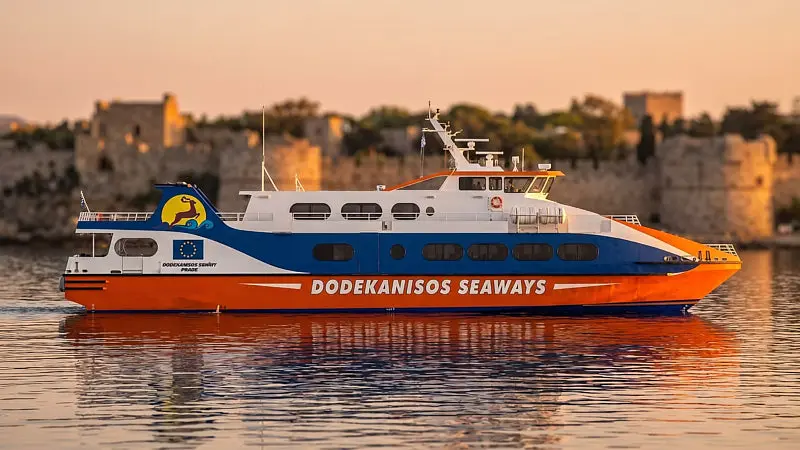
Executive Overview: A Twenty-Year Epoch Closes with a Landmark Agreement
In a major development for European short-sea shipping and regional ferry operations, Rhodes-headquartered Dodekanisos Seaways has formally re-established its historic shipbuilding partnership with Norwegian shipyard GOT Marine. Following a two-decade intermission since their last direct newbuilding collaboration, the Greek ferry operator has finalized a contract for a next-generation high-speed passenger catamaran, backed by an agreement that includes options for two additional sister vessels.
This deal highlights the enduring quality of Norwegian naval architecture alongside the growing requirement for fleet modernizations across the Mediterranean basin. The deal secures one firm vessel construction slot at GOT Marine’s specialized facilities in Mandal, Norway, while establishing a contractual framework that could see up to three modern fast ferries delivered to the South Aegean over the coming years.
For Dodekanisos Seaways, which serves as an essential maritime lifeline connecting the isolated island communities of the Dodecanese archipelago, this capital investment addresses dual imperatives: replacing older tonnage with energy-efficient designs and meeting regulatory mandates established by the European Union’s decarbonization frameworks. For GOT Marine, the return of a high-profile international client highlights the enduring global competitiveness of Norwegian lightweight aluminum shipbuilding in an increasingly cost-conscious maritime sector.
================================================================================
                    DODEKANISOS SEAWAYS & GOT MARINE DEAL
================================================================================
 [GOT Marine Shipyard]                                  [Dodekanisos Seaways]
   Mandal, Norway                                          Rhodes, Greece
         |                                                       |
         |=== FIRM ORDER: 1x Next-Gen Fast Catamaran ==========>|
         |=== OPTIONAL:   2x Sister Fast Catamarans ===========>|
         |                                                       |
         +-------------------------------------------------------+
         | Key Drivers: Decarbonization, Aegean Reliability,     |
         | Fleet Modernization & Historical Operational Success |
================================================================================
Detailed Chronology: From Mandal to Rhodes—Tracing a Two-Decade Legacy
The Early Millennium Foundation
The operational partnership between Dodekanisos Seaways and the shipbuilders of Mandal dates back to the turn of the 21st century. Founded in 1999 by the Spanos family, Dodekanisos Seaways set out to modernize intra-island connectivity within the Dodecanese, a region historically serviced by slower, conventional displaced tonnage or aging second-hand craft.
To achieve high transit speeds and exceptional reliability across the Aegean Sea, the operator turned to Norway’s southern shipbuilding hub in Mandal—then operating under the heritage banner of Båtservice Holdings, whose ship construction assets, technology, and facility lineage now form an integral part of GOT Marine.
The initial fruits of this partnership were two custom-engineered aluminum catamarans:
- Dodekanisos Express – Delivered in 2000, setting a new benchmark for speed, operational stability, and passenger comfort across the Rhodes–Kos–Symi route network.
- Dodekanisos Pride – Delivered in 2005, reinforcing the company’s schedule resilience and demonstrating the longevity of high-grade Norwegian marine aluminum structures operating in high-salinity Mediterranean environments.
The Interim Epoch and Fleet Evolution
Between 2005 and 2024, Dodekanisos Seaways focused its operational strategy on optimizing its existing fleet, expanding its logistical networks, and integrating conventional ro-pax capacity—such as the acquisition and deployment of the vessel Panagia Skiadeni—to handle heavy vehicle freight alongside seasonal tourism spikes.
Concurrently, the Mandal shipyard underwent its own evolution, expanding its engineering capabilities, integrating digital hydrodynamics and advanced propulsion systems, and consolidating its identity under GOT Marine (a division of Global Ocean Technology). Throughout this twenty-year hiatus, the original Mandal-built catamarans remained the operational backbone of Dodekanisos Seaways, accumulating tens of thousands of operating hours in demanding sea conditions. This long-term operational performance proved to be the primary catalyst for the operator’s return to Norway.
Structuring the New Deal: Firm Order and Expansion Options
Negotiated over several months of technical alignment and financial structuring, the newly inked agreement establishes a flexible, phased fleet modernization program:
- Firm Commitment: One (1) specialized, high-speed lightweight aluminum passenger catamaran, with construction commencing immediately at GOT Marine’s Mandal yard.
- Option Package: Strategic options for up to two (2) additional sister vessels, allowing Dodekanisos Seaways to scale its fleet renewal in alignment with market demand, route expansion opportunities, and capital deployment schedules.
- Financing & Delivery Dynamics: Designed to optimize capital expenditure, the contract leverages specialized maritime export financing frameworks, with the initial vessel slated for rigorous sea trials in Norwegian waters prior to its blue-water transit to the Mediterranean.
Technical Metrics & Operational Context: Engineering for the Aegean Sea
Archipelago Dynamics and Navigational Demands
Operating in the South Aegean Sea presents a difficult set of environmental and logistical challenges. The Dodecanese island chain—comprising major centers like Rhodes and Kos alongside smaller, remote outposts like Kastellorizo, Halki, Nisyros, Tilos, Symi, Leros, Patmos, Lipsi, and Agathonisi—requires vessels capable of operating in severe sea conditions.
+-------------------------------------------------------------------------------+
|                       AEGEAN OPERATIONAL CHALLENGES                           |
+-------------------------------------------------------------------------------+
|  [Meltemi Winds]   --> Seasonal gale-force winds requiring high sea-keeping  |
|  [Tight Harbors]   --> Shallow drafts & high maneuverability for small ports   |
|  [Island Distances]--> Fast transit speeds (30+ knots) for daily turnarounds  |
|  [High Salinity]   --> Corrosion-resistant marine-grade aluminum construction |
+-------------------------------------------------------------------------------+
The region is famous for the Meltemi—strong, dry northern winds that sweep across the Aegean during summer months, producing steep, short-period waves that cause high structural stress on fast ferries. Furthermore, small island harbors feature shallow drafts, narrow approach channels, and minimal port infrastructure, requiring fast ferries to possess:
- High operational maneuverability without reliance on tug assistance;
- Extremely low operational draft profiles;
- High structural integrity to withstand repetitive dynamic slamming forces;
- Minimal wake wash profiles to prevent shoreline erosion and harbor surge in historic ports.
Naval Architecture, Propulsion, and Efficiency Metrics
While full preliminary drawings remain protected under commercial confidentiality, technical parameters disclosed by GOT Marine and regional maritime intelligence indicate significant architectural advancements over early-2000s designs:
| Technical Parameter | Legacy Vessels (Express / Pride) | Next-Gen GOT Marine Catamaran |
|---|---|---|
| Hull Material | High-tensile Marine Aluminum | Advanced Lightweight Aluminum Alloy |
| Length Overall (LOA) | ~40.0 meters | ~42.5 meters (Optimized L/B Ratio) |
| Passenger Capacity | ~300 passengers | 350+ passengers (Enhanced Ergonomics) |
| Operational Speed | 30–32 knots | 32–34+ knots (Design Continuous Rating) |
| Propulsion Architecture | Conventional High-Speed Diesel | Selective Catalytic Reduction (SCR) / Hybrid-Ready |
| Emissions Profile | IMO Tier II Baseline | IMO Tier III / FuelEU Maritime Compliant |
| Hydrodynamic Profile | Symmetrical Twin-Hull Design | Optimized Computational Fluid Dynamics (CFD) Bow |
The new design incorporates advanced computational fluid dynamics (CFD) modeling to optimize hull-form symmetry, drastically reducing hydrodynamic resistance at high Froude numbers. Constructed from high-grade, marine-grade aluminum, the vessel achieves an optimized power-to-weight ratio, enabling higher service speeds while lowering fuel consumption per passenger-kilometer compared to previous fleet baselines.
The propulsion suite is engineered for environmental compliance and operational adaptability. Equipped with selective catalytic reduction (SCR) exhaust gas treatment systems to satisfy IMO Tier III NOx limits, the engine rooms are also designed to accommodate future retrofit paths for alternative low-carbon fuels or hybrid-electric battery storage modules as shore-side charging infrastructure develops in the Greek islands.
Official Statements & Strategic Alignment: Industry Leaders Sound Off
The re-engagement between GOT Marine and Dodekanisos Seaways highlights a shared commitment to maritime reliability, safety, and regional connectivity.
GOT Marine’s Manufacturing Commitment
Executing complex aluminum fast craft requires specialized shipyard capabilities, a point emphasized by GOT Marine leadership upon finalized contract execution.
"The return of Dodekanisos Seaways to our Mandal yard after two decades is a strong endorsement of our vessel design and Norwegian shipbuilding heritage," remarked executives at GOT Marine. "When an operator relies on ships built by our yard for twenty years to maintain continuous daily service in demanding waters, their return for a third vessel—and potential fourth and fifth—demonstrates the real-world value of our engineering. We are delivering a vessel engineered for fuel efficiency, low maintenance overhead, and exceptional sea-keeping capabilities."
GOT Marine’s project management team noted that the new construction program will utilize modern modular fabrication techniques at the Mandal facility, ensuring strict quality control, weight monitoring, and streamlined production schedules.
Dodekanisos Seaways’ Fleet Renewal Mandate
From the operational headquarters in Rhodes, leadership framed the acquisition as a forward-looking strategy designed to raise passenger service standards while meeting increasingly strict European environmental targets.
"Our decision to return to GOT Marine is rooted in twenty years of real-world experience," stated representatives from Dodekanisos Seaways. "Our passengers and island communities rely on Dodekanisos Express and Dodekanisos Pride every single day. As we look to the next twenty years, we required a shipyard partner capable of delivering unmatched structural quality alongside modern energy-efficient hull forms. This initial firm order, coupled with options for two additional sister ships, secures the long-term operational resilience of our company and ensures the islanders of the Dodecanese remain connected with high-speed, state-of-the-art maritime transport."
Future Outlook & Regional Maritime Implications: Decarbonization and the Greek Ferry Renaissance
Regulatory Compliance: FuelEU Maritime and EU ETS Impacts
This deal comes at a pivotal moment for the Greek passenger shipping sector. The inclusion of maritime transport in the European Union Emissions Trading System (EU ETS), alongside the step-by-step implementation of the FuelEU Maritime regulation, places significant financial penalties on carbon-intensive and aging vessels.
For short-sea operators in Greece, fleet modernization is no longer optional—it is a clear economic necessity.
  +-----------------------------------------------------------------------+
  |              EUROPEAN MARITIME DECARBONIZATION PRESSURES              |
  +-----------------------------------------------------------------------+
  |                                                                       |
  |   [EU ETS Extension] --------> Financial penalties on carbon output   |
  |                                                                       |
  |   [FuelEU Maritime] ---------> Mandates reduction in GHG intensity   |
  |                                                                       |
  |   [Fleet Obsolescence] -------> Urgent requirement to replace legacy  |
  |                                tonnage with high-efficiency hulls     |
  |                                                                       |
  +-----------------------------------------------------------------------+
                                     |
                                     v
  +-----------------------------------------------------------------------+
  |    SOLUTION: GOT Marine High-Speed Eco-Catamaran Order Framework      |
  +-----------------------------------------------------------------------+
By investing in lightweight aluminum construction, hydrodynamic hull optimization, and SCR-equipped, hybrid-ready machinery, Dodekanisos Seaways proactively mitigates future exposure to carbon tariffs. Should the operator exercise its options for the two additional sister ships, it will complete one of the most comprehensive fast-ferry decarbonization programs in the Eastern Mediterranean short-sea sector.
Economic Impact on Dodecanese Tourism and Island Connectivity
Beyond its regulatory and technical elements, the order carries important socioeconomic weight for the South Aegean region:
- Year-Round Vital Island Lifelines: Unlike operators that focus purely on peak summer tourism, Dodekanisos Seaways operates year-round services, transporting medical patients, school groups, essential supplies, and local commerce between small island dependencies and the regional hub of Rhodes.
- Enhanced Tourism Capacity: The added passenger capacity and higher operational speeds will expand daily excursion corridors during the peak summer season, connecting high-volume international tourist markets in Rhodes and Kos with outer-tier islands like Patmos, Symi, and Kalymnos.
- Supply Chain Resilience: Higher reliability and improved rough-weather tolerance reduce weather-induced cancellations during winter storms, providing island populations with secure, predictable access to the mainland and larger regional centers.
Timeline to Sea Trials and Delivery
With contract parameters finalized and engineering schematics locked in, construction on the firm vessel at GOT Marine’s Mandal shipyard moves into active production. Structural aluminum cutting and hull module assembly will proceed throughout the coming months, culminating in hull integration, machinery fit-out, and advanced system commissioning.
Upon completion of comprehensive fjord sea trials in Norway—designed to verify speed guarantees, fuel consumption curves, and turning radius metrics—the vessel will undertake its maiden voyage south to its home port of Rhodes. If the operational rollout matches performance projections, the exercise of options for the second and third vessels could see a continuous production line established at Mandal, cementing a multi-year manufacturing pipeline between Southern Norway and the South Aegean.
Through this landmark contract, Dodekanisos Seaways and GOT Marine demonstrate that long-term industrial relationships, grounded in quality construction and practical engineering, remain the premier formula for navigating the evolving demands of modern maritime transport.