




By Dan Berkson
Digital Advocacy Manager
Estimated Reading Time: 7 Minutes
Executive Overview
Across the globe, weather patterns are becoming increasingly erratic, characterized by sudden droughts, historic flooding, unprecedented marine heatwaves, and intensified hurricane seasons. While many of these shifts are analyzed through the broad lens of anthropogenic climate change, a powerful natural cycle often acts as the primary engine behind these localized climate shocks: the El Niño-Southern Oscillation (ENSO).
Often referred to in popular media as sibling phenomena, El Niño and La Niña represent the warm and cool phases of a massive, cyclical climate engine spanning the tropical Pacific Ocean. Understanding these fluctuations is no longer just an academic pursuit for meteorologists; it is an urgent necessity for global survival and economic planning.
Recent projections from the National Oceanic and Atmospheric Administration (NOAA) suggest a one-in-four probability that an extraordinarily powerful "super El Niño" could materialize. Historically, such events have triggered widespread ecological collapse, catastrophic agricultural failures, and record-shattering global temperatures. Yet, even as the world grows more vulnerable to these weather anomalies, the institutional infrastructure responsible for tracking and predicting them—namely, NOAA—faces severe political and budgetary pressures. Protecting our communities from the impacts of ENSO begins with safeguarding the federal science and research programs that warn us of their arrival.
Detailed Chronology: Unraveling the History of ENSO
The discovery of the mechanism governing ENSO was not an overnight breakthrough; rather, it was a century-long scientific evolution connecting atmospheric pressure changes across the globe to shifts in oceanic temperatures.
- 1923 — Discovering the Southern Oscillation: The journey toward understanding ENSO began in earnest when British physicist Sir Gilbert Walker identified what he termed the "Southern Oscillation." While studying monsoon patterns, Walker discovered large-scale, seesaw fluctuations in sea-level air pressure between the eastern and western tropical Pacific. Though he recognized the atmospheric component, the oceanic link remained elusive.
- The Late 1960s — Connecting Ocean and Atmosphere: Decades later, Norwegian-American meteorologist Jacob Bjerknes synthesized the atmospheric data discovered by Walker with oceanic temperature observations. Bjerknes realized that the warm water anomalies in the eastern Pacific and the weakening trade winds were not isolated occurrences; they were part of a unified, tightly coupled ocean-atmosphere feedback loop. The hybrid acronym ENSO (El Niño-Southern Oscillation) was officially born.
- 1974 — The Dawn of Predictive Modeling: Recognizing the profound socio-economic impacts of these shifts—particularly on fisheries off the coast of South America—researchers at Oregon State University attempted the first computerized predictions of ENSO cycles in 1974. This nascent modeling laid the groundwork for modern numerical weather prediction.
- Present Day — High-Resolution Forecasting: Today, computational power and satellite telemetry have revolutionized our ability to peer into the Pacific. NOAA and international partners deploy vast arrays of buoys (such as the TAO/TRITON array), Argo floats, and advanced supercomputers to forecast ENSO phases months in advance, providing critical early-warning systems for vulnerable populations worldwide.
Supporting Context & Metrics: The Mechanics of El Niño, La Niña, and Their Impacts
To comprehend why the ENSO cycle carries such global sway, one must examine the physical dynamics taking place beneath the surface of the Pacific Ocean.
The Two Faces of ENSO
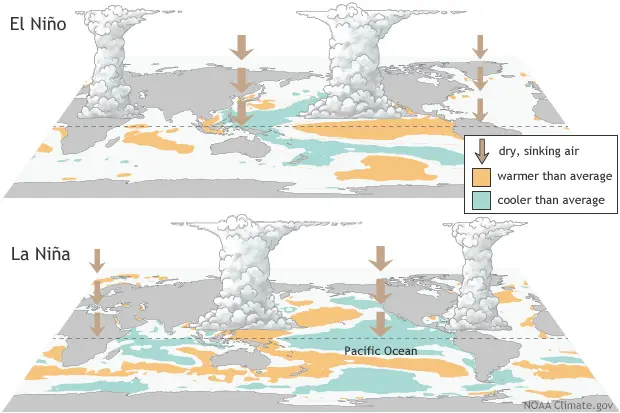
[Normal Conditions]  --> Trade winds blow west, warm water pools in Western Pacific.
[El Niño Phase]      --> Trade winds weaken, warm water sloshes back to the Americas.
[La Niña Phase] --> Trade winds strengthen, deep cold water upwells in Eastern Pacific.- El Niño (The Warm Phase): Typically building between March and June and peaking around December, El Niño occurs when equatorial easterly trade winds weaken or reverse direction. This allows vast pools of warm water, normally trapped near Indonesia, to migrate eastward toward the Americas. The consequences are profound: global average temperatures spike, marine ecosystems suffer severe stress (often resulting in coral bleaching and massive fish die-offs), and precipitation patterns are dramatically upended. While El Niño tends to suppress Atlantic hurricane activity, it dramatically increases the risk of torrential downpours, flooding, and agricultural droughts across other continents.
- La Niña (The Cool Phase): Acting as the thermal opposite of its sibling, La Niña features stronger-than-average easterly trade winds that push warm water westward and trigger extensive upwelling of cold, nutrient-rich deep water along the South American coast. For North America and the Atlantic basin, La Niña frequently fuels hyper-active Atlantic hurricane seasons and increases the frequency of severe tornadoes across the southern United States. Like El Niño, La Niña typically initiates in the spring and reaches peak intensity during the winter months.
The Looming Threat of a "Super El Niño"
Current meteorological models indicate a significant 25% chance that the developing El Niño cycle could surge into "very strong" or super El Niño territory. In the historical record, super El Niños have occurred only a handful of times, each instance serving as a catalyst for catastrophic climate anomalies:
- Multi-year agricultural droughts destroying staple crop yields across sub-Saharan Africa and parts of Asia.
- Unprecedented wildfire seasons in Australia and the western United States.
- Record-breaking global temperature anomalies that accelerate sea-level rise and destabilize polar ice sheets.
Official Statements and Institutional Perspectives
The gravity of the current ENSO outlook has alarmed marine scientists, climatologists, and environmental advocates alike. Because the ocean acts as the primary heat sink for the planet, absorbing over 90% of excess anthropogenic heat, its health dictates the stability of the global climate system.

"NOAA’s data and models deliver life-saving early warning forecasts—like that of the predicted super El Niño—which allow communities to better prepare for and respond to extreme weather events."
— Ocean Conservancy Research Briefing
However, the institutional capacity to deliver these life-saving forecasts is currently facing unprecedented administrative and financial headwinds. Experts note that federal budget proposals featuring billions of dollars in cuts to NOAA threaten to dismantle decades of progress in climate science.
"Every American, regardless of where they live, depends on NOAA’s scientists and professionals, whose work spans from the ocean floor to the far reaches of space," notes the Ocean Conservancy advocacy team. Potential reductions in funding threaten to:
- Compromise the deployment and maintenance of crucial oceanic observation buoys.
- Disrupt sustainable fisheries management, imperiling coastal economies.
- Stall long-term climate research initiatives needed to understand accelerating feedback loops.
Future Outlook: A Non-Partisan Imperative for Ocean Resilience
The challenges posed by the El Niño-Southern Oscillation do not adhere to political boundaries, nor do they discriminate based on geography. Whether an inland farming community faces a crippling multi-year drought fueled by an El Niño phase or a coastal town braces for a La Niña-fueled hurricane onslaught, the baseline requirement for survival remains the same: accurate, uninterrupted, publicly funded science.
Protecting our oceans and mitigating the devastating impacts of extreme weather requires an all-hands-on-deck approach. As policymakers debate federal budgets, maintaining robust funding for agencies like NOAA is not a partisan issue; it is a fundamental prerequisite for national security, economic stability, and environmental stewardship.
Investments in ocean research represent our most powerful tool to restore ocean health, decode complex climate cycles, and protect human lives.
The ocean is entirely non-partisan. To ensure our communities remain resilient against the next great climate shock, public advocacy has never been more urgent. Demand that members of Congress prioritize our oceans and protect vital scientific infrastructure today.