











Executive Overview
For more than half a century, the mere mention of Teeth of the Dog at Casa de Campo Resort & Villas has evoked images of crashing turquoise waves, wind-swept fairways, and the distinct, unforgiving architectural genius of Pete Dye. As the undisputed crown jewel of Caribbean golf, this Dominican Republic masterpiece has tested major champions, weekend warriors, and golf architects alike since it first opened its doors in 1971.
Yet, even golf legends have their blank spaces. Until recently, former world No. 1 and World Golf Hall of Famer Lorena Ochoa had never teed it up on Dye’s coastal masterpiece. That changed on September 4, when the Mexican superstar stepped onto the links to play her inaugural round.
Ochoa’s visit was far more than a routine celebrity appearance. It arrived less than six months after Teeth of the Dog emerged from the most comprehensive and ambitious restoration project in its storied history—a $15 million agronomic and architectural overhaul designed to sharpen Pete Dye’s original vision without altering the soul of the course.
Joined by elite dignitaries, including Dominican Republic Tourism Minister David Collado, Central Romana Corporation Executive Vice President Leo Matos, and Casa de Campo President Andrés Pichardo Rosenberg, Ochoa’s historic round served as a powerful global endorsement. It signaled to the international golf community that while the course has been meticulously modernized underneath the surface, its legendary character remains entirely intact.
This in-depth feature explores the sweeping changes behind the $15 million restoration, the broader logistics that make Casa de Campo an unmatched luxury escape, and why this new era solidifies the resort’s status as the definitive 63-hole golf capital of the Caribbean.
Detailed Chronology: A New Chapter for a 1970s Masterpiece
To understand the weight of Lorena Ochoa’s September visit, one must trace the timeline of the transformation that preceded it. For decades, Teeth of the Dog stood as an untouchable monument of golf architecture. Its routing—featuring the iconic oceanfront stretch affectionately known as the "Heaven 7"—defined Caribbean golf prestige.
However, time, weather, and the relentless demands of modern championship play necessitate evolution even for masterpieces. Casa de Campo leadership recognized that preserving a legend requires active stewardship.
The $15 Million Master Plan
The resort embarked on a massive, multi-million-dollar restoration project aimed at breathing new life into Dye’s original design intent. Rather than undertaking a modern redesign that would shock traditionalists, the project focused on sharpening the course’s foundational elements:
- Agronomic Upgrades: The installation of fresh, resilient Dynasty Paspalum turf across the entire layout ensures immaculate playing conditions year-round. Beneath the fairways, crews incorporated three inches of specialized sand, vastly improving drainage and firmness.
- Green Complexes and Bunkering: Greens were meticulously rebuilt to restore their original contours and edge definitions. Bunkers were reshaped and enlarged, bringing back the strategic penalty and visual intimidation that Dye originally intended.
- Infrastructure Renewal: Cart paths and surrounding drainage systems were entirely updated, ensuring the course operates at peak efficiency while protecting its fragile coastal ecosystem.
The Reopening and the Arrival of a Legend
Teeth of the Dog officially reopened to the public on March 13, immediately drawing high praise from golf purists who walked the newly firmed fairways.
When Ochoa arrived on September 4, she experienced a course operating at the absolute peak of its powers. Following her historic round, the Mexican icon shared her impressions:
"It’s a spectacular course, with enormous history."
Her visit was highlighted by an exclusive youth golf clinic, where she mentored aspiring players from the Casa de Campo golf academy and the Dominican Golf Federation. By passing down her wisdom on the newly restored turf, Ochoa bridged the gap between golf’s historic past and its bright Latin American future.
Supporting Context & Metrics: The Anatomy of Casa de Campo
While Teeth of the Dog commands global headlines, understanding the broader ecosystem of Casa de Campo Resort & Villas reveals why this property operates in a league of its own. Spanning an astonishing 7,000 acres along the southeastern coast of the Dominican Republic, Casa de Campo is not merely a hotel with a golf course attached; it is a sprawling luxury municipality designed for seamless resort living.
The 63-Hole Golf Portfolio
While Teeth of the Dog anchors the experience, a complete golf trip to Casa de Campo offers remarkable variety across 63 holes designed by Pete Dye:
- Teeth of the Dog: The unmatched oceanfront icon. With seven holes playing directly against the roaring Caribbean Sea, it demands precision, creativity, and nerve.
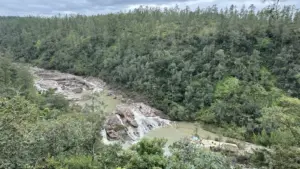
- Dye Fore: A dramatic, 27-hole layout split across the Chavón, Marina, and Lagos nines. Perched high above the rushing Chavón River, it provides staggering elevation changes and sweeping gorge views that contrast sharply with the coastal nature of Teeth.
- The Links: Dye’s inland masterpiece. Offering a subtler, more traditional British Isles-style test, it presents undulating fairways and strategic water hazards, serving as an ideal complement to the brute force of its oceanfront sibling.
Logistics and Seamless Travel
One of Casa de Campo’s most significant competitive advantages is its proximity to air travel infrastructure. While many international travelers utilize Punta Cana International Airport, Casa de Campo boasts its own secret weapon: La Romana International Airport (LRM).
- Airlift Efficiency: American Airlines operates regular nonstop flights between Miami (MIA) and La Romana (LRM), with a remarkably short flight time of just two hours and 35 minutes.
- Ground Transfer: La Romana International Airport is located a mere 10-minute drive from the resort gates. This efficient transit turns arrival day into a functional resort day, allowing travelers to step off a morning flight and be on the first tee by lunchtime.
Accommodations and Resort Infrastructure
The resort features 315 hotel rooms and suites, complemented by an extensive collection of ultra-luxury private villas scattered across the 7,000-acre estate. To navigate this vast property, every room and villa rental comes equipped with a private golf cart. Guests use their carts not just for the golf courses, but to travel effortlessly to Minitas Beach, the on-property marina, dining hubs, and the stunning Mediterranean-style replica village of Altos de Chavón.
Pricing remains remarkably flexible depending on the season. For instance, seasonal rate checks indicate that entry-level Superior Casita accommodations can occasionally be secured starting around $275 per night before taxes and fees during shoulder periods like September—offering exceptional value for golfers looking to experience the newly restored course before the high winter tourism season kicks into gear.
Official Statements & Industry Perspective
The successful restoration of Teeth of the Dog and the high-profile endorsement by Lorena Ochoa highlight a coordinated vision between resort leadership, tourism authorities, and international golf icons.
Andrés Pichardo Rosenberg, President of Casa de Campo:
"Our goal with this restoration was never to reinvent Pete Dye’s masterpiece, but rather to honor it. We wanted to peel back the years and present the course exactly as Pete envisioned it in 1971. Having a legend of Lorena Ochoa’s caliber experience the course for the first time validates every meticulous detail of our $15 million investment."
David Collado, Dominican Republic Tourism Minister:
"Golf tourism is a vital pillar of our national economy and international identity. The continuous evolution of world-class properties like Casa de Campo demonstrates our nation’s unwavering commitment to luxury, excellence, and sporting heritage. Welcoming global icons like Lorena Ochoa cements the Dominican Republic as the premier golf destination in the Caribbean and Latin America."
Golf architects and industry analysts have universally praised the restraint shown during the renovation. In an era where modern course updates often lean toward lengthening layouts into oblivion to combat modern ball technology, Casa de Campo chose a more sophisticated path: enhancing turf firmness, restoring green complexes, and emphasizing strategic angles that reward precision over sheer power.
Future Outlook: The New Standard for Caribbean Golf
As the golf world looks toward the future, the successful $15 million overhaul of Teeth of the Dog positions Casa de Campo at the forefront of luxury sports tourism for decades to come.
The resort’s strategy of blending historic architectural preservation with modern agronomic excellence has created a blueprint for how legendary golf properties should manage their aging assets. By avoiding the temptation to over-engineer the course, Casa de Campo has retained the terrifying charm of the "Heaven 7" while giving today’s players a firmer, faster, and more precise test of golf.
Furthermore, the involvement of global legends like Lorena Ochoa—and her active engagement with the next generation of Dominican junior golfers—signals a vibrant, sustainable future for the sport in the region. As young players train in the shadow of giants on world-class facilities, the Dominican Republic is actively cultivating future champions.
Summary Recommendation for Travelers
- For the Purist: Book a dedicated golf trip focused squarely on conquering the newly restored Teeth of the Dog and testing your elevation management on Dye Fore.
- For the Luxury Traveler/Families: Utilize Casa de Campo’s 7,000-acre resort infrastructure. While one member of the party tests their mettle against Pete Dye’s hazards, others can enjoy world-class spa treatments, equestrian polo, premier dining at the Marina, or boutique shopping at Altos de Chavón.
More than fifty years after its creation, Teeth of the Dog has been reborn. As Lorena Ochoa noted upon walking off the 18th green, its history is undeniable—and thanks to a visionary restoration, its future has never looked brighter.