









By Megan Bennett, Senior Manager, Digital Outreach
Estimated Reading Time: 6 Minutes
Executive Overview
While the global ocean is frequently visualized as a singular, temperate expanse, it is in reality a mosaic of extreme thermal environments. From the sub-zero abyssal plains of Antarctica to shallow coastal waters exceeding 100°F (38°C) and the scalding outflows of deep-sea hydrothermal vents, marine ecosystems span staggering temperature gradients. Unlike terrestrial mammals that can readily adjust ambient environments or alter clothing, aquatic organisms face relentless thermodynamic pressures.
To endure these conditions, marine species have evolved sophisticated physiological mechanisms known collectively as thermoregulation. Far from being a mere biological curiosity, the study of how ocean life maintains internal homeostasis has become a vital frontier in marine biology. As anthropogenic climate change drives historic marine heatwaves, intensifies tropical storms, and bleaches coral reefs, understanding these survival strategies provides critical insights into how marine biodiversity may—or may not—weather a rapidly warming world.
Detailed Chronology of Discovery: Unlocking Marine Adaptations
The scientific realization that marine organisms could conquer extreme environments through advanced internal adaptations did not happen overnight. For centuries, the deep ocean and polar seas were thought to be biological deserts, incapable of sustaining complex life due to extreme cold or intense pressure.
- The Early 20th Century (1928): Researchers first documented profound physiological anomalies in polar waters. The discovery of the Antarctic icefish challenged foundational assumptions about vertebrate biology when scientists found creatures surviving with entirely transparent, milky-white blood devoid of red blood cells or hemoglobin.
- Mid-20th Century Advances: As oceanographic technology matured, marine biologists began mapping the metabolic strategies of pelagic predators. The discovery of the rete mirabile—the "wonderful net" of blood vessels in apex predators like the bluefin tuna—revealed that fish could be regionally warm-blooded, shattering the rigid dichotomy between "cold-blooded" and "warm-blooded" animals.
- 1970s and 1980s Breakthroughs: The landscape of marine biology shifted dramatically with the 1977 discovery of hydrothermal vents along the Galápagos Rift. Researchers found entire ecosystems thriving in pitch-black waters reaching temperatures up to 660°F (349°C), sustained not by sunlight, but by chemosynthesis. This uncovered an entirely new paradigm of thermal tolerance.
- Modern Era (2000s–Present): Recent genetic sequencing continues to unearth evolutionary surprises, such as the 2025 discovery that Asian noodlefishes have completely lost their myoglobin and hemoglobin genes, mirroring the adaptations of their Antarctic counterparts. Today, marine physiologists are racing to understand these ancient evolutionary toolkits as modern oceans face unprecedented, human-driven temperature spikes.
Supporting Context & Metrics: The Mechanics of Marine Thermoregulation
Marine animals utilize a diverse array of physical, chemical, and behavioral adaptations to manage thermal stress. Examining these mechanisms reveals the sheer complexity of ocean life.
1. Countercurrent Heat Exchange and Gigantothermy in Leatherback Sea Turtles
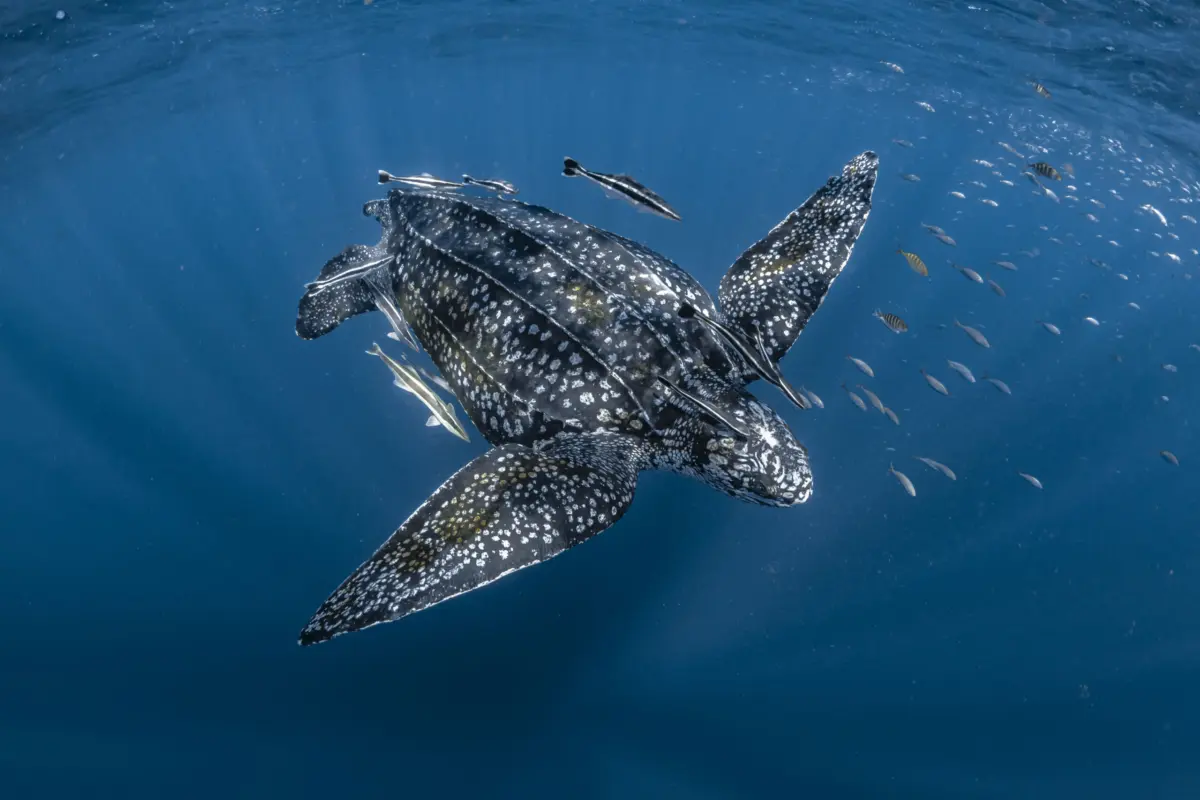
Leatherback sea turtles (Dermochelys coriacea) routinely migrate into near-freezing northern waters to feed on jellyfish. Because they are ectothermic (reliant on external heat sources), this behavior presents a severe physiological paradox.
Leatherbacks survive through two primary mechanisms:
- Countercurrent Heat Exchange: Arteries carrying warm blood from the heart run directly adjacent to veins carrying cold blood from the flippers. Heat from the arterial blood transfers to the venous blood, warming it before it re-enters the core. This process can be reversed during nesting season to offload excess heat.
- Gigantothermy: As the largest sea turtles on Earth, their sheer body mass—combined with a thick layer of oily, insulating fat and a leathery, rubbery shell—significantly reduces their surface-area-to-volume ratio, effectively trapping metabolic heat and maintaining a stable core temperature well above that of the surrounding water.
2. The Regional Endothermy of Bluefin Tuna
While most fish are ectothermic, bluefin tuna are regionally endothermic. They utilize a dense, intertwined vascular network known as the rete mirabile to reclaim metabolic heat generated by their swimming muscles. This allows them to maintain elevated temperatures in their muscles, viscera, eyes, and brain, even while hunting in frigid depths. However, this adaptation requires immense energy expenditure, granting them unmatched speed and reflexes to maintain their status as apex predators.
3. Biological Antifreeze: Preventing Cellular Crystallization
In sub-zero Antarctic waters, fish face the constant threat of ice crystal formation, which can puncture cellular membranes and prove fatal. Species such as the Antarctic toothfish, dragonfish, and icefish produce specialized Antifreeze Glycoproteins (AFGPs). These proteins circulate through the bloodstream, binding to nascent ice crystals and physically disrupting water molecules from locking into a rigid crystalline lattice.
Complementing this, the Antarctic icefish has evolved to operate entirely without red blood cells or hemoglobin. Instead, they absorb oxygen directly through their exceptionally thin skin and gills into their blood plasma, moving fluid efficiently via enlarged hearts and widened blood vessels.
4. Extreme Extremophiles: Hydrothermal Vent Ecosystems
At the opposite thermal extreme, hydrothermal vents spew mineral-rich water heated by subterranean magma to over 600°F. Here, giant tubeworms (Riftia pachyptila) anchor themselves in narrow, mixed-temperature gradients just inches from the vents. Growing up to eight feet long, these invertebrates possess no mouth or gut; instead, they maintain a symbiotic relationship with chemosynthetic bacteria housed inside their bodies. Using a bright red plume to absorb oxygen and hydrogen sulfide, the tubeworms feed the bacteria, which in turn supply the energy the worm needs to survive in one of the most volatile environments on Earth.
Official Statements and Expert Perspectives
The intersection of extreme marine physiology and global climate change has mobilized the scientific community to issue urgent warnings regarding ocean stability.
Marine conservationists emphasize that while evolutionary adaptations are extraordinary, they have hard biological limits. Dr. Evelyn Vance, a leading marine climate researcher, notes:
"Marine organisms have spent millions of years fine-tuning their metabolic furnaces to operate within specific thermal envelopes. When we alter ocean temperatures at the current anthropogenic pace, we are pushing these species past their evolutionary coping mechanisms. An adaptation that took ten thousand years to evolve cannot be reinvented in a single decade."
Conservation organizations point to recurring, devastating marine heatwaves—often referred to as "marine blobs"—as direct threats to both endothermic and ectothermic species. As thermal stress cascades through food webs, disrupting everything from krill populations to apex predators, institutional leaders stress that ocean resilience is inextricably linked to global carbon emissions.
Future Outlook: The Climate Crisis and the Fate of Ocean Ecosystems
The resilience demonstrated by leatherback turtles, bluefin tuna, Antarctic icefish, and hydrothermal tubeworms highlights the awe-inspiring adaptability of life on Earth. Yet, these marvels of evolution are facing an existential stress test.
The modern climate crisis is characterized by unprecedented warming rates, ocean acidification, and expanding hypoxic zones. Historic marine heatwaves are triggering catastrophic coral bleaching events, while warming waters fuel more intense and destructive hurricanes. These compounding pressures threaten to outpace the adaptive capacity of even the most resilient marine species.
Understanding thermoregulation is no longer an academic exercise reserved for physiology laboratories; it is a vital lens through which we must view planetary health. If marine ecosystems are to survive the coming decades, global society must transition from passive observation to active mitigation.
Take Action Now
The climate crisis is here, and its impacts on our oceans will only accelerate without immediate, decisive intervention. Safeguarding the future of marine life requires systemic policy changes and global emissions reductions.