









Across the turquoise expanses and sun-drenched shores of the Bahamas, Belize, the Mexican Caribbean, Guadeloupe, and the Dominican Republic, eight distinctive getaways share a singular, irresistible philosophy: grab the keys to a golf cart, press down the accelerator, and let the destination shrink to a wonderfully intimate scale.
From the moment you touch down in North Eleuthera and catch the water taxi across the channel to Harbour Island, a familiar question inevitably dictates your first hour on the ground: Where is the golf cart? Whether you are navigating the sandy paths of San Pedro on Ambergris Caye, tracing the rugged perimeter of Isla Mujeres, or zipping between luxury villas in a sprawling Dominican resort, the golf cart has evolved far beyond a novelty. Today, it stands as the ultimate symbol of a shifting travel paradigm—one that prioritizes unhurried exploration, community connection, and the seamless integration of traveler and terrain.
Executive Overview: The Rise of Micro-Mobility in Paradise
For decades, the standard vacation blueprint dictated the acquisition of a traditional rental car—a heavy, air-conditioned barrier separating the traveler from the environment. But across a carefully curated selection of islands and ultra-inclusive enclaves, a counter-movement has taken root. Micro-mobility, anchored by the humble golf cart, has redefined how visitors interact with their surroundings.
This is not merely a quirk of geography; it is a deliberate design for leisure. Destinations like Harbour Island, Bimini, Isla Holbox, Isla Mujeres, Green Turtle Cay, Terre-de-Haut, Ambergris Caye, and Casa de Campo harness the golf cart to dictate a slower, more engaged pace of life. It is an automotive equalizer. The cart is small enough to master within twenty-four hours, yet lovable enough to warrant endless circling of the same familiar blocks. You quickly learn which lane leads straight to the beach, where to pull over for a casual midday fish taco, and which scenic detour is worth taking twice in a single afternoon.
The momentum behind this trend is accelerating. Commercial aviation developments, such as American Airlines’ newly inaugurated nonstop service linking Miami directly to Bimini, have compressed travel windows to mere minutes. Meanwhile, heavy-duty utility and hospitality suppliers—such as Tropicars, which outfits resorts throughout the Caribbean—report that golf carts are no longer peripheral amenities. They are foundational infrastructure, tasked with moving guests effortlessly between private villas, championship golf courses, marinas, and remote stretches of coastline.
In some destinations, the cart simply ensures a massive resort functions efficiently. In others, it fundamentally defines the soul of the destination.
Detailed Chronology: The Evolution of the Island Circuit
To understand how the golf cart transitioned from a golf course accessory to a masterclass in destination design, one must trace its integration across disparate pockets of the tropics.

The Pioneer: Harbour Island, The Bahamas
Harbour Island remains the purest, most romanticized expression of the golf-cart lifestyle. Spanning a mere 3.2 miles in length, this Bahamian enclave concentrates Dunmore Town’s historic colonial architecture, world-famous Pink Sand Beach, boutique inns, and waterfront eateries into a footprint so tight that intersections become familiar landmarks by your second morning.
The cart alters the psychological experience of "Briland." Visitors roll effortlessly from Dunmore Town to the blush-colored sands of the eastern shore, often without an itinerary, surrendering to the whims of the afternoon. Crucially, the golf cart fosters an unusually high degree of socialization. Carts pass one another at speeds slow enough to allow for casual waves, spontaneous hellos, and last-minute changes of dinner plans. The streets cease to be asphalt corridors to be endured and instead become vibrant extensions of the island’s hotels, shops, and homes.
The Fast Escape: Bimini, The Bahamas
Geographically, Bimini has always been a neighbor to Florida, but modern aviation has shrunk that distance to a negligible blip. The introduction of scheduled air service—exemplified by American Airlines’ roughly 52-minute nonstop hop from Miami—has transformed Bimini into the quintessential weekend micro-escape.
Upon landing in North Bimini, a golf cart immediately makes sense of the geography. Marinas, historic bonefishing shacks, and beaches sit within arm’s reach. Rather than turning a quick getaway into a logistical headache involving full-sized car rentals, visitors hop into a cart and bounce seamlessly from shore to shore. Bimini retains a delightfully unpolished, maritime-centric grit that distinguishes it from its polished Bahamian counterparts, making the utility of an open-air golf cart feel entirely authentic.
The Sandy Streets of Isla Holbox, Mexico
Heading west into the Mexican Caribbean, Isla Holbox reinterprets the concept entirely. Eschewing paved asphalt altogether, Holbox relies on a web of unpaved, white-sand streets where golf carts and bicycles reign supreme.
Located at the northern edge of the Yucatán Peninsula, Holbox utilizes carts to connect rustic beach clubs, boutique eco-resorts, and local taquerias. The psychological transformation here is immediate: the moment conventional automotive traffic vanishes, the ambient noise of the modern world fades with it. The destination feels less like a place you tour and more like an ecosystem you inhabit.
The Classic Circuit: Isla Mujeres, Mexico
In direct contrast to Holbox’s rustic charm, Isla Mujeres offers the quintessential paved-island road trip. A short ferry ride from the Cancun mainland deposits travelers into a bustling hub where renting a golf cart is practically a mandatory rite of passage.
The island lends itself to a satisfying daily circuit: starting in Centro, cruising past the crystalline shallows of Playa Norte, tracing the dramatic cliffs of the Caribbean-facing eastern coast, and culminating at the southern tip of Punta Sur. The cart provides just enough horsepower and range to spend an entire day exploring without making transportation feel like manual labor. It bridges the gap between structured sightseeing and unstructured wandering.
The Expansive Playground: Ambergris Caye, Belize
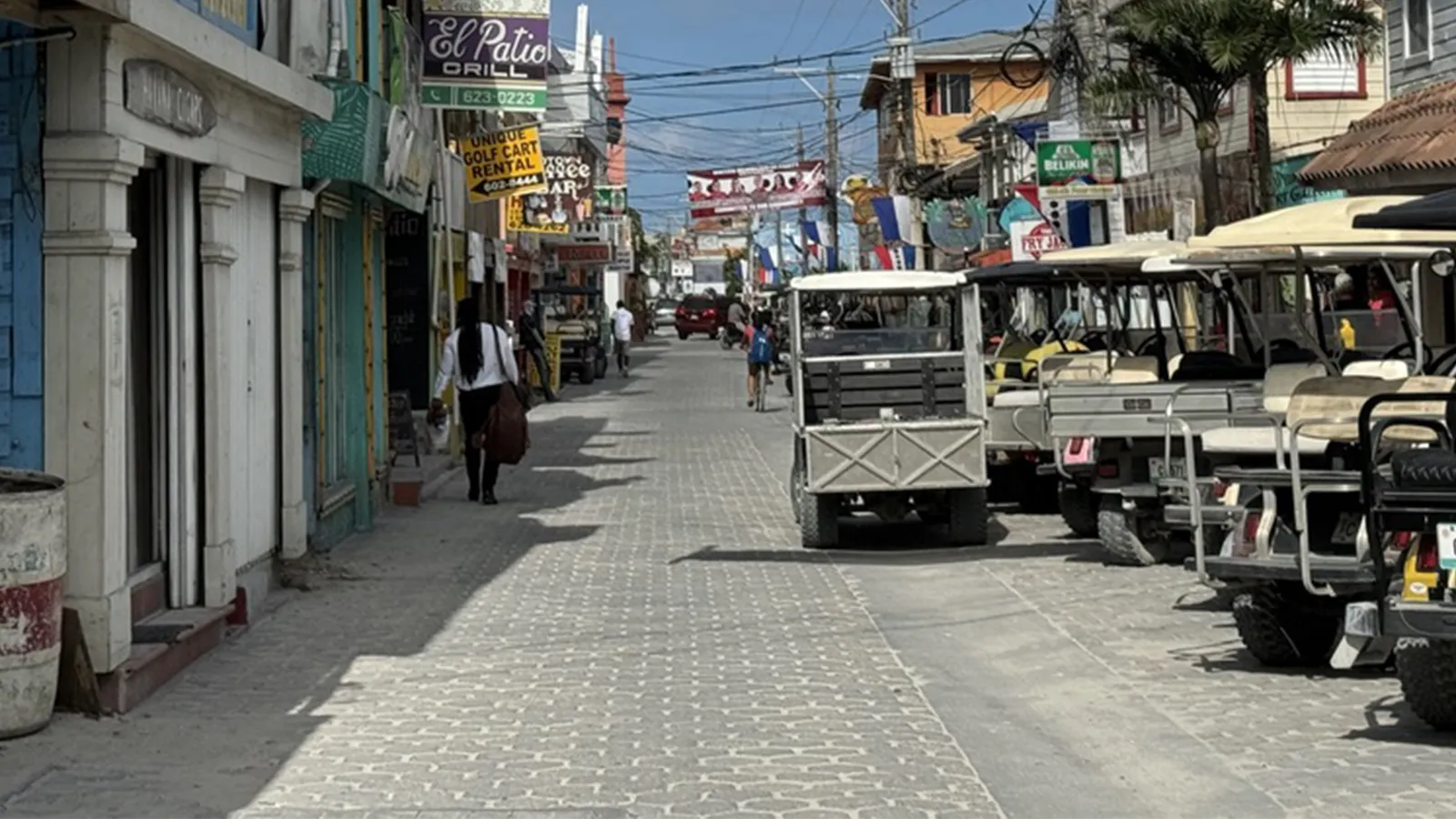
San Pedro, the bustling heart of Ambergris Caye, presents a livelier, more commercialized application of cart culture. As Belize’s largest island, Ambergris Caye requires a vehicle with stamina, given the string of resorts, dive shops, and bars stretching miles north of the town center.
Here, the golf cart serves as a practical workhorse. The streets of San Pedro hum with a constant, energetic parade of carts navigating between dive boats and seaside bistros. Yet, despite its expanding infrastructure, the island maintains its easygoing Caribbean ethos. For travelers seeking a deep dive into barrier-reef diving and culinary exploration without sacrificing the freedom of an open-air vehicle, Ambergris Caye hits the sweet spot.
The Out Island Hideaway: Green Turtle Cay, The Bahamas
Reaching Green Turtle Cay demands a deliberate effort—a flight into the Abacos followed by a traditional ferry crossing. That slight friction is precisely what preserves its timeless character.
Spanning roughly three miles, Green Turtle Cay defaults instantly to the golf cart upon arrival. While conventional cars exist on the island, they are statistical anomalies. Days are spent putting under dense canopies of trees, visiting the historic village of New Plymouth, and discovering secluded pocket beaches. It is the definitive Out Island experience: quiet, restorative, and entirely detached from the hurried tempo of contemporary life.
The French Caribbean Variation: Terre-de-Haut, Guadeloupe
In Terre-de-Haut, part of the Les Saintes archipelago in the French West Indies, the micro-mobility concept receives a distinctly European refinement. Covering just over five square kilometers, this picturesque island relies on a mix of electric carts, scooters, and bicycles.
Because the terrain features steep, undulating hills rising toward historic sites like Fort Napoléon, electric assistance is particularly welcome. The island’s pastel-colored French cafes, artisanal bakeries, and cliffside lookouts are built for intimate scales. Here, the cart is not merely a novelty; it is a sophisticated concession to an island where full-sized automobiles feel entirely out of character.
The Private Empire: Casa de Campo, Dominican Republic
Breaking the geographical rules of the genre entirely, the 7,000-acre Casa de Campo Resort & Villas in La Romana proves that an island isn’t strictly required to achieve the golf-cart state of mind.
Functioning as a self-contained sovereign state of luxury—complete with 315 hotel rooms, sprawling private estates, a world-class marina, equestrian facilities, a replica 16th-century Mediterranean village at Altos de Chavón, and 63 holes of championship golf (including the legendary, ocean-hugging Teeth of the Dog course)—Casa de Campo relies on golf carts as its primary transit system. Guests traverse the vast property from suites to the private beach club at Minitas, or from the polo fields to fine dining establishments, entirely via private cart. It transforms a massive resort footprint into an intimate neighborhood.
Supporting Context & Metrics: The Scale of Small-Scale Travel
To quantify the shift toward micro-mobility, one must look at the convergence of aviation logistics, resort infrastructure, and guest psychology.
- Geographic Compression: Destinations ranging from Harbour Island (3.2 miles long) to Terre-de-Haut (5.22 square kilometers) and Casa de Campo (7,000 hyper-contained acres) prove that optimal leisure density occurs when destinations measure their key assets in minutes of travel time rather than miles.
- Aviation Efficiency: The expansion of rapid-fire regional routes—such as American Airlines’ 52-minute scheduled flight from Miami to Bimini operating multiple times weekly—demonstrates that modern travelers increasingly value frictionless travel pipelines that immediately deposit them into low-impact transportation modes.
- Hospitality Integration: According to industry suppliers like Tropicars, the demand for commercial and residential golf carts in tropical hospitality has transitioned from supplemental amenity to core operational backbone. Resorts utilize electric and gas fleets not just for guests, but for housekeeping, maintenance, and security, thereby lowering the carbon and acoustic footprints of major properties.
Official Statements and Industry Insights
Hospitality executives and travel authorities have long recognized the psychological impact of removing traditional automotive barriers from vacation spaces.
"When you remove the traditional rental car, you instantly dismantle the stress of navigation, parking anxiety, and highway speeds," notes a regional hospitality developer specializing in boutique Bahamian properties. "The golf cart forces you to slow down to the speed of conversation. You wave at strangers, you smell the salt air, and you truly look at your surroundings rather than staring through a windshield at 60 miles per hour."
Tourism boards in destinations like the Mexican Caribbean and the Out Islands of the Bahamas have similarly championed micro-mobility as a sustainability measure. By limiting heavy vehicular traffic in sensitive coastal zones, fragile ecosystems—such as the pristine nesting grounds of Holbox or the delicate pink sands of Eleuthera—are better insulated against environmental degradation.
Furthermore, aviation analysts point to the symbiotic relationship between short-haul flight routes and micro-mobility destinations.
"When a flight from a major transit hub like Miami takes under an hour, travelers are looking for an immediate transition into relaxation," industry analysts report. "Stepping off a plane, boarding a quick ferry or transfer, and immediately sliding behind the steering wheel of a golf cart completes the psychological transition from ‘traveler’ to ‘vacationer’ faster than any traditional car rental counter ever could."
Future Outlook: Where is Micro-Mobility Heading?
As global tourism continues to polarize between ultra-massive mega-resorts and hyper-personalized slow travel, the golf-cart-centric destination occupies an increasingly coveted sweet spot.
Looking forward, several trends are poised to shape this niche:
- Electrification and Smart Tech: The transition from noisy, combustion-engine carts to whisper-quiet lithium-ion electric fleets is accelerating. Resorts and island municipalities are adopting solar-charging stations, smart-key geofencing, and digital fleet management to keep carts operating efficiently while preserving acoustic tranquility.
- Infrastructure Adaptability: As more destinations seek to reduce their carbon footprints and ease traffic congestion, municipal planners are designing roadways with dedicated micro-mobility lanes, prioritizing pedestrians, cyclists, and carts over SUVs.
- The Psychology of Space: Post-pandemic traveler preferences heavily favor open-air, low-density environments. Destinations that naturally facilitate open-air transit via golf cart are positioned to capture an even larger share of the experiential luxury market.
Ultimately, the enduring appeal of the golf-cart escape transcends the vehicle itself. It is a testament to the profound psychological relief of arriving somewhere small enough—or self-contained enough—that you can finally stop thinking about logistics altogether. You know the exact turn toward the beach, the familiar wave from a local shopkeeper, and the comforting purr of the little electric motor waiting outside your door. It is the sound of a vacation done right.