Europe’s automotive landscape is undergoing a profound transformation. Powered by the rigorous enforcement of European Union clean car targets, the market for battery-electric vehicles (BEVs) is no longer a niche playground for affluent early adopters or luxury enthusiasts. Instead, it has rapidly evolved into a mainstream commercial powerhouse. According to a landmark progress report released by Transport & Environment (T&E), stringent CO2 regulations are successfully dismantling the historic barriers to EV adoption, flooding the market with accessible, mass-market electric cars, and driving record-shattering sales figures.
This shift comes at a critical geopolitical and economic juncture. Amid soaring global oil prices and acute geopolitical instability in the Middle East—manifested in recent conflicts such as the Iran war—European drivers have faced punishing fuel costs. The transition to electric mobility has suddenly transformed from an environmental aspiration into an immediate financial shield.
Yet, this burgeoning success story faces a formidable domestic threat. Industry traditionalists and certain political factions continue to lobby for a watering down of the EU’s upcoming 2030 and 2035 fleet emissions targets. T&E’s report warns that any regulatory backpedaling would be catastrophic. Weakening these climate milestones would instantly choke off the supply pipeline of sub-€25,000 electric vehicles, undermine the competitiveness of European legacy automakers in the global EV race, and lock millions of European households back into a cycle of debilitating oil dependency.
Detailed Chronology: From Stagnation to the 2026 Model Wave
The Lost Years (2021–2024): The Cost of Flat Targets
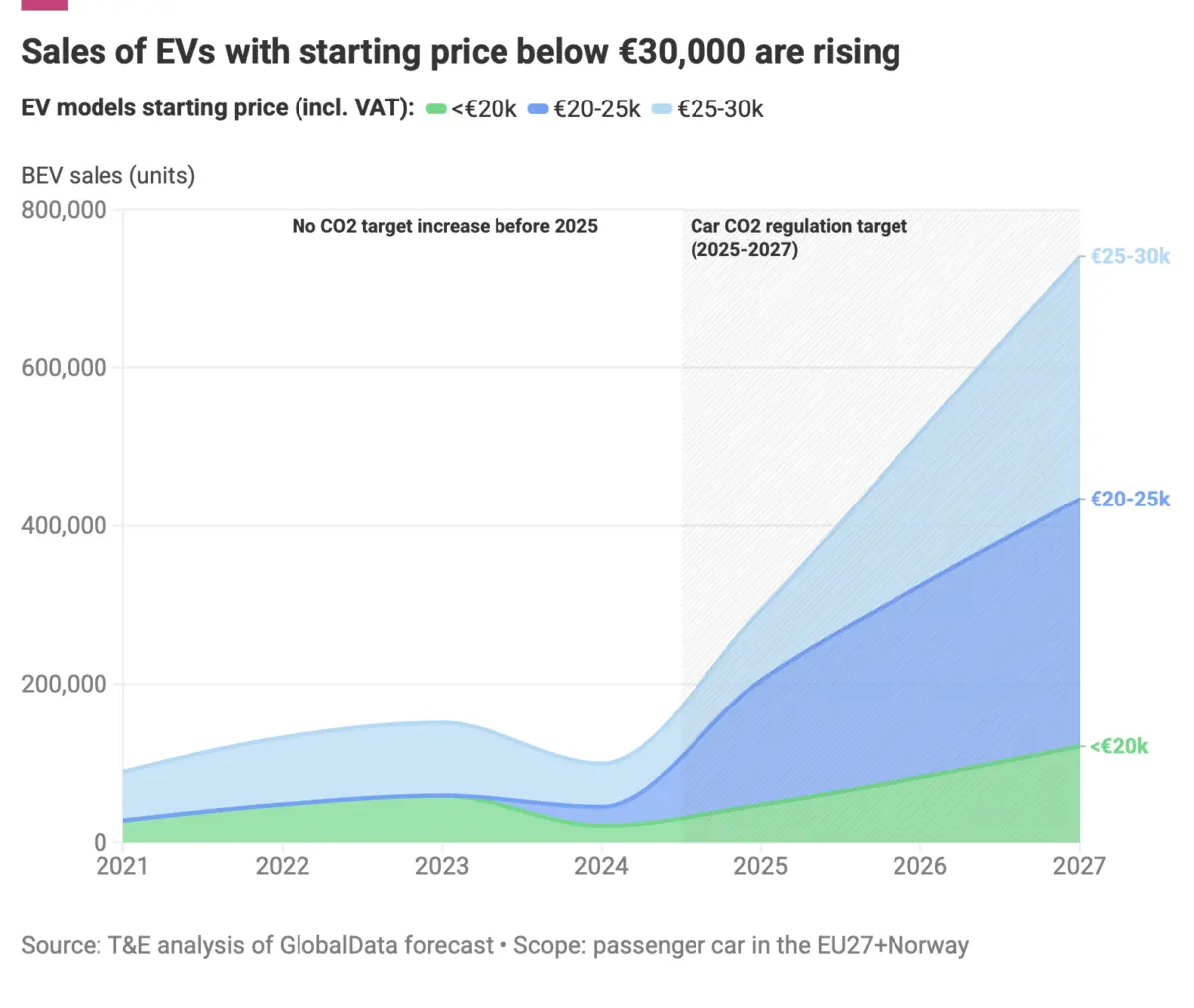
To understand the unprecedented momentum of the current EV market, one must examine the regulatory stagnation of the early 2020s. Between 2021 and 2024, EU fleet emission targets remained largely flat. During this period, legacy European carmakers frequently pointed to a perceived "lack of consumer demand" as justification for their sluggish rollout of affordable battery-electric vehicles.
Automotive boardrooms heavily prioritized high-margin, large-format luxury SUVs and performance hybrids, arguing that battery chemistry costs and supply chain constraints made sub-$30,000 electric hatchbacks economically unviable. Consequently, the average European consumer faced a frustratingly limited selection of expensive models, capping market penetration and fueling a narrative that mass-market electrification was moving too fast.
The 2025–2027 Regulatory Catalyst
The landscape shifted dramatically with the approach of the tighter 2025–2027 EU CO2 reduction phases. Designed to incrementally ratchet down average fleet emissions, these targets served as an inescapable regulatory compliance hammer for European original equipment manufacturers (OEMs). Suddenly, compliance was no longer optional; failure to sell a critical mass of zero-emission vehicles meant multi-billion-euro regulatory fines.
Faced with this reality, automakers fundamentally altered their production pipelines. Rather than paying penalties to the European Commission, manufacturers rapidly redirected capital toward developing and scaling affordable architectures. The results have shattered previous industry assumptions about consumer behavior and manufacturing viability.
The first half of 2026 marked a watershed moment for European electromobility. The report highlights that nearly 40 new electric models debuted in the first six months of the year alone, driving the total number of available mass-market BEVs past the 150 mark. Furthermore, industry analysts project that roughly 60 additional new models will hit showrooms by the close of 2026.
To put this acceleration into perspective, the rate of new model introductions in 2026 is nearly four times higher than the annual average of just 15 models per year recorded between 2021 and 2024. Crucially, automotive designers and product planners finally turned their attention to the sub-€25,000 segment. The number of models available at this critical price point doubled almost overnight, unlocking massive, pent-up consumer demand that legacy executives had previously claimed did not exist.
Supporting Context & Metrics: Sales Records and Oil Shock Economics
Record-Breaking Market Share and Registrations
The convergence of aggressive new vehicle launches, maturing battery supply chains, and external economic pressures propelled EU electric car sales to unprecedented heights in 2026.
Data compiled through August 2026 reveals that a staggering 1.64 million battery-electric vehicles (BEVs) were registered across the European Union, representing a robust 45% increase compared to the same period in the previous year. This upward trajectory reached a historic milestone in the second quarter of 2026, when BEVs officially outsold pure petrol cars across a full quarter for the first time in history, capturing an impressive 22% market share.
Industry analysts note that all major European carmakers are currently on track to achieve full compliance with the 2025–2027 targets—proving conclusively that the regulatory framework was the single most vital catalyst for the current EV wave.
The Geopolitical Oil Shock and Running Cost Savings
While regulatory compliance forced automakers’ hands, the external economic environment created an undeniable consumer imperative to ditch internal combustion engines (ICE).
The recent oil price shock—exacerbated by regional conflict in the Middle East, including the Iran war—has collectively cost EU road users an estimated €53 billion. By mid-September, filling a standard 50-litre diesel tank cost European motorists roughly €30 more than it did prior to the crisis.
In stark contrast, electric vehicle owners enjoyed insulated running costs. According to T&E’s calculations, a driver who made the switch to an electric vehicle at the onset of the oil crisis would have accumulated roughly €350 in pure running cost savings by mid-September alone. When compounded over the annual mileage of an average European driver, the total cost of ownership (TCO) advantage of BEVs has become an overwhelming economic argument, completely neutralizing historical anxieties regarding upfront vehicle purchase prices.
The Volkswagen Case Study: Proving Demand Existed
Nothing debunked the myth of "low consumer demand" quite like the market debut of Volkswagen’s long-awaited affordable EV hatch, the ID. Polo.
Priced accessibly for the mass market, the ID. Polo was met with a tidal wave of consumer enthusiasm. The vehicle was virtually sold out almost immediately upon opening order books, racking up over 40,000 firm orders and triggering a staggering 10-month waitlist for eager buyers.
This single model launch served as an empirical indictment of previous automotive lobbying efforts. The issue across the European market was never a lack of consumer appetite for electric cars; rather, it was a systemic failure by legacy manufacturers to offer reasonably priced, well-designed products that met the financial reality of ordinary households.
Official Statements: Industry Perspectives on the Regulatory Battle
The success of the EU’s clean car targets has intensified political lobbying in Brussels. Conservative political blocs and certain industrial associations have floated proposals to water down or delay the upcoming 2030 and 2035 zero-emission milestones, citing transitional pressures on manufacturing plants.
Weighing heavily against these dilution efforts, Lucien Mathieu, Cars Director at Transport & Environment (T&E), issued a sharp critique of the automotive industry’s historical posture and a stern warning regarding future policy decisions:
"European drivers are finally seeing more of the smaller and more affordable electric cars they have been waiting for. The oil crisis has further fuelled the rush by European consumers for affordable small electric cars. VW’s ID. Polo was quickly sold out, with over 40,000 orders and a 10-month waitlist.
European car makers were complaining about the lack of demand for a long time. Now we can clearly see: The issue was not the demand, but what they had to offer. The consumer’s appetite for small affordable electric cars proves the car makers’ claims wrong."
Addressing the existential danger of regulatory rollbacks, Mathieu added:
"The EU’s car targets are expanding consumer choice, bringing down the cost of going electric and giving European manufacturers a chance to compete in the global EV race. Weakening the 2030 target now would choke off affordable models by nearly three-quarters just as they are reaching the market and lock millions across Europe into debilitating oil dependency."
Future Outlook: The Global EV Race and Europe’s Decisive Crossroads
As Europe looks past the immediate successes of 2026, the continent stands at a definitive crossroads. The global automotive landscape is shifting at a blistering pace. Chinese automakers, armed with highly efficient domestic supply chains, sophisticated software ecosystems, and highly competitive cost structures, are aggressively expanding their footprint across global export markets, including Latin America, Southeast Asia, and increasingly, Europe itself.
For European legacy automakers—long considered the crown jewels of industrial manufacturing—competing in this new global paradigm requires absolute focus, rapid innovation, and unyielding scale. The current generation of sub-€25,000 EVs rolling off European assembly lines represents the opening salvo in this industrial battle.
However, developing affordable, profitable electric vehicles requires massive upfront capital expenditure in battery gigafactories, software engineering, and re-tooled manufacturing plants. This capital allocation is entirely dependent on regulatory certainty. If the European Union succumbs to short-term political pressure and dilutes its 2030-2035 CO2 targets, the foundational business case for mass-market electrification will fracture.
Modifying the targets would instantly relieve the compliance pressure on automakers, risking a dangerous retreat into high-margin ICE or hybrid placeholders. Such a policy reversal would choke off the pipeline of affordable BEVs by an estimated 75%, leaving European manufacturers dangerously uncompetitive against fast-moving global rivals while simultaneously exposing European citizens to future oil price volatility.
Ultimately, the data from 2026 tells an unambiguous story: when given the right regulatory push and access to reasonably priced options, European consumers are ready, willing, and eager to embrace the electric transition. Protecting and enforcing the EU’s clean car targets is no longer merely an environmental imperative; it is the ultimate safeguard for Europe’s economic resilience, energy security, and industrial future.