








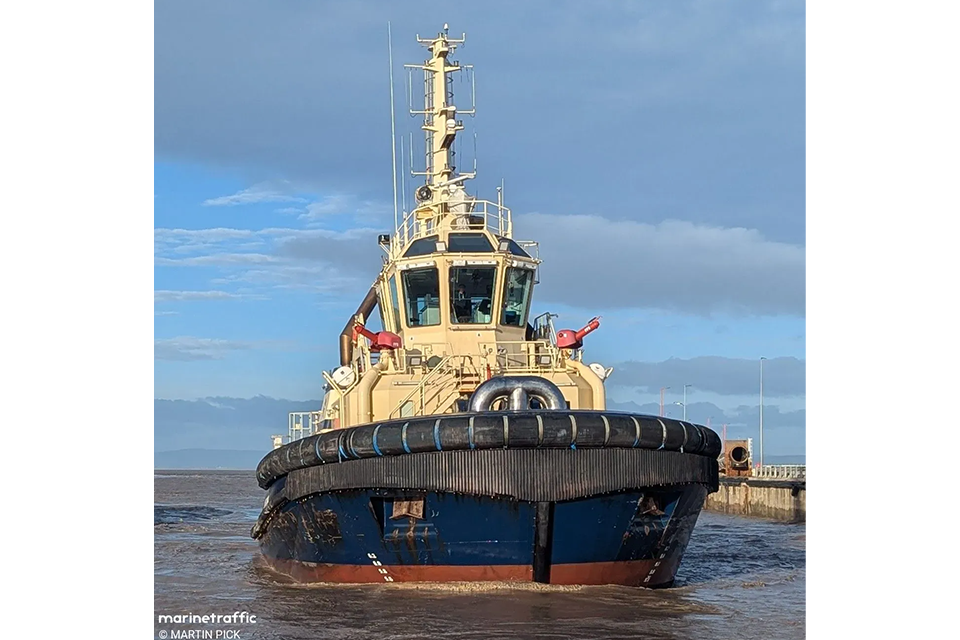
Maritime safety regulators have issued a stern warning to the commercial towage sector following a dramatic near-miss incident in the United Kingdom. On the evening of February 4, 2025, the UK-registered harbor tug Svitzer Avon suffered a catastrophic towline failure while assisting a massive car carrier into the Royal Portbury Dock in Bristol, England. The resulting snapback hurled the heavy-duty tow rope backward with immense kinetic energy, shattering both the forward and stern wheelhouse windows of the tug and blanketing the bridge in flying glass.
Miraculously, the two crew members inside the wheelhouse—the relief master and the mate—escaped with only minor injuries. However, the severity of the structural damage and the sheer unpredictability of the flying debris highlight a systemic vulnerability that continues to plague maritime operations.
Following a preliminary assessment of the incident, the UK’s Marine Accident Investigation Branch (MAIB) has officially closed the investigation, but not without delivering a blistering critique of the vessel’s operator, Svitzer Marine Limited. The Chief Inspector of Marine Accidents took the unusual and forceful step of writing directly to the company’s managing director, expressing deep concern that towline failures have become dangerously "normalised" within the industry. The regulator has urged the operator to immediately overhaul its safety protocols, address outstanding safety recommendations, and take tangible steps to shield crews from the devastating physics of snapback phenomena.
This report examines the minute-by-minute breakdown of the incident, the environmental and operational factors at play, the technical specifications of the vessels involved, and the broader ramifications for safety standards across the global towage industry.
Detailed Chronology: The Night of February 4, 2025
The sequence of events on the evening of February 4 began like any routine harbor assist operation, but rapidly escalated into a high-risk emergency under the cover of darkness.
Departure and Positioning (19:54 – 20:03)
At approximately 1954, two UK-registered tugs, the Svitzer Avon and the Svitzer Brunel, slipped their moorings and cleared the lock at Royal Portbury Dock, Bristol. Their objective was to rendezvous with the incoming deep-sea car carrier Auto Eco, which was navigating the King Road approaches ahead of its entry into the port. A marine pilot had already boarded the Auto Eco to oversee the maneuver, and the ship was slated to employ both tugs for a coordinated ship-assist move through the lock system and onward to its designated berth.
On board the Svitzer Avon, a division of labor had been established prior to departure. A relief master—who held the necessary type qualifications for the vessel class but possessed comparatively little hands-on operational experience aboard this specific tug—was acting in a supervisory capacity. Beneath him, the mate was actively at the vessel’s controls, handling the maneuvering requirements for the initial transit.

By 2003, the Svitzer Avon had successfully maneuvered into position astern of the massive car carrier. The tug’s crew prepared and passed the primary towline to the Auto Eco’s mooring deck. The connection was established using a tow rope and pennant, joined by a cow hitch, deployed via a heaving line and messenger rope. Once hauled aboard the car carrier, the line was made fast to a secure bollard. On the tug, the tow rope passed through the forward staple and was held firmly by the winch brake. Although the tug was fully equipped with a dynamic render system designed to ease sudden tension loads, it was not engaged during this phase of the operation.
The Maneuver and Escalating Tension (20:09 – 20:11)
At 2009, the pilot on board the Auto Eco radioed the Svitzer Brunel, instructing the bow tug to stand by on the ship’s port bow. Almost immediately afterward, the pilot issued a direct command to the Svitzer Avon astern: "25% straight back."

As the Auto Eco began executing a critical turn to line up its approach toward the lock entrance, dynamic hydrodynamic forces began to mount. Simultaneously, the Svitzer Avon was actively maneuvering to maintain its precise position directly astern of the moving vessel.
At approximately 2011, the delicate balance of forces was disrupted. An overcorrection in handling occurred as the tug and ship interacted within the constrained waterway. This sudden miscalculation caused the Svitzer Avon to violently shear and heel over to one side.
The Snapback and Wheelhouse Impact (20:11)
The sudden, violent movement of the tug dramatically increased the load on the towline far beyond normal operational parameters. Unable to compensate dynamically—due in part to the disengaged render system—the main tow rope parted instantly under the immense strain.
The physics of a parting towline are notoriously violent. Stored elastic energy instantly released, causing the heavy rope to recoil with supersonic speed toward the tug. The recoiling line violently struck the Svitzer Avon’s wheelhouse structure, the kinetic impact shattering the forward windscreen glazing completely. The concussive wave and flying debris were so severe that the stern window of the wheelhouse also shattered from the pressure and secondary impacts.
A cloud of pulverized safety glass and structural fragments filled the bridge enclosure, resulting in minor lacerations and trauma to both the master and the mate who were stationed at the controls.
Post-Incident Recovery and Medical Response
Despite the shock of the explosion-like impact and their injuries, the crew’s training immediately took over. The master and mate quickly checked one another for catastrophic trauma or life-threatening injuries. Recognizing that the Auto Eco was still unmoored and in the middle of a complex transit, the crew of the Svitzer Avon maintained operational composure. They rapidly coordinated with the bow tug, Svitzer Brunel, to swap tasking arrangements and safely complete the ship-assist maneuver.
Once the Auto Eco was safely secured alongside its berth, the Svitzer Avon broke away and maneuvered back to the dockside, where a port medical team was waiting. The injured master and mate were promptly transferred via ambulance to a local hospital, where they received medical treatment for their cuts and bruising before being discharged later that same day.
Supporting Context & Metrics
To fully understand the Svitzer Avon incident, one must examine the physical and environmental parameters present at the time of the casualty, as well as the technical profiles of the vessels involved.
Environmental Conditions
The incident occurred during night operations under challenging hydrodynamic conditions:
- Date and Time: February 4, 2025, at 20:11 GMT.
- Location: Royal Portbury Lock approach ($51^circ30.2’textN; 002^circ43.9’textW$).
- Weather: Cloudy with fair visibility, but accompanied by a steady South-South-West wind blowing at Force 4.
- Sea State: Slight to moderate sea conditions, featuring an underlying 0.5-meter swell.
- Tidal Influence: A powerful East-North-East flood tide running at a swift 3.5 knots, creating significant cross-current pressures on maneuvering vessels operating in the lock approaches.
Vessel Particulars: Svitzer Avon
- Vessel Name: Svitzer Avon
- Flag: United Kingdom
- Classification Society: American Bureau of Shipping (ABS)
- IMO Number: 9788162
- Vessel Type: Harbor and Coastal Tug
- Registered Owner: Svitzer EuroMed B.V.
- Management: Svitzer Marine Limited
- Construction Material: Steel
- Year of Build: 2017
- Length Overall (LOA): 28.2 meters
- Gross Tonnage: 461 GT
- Minimum Safe Manning: 3 crew members
- Actual Crew On Board: 5 personnel
Voyage and Operational Particulars
- Port of Departure: Royal Portbury Dock, Bristol, England
- Port of Arrival: Royal Portbury Dock, Bristol, England
- Voyage Type: Internal waters / Port towage operations
- Cargo Information: Not applicable (Light tug transit and assist setup)
- Vessel Operation: Ship-assist towing
- Voyage Segment: Arrival phase
Official Statements and Regulatory Scrutiny
The aftermath of the Svitzer Avon casualty has triggered intense regulatory scrutiny, focusing not merely on the actions of the crew on the night of February 4, but on corporate safety culture and equipment management across the wider maritime industry.
The MAIB Position and Findings
While the formal MAIB investigation was closed following the implementation of initial local corrective actions and the existence of ongoing safety files (specifically MAIB Recommendation 2022/138), the findings carry a profound warning. The primary safety recommendation issued in the summary report focuses directly on structural and procedural defenses against snapback hazards:
"Undertake a fleetwide risk assessment to determine the level of risk associated with towline failure and snapback and the potential for impact by a line recoiling into wheelhouse windows, and, where appropriate, employ appropriate laminated glass or other defences to mitigate against the risk of flying glass injuring its tug crews."
A Direct Rebuke from the Chief Inspector
In an escalation of standard regulatory procedure, the Chief Inspector of Marine Accidents dispatched a formal, unvarnished letter to the managing director of Svitzer Marine Limited. The Chief Inspector made it unequivocally clear that regulators view the recurrence of such incidents with extreme alarm.
The letter highlighted a pervasive industry trend: towline failure has become dangerously "normalised." When equipment failures of this magnitude are treated as routine operational hiccups rather than near-miss catastrophic emergencies, the urgency to implement robust engineering controls evaporates. The Chief Inspector sharply criticized the operator for failing to adequately mitigate these risks and demanded that the company immediately re-evaluate its stance on past safety recommendations. Specifically, the operator was urged to review its response to MAIB Recommendation 2022/138, taking aggressive steps to both minimize the mechanical frequency of towline partings and physically harden wheelhouse structures to protect crew members from flying debris when lines fail.
Future Outlook: Implications for the Towage Industry
The harrowing experience aboard the Svitzer Avon serves as a stark wake-up call for commercial tug operators worldwide. Harbor assist operations inherently place vessels in high-stress, dynamic environments where split-second errors, heavy currents, and massive ship momentum intersect. When a towline parts under load, the energy released is comparable to a coiled spring loaded with tons of destructive force.
Moving forward, maritime safety experts argue that the industry must transition away from relying solely on procedural hazard avoidance toward comprehensive engineering defenses. Key areas slated for mandatory re-evaluation across progressive towage fleets include:
- Window Hardening and Laminated Glazing: Wheelhouses on modern tractor and ASD (Azimuth Stern Drive) tugs are frequently designed with expansive, uninterrupted lines of sight. However, standard tempered glass offers minimal resistance to high-velocity snapback impacts. The adoption of multi-layer laminated polycarbonate or ballistic-grade marine glass is expected to become an essential standard to prevent bridge penetration during line failures.
- Mandatory Render System Utilization: While towing winches are routinely outfitted with electronic or hydraulic render-recovery systems designed to pay out line when tension exceeds safe thresholds, operators frequently lock or bypass these systems during delicate ship-assist maneuvers to maintain tight positional control. Training regimens must emphasize that safety systems cannot be sidelined for operational convenience.
- Ergonomic and Crew Resource Management (CRM): The incident underscored the challenges of pairing type-qualified relief personnel with specific vessel platforms under high-stress conditions. Enhanced familiarity training, robust bridge resource management, and conservative operational limits during adverse tidal streams will be critical in preventing overcorrection errors.
- Corporate Accountability: By calling out the "normalisation" of towline failures, the MAIB has signaled a zero-tolerance regulatory attitude toward recurring mechanical failures. Fleet operators can expect heightened audits, stricter adherence to inspection intervals for synthetic and wire tow ropes, and mandatory implementation of load-monitoring telemetry.
Ultimately, the crew of the Svitzer Avon walked away from this incident with minor injuries, but the maritime community recognizes that the line between a minor casualty and a multi-fatality disaster was razor-thin. If commercial operators heed the warnings of marine regulators, the hard-learned lessons from the Bristol Channel may finally force a permanent culture shift in how the industry manages the immense energies of ship-assist towing.