By Global Maritime Correspondent
Published October 10, 2026
Executive Overview
In what maritime authorities are calling an extraordinarily rare and miraculous survival story, a 44-year-old Salvadoran national was pulled alive from the open waters of the Ionian Sea early on October 10, 2026, roughly 20 hours after going overboard from Royal Caribbean International’s Odyssey of the Seas.
The woman, whose identity has been withheld out of respect for her privacy, was spotted by a passing commercial cargo vessel approximately 70 nautical miles southwest of the Greek island of Zakynthos. A Hellenic Coast Guard vessel subsequently recovered her alive and conscious before transporting her ashore to Katakolo for urgent medical treatment.
The incident triggered a massive, multi-agency international search and rescue (SAR) operation coordinated by the Hellenic Coast Guard’s Joint Search and Rescue Coordination Center (EKSED). While surviving an extended period in open ocean waters is statistically improbable—often hindered by severe hypothermia, dehydration, exhaustion, and the vastness of the sea—this case stands as a testament to determined rescue coordination, favorable environmental conditions, and sheer human endurance.
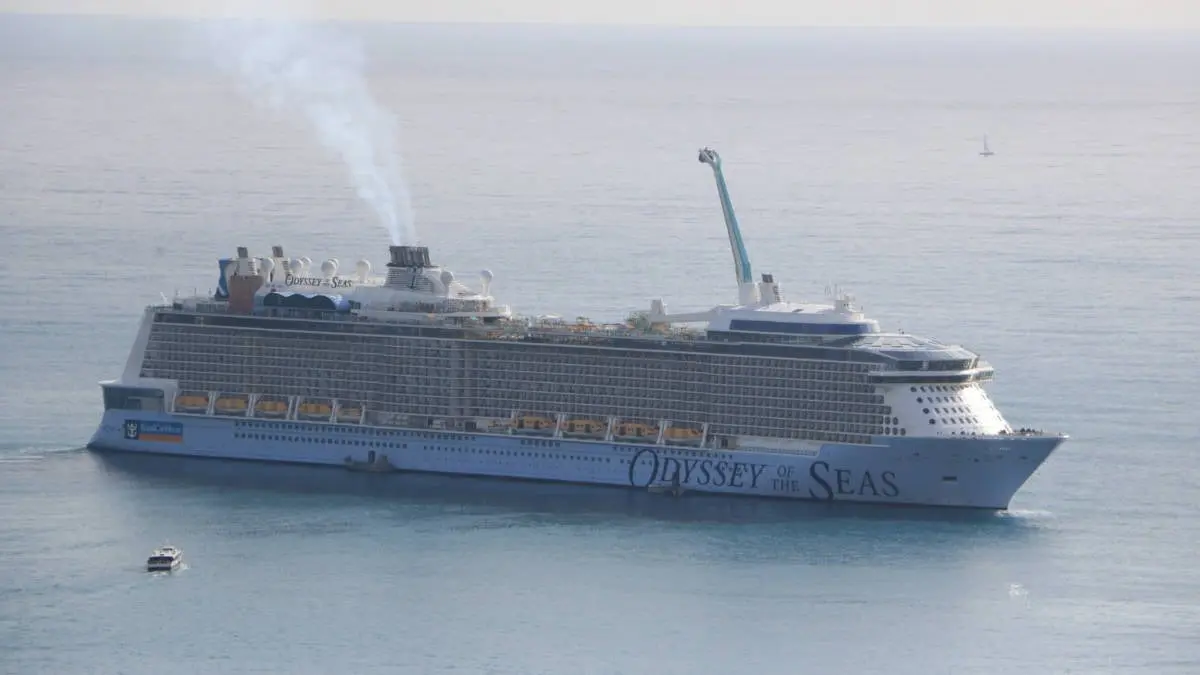
For the 4,198 guests aboard the 167,704-gross-ton Odyssey of the Seas, the dramatic event abruptly altered the final days of a seven-night Greek Isles voyage, forcing the ship to suspend its itinerary, participate in extensive search patterns, and ultimately bypass its scheduled final port of call in Naples, Italy.
Detailed Chronology: From Emergency to Miracle Rescue
Phase 1: The Incident and Immediate Response
The ordeal began in the early morning hours of October 9, 2026. Odyssey of the Seas was navigating the waters of the Mediterranean, sailing from Mykonos toward Naples as part of a weeklong round-trip Greek Isles itinerary that had originally departed Civitavecchia on October 4.
At some point during the early morning hours, the 44-year-old passenger went overboard. Shipboard safety protocols—which include high-definition automated optical overboard detection systems, closed-circuit television (CCTV) monitoring, and bridge watch procedures—soon flagged the emergency.

Upon realizing a guest was missing and had entered the water, the captain of Odyssey of the Seas executed an immediate man-overboard maneuver. The massive 167,704-ton cruise ship stopped its forward momentum, turned around in the open sea, and retraced its path to begin a rigorous search and rescue pattern.
Phase 2: The Multi-Agency Search Operation
Cruise Hive and various maritime trackers reported that initial search efforts commenced approximately 72 nautical miles southwest of Zakynthos. Understanding the critical nature of time in open-water rescues, the Hellenic Coast Guard’s EKSED rapidly mobilized resources.
The search operation quickly evolved into a coordinated regional effort. It involved:
- The Cruise Ship Itself: Odyssey of the Seas actively participated in the grid search for approximately 14 hours, deploying shipboard spotters and utilizing its advanced maritime radar and search capabilities.
- Aviation Support: A Hellenic Air Force or Coast Guard search-and-rescue helicopter was dispatched to sweep the vast expanses of the Ionian Sea from the air.
- Passing Maritime Traffic: Multiple commercial vessels traversing the busy Mediterranean shipping lanes were alerted to assist in the visual search, scanning the swells for any sign of the missing woman.
Despite the intense surface and aerial sweeps throughout the daylight hours of October 9, immediate sightings yielded no results, raising concerns as night fell over the Ionian Sea. After contributing roughly 14 hours to the search and receiving clearance from maritime authorities as other assets took over the primary grid, Odyssey of the Seas was forced to resume its westward journey toward Italy to manage its remaining itinerary constraints.
Phase 3: The Discovery and Recovery
The breakthrough occurred in the early hours of October 10. According to reports from Greek outlet Ellada24, citing the Hellenic Coast Guard, a passing cargo ship sighted a person struggling in the water roughly 70 nautical miles southwest of Zakynthos.
The cargo ship immediately notified authorities, and a Hellenic Coast Guard rescue vessel was rushed to the coordinates. Rescuers successfully pulled the 44-year-old woman from the water conscious.
Passengers aboard Odyssey of the Seas learned of the incredible development at approximately 2:00 a.m. on October 10, when the ship’s captain made an official public announcement over the public address system. According to passenger accounts shared widely on community forums like Reddit, the captain confirmed that the woman had been found alive after spending nearly 20 hours adrift, and that she was being rushed to a hospital for evaluation and treatment, primarily for hypothermia.
Supporting Context, Statistics, and Environmental Factors
The Statistics of Overboard Survival
Incidents of passengers going overboard on cruise ships are rare, but when they do occur, survival rates are historically low. According to data compiled by industry groups like Cruise Lines International Association (CLIA) and independent maritime researchers, roughly 20 to 25 people go overboard across the global cruise fleet each year.

Of those incidents, the overall survival rate hovers below 25%. Survival depends heavily on a confluence of narrow variables:
- Immediate Notification: How quickly the bridge is alerted or the automated system detects the fall, allowing the ship to drop a marker and begin turning.
- Water Temperature: Hypothermia sets in rapidly in cold water. In warmer or temperate waters—such as the Mediterranean in early October—the human body can stave off fatal hypothermia significantly longer than in frigid northern seas.
- Sea State and Visibility: Calm seas, good visibility, and daylight drastically improve the chances of visual spotting.
- Physical and Mental Resilience: The individual’s ability to stay afloat, manage panic, and conserve energy over extended periods.
To survive nearly 20 hours in the open sea is an extraordinary anomaly. Medical professionals note that while hypothermia, severe dehydration, salt-water ingestion, and shock are major threats over a multi-hour period, temperate seasonal water temperatures in the Ionian Sea likely played a critical role in keeping the victim alive.
Vessel Profile: Odyssey of the Seas
- Class: Quantum Ultra-class
- Gross Tonnage: 167,704 GT
- Passenger Capacity: 4,198 (double occupancy) / Maximum capacity exceeding 5,500
- Crew Members: Approximately 1,550
- Homeport / Deployment: Operates various itineraries across the Caribbean, Mediterranean, and European waters.
The ship boasts state-of-the-art maritime engineering, safety technology, and stabilization systems. However, even the most advanced vessels face immense logistical challenges when executing a man-overboard search in open waters, where currents, wind drift, and wave action can displace a person miles away from their initial fall point within a matter of hours.
Official Statements and Industry Impact
While the Hellenic Coast Guard confirmed the logistical details of the rescue—highlighting the coordination between the cargo vessel, the coast guard cutter, and EKSED—official statements regarding the exact medical condition of the survivor and the precise circumstances leading to her fall remain limited. Medical privacy laws and ongoing investigations by maritime authorities mean that detailed disclosures regarding how the woman went overboard are not yet public.
Royal Caribbean International has maintained a measured approach, focusing on operational updates for its guests and cooperating fully with maritime search authorities. The cruise line has not released a broader corporate statement beyond the direct communications provided to the passengers onboard Odyssey of the Seas.
Itinerary Disruption and Guest Reactions
The humanitarian mission exacted a heavy toll on the ship’s operational schedule. Odyssey of the Seas was slated to make its final port call of the cruise in Naples, Italy, on October 10, allowing guests a final day ashore before returning to Civitavecchia.
Because the vessel spent roughly 14 hours actively participating in the grid search, the transit time required to reach Naples was compromised. Consequently, Royal Caribbean made the operational decision to cancel the Naples call entirely.
Passengers were informed that their scheduled day in Naples would instead become a full day at sea as the ship bypassed the Italian port and tracked directly toward Civitavecchia. Despite the disappointment of missing a major destination, the overarching sentiment among passengers on social media platforms like Reddit was overwhelmingly understanding, prioritizing the preservation of human life over sightseeing.
“Our day in Naples has been cancelled,” wrote one guest on Reddit. “Just hope the disruption to everyone’s travel plans will be kept to a minimum.” Another cruiser echoed the sentiment, noting that the entire ship community was relieved and astonished to hear the captain’s 2:00 a.m. announcement that the missing woman had been found alive.
According to latest cruise ship tracking data, Odyssey of the Seas successfully navigated past the Italian coastline toward Civitavecchia. Royal Caribbean has confirmed that the scheduled disembarkation on October 11 will proceed as planned, and no operational impacts have been announced for the subsequent seven-night Greek Isles voyage departing later that same day.
Future Outlook and Ongoing Investigations
As the 44-year-old Salvadoran national continues her recovery under medical supervision in Greece, maritime investigators from the Hellenic Coast Guard are expected to conduct formal interviews to piece together the sequence of events that led to her falling overboard.
Key questions likely to be addressed in the investigation include:
- At what exact time did the incident occur, and what were the environmental conditions at that specific coordinate?
- Did shipboard camera systems or automated sensors capture the event?
- What medical therapies are being administered to manage her recovery from prolonged exposure and hypothermia?
For the global cruise industry, this dramatic event will undoubtedly reignite discussions surrounding the efficacy of advanced overboard detection technologies, safety railing standards, and the psychological support services available aboard modern mega-ships.
Yet, for now, the primary narrative remains one of profound relief. In an industry where search-and-rescue operations too often end in tragedy, the resurrection of hope in the Ionian Sea stands as a rare and triumphant reminder of the resilience of the human spirit and the unwavering dedication of international maritime rescue networks.