








Executive Overview
In a milestone decision that marks a watershed moment for American public transportation and environmental policy, the Los Angeles County Metropolitan Transportation Authority (LA Metro) board of directors officially approved a massive contract award on September 24. The board’s green light authorizes the procurement of 220 state-of-the-art, 40-foot AXESS EVO-BE battery-electric transit buses. Manufactured by ENC—a prominent subsidiary of Rivaz Inc.—this historic agreement stands as the largest single base award of 40-foot battery-electric transit buses ever executed by a U.S. public transit agency.
This high-stakes procurement is far more than a routine fleet upgrade; it represents a foundational pillar in Southern California’s aggressive strategy to transition entirely to a zero-emission public transportation network. As urban centers across the globe grapple with the escalating realities of climate change, poor urban air quality, and the imperative to modernize aging municipal infrastructure, LA Metro’s investment positions the agency at the vanguard of the global transit revolution.
Valued significantly in both financial terms and environmental impact, the agreement underscores a growing paradigm shift within the public sector: a preference for domestically manufactured, highly reliable, zero-emission heavy-duty vehicles that simultaneously stimulate local economic growth and create high-quality manufacturing jobs. By partnering with ENC, LA Metro is not only modernizing its physical fleet but also casting a vote of confidence in the resurgent capacity of American manufacturing, specifically within the state of California.
The vehicles resulting from this procurement will be constructed entirely within the state, leveraging local labor, cutting-edge engineering, and stringent quality-control protocols. As these 220 advanced electric buses roll out onto the streets of Los Angeles County over the coming years, they will displace millions of pounds of carbon emissions, significantly reduce particulate pollution in densely populated urban corridors, and offer millions of daily riders a quieter, smoother, and more reliable transit experience.
Detailed Chronology of the Procurement and Board Approval
The path leading to the September 24 board approval was paved by years of strategic planning, rigorous vehicle testing, and collaborative policy-making between LA Metro, municipal leaders, and industry manufacturers. Understanding the magnitude of this contract requires examining the meticulous sequence of events that brought the largest electric bus procurement in U.S. history to fruition.
The Buildup: Aligning Regional Policy with Fleet Realities
For over a decade, LA Metro has operated under the shadow of ambitious local and state mandates, most notably the California Air Resources Board’s (CARB) Innovative Clean Transit (ICT) regulation. This mandate requires all public transit agencies in the state to transition 100% of their fleets to zero-emission buses by 2040. To meet—and ideally beat—this ambitious timeline, LA Metro’s leadership initiated a comprehensive audit of its existing fleet, identifying high-emission routes, aging diesel and compressed natural gas (CNG) vehicles, and operational bottlenecks that needed addressing.
Concurrently, the manufacturing landscape was evolving. Early generations of electric transit buses faced challenges regarding range, battery degradation, and reliability under punishing urban driving conditions. Recognizing these hurdles, ENC and its parent company, Rivaz Inc., invested heavily in research and development to produce a next-generation platform capable of meeting the rigorous operational demands of a major metropolitan transit provider like LA Metro.
The Rigorous Evaluation and Testing Phase
Before any multi-million-dollar contract can be awarded by a municipal transit authority of LA Metro’s scale, the candidate vehicles must undergo exhaustive evaluations. The ENC AXESS EVO-BE model underwent comprehensive testing at the Federal Transit Administration’s (FTA) Bus Testing Center in Altoona, Pennsylvania. Known industry-wide simply as "Altoona testing," this facility subjects transit vehicles to grueling simulations of structural integrity, durability, reliability, performance, braking, and fuel or energy economy.
The AXESS EVO-BE passed these trials with flying colors, proving its structural resilience—anchored by ENC’s proprietary 304-grade stainless steel frame—and demonstrating the efficiency of its heavy-duty electric drive architecture. These results provided LA Metro’s technical evaluators with the empirical data needed to recommend the vehicle for deployment across Los Angeles’s notoriously demanding and diverse topography, which ranges from coastal sea-level routes to steep inland grades.
The September 24 Board Vote
On September 24, the LA Metro board of directors formally convened to review the procurement recommendation. Following presentations by agency leadership detailing the financial structuring, delivery timelines, and environmental projections, the board cast its historic unanimous vote approving the award of 220 40-foot AXESS EVO-BE battery-electric transit buses to ENC.
The decision immediately reverberated through the public transit sector, signaling to peer agencies nationwide that large-scale electrification is not a distant, theoretical goal, but a practical, immediate reality achievable through decisive leadership and robust industrial partnerships.
Supporting Context & Metrics: Engineering Excellence and Industrial Scale
To appreciate the scope of this procurement, one must examine the technological sophistication of the vehicles being deployed and the industrial powerhouse responsible for their creation. The AXESS EVO-BE is not merely a conventional bus retrofitted with an electric motor; it is a ground-up engineering achievement designed to optimize energy efficiency, passenger comfort, and structural longevity.
Technical Specifications of the AXESS EVO-BE
At the heart of the AXESS EVO-BE is a sophisticated powertrain pairing ENC’s robust vehicle architecture with BAE Systems’ industry-leading Gen3 electric drive system. This integration provides seamless acceleration, regenerative braking, and optimal power delivery across varied urban topographies.
Key technical parameters of the procured buses include:
- Energy Storage Capacity: Equipped with up to 738 kWh of onboard energy storage, the buses are engineered to deliver extended operational ranges, allowing transit authorities to maintain demanding daily schedules without requiring frequent, disruptive mid-day recharges.
- Structural Integrity: Built upon ENC’s signature 304-grade stainless steel structure, the buses offer superior corrosion resistance and crashworthiness, ensuring a prolonged operational lifecycle that maximizes return on investment for taxpayers.
- Configurations & Accessibility: While the core of this specific LA Metro order focuses on the 40-foot configuration, the platform is adaptable across 33-, 35-, and 40-foot lengths. Every vehicle is fully ADA-compliant, featuring highly configurable interior floor plans designed to accommodate diverse community needs, including secure wheelchair restraints, priority seating, and optimal passenger flow dynamics.
Manufacturing Infrastructure: The Jurupa Valley Facility
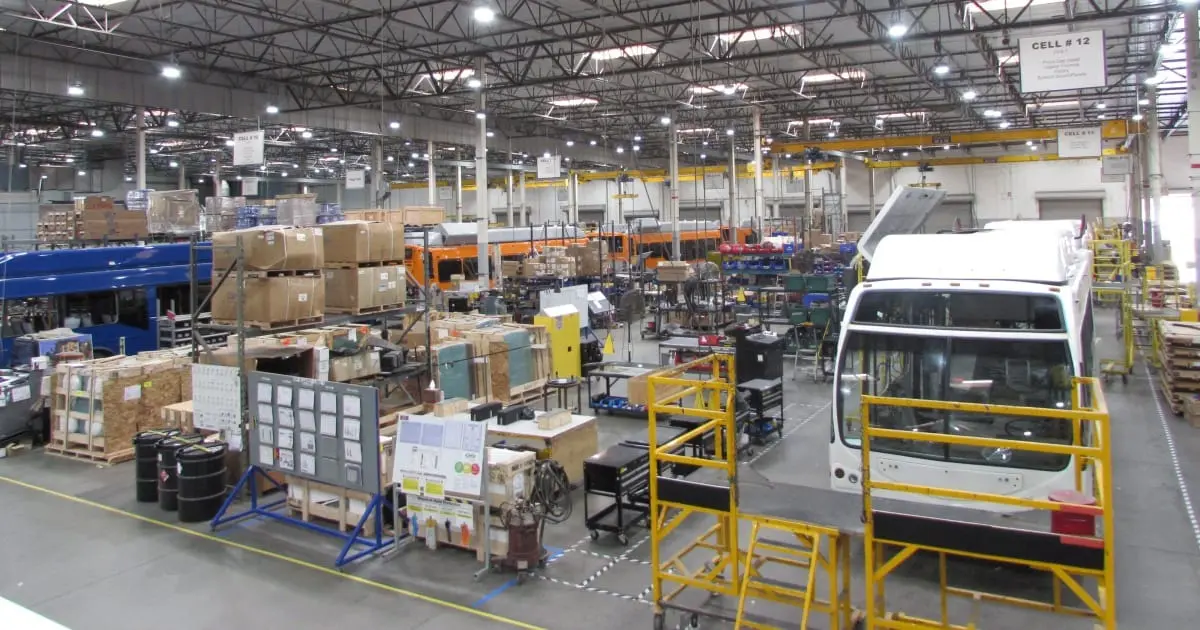
The production of these 220 advanced transit buses will take place entirely within the United States, specifically at ENC’s sprawling 227,000-square-foot, ISO 9001-certified manufacturing facility located in Jurupa Valley, California.
This facility serves as a vital anchor for regional manufacturing employment. More than 300 skilled Californians are currently employed at the plant, handling every intricate stage of the production lifecycle. Unlike operations that merely assemble pre-fabricated foreign components, ENC’s Jurupa Valley workforce executes full-spectrum manufacturing, including:
- Precision frame welding and structural fabrication.
- Advanced industrial painting and anti-corrosion treatments.
- Integration of complex electrical harnesses and heavy-duty propulsion systems.
- Comprehensive interior outfitting and rigorous final testing and quality assurance trials.
Corporate Reinvestment and Future Production Capacity
The stability and scalability of this production line have been significantly bolstered by recent capital infusions. Since Rivaz Inc. assumed ownership of ENC in 2024, the company has demonstrated an unwavering commitment to American manufacturing through strategic reinvestments exceeding $50 million. These funds have been systematically directed toward facility upgrades, advanced tooling, comprehensive workforce development initiatives, and rigorous production readiness programs.
Looking forward, ENC is not resting on its laurels. The manufacturer has unveiled ambitious expansion plans designed to scale its annual production capacity dramatically. Historically maintaining an output of 250 to 300 buses per year, ENC is positioning its Jurupa Valley operations to ramp up production to an impressive 800 to 1,000 buses annually within the next four to five years, ensuring the company can meet the surging national demand for zero-emission transit solutions.
Official Statements and Leadership Perspectives
The announcement of this historic partnership elicited strong reactions from key figures across the public sector and corporate leadership, highlighting the multifaceted benefits of the agreement—spanning environmental justice, economic development, and institutional trust.
LA Metro CEO Stephanie Wiggins emphasized the profound human and environmental impact of the procurement, framing clean transit as a fundamental equity issue for the communities the agency serves:
"Los Angeles County riders deserve clean, reliable transit and this award moves our region closer to a zero-emission bus fleet that brings cleaner air to the neighborhoods we serve. This investment will create good-paying jobs, strengthen our local economy, and provide our riders with more reliable service for years to come."
Echoing these sentiments, Jason Lee, Chief Executive Officer of ENC, highlighted the validation that this contract represents for his organization’s workforce and product line:
"Metro’s decision reflects confidence in our people, our product, and our ability to deliver at scale. We commend Stephanie Wiggins and the Metro team for the steady leadership that is moving Los Angeles County toward a cleaner, more modern transit system. ENC is ready to work with Metro on the next steps at full speed."
John Obert, Vice President of Transit Sales at ENC, underscored the importance of trust and local economic stewardship in executing a contract of this magnitude:
"An award of this scale is built on trust, and we intend to keep earning it every day. Our California team will build these buses close to the communities they serve, with the quality and reliability Metro riders count on. We are proud of the good jobs this work represents for hundreds of Californians, and of the role these buses will play in how Los Angeles County moves."
These statements reflect a shared philosophy between transit provider and manufacturer: that large-scale infrastructure projects must deliver dual dividends—advancing environmental sustainability while actively investing in the domestic workforce and local communities.
Future Outlook: Transforming Los Angeles Transit
As the ink dries on this landmark agreement, attention naturally shifts to the future. The integration of 220 battery-electric buses into LA Metro’s fleet over the coming years is set to trigger a transformative ripple effect across the region’s broader transit ecosystem.
Environmental and Public Health Impacts
The environmental dividends of displacing 220 internal-combustion or older CNG buses with advanced battery-electric alternatives cannot be overstated. Diesel and older fossil-fuel transit buses are major contributors to urban air pollution, emitting particulate matter (PM2.5), nitrogen oxides ($NO_x$), and greenhouse gases that disproportionately impact urban neighborhoods situated near major transit corridors and bus yards.
By replacing these legacy vehicles with zero-emission AXESS EVO-BE buses, LA Metro will directly improve air quality in some of Los Angeles County’s most environmentally vulnerable communities. This transition aligns seamlessly with federal and state environmental justice initiatives aimed at reducing the public health burden of transportation-related pollution.
Infrastructure and Operational Scaling
Operating a fleet of this scale requires parallel investments in supporting infrastructure. Alongside the vehicle procurement, LA Metro is actively expanding and upgrading its maintenance facilities and depot charging infrastructure. Ensuring that hundreds of electric buses can be charged overnight efficiently and reliably demands sophisticated smart-grid integration, high-capacity utility partnerships, and advanced fleet management software.
The operational data gathered from the rollout of these 220 buses will serve as an invaluable case study for other major metropolitan agencies navigating similar transitions. Maintenance crews, transit planners, and administrative staff will gain deep expertise in managing large-scale electric fleets, paving the way for subsequent procurement phases until LA Metro achieves its ultimate goal of a 100% zero-emission system.
A Blueprint for American Transit
Ultimately, the partnership between LA Metro and ENC sets a powerful precedent for the future of American public mobility. By demonstrating that a major transit authority can procure hundreds of advanced, zero-emission vehicles built entirely by domestic workers within the same state, the collaboration offers a viable blueprint for urban sustainability.
As these sleek, quiet, stainless-steel electric buses begin navigating the bustling boulevards and complex highways of Los Angeles County, they will carry more than just daily commuters. They will carry the tangible promise of a cleaner, greener, and more resilient urban future—proving that large-scale industrial ambition and environmental stewardship can travel hand-in-hand down the road ahead.