






Executive Overview
Despite the European Union’s public commitment to decouple its economy from Russian fossil fuels, the bloc’s financial relationship with Moscow’s Arctic energy crown jewel has reached unprecedented heights. New shipping data and financial analyses reveal that EU spending on Russian liquefied natural gas (LNG) from the Yamal project has already bypassed the entirety of last year’s total, exposing a glaring disconnect between Brussels’ geopolitical rhetoric and the physical realities of European energy markets.
Between January 1 and September 5, 2026, EU member states paid an estimated €7.28 billion for LNG originating from the Yamal project, located deep within the Russian Arctic. This figure already exceeds the €7.2 billion estimated for the entirety of 2025. The surge in expenditures is driven by a combination of volatile European gas prices and an absolute increase in cargo volumes arriving at European maritime terminals.
Yamal LNG Exports to EU (Jan-Aug Comparison)
=========================================================
Year    Cargoes    Volume (M tonnes)    EU Share of Exports
---------------------------------------------------------
2025    N/A        10.34M               78.2%
2026    156        11.39M (+10.1%)      89.0%
=========================================================
This trend highlights the ongoing reliance of Russia’s Arctic LNG trade on European infrastructure and maritime services. While the EU prepares for a comprehensive import ban set to take effect on January 1, 2027, European ports have effectively served as the primary commercial life support system for Russia’s northernmost gas fields. This dependence is highly structural, rooted in the seasonal physics of the Northern Sea Route (NSR) and a specialized fleet of ice-class tankers that rely on European shipyards and shipping companies to remain operational.
Detailed Chronology: The 2026 Import Surge
To understand how the EU arrived at this record-breaking spending level, it is necessary to examine the flow of Yamal LNG over the course of 2026.
   [Jan - Aug 2026]                                 [August 2026]                             [Sept 13-14, 2026]
EU imports 11.39M tonnes                      Northern Sea Route opens;                     European Arctic Summit
(89% of Yamal's global exports)               cargoes split between EU & Asia                held in Rovaniemi, Finland
         |                                                  |                                              |
         +--------------------------------------------------+----------------------------------------------+
                                                                                                           |
                                                                                                  [January 1, 2027]
                                                                                                 EU-wide import ban
                                                                                                 on Russian LNG begins
The Winter and Spring Monopolization (January–July 2026)
During the first eight months of 2026, Yamal LNG’s global exports actually contracted by 3.1%, falling to 12.82 million tonnes. However, this global decline did not translate to reduced volumes for Europe. Instead, Russian Arctic gas flows concentrated heavily toward European regasification terminals.
From January through August, EU ports received 156 Yamal LNG cargoes, carrying approximately 11.39 million tonnes of LNG. This represents a 10.1% increase compared to the same period in 2025. Consequently, the EU’s share of Yamal’s total global exports climbed to a staggering 89%, up from 78.2% during the first eight months of 2025.
During these colder months, thick ice sheets cover the Kara Sea and the East Siberian Sea, rendering the eastern passage of the Northern Sea Route impassable for standard vessels and highly perilous even for specialized icebreakers. As a result, Russia had little choice but to send its LNG west toward ice-free European waters.
The August Seasonal Shift
The commercial pattern shifted briefly in August, dictated by Arctic geography rather than Brussels’ policy. The seasonal melting of Arctic sea ice opened the eastern passage of the Northern Sea Route, allowing LNG tankers to navigate toward energy-hungry markets in East Asia without the assistance of heavy nuclear icebreakers.
During August, Yamal LNG deliveries were evenly split:
- To Europe: Seven cargoes totaling approximately 498,000 tonnes were delivered to EU ports—a 36% drop compared to August 2025.
- To Asia: Seven cargoes carrying roughly 494,000 tonnes went east toward Asian terminals.
Despite this brief seasonal diversion, the temporary opening of the Northern Sea Route did little to alter the broader reality: Europe remains the indispensable anchor market for Yamal LNG.
Supporting Context & Metrics: The Logistics of Arctic Energy
The persistent flow of Russian LNG into Europe is not merely a matter of buyer demand; it is dictated by specialized marine engineering and shipping logistics.
The Arc7 Ice-Class Bottleneck
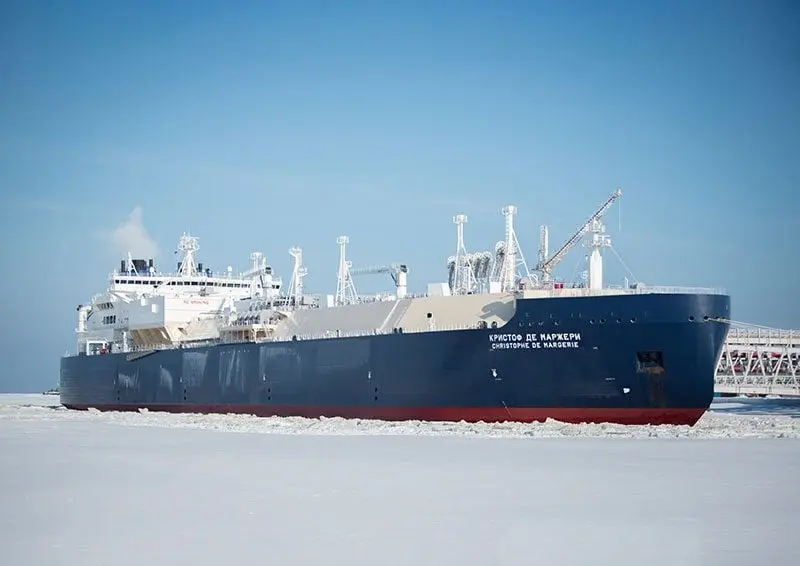
The Yamal LNG project, operated by Russian independent gas producer Novatek alongside international partners, is geographically isolated. Located on the Yamal Peninsula, the project relies on a highly specialized, limited fleet of Arc7-reinforced ice-class LNG carriers. These vessels are designed with reinforced hulls and specialized propulsion units that allow them to break through ice up to 2.1 meters thick.
Because the global fleet of Arc7 carriers is small and extremely expensive to build, maximizing their operational efficiency is critical for Novatek. Delivering cargo to European terminals like Zeebrugge in Belgium, Montoir-de-Bretagne in France, or Bilbao in Spain requires a much shorter round-trip voyage than sailing to Asia.
Yamal LNG Shipping Dynamics
=====================================================================
Route                  Typical Round-Trip Time    Seasonal Feasibility
---------------------------------------------------------------------
Yamal to West Europe   Approx. 10–14 days         Year-round
Yamal to East Asia     Approx. 30–40 days         Summer/Autumn only
=====================================================================
By unloading their cargoes at European ports, Arc7 tankers can quickly return to the Yamal Peninsula to load more gas. During winter, when the eastern route to Asia is completely blocked, these short-distance western shuttle runs are the only way to keep the Yamal production facilities from shutting down due to storage capacity limits.
The Role of European Shipowners and Maritime Services
Despite geopolitical tensions, European maritime service providers remain deeply integrated into the Yamal supply chain. An analysis of shipping registries reveals that two major European-linked shipping entities dominated Yamal exports between January and August:
- Seapeak (Glasgow-based): Its managed Arc7 vessels carried 65 Yamal cargoes, totaling 4.73 million tonnes.
- Dynagas (Greece-based): Its vessels handled 62 cargoes, totaling approximately 4.5 million tonnes.
Together, these two shipping groups accounted for roughly 72% of all Yamal LNG exports during the eight-month period.
Furthermore, the Arctic LNG fleet continues to rely on European shipyards for specialized technical maintenance. According to the German environmental and human rights organization Urgewald, Denmark’s Fayard shipyard is the last identified EU shipyard actively servicing the Arc7 fleet. Specifically, the Dynagas-operated Arc7 carrier Boris Davydov was documented undergoing maintenance at the Fayard facility starting August 29, highlighting a key regulatory loophole in the current EU sanctions regime.
Official Statements & Policy Advocacy
The publication of these figures by Urgewald, based on shipping data from Kpler, was timed to coincide with the European Arctic Summit in Rovaniemi, Finland. The summit brings together European policymakers, regional security experts, and environmental advocates to discuss the growing geopolitical and security challenges in the Arctic circle.
Civil Society and Advocacy Demands
Urgewald and allied environmental groups are leveraging these findings to demand immediate, decisive action from European leadership. Environmental advocates argue that the billions of euros flowing from European utility companies to Yamal LNG directly fund the Kremlin’s state budget and its military operations.
In an official statement, Urgewald urged EU member states to systematically dismantle the logistics network that supports Russia’s northern energy projects:
"The European Union cannot claim to stand for regional security and climate leadership while simultaneously serving as the primary financial guarantor and maritime service provider for Russia’s Arctic expansion. We urge EU governments to target the Arctic LNG trade in the upcoming 22nd sanctions package. This must include explicit, watertight bans on the sale of LNG tankers to Russian entities, a prohibition on European shipyards servicing ice-class vessels, and a ban on European insurers underwriting these cargoes."
Methodological Notes on Financial Estimates
Urgewald’s payment figures are calculated estimates rather than direct, reported sales revenues, as contract-level pricing for LNG is proprietary and highly guarded. The group calculated the €7.28 billion figure using:
- Actual delivered volumes at EU ports as tracked by Kpler.
- Standard energy conversion factors (converting metric tonnes of LNG to megawatt-hours or million British Thermal Units).
- Monthly average prices on the Dutch Title Transfer Facility (TTF), which serves as the European benchmark for natural gas pricing.
Because these are estimates based on spot market benchmarks, they do not account for long-term contract discounts, shipping tariffs, port fees, pipeline transit costs, or freight insurance adjustments. However, market analysts agree that the figures accurately reflect the scale of the capital transfer from European buyers to Russian state-aligned energy entities.
Future Outlook: The 2027 Cliff
The ultimate test for both European energy resilience and Russia’s Arctic export strategy will arrive on January 1, 2027.
                 [JANUARY 1, 2027: EU BAN TAKES EFFECT]
                                   |
         +-------------------------+-------------------------+
         |                                                   |
         v                                                   v
[The Challenge for Russia]                         [The Challenge for Europe]
* Winter ice blocks eastern route to Asia          * Must replace ~11-12M tonnes of LNG
* Shortage of non-EU winter transshipment hubs     * Potential upward pressure on TTF prices
* Risk of production shut-ins at Yamal             * High dependence on US and Qatar imports
The Logistical Challenge for Russia
On this date, the EU’s comprehensive ban on Russian LNG imports is scheduled to take effect. Unlike previous sanctions packages that targeted transshipments (the unloading and reloading of Russian LNG for transport to non-EU nations), the 2027 ban will prohibit the import of Russian LNG into the European domestic grid.
When this ban takes effect, Yamal LNG will face a severe logistical crisis:
- The Winter Bottleneck: During the winter of 2027, the Northern Sea Route to Asia will be frozen solid. Without access to European terminals to unload gas, Arc7 tankers will have nowhere to go.
- Storage Limitations: LNG production facilities cannot easily be turned off. If LNG cannot be shipped out, storage tanks at the Yamal facility will fill up within days, potentially forcing Novatek to shut in production wells—a technically difficult and expensive process in permafrost conditions.
- The Search for Alternatives: Russia may attempt to bypass the ban by utilizing ship-to-ship (STS) transfers in international waters or by finding non-EU Mediterranean partners willing to act as intermediaries. However, doing so during the winter storm season in northern waters presents extreme environmental and logistical risks.
The Supply Challenge for Europe
For Europe, the ban will eliminate a significant portion of its winter gas supply. Replacing 11 to 12 million tonnes of annual LNG imports will require increased deliveries from the United States, Qatar, and North African pipeline suppliers. While European gas storage infrastructure has been well-maintained since the 2022 energy crisis, the complete removal of Yamal LNG from the European balance sheet is highly likely to introduce fresh volatility into Dutch TTF benchmark prices.
As the political deadline of 2027 approaches, the surging import figures of 2026 serve as a stark reminder of the difficulty of decoupling. The coming months will reveal whether Europe can successfully sever its final maritime links to Russia’s Arctic wealth, or if economic necessity will find new ways to bypass geopolitical resolve.