Georgia’s ambitious drive to reshape Black Sea maritime commerce has reached a critical operational milestone. The development of the Anaklia Deep Sea Port—a cornerstone infrastructure undertaking designed to elevate Georgia into a premier Eurasian trade and logistics hub—has entered a high-intensity phase of marine civil engineering.
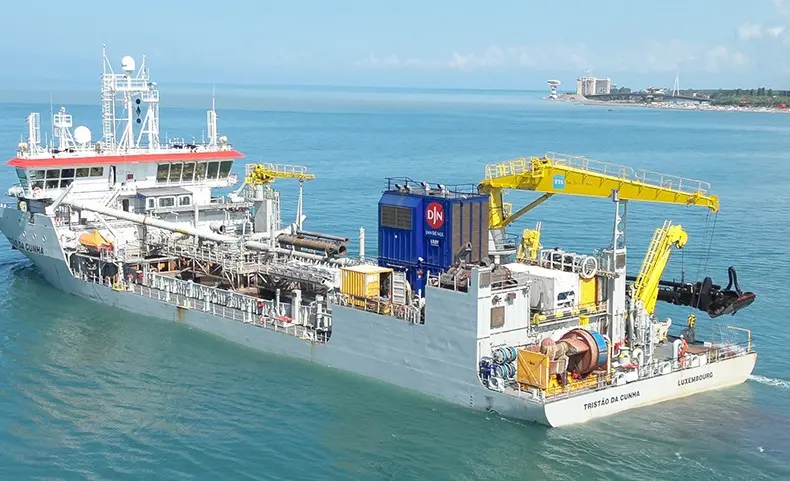
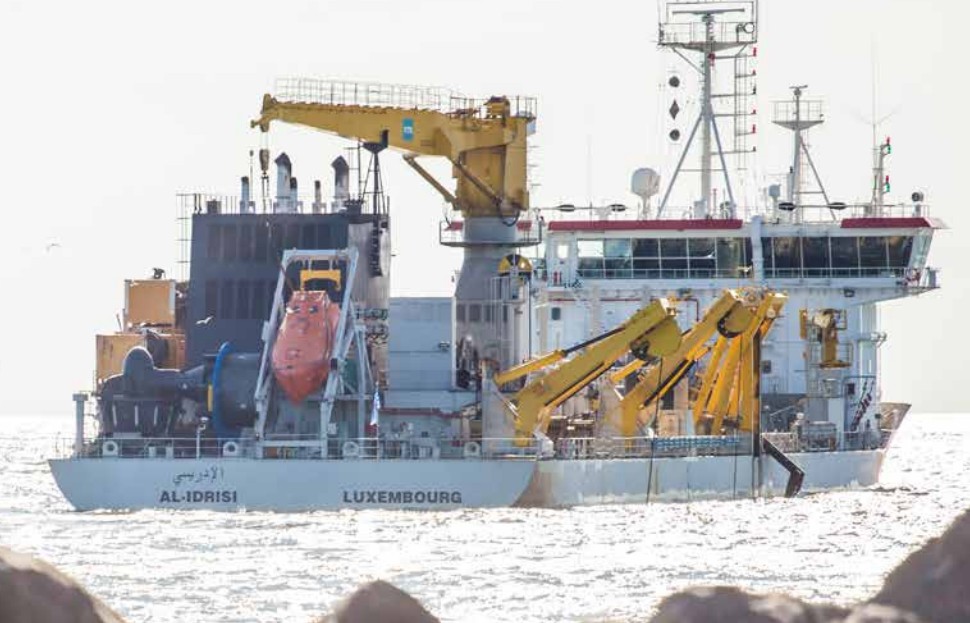
Following the successful deployment of Jan De Nul’s trailing suction hopper dredger (TSHD) Tristão da Cunha, which officially kicked off foundational dredging operations last week, global dredging and marine engineering heavyweight Jan De Nul is further reinforcing its operational capacity. A second high-capacity vessel, the massive TSHD Al-Idrisi, is scheduled to arrive in the area by the end of August 2026.
The coordinated deployment of these two state-of-the-art vessels marks a decisive shift from strategic planning to physical transformation along the Georgian coastline. Tasked with carving out the port’s vital marine pathways, the fleet will execute complex capital dredging works to create deep-water access channels capable of accommodating the largest commercial vessels transiting the Black Sea.
As geopolitical shifts place renewed emphasis on alternative Eurasian trade networks—specifically the strategic Middle Corridor connecting Central Asia and China to Europe—the Anaklia Deep Sea Port emerges as a linchpin project. Backed by a hybrid "landlord" development model that harmonizes state-led infrastructure investment with private sector terminal operation, the project promises to rewrite the rules of regional logistics, maritime capacity, and international commerce.
Detailed Chronology of the Anaklia Dredging Campaign
The timeline leading up to the current marine operations at Anaklia reflects a meticulously planned, multi-stage engineering campaign orchestrated by Georgian authorities in partnership with world-class maritime contractors.
Pre-Construction and Mobilization (Early 2026)
Months prior to the arrival of the first dredge, preliminary site surveys, bathymetric mappings, and environmental baseline assessments were conducted off the coast of Anaklia. Engineering teams evaluated sediment compositions, wave dynamics, and marine ecologies to ensure that the massive capital dredging campaign could proceed with minimal ecological disruption while meeting strict structural tolerances.
The selection of Jan De Nul—a globally renowned specialist in complex hydraulic engineering, coastal protection, and land reclamation—signaled the Georgian government’s intent to employ top-tier technological expertise. Logistics corridors were established, and staging areas along the coastline were prepared to receive heavy equipment, survey vessels, and support craft.
Phase One: Arrival and Commencement by TSHD Tristão da Cunha
In mid-August 2026, the trailing suction hopper dredger Tristão da Cunha arrived at the Anaklia project site, immediately mobilizing to initiate the capital dredging works. As a highly maneuverable and technologically advanced vessel, the Tristão da Cunha began the precision task of extracting seabed material from the designated zones. Its deployment signaled the official transition from terrestrial preparations to active marine excavation, capturing the attention of regional stakeholders, international trade analysts, and maritime registries alike.
Phase Two: Fleet Reinforcement with TSHD Al-Idrisi (Late August 2026)
To accelerate project timelines and meet stringent engineering deadlines, Jan De Nul is augmenting its on-site presence. The arrival of the heavy-duty TSHD Al-Idrisi by the close of August 2026 will double the operation’s earthmoving capacity. Operating in tandem, the Tristão da Cunha and the Al-Idrisi will execute a synchronized dredging strategy, optimizing round-trip times for material extraction, hopper offloading, and channel profiling.
Phase Three: Channel Shaping and Breakwater Construction (Current & Onward)
With both vessels operating concurrently, the focus shifts to carving out the port’s primary maritime arteries: the entrance channel and the turning basin. These operations run parallel to the ongoing construction of a massive 1,376-meter breakwater. Together, these interventions will tame the dynamic wave energy of the Black Sea, establishing a calm, protected water basin necessary for the safe berthing, turnaround, and servicing of next-generation container ships.
Supporting Context & Technical Metrics
The technical parameters governing the Anaklia Deep Sea Port project reflect an uncompromising commitment to modern maritime standards. Designed to eliminate the capacity bottlenecks that have historically plagued regional shipping, the port’s engineering specifications position it as a heavyweight contender in Black Sea logistics.
Navigational Dimensions and Target Depths
Under the master plan overseen by the Ministry of Economy and Sustainable Development of Georgia, the capital dredging campaign is engineered to achieve specific, high-performance metrics:
Target Navigational Depth: Approximately 17.5 meters, ensuring sufficient under-keel clearance for deeply laden mega-vessels.
Breakwater Length:1,376 meters, providing critical structural defense against open-sea swells and coastal drift.
Entrance and Turning Channels: Designed with generous turning basins and sweeping approaches to allow seamless two-way traffic flow and rapid maneuverability for ultra-large container ships.
Vessel Compatibility: Accommodating Panamax and Post-Panamax Giants
Historically, Georgian ports faced severe capacity constraints, limiting vessel sizes and forcing cargo owners to rely on smaller feeder vessels transiting through congested regional hubs. The Anaklia project shatters these limitations.
The 17.5-meter depth and sophisticated channel geometry are specifically calibrated to handle large-capacity container vessels operating in the Black Sea, including:
Panamax Vessels: Traditional behemoths constrained by the historical dimensions of the Panama Canal locks.
Post-Panamax and New Panamax Vessels: Modern container ships boasting massive beam and draft measurements, capable of carrying thousands of twenty-foot equivalent units (TEUs).
Berthing Infrastructure Breakdown
The construction of the 1,376-meter breakwater does more than just calm the waters; it unlocks the physical geography required for extensive terminal development. The sheltered basin will enable the immediate and phased build-out of:
Deep-Water Container Berths: Up to 700 meters of linear quay wall designed specifically for container handling operations, equipped with heavy-lift foundations for ship-to-shore gantry cranes.
Dry and Bulk Cargo Berths: Up to 600 meters of jetty-type berths engineered to accommodate bulk carriers transporting agricultural products, minerals, industrial raw materials, and general cargo.
Official Statements & Institutional Perspectives
The strategic importance of the Anaklia Deep Sea Port has drawn high-level commentary from key government bodies, highlighting the alignment between national economic policy and international marine engineering execution.
According to official briefings released by the Ministry of Economy and Sustainable Development of Georgia, the execution of the dredging project represents a monumental leap forward for the nation’s transport infrastructure. Spokespersons for the Ministry emphasized that the technical parameters being forged by Jan De Nul’s fleet are not arbitrary, but rather calculated to meet the evolving demands of global supply chains.
"These advanced technical parameters will ensure the safe handling of large-capacity container ships operating in the Black Sea, including Panamax and Post-Panamax class vessels," noted a representative from the Ministry.
Furthermore, the Ministry underscored the multi-functional design of the new marine defenses: "The breakwater is set to create a protected water basin and enable the development of up to 700 meters of deep-water container berths, as well as up to 600 meters of jetty-type berths for dry and bulk cargo."
The Georgian government has deliberately chosen a landlord port model to execute this vision. Under this proven economic framework:
The State retains ownership of, and directly invests in, core foundational infrastructure—including breakwaters, navigational channels, dredging works, and common-user utilities.
Private Sector Partners are responsible for superstructural investments, including the construction, equipping, and commercial operation of individual terminals.
According to the Ministry, this hybrid approach guarantees phased development that precisely matches cargo volume growth, fosters healthy competitive dynamics among international terminal operators, and solidifies Anaklia’s long-term positioning as a premier maritime gateway.
Future Outlook: Anaklia and the Middle Corridor
As the dredgers Tristão da Cunha and Al-Idrisi churn through the seabed off the Georgian coast, their work echoes far beyond the immediate construction zone. The completion of the Anaklia Deep Sea Port is poised to fundamentally alter trans-Eurasian trade routes, offering a strategic alternative to traditional northern and southern corridors.
The Rise of the Trans-Caspian International Transport Route (Middle Corridor)
In an era marked by shifting geopolitical alignments and complex supply chain vulnerabilities, the Middle Corridor—connecting China and Central Asia to Europe via the Caspian Sea, Azerbaijan, Georgia, and the Black Sea—has risen to prominence. Global logistics providers, shipping lines, and manufacturing conglomerates are actively seeking resilient trade lanes that bypass traditional chokepoints.
By offering a deep-water harbor capable of receiving post-Panamax container vessels, Anaklia bridges the gap between land transport networks and maritime shipping. Rail cargo arriving from Central Asia can be seamlessly transferred to high-capacity container ships, creating a fluid, uninterrupted intermodal bridge between East and West.
Economic Catalyst for Georgia and the Region
Beyond its strategic geopolitical value, the port serves as a powerful domestic economic catalyst. The phased development model ensures sustainable job creation, stimulates regional manufacturing and warehousing investments, and positions Georgian ports as competitive players on the global stage. As international operators eye the newly enabled 700 meters of container berths and 600 meters of bulk jetties, foreign direct investment is expected to accelerate.
Conclusion
The arrival of Jan De Nul’s advanced dredging fleet at Anaklia is more than an engineering milestone; it is the physical realization of Georgia’s maritime destiny. With the Tristão da Cunha hard at work and the Al-Idrisi steaming toward the Black Sea, the foundational architecture of the Anaklia Deep Sea Port is rising from the seabed. As channels deepen to 17.5 meters and breakwaters stretch across the horizon, Anaklia stands ready to claim its rightful place as the crowning jewel of the Middle Corridor—transforming regional logistics and connecting Central Eurasia to the wider world.