











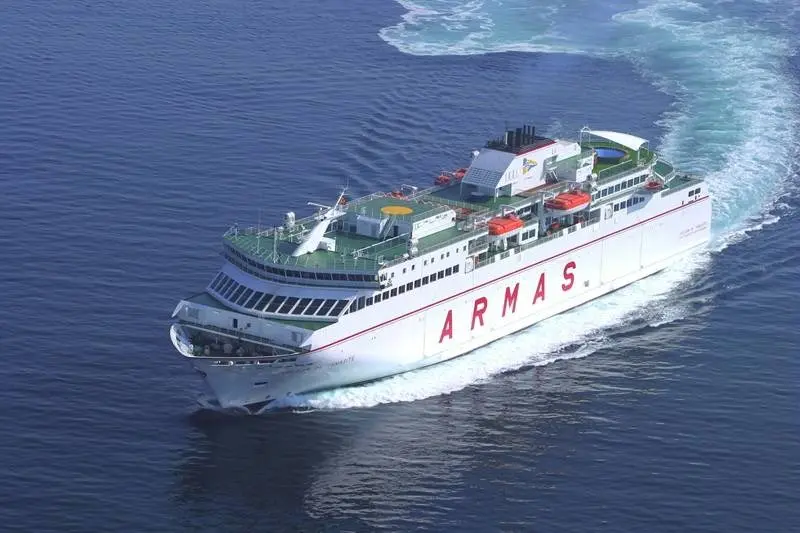
ALGECIRAS, SPAIN — In a move that significantly recalibrates the competitive dynamics of short-sea shipping between Europe and North Africa, Copenhagen-based ferry and logistics giant DFDS has finalized an agreement to acquire the Ro-Pax vessel Volcán de Tamasite from Spanish operator Naviera Armas. The transaction, which has cleared all necessary regulatory hurdles in both Madrid and Rabat, marks a major milestone in DFDS’s targeted expansion into the Mediterranean and the Strait of Gibraltar.
By integrating this high-capacity vessel into its Algeciras–Tanger Med route, DFDS is poised to capture a larger share of the surging freight and passenger volumes flowing through one of the world’s most critical maritime choke points. The vessel is scheduled to enter service under the DFDS banner in mid-November 2026, bringing immediate capacity relief to a corridor defined by rapid industrial nearshoring and intense seasonal passenger spikes.
Executive Overview
The acquisition of the Volcán de Tamasite represents a calculated step in DFDS’s ongoing geographic diversification strategy. Traditionally dominant in the North Sea and Baltic regions, the Danish logistics powerhouse has systematically turned its attention toward the Mediterranean as a high-growth frontier. This transaction follows DFDS’s landmark acquisition of FRS Iberia/Maroc in early 2024, which established the company’s foundational footprint in the Strait of Gibraltar.

| Metric / Parameter | Details |
|---|---|
| Vessel Name | Volcán de Tamasite |
| Seller | Naviera Armas |
| Buyer | DFDS |
| Route Assignment | Algeciras (Spain) – Tanger Med (Morocco) |
| Passenger Capacity | 1,469 passengers |
| Freight Capacity | 1,414 lane meters |
| Expected Service Entry | Mid-November 2026 |
| Regulatory Approvals | Secured (Spanish CNMC & Moroccan Conseil de la Concurrence) |
The Strait of Gibraltar is more than a geographic transition zone; it is a vital economic bridge linking the European Union’s single market with the rapidly industrializing economies of North Africa. By adding the Volcán de Tamasite to its existing two-vessel fleet in the region, DFDS will boost its frequency, reliability, and total cargo-carrying capacity. This move directly addresses the logistical bottlenecks that frequently plague the Algeciras–Tanger Med corridor during peak trading seasons and the annual Paso del Estrecho (Operation Marhaba) passenger migration.
Detailed Chronology: From Strategic Intent to Regulatory Approval
The path to finalizing the acquisition of the Volcán de Tamasite reflects the complex regulatory and corporate environments governing cross-continental maritime corridors.
[Late 2023 / Early 2024] ──> [Mid-2026] ──────────────────> [October 8, 2026] ──────────> [Mid-November 2026]
DFDS enters Strait via        Negotiations with Naviera      Regulatory clearance &     Anticipated service entry
FRS Iberia acquisition        Armas finalized                deal finalized             of Volcán de Tamasite
1. The Strategic Prelude (2024)
DFDS’s entry into the Strait of Gibraltar was cemented through its acquisition of FRS Iberia/Maroc. This initial move provided DFDS with the operational infrastructure, local expertise, and port slots necessary to run a reliable short-sea service. However, to compete effectively against entrenched regional players like Baleària, DFDS required immediate, scalable tonnage.
2. Identifying the Asset (Mid-2026)
As Naviera Armas embarked on a corporate restructuring program to streamline its fleet and focus on its core Canary Islands routes, the Volcán de Tamasite became available. Having already operated on the Algeciras–Tanger Med route for several years, the vessel offered a "plug-and-play" solution for DFDS. Its crew compatibility, familiar docking profiles, and proven performance in the tricky currents of the Strait made it an ideal target.

3. Navigating Regulatory Clearances (Q3 2026)
Because the Strait of Gibraltar is a highly consolidated market, any transfer of vessel assets and operating permits requires rigorous antitrust scrutiny.
- In Spain: The Comisión Nacional de los Mercados y la Competencia (CNMC) reviewed the deal to ensure it did not lead to monopolistic control over cargo rates or passenger fares out of the Port of Algeciras.
- In Morocco: The Conseil de la Concurrence evaluated the transaction’s impact on national supply chain security and consumer choice at the Port of Tanger Med.
Both regulatory bodies granted unconditional approval in early autumn 2026, clearing the way for the formal closing of the deal.
4. Finalization and Handover (October 8, 2026)
With regulatory approvals secured, DFDS officially closed the transaction on October 8, 2026. The agreement includes not only the physical vessel but also the transfer of all associated operating permits and route licenses. The vessel is currently undergoing technical inspections, minor retrofits, and rebranding to align with DFDS’s corporate identity ahead of its mid-November launch.
Supporting Context & Operational Metrics
To understand the impact of the Volcán de Tamasite acquisition, one must examine both the technical capabilities of the vessel and the macroeconomic realities of the Algeciras–Tanger Med trade corridor.
Technical Profile of the Volcán de Tamasite
Built by the renowned Spanish shipyard Astilleros Barreras, the Volcán de Tamasite is a robust, highly versatile Ro-Pax vessel engineered specifically for short-sea crossings.
- Passenger Experience: With a capacity of 1,469 passengers, the ship features modern seating lounges, dining facilities, and duty-free retail spaces designed to handle large crowds comfortably during the high-density summer months.
- Freight Capabilities: The vessel offers 1,414 lane meters of freight capacity. In practical terms, this translates to space for approximately 80 to 90 standard road trailers per crossing. The vessel’s internal ramp configuration allows for rapid loading and unloading, a critical factor in maintaining tight port turnaround times.
The Macroeconomic Engine of the Strait
The Algeciras–Tanger Med route is the busiest maritime commercial link between Europe and Africa, facilitating more than 10,000 sailings annually across the DFDS network alone. Several macroeconomic trends are driving the sustained demand for increased capacity on this route:
                  ┌──────────────────────────────┐
                  │   Moroccan Industrial Hubs   │
                  │  (Automotive, Textiles, Ag)  │
                  └──────────────┬───────────────┘
                                 │
                     [Just-In-Time Logistics]
                                 │
                                 ▼
                  ┌──────────────────────────────┐
                  │    Strait of Gibraltar       │
                  │    (DFDS Ro-Pax Fleet)       │
                  └──────────────┬───────────────┘
                                 │
                    [Rapid Short-Sea Crossing]
                                 │
                                 ▼
                  ┌──────────────────────────────┐
                  │   European Consumer Markets  │
                  └──────────────────────────────┘
1. The Automotive Manufacturing Boom
Morocco has established itself as North Africa’s premier automotive manufacturing hub. Facilities such as Tangier Automotive City and the massive Renault and Stellantis plants require highly integrated, "just-in-time" supply chains. Automotive parts, engines, and completed vehicles must cross the Strait daily to meet the synchronized production schedules of European assembly plants.

2. Agricultural "Green Corridors"
Morocco serves as a major agricultural exporter to the European Union. Fresh produce, berries, and seafood require rapid, refrigerated transport (reefers) to preserve shelf life. The addition of the Volcán de Tamasite ensures that freight forwarders have access to consistent departures, reducing the risk of spoilage at port terminals.
3. Fast-Fashion Textile Logistics
The proximity of Moroccan textile factories to European retail centers allows global fashion brands to operate ultra-responsive supply chains. Raw fabrics sent south are returned north as finished garments within days—a cycle that depends entirely on reliable, high-frequency Ro-Ro shipping.
Corporate Perspectives & Strategic Alignment
For DFDS, this acquisition is not merely an expansion of tonnage; it is a manifestation of the group’s "Moving Together 2030" strategy, which emphasizes building scale, density, and resilience in core transport corridors.
In previous corporate communications regarding the Mediterranean expansion, DFDS leadership has emphasized that regional growth is vital to buffering the company against cyclical downturns in Northern Europe. By balancing its portfolio with Mediterranean-African trade lanes, DFDS creates a more resilient, year-round revenue stream. The seasonal peaks of the Mediterranean (driven by summer tourism and agricultural harvests) contrast with and complement the industrial shipping patterns of the Baltic and North Seas.
Conversely, for Naviera Armas, the sale of the Volcán de Tamasite represents a tactical retreat to its primary stronghold: the Canary Islands cabotage market. Facing intense competition and carrying significant debt from previous acquisitions, Naviera Armas’s divestment allows it to shore up its balance sheet while optimizing its fleet utilization in domestic Spanish waters.
Future Outlook: Decarbonization, Infrastructure, and the 2030 Horizon
The integration of the Volcán de Tamasite into DFDS’s Mediterranean fleet occurs at a time of profound structural change for the maritime industry. Over the next decade, several key factors will shape the success of DFDS’s expanded operations in the Strait of Gibraltar.
1. The Decarbonization Mandate
As the European Union’s Emissions Trading System (EU ETS) increasingly penalizes maritime emissions, operators in European waters are under intense pressure to decarbonize. While the Volcán de Tamasite is currently powered by conventional marine fuel oil, DFDS is actively investing in fleet-wide energy efficiency measures.
Industry analysts expect DFDS to introduce hull coatings, optimized propulsion systems, and potentially shore-power (cold ironing) capabilities to the vessel during future scheduled drydockings. Furthermore, DFDS’s long-term goal to deploy green vessels by 2030 will inevitably influence how it operates its Mediterranean routes, pushing Spain and Morocco to develop low-carbon bunkering infrastructure at Algeciras and Tanger Med.
2. Infrastructure Expansion at Port Terminals
Both the Port Authority of Algeciras (APBA) and Tanger Med are undergoing multi-million-euro infrastructure upgrades. Tanger Med, already the largest port in Africa by container volume, is expanding its Ro-Ro terminals to accommodate larger vessels and faster processing times. On the northern side, Algeciras is digitizing its customs clearance processes to minimize wait times for non-EU freight. DFDS’s increased capacity directly aligns with these port expansion plans, ensuring that vessel capacity matches shoreside throughput capabilities.
3. The 2030 FIFA World Cup Catalyst
Looking further ahead, the joint hosting of the 2030 FIFA World Cup by Spain, Portugal, and Morocco is set to trigger unprecedented infrastructure development and passenger transit demands across the Strait of Gibraltar.
                    [2030 FIFA World Cup]
                             │
            ┌────────────────┴────────────────┐
            ▼                                 ▼
   [Infrastructure Boom]             [Passenger Surge]
   - Port expansions                 - Fans traveling between
   - Digital customs systems           Spanish & Moroccan venues
   - Improved rail links             - High demand for Ro-Pax
The event will require seamless transport links for hundreds of thousands of football fans traveling between matches in Madrid, Lisbon, Casablanca, and Tangier. Operators with established high-capacity Ro-Pax fleets, such as DFDS, will be uniquely positioned to serve as the primary transport arteries for this historic cross-continental event.
Conclusion
The acquisition of the Volcán de Tamasite is a clear signal of DFDS’s ambition to become the dominant logistical force in the Strait of Gibraltar. By securing a familiar, high-capacity vessel and clearing the necessary regulatory hurdles, the company has strengthened its capacity to support the critical trade flows connecting Europe and North Africa. As the vessel prepares to enter service in mid-November 2026, DFDS is well-positioned to capitalize on the region’s nearshoring boom, navigate the upcoming challenges of maritime decarbonization, and play a central role in the logistical integration of the two continents.


