







SANTO DOMINGO, Dominican Republic — Across the sun-drenched archipelagos of the Caribbean, the hospitality industry has long optimized for a singular, frictionless fantasy: pristine white-sand beaches, swaying palms, and a discreet distance from the complexities of the modern world. Yet, tucked away on a limestone-paved thoroughfare on the western bank of the Ozama River, a rare property flips this paradigm on its head.
At the Hodelpa Nicolás de Ovando, the primary amenity is not an infinity pool or a secluded patch of sand, though both are present. It is the palpable, unyielding weight of more than 500 years of history. Occupying a complex of three interconnected stone mansions—including the primary residence of Nicolás de Ovando, the Spanish governor who arrived on Hispaniola in 1502—this five-star hotel offers an experience that defies the traditional resort model. Guests do not merely observe the birth of the European Americas through the protective glass of a museum display case; they sleep within its very fabric.
Executive Overview
The Hodelpa Nicolás de Ovando stands as a masterclass in adaptive reuse within a UNESCO World Heritage site. Situated on Calle Las Damas in Santo Domingo’s historic Ciudad Colonial, the property merges high-end contemporary hospitality with the raw, unaltered architecture of early Spanish colonization.
While the Dominican Republic remains an undisputed global tourism heavyweight largely defined by its sprawling all-inclusive beach resorts in Punta Cana, La Romana, and Puerto Plata, the capital city offers an entirely different proposition. Santo Domingo is the oldest continuously inhabited European city in the Americas, and its colonial core serves as the architectural incubator for the Spanish New World.
The hotel’s survival across five centuries is a testament to the durability of its construction—thick stone masonry, heavy wooden structural beams, and classic brick archways. Yet, what makes a stay here uniquely compelling for the modern cultural traveler is its accessibility. Recent industry searches indicate standard rates starting as low as $123 per night via platforms like Google Hotels, positioning this historic immersion at a remarkably democratic price point for a five-star luxury property.
Detailed Chronology: The Evolution of a Colonial Capital
To understand the architecture of the Hodelpa Nicolás de Ovando, one must trace the violent, transformative birth of European urban planning in the Western Hemisphere.
The Destruction and Rebirth: 1502
In 1502, a devastating hurricane leveled the original settlement of Santo Domingo, which had been founded by Bartholomew Columbus on the eastern bank of the Ozama River just a few years prior. The disaster prompted the Spanish Crown to dispatch Nicolás de Ovando as the new royal governor of the Indies, armed with a mandate to rebuild the colony on a more permanent, strategic footing.

Ovando relocated the city to the western bank, commissioning a rigid grid system of streets, public squares, and stone fortresses. This urban layout—subsequently dubbed the "Ovando model" by architectural historians and urban planners—became the foundational blueprint replicated by the Spanish Empire across Central and South America.
The Rise of Calle Las Damas
Under Ovando’s administration, Calle Las Damas was laid out and cemented into history. Widely recognized by Dominican authorities as the first officially paved street in the Americas, it earned its poetic name—The Street of the Ladies—during the mid-16th century, when the noblewomen of the viceregal court would promenade along its limestone flags in elaborate silk gowns.
Ovando claimed a prime parcel along this prestigious corridor, constructing a sprawling compound of interconnected stone houses that served as both a private residence and a seat of administrative power. During his tenure from 1502 to 1509, Ovando consolidated the colonial system, an era inextricably linked to the brutal subjugation, forced labor, and systematic decimation of Hispaniola’s Indigenous Taíno population—a dark chapter that remains an inescapable part of the site’s historical ledger.
Centuries of Transition and UNESCO Recognition
Over the succeeding centuries, the buildings along Calle Las Damas witnessed the rise and fall of empires, pirate raids by Sir Francis Drake, political revolutions, and the slow, graceful decay of colonial grandeur.
Recognizing the irreplaceable global significance of this urban core, UNESCO inscribed the Colonial City of Santo Domingo as a World Heritage Site in 1990. The designation protected not merely isolated monuments, but an entire living urban matrix where 16th-century administrative palaces, defensive walls, and residential compounds exist side-by-side with modern cafes, art galleries, and residential neighborhoods.
Supporting Context & Metrics: Architecture and Amenities
While many "historic hotels" in global tourism markets retain little more than a preserved limestone facade masking a completely modern concrete interior, the Hodelpa Nicolás de Ovando preserves its structural integrity deep into the guest experience.
Architectural Metrics and Spatial Design
- The Three Houses: The hotel spans three distinct 16th-century residential structures, retaining original masonry, exposed timber beams, and interior courtyards.
- Materiality: Walls constructed of native coral limestone and heavy brick arches frame internal passageways, creating a labyrinthine layout that encourages exploration.
- Room Inventory & Tiers: Accommodations vary widely in shape and square footage due to the irregular nature of historical architecture. The crown jewel for history-focused travelers is the Imperial Colonial Room, which bundles high-end room appointments with exclusive Imperial Club privileges.
Modern Luxury Integration
The integration of five-star amenities within a 500-year-old historic shell requires careful architectural engineering. Key features include:
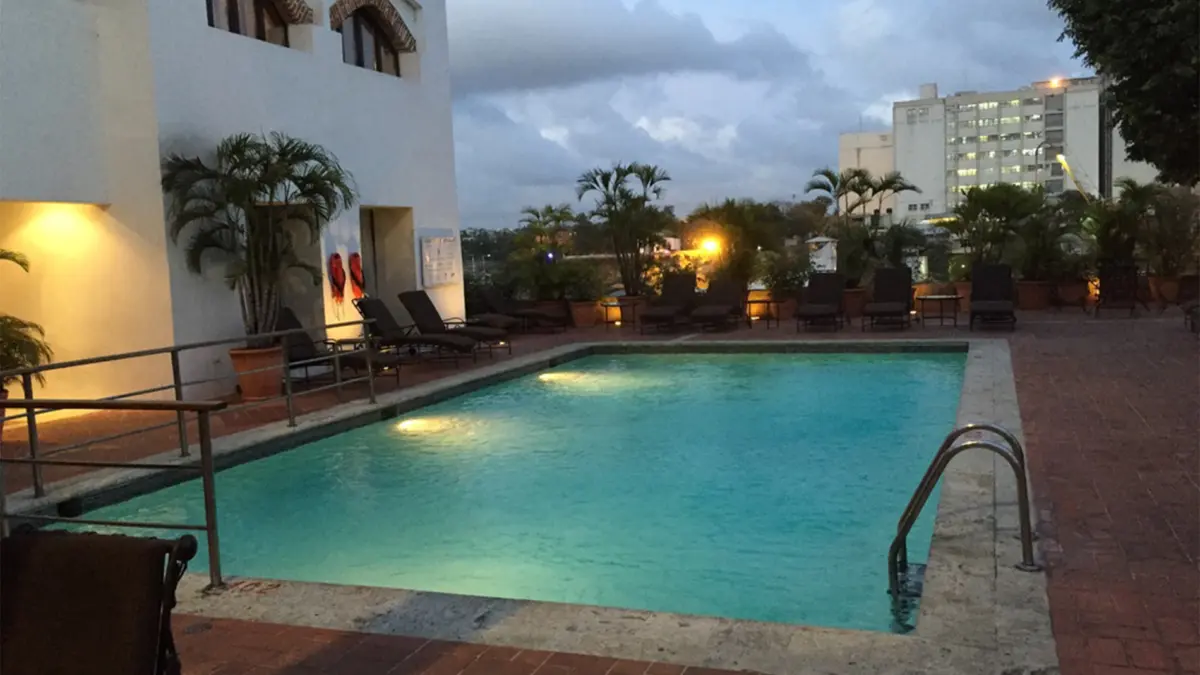
- The Courtyard Pool: An outdoor swimming pool nestled directly against ancient stone walls, providing a striking visual contrast between tropical resort leisure and Renaissance-era austerity.
- Culinary Offerings: Restaurant 1502 anchors the property’s dining room, offering elevated Dominican gastronomy, while the Taberna El Mojito serves craft cocktails in a historic courtyard setting.
- Wellness & Services: Full-service gym facilities, professional massage treatments, and comprehensive room service ensure that the property meets contemporary international luxury standards.
- Value Proposition: With introductory rates hovering around $123 per night, the hotel offers an extraordinarily high historical return-on-investment compared to standardized luxury beach resorts.
Official Statements and Expert Perspectives
Cultural preservationists and tourism authorities have long pointed to the Ciudad Colonial as a benchmark for sustainable urban heritage tourism in the Caribbean.
"Santo Domingo does not merely preserve its past behind glass; it invites the world to inhabit it," notes a senior regional tourism analyst tracking the Dominican Republic’s urban expansion. "Properties like the Hodelpa Nicolás de Ovando prove that visitors are increasingly hungry for authentic, narrative-driven travel experiences that transcend the traditional beach vacation."
Management at the property emphasizes that the integration of guided historic tours—often bundled into premium room tiers like the Imperial Club—is designed to foster a deeper intellectual connection between the traveler and the physical environment.
"When a guest steps out of our lobby onto Calle Las Damas, they are not stepping into a theme park," a property representative notes. "They are stepping onto the exact stone where the institutions of the New World were forged. Our job is to ensure that when they return to their room, that story follows them through the door."
Future Outlook: The Shift Toward Experiential Cultural Tourism
The Dominican tourism landscape is currently undergoing a strategic diversification. While Punta Cana and the country’s northern coast continue to pull record numbers of sun-seekers, the Ministry of Tourism has heavily prioritized the revitalization of the Ciudad Colonial through targeted infrastructure investments, enhanced security measures, and urban restoration projects.
This broader macroeconomic shift favors properties that can offer depth, education, and cultural immersion. Modern travelers—particularly Millennials and Generation Z demographics—demonstrate an increasing preference for experiential travel over passive relaxation. They seek destinations with layers, provenance, and narrative weight.
The Hodelpa Nicolás de Ovando is uniquely positioned to capitalize on this secular trend. By maintaining an accessible price point while preserving its uncompromising architectural pedigree, the hotel bridges the gap between high-end historical preservation and modern hospitality demands.
As Santo Domingo continues to cement its status as the premier cultural capital of the Caribbean, properties on Calle Las Damas serve as a reminder that the region’s story is vastly older, richer, and far more complex than the average postcard suggests. For those willing to trade an ocean view for a stone archway, the doors of Governor Ovando’s 500-year-old estate remain wide open.