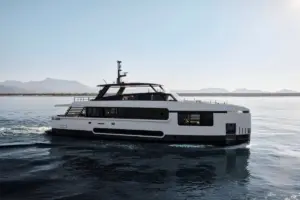
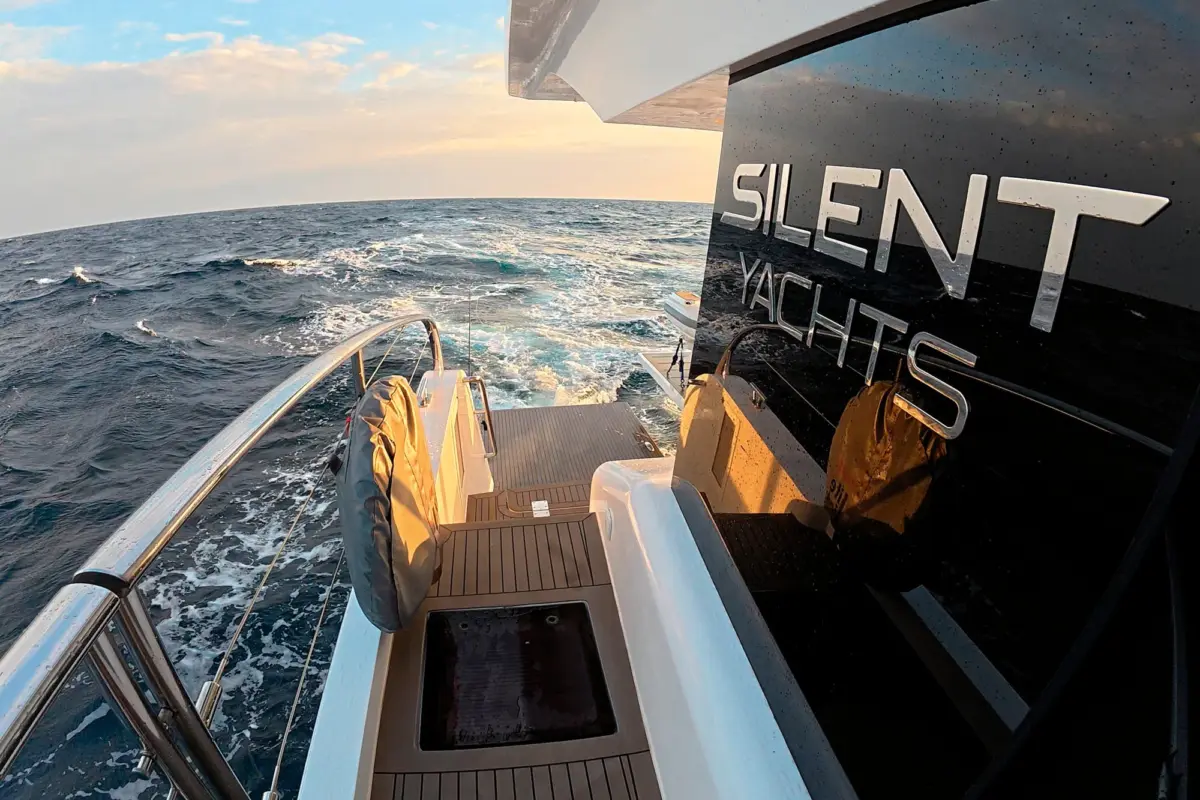
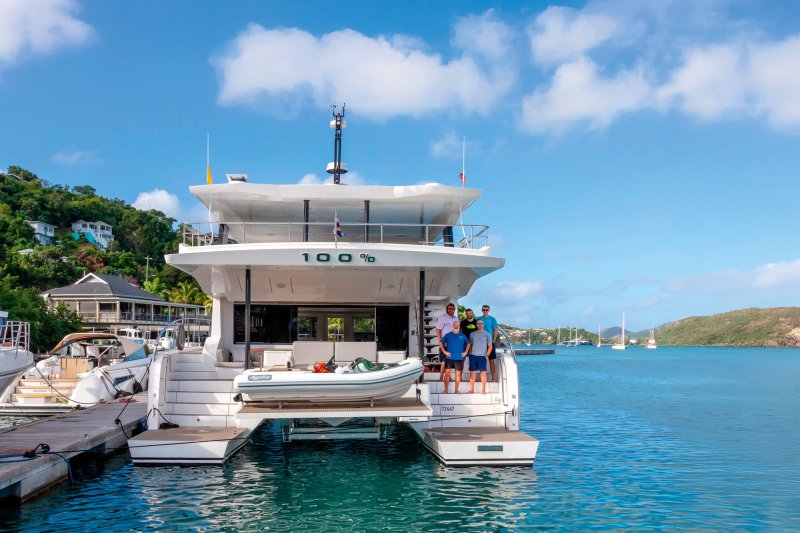
The maritime industry is undergoing a quiet revolution, and its standard-bearer has just proven its mettle on the ultimate offshore testing ground. The Silent 62, a state-of-the-art solar-electric catamaran engineered by Silent Yachts, has successfully completed a grueling five-week transatlantic crossing from Europe to the Caribbean. More than just a logistical delivery, this voyage served as a live-fire endurance test for modern alternative-propulsion yachting.
During the thousands of nautical miles traversed between Gibraltar, Morocco, the Canary Islands, Cape Verde, and Antigua, the Silent 62 ran exclusively on battery propulsion for more than 70 percent of the entire trip. The vessel consumed fewer than 1,500 gallons of fossil fuel for the entire five-week passage—a fraction of the consumption logged by conventionally powered yachts of comparable scale.
Led by Silent Yachts Chairman Steve Bell, alongside the yacht’s owner and a two-person crew, the expedition was designed to rigorously benchmark technological advancements made over the past four years. By comparing data against a historic crossing by an older Silent Yachts model (the Solar Wave 64), the team demonstrated definitive leaps forward in solar efficiency, battery storage longevity, energy management software, and overall hull hydrodynamics.
As the marine sector faces mounting pressure to decarbonize, this transatlantic feat provides undeniable proof that ocean-crossing luxury yachts can successfully harness the sun without completely abandoning the safety net of traditional backup generators.
Detailed Chronology: The Transatlantic Passage
Embarking on a transatlantic voyage in late autumn presents a strategic paradox for a solar-powered vessel. Chairman Steve Bell and his crew scheduled the departure for November and December to capture favorable sea states and bypass the Atlantic hurricane season. However, this timeframe also presents a distinct meteorological hurdle: the sun sits low below the equator, drastically reducing optimal solar-collection angles.
Despite these solar limitations, the route allowed the crew to leverage the Northern Equatorial Current—a dependable 1-knot ocean current running from Cape Verde to the Caribbean—alongside steady 15-knot trade winds. The journey was mapped across distinct legs, each presenting unique weather patterns, hydrodynamic challenges, and operational datasets.
Leg 1: Outrunning the Weather (Gibraltar to Morocco)
The expedition commenced with an urgent test of performance: outrunning an approaching weather system. Spanning 475 nautical miles, this initial dash required a higher-than-average cruising speed.
Operational Insight: To maintain the pace necessary to dodge deteriorating conditions, the generators were engaged more frequently, highlighting the energetic cost of high-speed displacement travel in heavy weather.
Leg 2: Headwinds and Swells (Morocco to the Canary Islands)
Moving southward, the crew encountered adverse environmental conditions that tested the vessel’s structural integrity and energy reserves.
Operational Insight: Facing persistent head seas and strong swells, the Silent 62 relied heavily on its electric drive trains to push through turbulent waters, maintaining impressive efficiency despite the resistance.
Leg 3: Catching the Currents (Cape Verde to Antigua)
The ultimate test of the voyage was the vast open-ocean passage from Cape Verde to Antigua—the longest uninterrupted stretch of the journey.
Distance: 2,110 nautical miles
Average Speed: 6.1 knots
Energy Breakdown:77 percent battery propulsion / 23 percent generator runtime
Operational Insight: Benefiting from 15 knots of following wind on the stern and the push of the equatorial current, the yacht achieved peak efficiency. For nearly four-fifths of this monumental 2,110-mile stretch, the vessel glided in absolute silence, propelled solely by stored solar energy.
Supporting Context & Metrics: Hard Data from the Open Ocean
The primary objective of the voyage was not merely to complete a bucket-list crossing for the yacht’s owner, but to harvest five weeks of pristine, real-world data. Modern yacht owners—particularly those drawn to eco-conscious alternative energy platforms—demand absolute transparency regarding power generation, consumption rates, and system reliability.
Daily Energy Profiles
The Silent 62 operates with a daily energy consumption ranging between 350 to 600 kWh, depending entirely on cruising speeds, hotel loads (air conditioning, desalination, galley appliances, and navigation electronics), and sea states.
Critics of solar-electric propulsion frequently question why vessels of this size cannot operate on solar panels and batteries alone, without ever turning on a fossil-fueled generator. Chairman Steve Bell offered clear mathematical context to this debate:
"Someone asked me, ‘Why do you have to run the generator?’ We have 42 solar panels on our yacht. We would have to tow over 200 to do solar alone. We crossed the Atlantic, and 72 percent of the time, we were on solar and batteries, and the generator was running for 28 percent of the time. It’s dark for 50 percent of the time we’re out there."
Because nighttime accounts for roughly half of any 24-hour cycle, and because the sun’s intensity fluctuates based on latitude and cloud cover, battery banks inevitably require recharging during extended oceanic crossings.
Mechanical Reliability and Software Evolution
Ocean passages are notorious for breaking gear. Yet, aside from changing a generator impeller and performing minor routine maintenance, the crossing was remarkably drama-free.
The vessel functioned largely as a software-driven ecosystem. When minor digital hiccups occurred, the remedy was modern: powering down and rebooting the onboard computing architecture. The crew carried enough spare parts to theoretically build an entirely second yacht, yet nearly all of them remained untouched in their lockers at the bottom of the hull.
Official Statements & Industry Perspectives
Reflecting on the evolution of alternative propulsion, Steve Bell contrasted the performance of the Silent 62 with a predecessor from four years prior—the Solar Wave 64 that crossed the Atlantic before his tenure at the shipyard.
"I talked to that captain," Bell recalled. "It used double the fuel. We’ve got more solar panels, so that’s just an improvement in the efficiency of the technology."
Bell emphasized that while ocean crossings make great headlines, they represent a fraction of how these yachts are actually utilized by their owners. The true sweet spot for a Silent 62 is bay-to-bay coastal cruising and island hopping.
"Consider a trip we did in the Bahamas, from the Exumas up to New Providence," Bell explains. "We had five days, running about 30 miles, three or four hours of cruising a day. We never ran the generator. If you have no job and you have the luxury where you can just go cruising, then you manage it like an off-grid house. It’s a huge opportunity for people who want to cruise efficiently."
Furthermore, Bell noted that the data gathered during the crossing sparked a wave of software development ideas aimed at enhancing the owner experience:
"Some of the people who buy our yachts are geeky. They want to see all the data, know exactly what they’ve used, what they will use. The software development is huge in what we’re trying to do. We’re thinking about maintenance on a daily basis, where it logs like a full-service history. My brain was spinning about how to make all of that better."
Future Outlook: Expeditions, Customization, and Market Demand
The success of this transatlantic crossing redefines what is possible for semi-custom eco-yachts. Far from being restricted to protected coastal waters, the Silent 62 is certified and proven for true blue-water expedition work.
Expanding Horizons: Circumnavigation and Beyond
Bell envisions owners taking the Silent 62 far beyond traditional cruising grounds, comparing its oceanic capability to established expedition brands like Nordhavn or participants in the Oyster World Rally.
Expedition Potential: Owners wishing to cross the Panama Canal, cruise down to the Galapagos, and island-hop across the Pacific to Fiji can do so with confidence.
Customization for Extremes: For those planning extreme remote expeditions, Silent Yachts can customize the platform by integrating larger fuel tanks, secondary fuel reservoirs, or upgraded generator capacities.
Production and Delivery Timelines
Market demand for sustainable luxury catamarans remains remarkably robust. The shipyard’s order book for the Silent 62 is completely full for the remainder of the year and extends well into early next year.
Construction takes approximately 12 months from inception to handover. During this 1-year window, owners work closely with the shipyard on semi-custom interior configurations. Options include:
A full-beam owner’s cabin occupying an entire hull side.
Flexible cabin layouts scaling up to five staterooms.
Relocation of the galley to the lower deck, alongside bespoke finishes, sustainable materials, and customized electronics packages.
The Road Ahead for Solar Efficiency
While photovoltaic technology and lithium-ion battery chemistry continue to advance, Bell cautions that radical leaps in solar efficiency will take time. The governing bottleneck remains the physical limitation of solar panel conversion rates and the absolute requirement to replenish large battery banks during multi-week offshore passages.
Nevertheless, the Silent 62 has definitively crossed the psychological and technical Rubicon. By running silently on battery power for 72 percent of a transatlantic voyage while burning less than 1,500 gallons of fuel, Silent Yachts has proven that sustainable blue-water cruising is no longer a futuristic dream—it is an available, high-performance reality on the water today.