











By Gordon Smith
October 12, 2026
Executive Overview
For years, the Kingdom of Saudi Arabia has deployed immense financial resources, strategic foresight, and aggressive global marketing to rebrand itself as a premier international aviation hub and a tourism powerhouse. Central to Vision 2030—the nation’s sweeping blueprint to transition away from a hydrocarbon-dependent economy—is the ambition to turn its skies into a global bridge connecting East and West. Billions of dollars have been poured into modernizing national carriers, constructing mega-airports, and courting international visitors.
Over the past week, however, that grand ambition has collided with a sobering and volatile geopolitical reality.
A sustained campaign of targeted, deadly attacks on the Kingdom’s critical aviation infrastructure—most notably King Khalid International Airport in Riyadh—has sent shockwaves through the global travel industry. The assaults have instantly ignited profound concerns regarding the physical security of flying within Saudi airspace, the structural resilience of the nation’s high-profile aviation projects, and the long-term viability of its economic diversification strategy.
Yemen’s Houthi movement has openly claimed responsibility for the offensive. In a direct challenge to the international community, Houthi leadership has explicitly designated Saudi airports and sovereign airspace as active military targets, issuing stark warnings to global airlines and civilian travelers to steer clear of the region.
For an economy banking its future on open borders, seamless global connectivity, and millions of international tourists, it is difficult to conceive of a more damaging, high-stakes threat. As airlines reassess risk profiles and insurers eye skyrocketing premiums, the unfolding crisis threatens to stall the momentum of one of the world’s most ambitious aviation transformations.
Detailed Chronology: A Week of Escalating Violence
While the underlying hostilities between Saudi Arabia and the Iran-backed Houthi movement are rooted in a protracted regional conflict spanning over a decade, the character and intensity of this latest offensive mark a dangerous inflection point.

The crisis escalated rapidly over a seven-day period, shattering a fragile sense of regional calm and directly embedding commercial aviation into the theater of war.
Day 1–3: The Initial Breaches
The sequence began with early-morning incursions targeting vital infrastructure in the southern provinces before shifting dramatically inland toward the capital. Security protocols were immediately tested as incoming projectiles and unmanned aerial vehicles (UAVs) targeted perimeter facilities near major transport hubs. While Saudi air defense systems successfully intercepted a significant portion of the incoming threat matrix, the psychological and operational impact was immediate. Flights were temporarily grounded, and airspace restrictions were hastily implemented, causing cascading delays across domestic and regional networks.
Day 4–5: The Capital Targeted
The gravity of the campaign became undeniable when King Khalid International Airport in Riyadh—the beating heart of the Kingdom’s international connectivity and the primary operational base for several major carriers—became the direct focus of incoming attacks. Explosions near cargo and auxiliary zones rattled passengers and ground staff alike.
Although terminal operations managed to avoid direct, catastrophic structural hits, the proximity of the blasts forced emergency suspensions of air traffic. International carriers operating out of European and Asian hubs found their aircraft diverted or held at origin airports, creating logistical bottlenecks that rippled through global schedules.
Day 6–7: Ultimatum and Economic Fallout
As the week drew to a close, Houthi military spokespersons formalized their strategy, issuing public broadcasts that explicitly warned commercial airlines against operating flights into Saudi territory. Citing the Kingdom’s involvement in the broader Yemeni conflict, the militant group declared all major Saudi airports legitimate targets.
This psychological warfare immediately yielded results: international carriers began convening emergency risk-management sessions, evaluating whether the geopolitical risk of flying to Riyadh and Jeddah outweighed the commercial benefits. The localized conflict had successfully morphed into an international aviation crisis.
Supporting Context & Metrics: The High Stakes of Vision 2030
To understand the profound gravity of these attacks, one must examine the central role that aviation plays in Saudi Arabia’s macroeconomic strategy. Vision 2030 is not merely an incremental modernization plan; it is an existential pivot designed to secure the nation’s future in a post-oil era.

The Pillars of Saudi Aviation
- The National Aviation Strategy (NAS): Saudi Arabia has committed to injecting over $100 billion into its aviation sector by the end of the decade. The goal is to triple passenger traffic to 330 million travelers annually, connect the Kingdom to more than 250 direct destinations, and establish Riyadh as a dominant global mega-hub capable of rivaling Dubai and Doha.
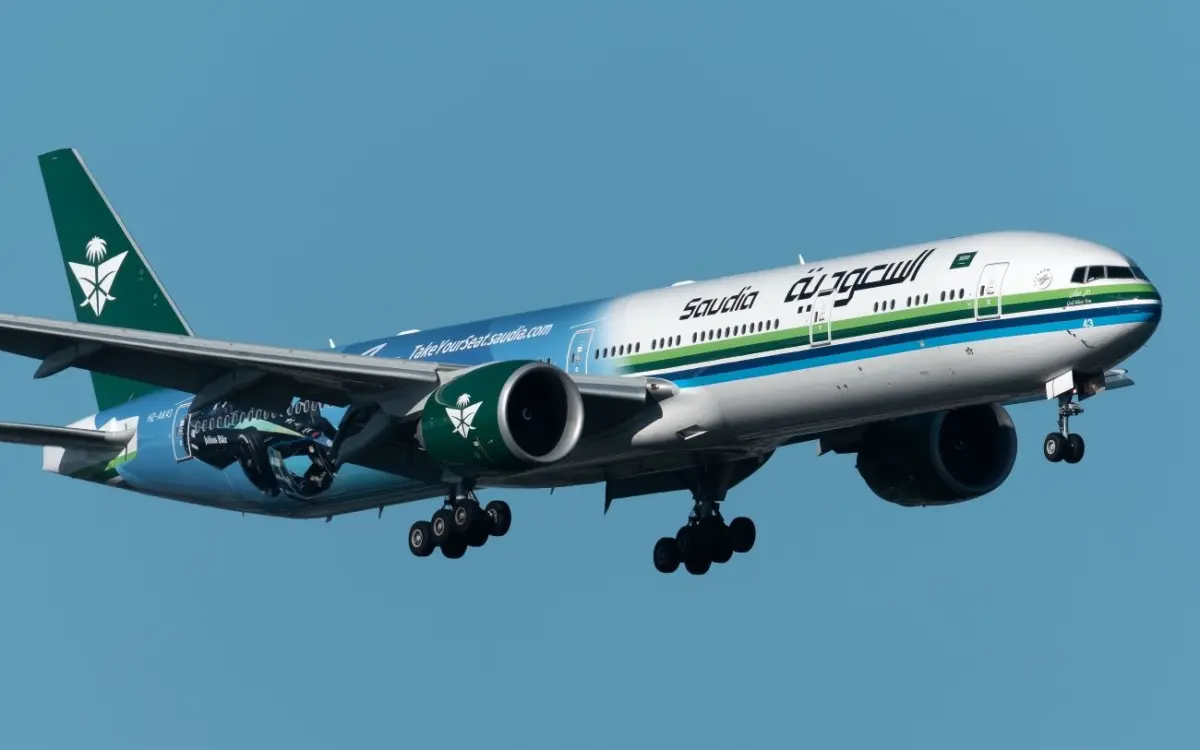
- New Infrastructure and Fleet Expansion: Billions are being spent on the master planning of King Salman International Airport in Riyadh—projected to be one of the largest airports in the world—alongside massive fleet orders by flag carrier Saudia and the newly launched Riyadh Air.
- Tourism Targets: The Kingdom has set sights on welcoming 150 million tourists annually by 2030. Achieving this relies entirely on the premise that travelers feel safe, welcome, and immune to regional instability.
The Fragility of Aviation Economics
Commercial aviation operates on razor-thin margins and relies heavily on consumer confidence and predictable insurance markets. When airspace is contested, the economic calculus changes overnight:
- Insurance Premiums: War-risk insurance rates for flights operating into high-threat airspace skyrocket instantly, squeezing airline profitability.
- Fuel and Rerouting Costs: Longer flight paths to avoid restricted zones burn additional fuel, increasing operational costs and carbon footprints.
- Passenger Confidence: Leisure and business travelers are notoriously risk-averse. Graphic imagery or news reports concerning airport security breaches can depress booking curves for months, regardless of whether operations resume normally.
Official Statements and Industry Reactions
The international community, aviation regulators, and Saudi authorities have mobilized in response to the escalating crisis, balancing the need for transparent security assessments with efforts to maintain market stability.
The Official Saudi Response
The Saudi government and the General Authority of Civil Aviation (GACA) have pushed back forcefully against the Houthi campaign, emphasizing the robust nature of the Kingdom’s multi-layered defense architecture.
In official briefings, security spokespersons have underscored that the vast majority of incoming aerial threats are successfully neutralized long before reaching populated civilian zones or critical runway infrastructure.
“The safety and security of every passenger, crew member, and aviation worker remains our absolute, non-negotiable priority,” a senior GACA official stated earlier this week. “Our air defense capabilities are operating with high precision, and our airport infrastructure has been engineered with redundancy and resilience to ensure that vital supply chains and passenger corridors remain operational.”
Furthermore, Riyadh has called upon the international community to condemn the targeting of civilian infrastructure, framing the Houthi actions not merely as an assault on Saudi sovereignty, but as a direct violation of international law and a severe threat to global civil aviation safety.
Global Airline and Regulatory Reactions
International regulatory bodies, including the European Union Aviation Safety Agency (EASA) and the U.S. Federal Aviation Administration (FAA), have been closely monitoring real-time intelligence feeds. While blanket airspace closures have not yet been mandated, several foreign carriers have independently adjusted their scheduling, temporarily pausing overnight layovers in Riyadh and evaluating point-to-point routing.
“Airlines are fundamentally risk-mitigation machines,” notes a prominent aviation safety consultant based in London. “When a non-state actor explicitly names civilian airports as targets and backs those threats up with kinetic action, carriers cannot simply maintain business as usual. They are legally and morally obligated to protect their passengers and flight crews. The pressure on airline boards right now is immense.”
Future Outlook: Navigating the Turbulence Ahead
As the dust settles on a harrowing week, the trajectory of Saudi Arabia’s aviation sector hangs in a delicate balance. The coming weeks will test the resilience of the Kingdom’s defense systems, the loyalty of its international airline partners, and the psychological fortitude of global travelers.
1. The Security Imperative
For Vision 2030 to stay on track, Saudi Arabia must definitively re-establish absolute airspace security. This will likely require enhanced intelligence sharing with Western allies, deployment of advanced anti-drone and anti-missile defense batteries directly surrounding major aviation hubs, and a visible demonstration of military deterrence.
2. Commercial Adaptability
Airlines and lessors will be watching closely to see how quickly operational normality can be preserved in the face of ongoing threats. If carriers begin pulling capacity out of Saudi markets, the economic ripple effects could impact hotel occupancy, tourism revenues, and the ambitious timelines set for Riyadh Air and King Salman International Airport.
3. Diplomatic and Geopolitical Resolution
Ultimately, aviation security cannot be solved by defense technology alone; it requires a durable political solution to the conflict in Yemen. Until a lasting ceasefire or security pact can be negotiated, Saudi Arabia’s skies will remain a focal point of regional tensions.
The Kingdom’s leaders have proven adept at dreaming big, mobilizing capital on a historic scale, and executing complex megaprojects against the odds. Yet, as this week’s events starkly demonstrate, the grand architecture of a modern aviation superpower must ultimately rest upon a foundation of enduring peace and unshakeable security. How Riyadh navigates this immediate existential challenge will define not just the future of its skies, but the ultimate success of its modern economic transformation.


