






Executive Overview
The global shift toward sustainable, carbon-neutral maritime leisure has reached a critical inflection point. As traditional internal combustion engines face mounting regulatory scrutiny and changing consumer expectations, a new wave of marine innovators is reimagining what it means to spend a day on the water. At the forefront of this transformation is ESEA, a forward-thinking electric boat builder that has officially closed its initial seed funding round.
This financial milestone follows the high-profile debut of the company’s flagship vessel, the F800, which made its world premiere at the prestigious Boot Düsseldorf boat show. The fresh capital infusion will serve as the engine for ESEA’s long-term corporate vision: establishing a scalable, modular manufacturing framework, expanding its product portfolio, and delivering a completely reimagined generation of watercraft tailored specifically for modern, eco-conscious consumers.
Rather than catering exclusively to traditional sailors or veteran yacht owners, ESEA has deliberately engineered its platform for a growing demographic of time-constrained professionals and leisure seekers who crave simplicity, luxury, and environmental responsibility. Guided by its core corporate philosophy—“Easy, Smart, Silent”—the company has dissolved the technical friction historically associated with boating. By combining cutting-edge electric propulsion, streamlined digital controls, award-winning naval architecture by the UK’s Thorne Yacht Design, and an intuitive user experience, ESEA is proving that sustainable boating does not require a compromise in comfort, performance, or ease of use.
Detailed Chronology: From Concept to Boot Düsseldorf Debut and Seed Success
The genesis of ESEA is rooted in a unique convergence of cross-industry expertise. Co-founder and Director Dee Du, alongside a founding team drawing from extensive backgrounds in superyacht sales, fleet management, and non-naval software engineering, identified a stark polarization within the recreational boating market. On one side stood highly technical, labor-intensive sailing yachts and fast motorboats requiring specialized maintenance and constant vigilance; on the other stood a burgeoning class of consumers who valued their leisure time deeply and sought frictionless, stress-free relaxation.
Identifying the Market Gap
This diverse founding team recognized that a vast segment of potential boaters was being alienated by the complexity of traditional watercraft. Modern consumers—accustomed to the seamless user experiences of electric vehicles, smart-home automation, and intuitive consumer electronics—found the archaic throttle systems, noisy engines, oily bilges, and steep learning curves of legacy boats unappealing.
To bridge this gap, the team distilled their objectives into a concise corporate mantra: Easy, Smart, Silent. This foundational philosophy ultimately inspired the company’s name, ESEA, a phonetic nod to the primary emotional state they intended to deliver to the end user.
Bringing the F800 to Life
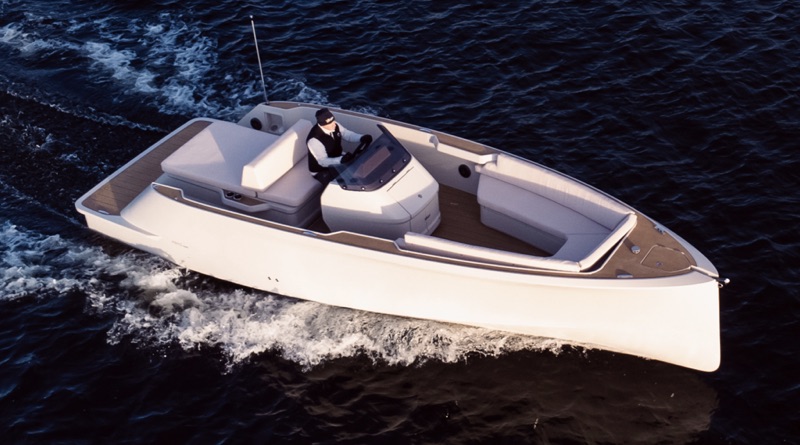
Translating this philosophy into physical naval architecture required collaboration with world-class marine designers. ESEA partnered with renowned superyacht designers and commissioned the UK-based Thorne Yacht Design to execute the naval architecture for their debut vessel, the F800. The objective was clear: merge sustainable propulsion, structural efficiency, and high-end aesthetic luxury into a single cohesive platform.
The culmination of these development efforts was unveiled to the international marine industry at Boot Düsseldorf, one of the world’s premier boat shows. The public and media reception to the F800 was immediate and enthusiastic, validating the company’s design choices and laying the groundwork for the successful closure of its initial seed funding round. This vital capital will now allow ESEA to transition from a single-model startup into a globally scalable manufacturer.
Engineering and Design Philosophy: The Anatomy of the F800
The F800 is not merely an electric motor retrofitted into a traditional hull; it is a ground-up design exercise optimized from the keel up for electron-based mobility.
Optimized Displacement Hull and Split-Hull Innovation
To maximize the efficiency and operational range of an electric drivetrain, minimizing hydrodynamic drag is paramount. ESEA achieved this through an advanced, highly optimized displacement hull featuring an almost knife-sharp bow profile.
Because the entry angle of the bow is too severe to be cleanly manufactured using a standard single-mold process, Thorne Yacht Design and ESEA utilized an innovative split-hull technique. The hull is fabricated as separate port and starboard sections, which are then structurally bonded together post-molding. This manufacturing technique yields a razor-sharp entry that slices cleanly through chop and minimizes wake energy, ensuring maximum energy efficiency at cruising speeds.
Propulsion and Digital Integration
At the heart of the F800’s powertrain is a reliable 20 kW electric motor (delivering roughly the equivalent of a 30-to-35 horsepower internal combustion engine). Unlike fossil-fuel engines, which require regular oil changes, winterization, belt replacements, and complex mechanical tuning, electric propulsion is virtually maintenance-free.

Furthermore, because the powertrain operates entirely on electrical currents rather than mechanical linkages, it serves as an ideal canvas for smart digital control systems. The F800’s propulsion, energy storage, and onboard auxiliary systems are fully integrated into a centralized digital network. This integration unlocks a level of precision, programmability, and responsiveness that is impossible to achieve with mechanical cables.
Advanced Maneuverability and Docking Support
One of the most intimidating aspects of boating for novices is docking in tight spaces or dealing with crosswinds and currents. ESEA engineered the F800 to eliminate this anxiety through smart-helm software and hardware features:
- Dock Mode & Digital Gear: By engaging the dedicated dock mode button on the interface, the electronic throttle curve is automatically desensitized. This prevents sudden surges or jumps when shifting between forward and reverse, allowing for buttery-smooth micro-adjustments.
- Steerable Pod Drive: The vessel utilizes a highly maneuverable steerable pod drive capable of a 270-degree rotation arc, giving the captain exceptional vector control during close-quarters maneuvering.
- Virtual Anchor: For moments when the crew wishes to pause for swimming, dining, or socializing, a virtual anchoring system utilizes GPS and dynamic motor adjustments to automatically hold the boat’s precise geographical position without the hassle of dropping physical ground tackle.
Supporting Context, Metrics, and Technical Specifications
To fully appreciate the operational capability of the ESEA F800, one must analyze its performance metrics in comparison to conventional fossil-fueled day boats.
Performance and Endurance
Electric vessels are often critiqued by skeptics regarding operational range. However, when paired with an efficient displacement hull, electric propulsion yields extraordinary endurance figures at cruising speeds.
- Cruising Efficiency: Powered by its 20 kW motor, the F800 achieves an optimal cruising speed of 6 knots (11 km/h / 7 mph). At this pace, the vessel boasts a staggering operational endurance of nearly 11 continuous hours, translating to a maximum cruising range of 67 Nautical miles (124 km / 77 miles).
- Top Speed: While the hull’s "sweet spot" is optimized for displacement cruising, the vessel is capable of doubling its transit speed, reaching a maximum velocity of 12 knots (22 km/h / 14 mph).
- The Philosophy of Slow Speed: As Co-founder Dee Du emphasized during discussions at Boot Düsseldorf, excessive speed introduces unnecessary friction into the recreational experience. High-speed boating forces both the pilot and passengers to be perpetually on guard—scanning for floating debris, bracing against wakes, and worrying about spilled beverages. By capping the primary design envelope at a serene, stable 6 knots, ESEA ensures a tranquil environment where passengers can converse freely without raising their voices or hanging onto handrails.
Technical Specifications Matrix
| Specification Category | Metric (Metric System) | Metric (Imperial System) |
|---|---|---|
| Length Overall (LOA) | 8.0 meters | 26 feet |
| Beam (Width) | 2.64 meters | 8 feet, 7 inches |
| Motor Output | 20 kW | ~30–35 horsepower equivalent |
| Cruising Range | 124 kilometers | 67 Nautical miles / 77 statute miles |
| Cruising Speed | 11 km/h | 6 knots / 7 mph |
| Maximum Speed | 22 km/h | 12 knots / 14 mph |
| Endurance at Cruising Speed | ~11 hours | ~11 hours |
Onboard Amenities and User-Centric Ergonomics
The layout of the F800 reflects a deep understanding of how people actually socialize on the water. The design prioritizes open, versatile living spaces:
- Social Bow Area: Positioned ahead of the central steering console is an expansive, comfortable lounge area designed for conversation and relaxation.
- Stern Sun Bed & Swimming Platform: At the rear of the vessel, a generous sun bed flows seamlessly down to an integrated swim platform, providing effortless access to the water for swimming or paddleboarding.
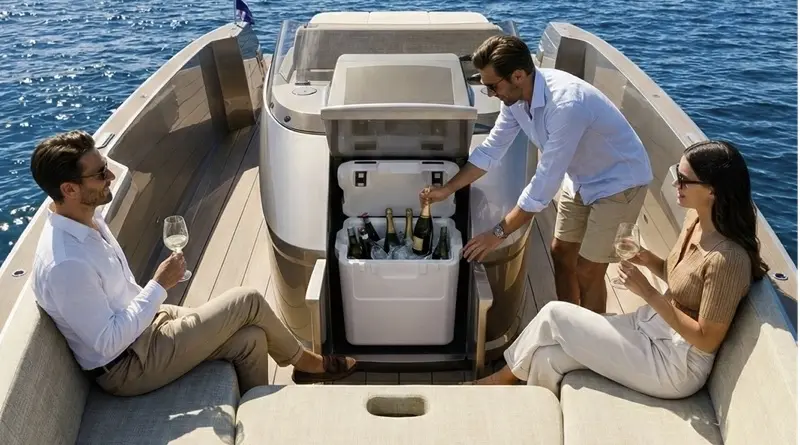
- Thoughtful Lighting and Storage: Ambient deck lights are engineered to shine strictly downward, eliminating the harsh glare that can blind passengers at night. Additionally, built-in cooling boxes are strategically positioned within arm’s reach of every seating zone, ensuring refreshments are always accessible without disrupting the flow of the party.
Official Statements and Visionary Leadership
The underlying philosophy guiding ESEA’s leadership team centers entirely on removing cognitive load and physical friction from the boating experience.

Reflecting on the company’s foundational mission, Co-Founder and Director Dee Du stated:
"We founded ESEA with the belief that boating should feel simple, intuitive, and enjoyable. With the F800, we have taken a fully integrated approach, bringing together propulsion, controls, and onboard systems into a single, cohesive design that creates a more seamless and responsive experience on the water."
Elaborating further on the emotional objective of the brand, Du noted the distinct absence of environmental nuisances that typically plague traditional fossil-fuel boating:
"The goal is for them to have an easy experience, whether they are driving it or as a passenger. No friction, just enjoyment. They can really enjoy the water and natural surroundings without any noise, and their food and drinks without any fumes and smoke. Really, everything is designed for the name of the boat—easy. That’s our philosophy. Make everything easy for the user."
This customer-first ethos is reinforced by the boat’s streamlined digital instrumentation interface. Rather than overwhelming the helmsman with endless dials tracking motor RPMs, oil pressures, and high-voltage electrical diagnostics, the oversized, high-definition cockpit display presents only the metrics that matter: instantaneous speed, GPS location, current battery state-of-charge, and remaining operational range. Detailed diagnostic data remains accessible in the background, but the primary focus is firmly fixed on relaxation and immersion in nature.
Future Outlook: Scaling Innovation and Upcoming Models
The successful closure of ESEA’s initial seed funding round marks not a destination, but a launchpad for broader commercial expansion. The company has laid out a clear roadmap for how this newly acquired capital will be deployed in the near and medium term.

Modular Product Architecture
A core pillar of ESEA’s corporate strategy moving forward is the refinement of a modular product architecture. By standardizing underlying electrical powertrains, battery modules, and digital control frameworks, ESEA can streamline engineering overhead and adapt its core technologies across a diversified family of future watercraft.
Globally Adaptable Manufacturing
To keep pace with anticipated global demand, ESEA is simultaneously investing in a scalable, globally adaptable manufacturing model. This framework will allow the company to establish efficient production partnerships or regional assembly hubs without sacrificing the exacting quality control standards established during the development of the F800.
The Next Frontier: Expanding the Portfolio
The immediate tangible result of this growth strategy is currently underway in the company’s research and development facilities. ESEA is actively developing a new 6-meter (approximately 20-foot) model.
This upcoming vessel is designed to distill the core philosophy of the F800 into a more compact, accessible footprint. By extending the Easy · Smart · Silent design language into a smaller size class, ESEA aims to capture a wider segment of the recreational marine market, opening the doors of sustainable electric boating to a broader demographic of urban water enthusiasts, resort operators, and weekend hobbyists.
As ESEA scales its manufacturing capabilities and expands its global footprint, the marine industry is taking notice. The company is proving that the future of boating does not lie in louder engines, more complex mechanical systems, or antiquated traditions. Instead, the future belongs to builders who recognize that luxury, sustainability, and simplicity are not mutually exclusive—they are the ultimate evolution of life on the water.