











Executive Overview
For over a decade, China’s solar photovoltaic (PV) sector has served as the undisputed locomotive of the global energy transition. Propelled by aggressive state backing, massive industrial scaling, and a domestic market hungry for clean power, the country routinely shattered records, culminating in a staggering 2025 where it deployed over 315 gigawatts (GW) of solar capacity in a single year.
However, the landscape of 2026 presents a dramatically different reality. China’s solar industry is no longer characterized by unbridled, breakneck expansion. Instead, the sector is traversing a complex, high-stakes transition phase. It is currently grappling with moderating installation rates, a pivotal shift toward market-based electricity pricing, severe manufacturing overcapacity, and a race toward higher-efficiency module technologies.
Industry analysts observe that the ecosystem is being pulled in multiple, conflicting directions. Project developers must now navigate a market-oriented grid where volume matters less than timing and location; manufacturers are squeezed between excess capacity and suppressed pricing; and grid operators are tasked with absorbing unprecedented volumes of variable, weather-dependent renewable energy.

The underlying narrative of China’s solar sector in 2026 is one of maturation. The era of sheer volume-driven growth is giving way to an era defined by grid integration, massive energy storage deployment, strict technological efficiency standards, and a globally distributed supply chain.
Detailed Chronology of the 2026 Transition
To understand the current state of China’s solar market, one must trace the rapid sequence of regulatory, economic, and industrial shifts that have unfolded through the first half of 2026.
Q1 2026: The Deceleration and Export Surge
The year began with a noticeable cooling in domestic installations. Data from TaiyangNews revealed that solar additions in January and February fell by more than 17% compared to the same period in 2025. This deceleration was largely anticipated; it followed a frantic late-2025 rush by developers to connect projects to the grid before the formal expiration of legacy feed-in-tariff (FIT) regimes.
Simultaneously, however, Chinese manufacturers were moving massive volumes of hardware overseas. In the first two months of the year, solar panel exports exceeded 35 GW—though down 9% year-on-year—while solar-cell exports surged by an impressive 44%. This divergence signaled a strategic shift: Chinese firms were increasingly supplying intermediate components to international factories rather than just finished panels.

This export momentum culminated in March 2026, when outbound shipments of modules, cells, and wafers hit an all-time monthly record of 68 GW. Manufacturers were racing to clear inventories ahead of a looming domestic policy shift designed to curb overcapacity and ease international trade friction.
April 1, 2026: The VAT Rebate Watershed
The single most disruptive regulatory intervention of the year occurred on April 1, 2026, when Beijing officially removed the value-added tax (VAT) export rebate for photovoltaic products. First announced in January, the policy change was engineered to address mounting international trade friction regarding subsidized Chinese overcapacity and to force domestic consolidation.
The removal of the tax rebate immediately impacted export economics. May and June 2026 witnessed a visible decline in total module shipments from Chinese ports. Yet, the contraction was not uniform. While direct shipments to Western markets faced headwinds, exports to emerging markets in Southeast Asia, South Asia, and Africa continued to exhibit steady growth, underscoring a broader geographical diversification of global solar supply chains.
Mid-Year 2026: The Market Pricing Reality
By the middle of 2026, the structural foundation of China’s power sector had shifted. New renewable energy projects were increasingly compelled to operate under market-based electricity pricing mechanisms, entirely rewriting the financial models of solar asset ownership.
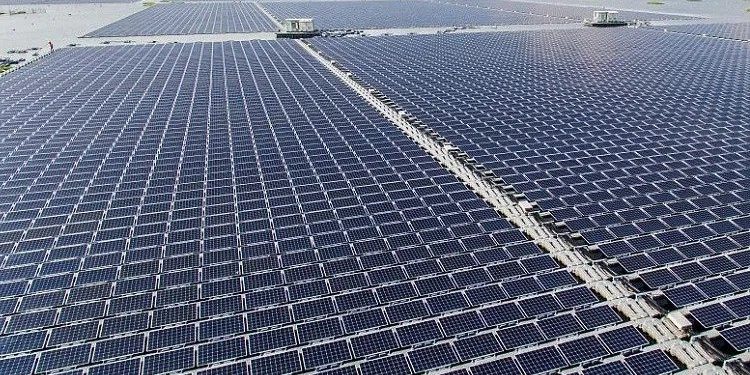
Rather than relying on guaranteed state-mandated tariffs, developers found themselves exposed to real-time wholesale electricity prices. This market exposure coincided with a staggering accumulation of variable renewable generation on the national grid. By June 2026, China’s wind capacity reached 679 GW, complementing its 1.27 terawatts (TW) of cumulative solar capacity. Together, wind and solar now account for nearly half of the nation’s total installed power-generating capacity—a monumental engineering achievement that simultaneously introduces severe grid management challenges.
Supporting Context & Metrics
Official data released by China’s National Energy Administration (NEA) for the first half of 2026 paints a vivid picture of an industry operating at a massive, industrialized scale, even as its growth rate normalizes.
Capacity and Generation Metrics
- First-Half Solar Additions: China installed 72.07 GW of new solar capacity in the first half of 2026, a slight tick up from the 71.77 GW added in the corresponding period of the previous year, but a far cry from the monthly averages seen during the 2025 boom.
- Cumulative Photovoltaic Capacity: Total installed solar capacity reached 1.27 terawatts (1,270 GW) by the end of June 2026.
- Generation and Utilization: During the first six months of the year, solar installations generated 655.5 billion kilowatt-hours (kWh) of electricity, maintaining a remarkably high average utilization rate of 91.4%. This high curtailment-management success rate underscores improved grid dispatch capabilities.
- Broader Energy Mix: Total national electricity consumption rose by 5.3% in H1 2026, propelled by energy-intensive sectors. High-technology and equipment manufacturing saw a 9.8% surge, while internet data services consumption skyrocketed by 44%, heavily driven by the nationwide expansion of data centers required for artificial intelligence and cloud computing.
The Energy Storage Boom
With wind and solar accounting for roughly 50% of installed capacity, grid stability has become the central engineering priority for Beijing and regional grid operators. The solution has materialized in an unprecedented build-out of energy storage.
By the end of June 2026, China’s new energy storage capacity reached 153 GW—representing a massive 396 gigawatt-hours (GWh) of storage volume—marking a breathtaking 61% increase year-on-year. This rapid deployment of battery and alternative storage systems is proving indispensable for capturing midday solar generation peaks and discharging power during evening demand spikes.
Parallel to storage growth, electricity market trading volumes expanded robustly. A total of 3.685 trillion kilowatt-hours were traded across China’s power markets in the first half of 2026, representing a 24.2% increase over the previous year. This liquidity reflects a power sector transitioning rapidly from administrative allocation to market-driven dispatch.
Technological Efficiency Frontlines
In a market constrained by overcapacity and low wholesale prices, raw manufacturing volume is no longer a guaranteed path to profitability. Technological efficiency has emerged as the premier competitive battleground for manufacturers.
Commercial module efficiencies achieved notable milestones in the first half of 2026:

- Back-Contact Products: Reached commercial efficiencies of 25%.
- TOPCon (Tunnel Oxide Passivated Contact) Products: Achieved efficiencies of 24.1%.
- Heterojunction (HJT) Products: Reached efficiencies of 23.8%.
For utility-scale project developers operating under market-based pricing, these efficiency gains are not merely academic; they are critical. Higher power density per square meter directly reduces balance-of-system (BOS) costs—including land acquisition, mounting structures, and cabling—thereby improving project internal rates of return (IRR) in a low-tariff environment.
Official Statements & Industry Perspectives
Industry leaders, energy economists, and regulatory bodies have increasingly spoken out regarding this structural inflection point.
Energy analysts monitoring the Chinese market emphasize that the 2026 slowdown should not be misconstrued as a contraction of the energy transition, but rather as a necessary systemic pause. As one Beijing-based energy researcher noted:
"The industry has spent the last decade proving it can manufacture hardware at a scale previously thought impossible. The challenge for 2026 and beyond is no longer whether we can build enough panels, but whether the financial, grid, and market systems can intelligently absorb and monetize them."
The transition to market-based pricing has fundamentally altered corporate strategy. Project developers report that site selection is now governed less by available land area and more by local grid absorption capacity and proximity to high-demand industrial centers. Building a massive solar farm in a remote, grid-constrained province is no longer economically viable when merchant pricing exposes the asset to zero or negative wholesale prices during peak generation hours.
Furthermore, Chinese manufacturing executives have acknowledged that the removal of the VAT export rebate has forced a strategic rethinking of globalization. Rather than exporting finished modules that face tightening trade barriers in the United States, Europe, and India, major Tier-1 manufacturers are aggressively establishing localized production partnerships across Southeast Asia, the Middle East, and Latin America. By exporting cells and wafers rather than complete panels, Chinese firms are successfully navigating local-content laws while retaining their upstream dominance in the global value chain.
Future Outlook
As China’s solar industry looks toward the remainder of 2026 and into the late 2020s, the trajectory of the sector will be dictated by three core pillars: market reform, storage integration, and technological consolidation.
- Deepening Market Integration: The expansion of market-based electricity pricing is expected to accelerate. As more solar assets are exposed to spot and forward power markets, corporate power purchase agreements (PPAs) will likely become standard practice, mirroring the maturation pathways of mature Western energy markets. Developers with sophisticated forecasting and asset-management capabilities will outperform traditional volume-driven builders.
- The Storage Imperative: The symbiotic relationship between solar deployment and energy storage will tighten. With storage capacity scaling past 153 GW, the grid’s capacity to absorb intermittent renewables is expanding, but the economic returns on storage assets will need continuous refinement through capacity mechanisms and auxiliary service markets.
- Consolidation and Technological Migration: The domestic manufacturing landscape is poised for a wave of consolidation. Smaller, inefficient cell and module makers lacking the capital to upgrade to advanced TOPCon, back-contact, or HJT production lines will likely be forced out or acquired. Meanwhile, leading manufacturers will continue to leverage efficiency gains to drive down levelized costs of electricity (LCOE).
Ultimately, China’s solar sector is shedding its adolescent growing pains. By transitioning from a subsidy-driven volume machine into a sophisticated, market-integrated, and technology-focused energy pillar, the industry is setting the structural blueprint for how a modern continental power grid can successfully transition to a renewable-dominant future.