From July 8 to July 11, the historic waters of Port Hercule and the Mediterranean coastline of the Principality of Monaco will transform into a global laboratory for the future of sustainable maritime transport. The 13th annual Monaco Energy Boat Challenge (MEBC), hosted by the prestigious Yacht Club de Monaco (YCM), will convene over 50 competing teams representing 20 countries across four continents. More than just a collection of races, the MEBC has evolved since its inception in 2014 into the world’s premier incubator for zero-emission marine propulsion, alternative fuels, and autonomous vessel technologies.
Over the past decade and a half, the event has drawn a staggering 1,825 innovators from more than 30 countries, spanning every continent except Antarctica. This year’s edition arrives at a critical juncture for the global maritime sector. As international regulatory bodies tighten environmental standards and the commercial yachting industry faces mounting pressure to decarbonize, the MEBC bridges the gap between avant-garde academic research and real-world industrial application.
Featuring four distinct competitive classes—Energy, Open Sea, SeaLab, and Artificial Intelligence (AI)—the event challenges university students, naval architects, and established electric boat builders to push the boundaries of what is possible on the water. Beyond the high-stakes racing, the event hosts two high-level industry conferences addressing advanced yacht design and the viability of alternative fuels such as hydrogen and methanol. Backed by cutting-edge infrastructure like the YCM E-Dock—the world’s largest public marine fast-charging installation on a single pontoon—the 2026 Monaco Energy Boat Challenge offers a definitive look at how the world will travel across the water tomorrow.
The four-day program is meticulously structured to test every facet of alternative marine technology, from raw speed and endurance to precise autonomous navigation and energy efficiency.
Wednesday, July 8: The Grand Parade and E-Boat Rally
The 13th edition opens with the traditional Grand Parade, bringing together every competing vessel across all classes in a unified procession across Port Hercule. This visual spectacle is immediately followed by the E-Boat Rally.
During the rally, participants in the Open Sea and SeaLab classes navigate the confines of the YCM harbor before venturing into the open Mediterranean. The route takes them past the iconic Oceanographic Museum of Monaco—a magnificent architectural marvel perched on the cliffs near the Prince’s Palace. This opening day serves as both a public showcase and a crucial systems-check for the vessels ahead of the rigorous competitive trials.
Thursday, July 9: Qualifying, Speed Trials, and Autonomous Precision
The second day shifts the focus to raw performance, agility, and system responsiveness across multiple venues:
Energy Class Qualifying Laps: University-built vessels take to the Port Hercule course for timed laps, establishing baseline performance metrics and seeding for subsequent rounds under the watchful eyes of technical judges.
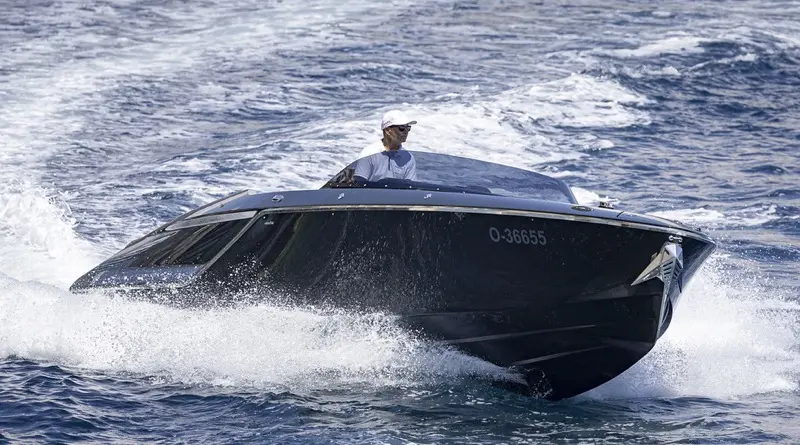
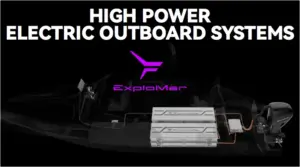
The YCM Speed Record: Arguably the most adrenaline-fueled spectacle of the week, this open-water event takes place along a coastal course mirroring the boundaries of the Yacht Club’s inaugural international powerboat contest of 1904. Competitors complete two 500-metre runs, which are combined into a single one-kilometre timed result. Last year, the Frauscher × Porsche 850 Fantom—equipped with the same electric motor found in the Porsche Macan SUV—shattered expectations with a blistering speed of 49.84 knots (92.3 kph / 57.35 mph). This year, its successor, the Frauscher × Porsche 790 Spectre, enters the fray, competing against advanced propulsion systems from Explomar, Taiga, Evoy/Vita, WIA Yachts, Weenav, and ZeroJet.
SeaLab Manoeuvrability: A technical trial within the harbor designed to evaluate precision handling, agility, and the immediate responsiveness of prototype propulsion and steering drivetrains.
AI Class Docking and Fleet Operations: Autonomous craft are evaluated on two fronts. In "Docking," vessels must approach and secure themselves to a slip entirely unassisted by human input. In "Fleet," multiple autonomous boats share the water simultaneously, testing real-time collision avoidance and dynamic path-planning algorithms.
Friday, July 10: Pushing Limits in Endurance and Long-Distance Runs
Friday tests the reliability, energy management, and endurance of both human-piloted prototypes and autonomous systems:
Energy Class Endurance Race: While sprint events capture public attention, the endurance race dictates real-world relevance. Competitors run the YCM Speed Record course, vying to complete the highest number of laps within a specified timeframe on a single charge or tank of hydrogen. It is the ultimate proving ground for energy efficiency and battery longevity.
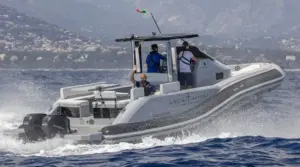
Open Sea and SeaLab 16-Nautical-Mile Race: This grueling long-distance trial sends boats from Monaco to Ventimiglia, Italy, and back. It provides an unsparing assessment of range and reliability. Last year’s race delivered a legendary, nail-biting finish when an A/XE craft from Evoy-Vita and Axopar led for the majority of the route, only to be overtaken in the final moments by the NRGX 6.3 RIB, powered by Explomar’s WAVE 300 (220 kW) electric outboard system. With new contenders stepping up in 2026, the long-distance crown remains wide open.
AI Class Figure of 8: Autonomous vessels navigate a continuous figure-eight course, challenging their onboard processing units with complex turning geometries and temporal obstacle management.
Saturday, July 11: Championship Showdowns and Awards
The final day culminates in intense head-to-head competition and the crowning of the overall class champions:
Open Sea Manoeuvrability & SeaLab Endurance Finals: The final stamina tests for prototype and commercial-adjacent entries on the championship course.
AI Class Slalom: A high-speed slalom through a dense field of buoys, representing the ultimate test of real-time machine vision, object detection, and reactive steering.
Energy Class Championship: The undisputed social and athletic climax of the week. Twenty-six university teams face off in a high-octane, head-to-head knockout tournament inside the main harbor. The technical course requires vessels to navigate multiple turning markers in a configuration that keeps outcomes hidden until the final 25 metres. The collective passion of the student engineers cheering from the quayside creates an electric atmosphere unmatched in the maritime world.
Following the final heats, cumulative points are tallied to crown the overall champions. Notably, the University of Bologna enters this year’s event as the undisputed dynasty of the Energy Class, having captured four of the past five titles.
Supporting Context, Infrastructure & Metrics
The scaling ambitions of the Monaco Energy Boat Challenge are deeply intertwined with the physical infrastructure provided by the Yacht Club de Monaco. Recognizing that electric and alternative fuel vessels require robust support facilities, the YCM inaugurated the YCM E-Dock in 2023 in partnership with Aqua superPower, the global marine fast-charging network.
The World’s Largest Floating Marine Fast-Charging Hub
Designed specifically to advance sustainable navigation, the E-Dock features up to 20 simultaneous charging points for the competing fleet. The eco-pontoon is an engineering marvel in its own right, featuring:
Integrated flexible solar panels spanning its roof to harvest clean energy.
A hybrid array of AC and DC fast chargers utilizing Aqua’s high-power marine charging infrastructure (Aqua 200 HPC) integrated with Kempower Satellite technology.
A charging capacity that officially eclipses even the temporary marine fast-charging infrastructure deployed by Aqua superPower for the Paris Olympics sailing events, making it the largest public marine fast-charging installation on a single pontoon globally.
Industry Conferences: Driving Thought Leadership
The "Challenge" in the event’s title serves a dual purpose: it describes the on-water races while throwing down a gauntlet to the broader maritime industry to solve pressing environmental problems. To facilitate this industrial transformation, the MEBC hosts two dedicated conference days:
The Advance Yachting Technology Conference (Thursday, July 9): Gathers superyacht builders, naval architects, designers, and supply chain stakeholders to discuss how future yacht design must inherently integrate clean propulsion. Discussions emphasize that decarbonization must occur in tandem with onboard energy efficiency and digital transformation.
The Alternative Fuels and Sustainable Yachting Conference (Friday, July 10): Now in its seventh year, this seminar series provides objective, data-driven analysis of alternative maritime fuels. Through expert presentations and panel Q&As, attendees explore the practicalities, safety profiles, and real-world scalability of hydrogen, methanol, and emerging synthetic fuels.
Official Statements and Industry Insights
The ethos of the Monaco Energy Boat Challenge is defined by a shared sense of urgency and youthful optimism. Observers and participants consistently highlight the unique energy that permeates the YCM quayside during the event.
"Visiting the Quayside of the Yacht Club de Monaco during the Challenge is an intensely inspiring experience," notes marine industry chroniclers. "Witnessing hundreds of university students from across the globe fine-tuning their zero-emission craft for the races—each driven by an absolute intent to make the world a better place—creates an infectious enthusiasm that sweeps through the entire principality."
The transition from purely academic prototypes to commercially viable alternative propulsion systems is reflected in the diversity of the entries. Industry veterans note that innovations tested in the grueling 16-nautical-mile endurance trials frequently find their way into the consumer and commercial markets within a few product cycles. By forcing teams to balance raw energy output with real-world range constraints, the MEBC directly addresses the historic consumer hesitation regarding electric and hydrogen mobility on the water.
Future Outlook: The Road Ahead for Zero-Emission Boating
As the 13th annual Monaco Energy Boat Challenge draws to a close on July 11, its legacy will extend far beyond the podium trophies and speed records. The event serves as a predictive barometer for the maritime sector at large.
The convergence of artificial intelligence in autonomous vessel classes points toward a future where commercial harbor craft, ferries, and exploratory vessels operate with heightened safety and efficiency through machine learning. Meanwhile, the rapid evolution of hydrogen fuel cell technologies and methanol-powered hydrofoils demonstrated in the SeaLab and Energy classes signals that the superyacht sector’s eventual transition away from fossil fuels is technically viable.
By uniting academia, forward-thinking startups, and legacy yacht builders under the patronage of the Yacht Club de Monaco, the MEBC ensures that the transition to sustainable marine propulsion is not merely an environmental obligation, but an engineering frontier full of discovery, speed, and ingenuity.