







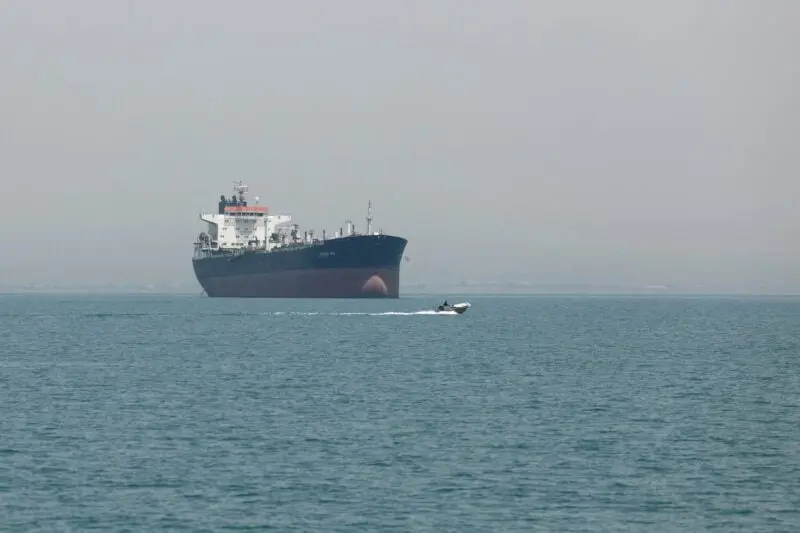
LONDON — The Strait of Hormuz, the world’s most critical maritime energy chokepoint, is currently operating under a highly volatile security regime. While merchant vessel traffic remains severely depressed compared to historical baselines, a highly coordinated, U.S.-led maritime security umbrella has successfully established a fragile lifeline for regional energy markets.
According to the latest intelligence and tracking data from the United Kingdom Maritime Trade Operations (UKMTO) and independent maritime analysts, a sophisticated, dual-track shipping corridor has emerged. Non-Iranian Gulf oil producers are steadily ramping up exports past a de facto blockade line, while Iran’s own seaborne crude trade has been systematically reduced to zero.
Executive Overview
The geopolitical standoff in the Middle East has fundamentally rewritten the rules of navigation in the Persian Gulf. Emerging data paints a picture of a waterway divided by conflict, where traditional open-ocean transit has been replaced by heavily guarded convoys and stealth runs.
The UKMTO’s latest tracking cycle reveals that overall transit volume through the Strait of Hormuz is hovering at approximately 20% of its pre-conflict norm. Despite a brief and ultimately unsustainable recovery in late June, shipmasters remain highly reluctant to enter the gulf without state-backed security guarantees.
STRAIT OF HORMUZ TRANSIT DYNAMICS (7-Day Cycle)
┌────────────────────────────────────────────────────────┐
│  Total Outbound Transits: 108                          │
│  Total Inbound Transits:  102                          │
├────────────────────────────────────────────────────────┤
│  U.S.-Facilitated Outbound: 86   │ AIS-Derived Out: 22 │
│  U.S.-Facilitated Inbound:  79   │ AIS-Derived In:  23 │
└────────────────────────────────────────────────────────┘
The defining feature of this crisis is the shipping industry’s overwhelming reliance on U.S.-facilitated passage. On the southern transit route, the ratio of U.S.-protected vessels to independent merchantmen broadcasting via the Automatic Identification System (AIS) stands at nearly 3-to-1. This protective umbrella has allowed major Arab Gulf producers—including Saudi Arabia, the United Arab Emirates (UAE), Kuwait, Iraq, Qatar, and Oman—to collectively push their crude exports back above the critical threshold of 10 million barrels per day (bpd).
Conversely, the U.S.-led blockade has successfully choked off Iranian commerce. While neighboring states utilize protected southern corridors to bypass hostile zones, Iranian crude exports have collapsed to absolute zero, exposing a stark asymmetry in the region’s economic resilience.
Detailed Chronology
The current maritime standoff is the direct result of a collapsed diplomatic framework and a subsequent military escalation that began in the late spring of 2026.
The Rise and Fall of the Islamabad Memorandum
In early 2026, regional powers and international mediators brokered the Islamabad Memorandum of Understanding (MoU). The temporary diplomatic agreement was designed to establish a de-escalation framework, guaranteeing unhindered passage for commercial shipping in exchange for partial sanctions relief and a freeze on hostile naval maneuvers.
By late June, the MoU facilitated a brief but promising recovery in commercial shipping. Shipowners, encouraged by a drop in insurance premiums and a pause in maritime attacks, briefly pushed transit volumes back toward 50% of historical averages.
The Collapse and Resumption of the Blockade
The diplomatic detente proved short-lived. By mid-summer, the Islamabad MoU suffered an effective breakdown amid mutual accusations of non-compliance, clandestine enrichment activities, and unverified naval incursions.
The collapse of the agreement triggered an immediate pivot by Washington and its allies. The United States officially reinstated its comprehensive maritime blockade, deploying carrier strike groups and allied naval assets to enforce strict compliance lines while safeguarding the commercial interests of partner nations.
The July 6 Escalation
On July 6, the maritime security environment deteriorated sharply. Hostile factions began launching targeted kinetic strikes against non-aligned merchant shipping, primarily utilizing one-way attack drones and anti-ship ballistic missiles.
Since the onset of this campaign, the Joint Maritime Information Center (JMIC) has recorded 32 distinct projectile strike incidents in and around the Strait of Hormuz, forcing the shipping industry to abandon independent transit in favor of military-escorted corridors.
Supporting Context & Metrics
A granular analysis of the UKMTO and TankerTrackers.com data reveals the operational mechanics of the current maritime corridor.
TRANSIT CORRIDOR DISTRIBUTION
               [ Persian Gulf ]
                      │
         ┌────────────┴────────────┐
         ▼                         ▼
   Northern Route            Southern Route
  (Iranian Waters)          (Omani/UAE Waters)
  - Primarily AIS-On        - Primarily U.S.-Facilitated
  - High Interdiction Risk  - High Projectile Risk (Oman)
  - 6 Transits/Day Average  - 20 Transits/Day Average
The AIS vs. Facilitated Transit Disparity
During the latest seven-day reporting window, the UKMTO recorded a total of 108 outbound and 102 inbound transits. However, the vast majority of these movements occurred under the radar of public tracking systems.
- The Southern Route: U.S.-stated facilitated transits along the southern route averaged 20 vessels per day. In stark contrast, independent vessels broadcasting AIS data on the same route averaged a mere 6 transits per day.
- The Weekly Breakdown: Of the 108 outbound transits, 86 were U.S.-facilitated, while only 22 were independent AIS-derived movements. Similarly, of the 102 inbound transits, 79 were U.S.-facilitated, compared to 23 AIS-derived movements.
This 3-to-1 disparity indicates that the commercial shipping sector has effectively outsourced its security to coalition navies. Shipmasters are systematically turning off their AIS transponders to evade tracking by hostile actors, relying instead on direct tactical coordination with U.S. and allied warships.
Geographic Split: Northern vs. Southern Routes
The waterway has been split into two distinct, high-risk corridors:
- The Northern Route: Vessels that continue to broadcast AIS are predominantly utilizing the northern route, which cuts through Iranian territorial waters. This path is favored by operators who calculate that maintaining visibility and staying close to the Iranian coast shields them from regional proxy attacks, though it exposes them to potential state-level interdiction.
- The Southern Route: This route, running through UAE and Omani waters, is the primary artery for U.S.-facilitated traffic. It is also utilized by UAE-facilitated vessels running "dark" (with AIS switched off). While the UKMTO acknowledges the presence of these UAE-supported movements, it notes that they cannot be independently verified due to the lack of active transponder data.
The 10 Million Barrel Milestone
Despite the severe drop in ship transits, the volume of oil reaching global markets has staged a remarkable recovery. TankerTrackers.com reported that combined crude exports from Iraq, Kuwait, Saudi Arabia, Qatar, the UAE, and Oman averaged over 10 million bpd during the first week of September.
This export surge—which includes volumes loaded at terminals in the Gulf of Oman that bypass the Strait of Hormuz entirely—marks the first time in two months that aggregate exports from behind the U.S. blockade line have crossed this threshold. It demonstrates that while the physical number of ship movements has plummeted, the average size of the tankers and the efficiency of the escorted convoys have maximized throughput.
Official Statements
The escalating stakes in the region have prompted stern warnings and analytical assessments from leading global maritime bodies.
Joint Maritime Information Center (JMIC)
The JMIC has maintained its assessment of the threat level in the Strait of Hormuz at SEVERE. In its latest weekly brief, the center emphasized the highly localized nature of the threat:
"The southern Omani route remains the highest-risk corridor for commercial shipping. Of the 32 projectile strike incidents recorded since the collapse of the Islamabad MoU on July 6, nineteen have occurred within this specific corridor. Operators are urged to exercise extreme caution and strictly adhere to coalition transit protocols."
TankerTrackers.com
In an analytical update published on September 11, 2026, TankerTrackers.com highlighted the stark economic divergence between Iran and its regional competitors:
"For the first time in two months since the de-facto cessation of the Memorandum of Understanding, the aggregate exports of crude oil out of the US Blockade Line by Iraq, Kuwait, Saudi Arabia, Qatar, the UAE and Oman have been averaging north of 10 million barrels per day. Iran, however, remains entirely isolated, with verified crude exports remaining at zero."
Future Outlook
The current equilibrium in the Persian Gulf is highly artificial and depends entirely on the continued allocation of substantial Western naval resources. Several factors will determine whether this fragile flow of energy can be sustained.
CRUDE OIL EXPORTS (September 2026)
┌────────────────────────────────────────────────────────┐
│  Allied Gulf Producers: >10,000,000 bpd  █████████████ │
│  Islamic Republic of Iran: 0 bpd                       │
└────────────────────────────────────────────────────────┘
The Threat of Escorted-Convey Fatigue
The U.S. Navy and its coalition partners are running highly resource-intensive operations to facilitate 20 transits per day. Maintaining this level of operational readiness indefinitely will strain naval assets, particularly as demands on global maritime security increase in other theaters, such as the Red Sea and the South China Sea.
Insurance and Freight Costs
While U.S. facilitation has restored some confidence, marine war risk insurance premiums remain at prohibitive highs. If projectile strikes on the southern Omani route continue to mount, underwriting syndicates may raise rates further, potentially pricing smaller, independent operators out of the region entirely.
Geopolitical Flashpoints
The stark contrast between a booming Arab Gulf export economy and a completely paralyzed Iranian energy sector creates a highly unstable geopolitical dynamic. With its domestic economy starved of oil revenue, Tehran may feel mounting pressure to disrupt the U.S.-facilitated southern corridor.
If the current blockade successfully keeps Iranian exports at zero heading into the winter months, the risk of a direct, state-on-state naval confrontation in the Gulf of Oman or the Arabian Sea will rise exponentially. Under such conditions, the current 20% transit baseline may represent the high-water mark for regional maritime trade for the foreseeable future.