










Executive Overview
Every year, millions of recreational boaters, commercial operators, and maritime enthusiasts take to the open seas, coastal waters, and inland lakes. While the vast majority of voyages conclude uneventfully, the dynamic and unpredictable nature of the marine environment means that emergencies can—and do—happen without warning. When a vessel begins taking on water, loses propulsion near a hazard, suffers an onboard fire, or experiences a man-overboard scenario, the difference between a successful rescue and a maritime tragedy often hinges on one critical factor: the ability to signal for help quickly, clearly, and effectively.
Visual distress signals (VDS) represent a cornerstone of modern maritime safety equipment. Designed to alert nearby vessels, aircraft, and shore-based rescue coordinators, these devices cut through the horizon to pinpoint a boat’s location when time is running out. However, possessing safety gear is only half the battle. Federal and state regulations dictate strict carriage requirements based on vessel size, operating waters, and the time of day. Furthermore, the modern boater must navigate a rapidly evolving landscape of safety technology, choosing between traditional pyrotechnic flares, modern electronic distress lights, and advanced satellite rescue beacons.
This comprehensive guide offers an authoritative, in-depth look at marine visual distress signals. Drawing on current regulatory standards and decades of on-water rescue expertise, we examine the legal requirements of VDS carriage, explore the distinct advantages and operational nuances of daytime versus nighttime signals, detail the proper handling of pyrotechnics and electronic alternatives, and outline best practices for emergency communication. Whether you are outfitting a coastal cruiser for an offshore passage or preparing a weekend runabout for the local lake, mastering the art and science of distress signaling is an essential responsibility for every skipper.

Detailed Chronology: The Evolution of Maritime Signaling and Regulatory Standards
The history of marine distress signaling is as old as seafaring itself, evolving from rudimentary fires lit on coastal headlands to sophisticated electronic networks monitored by international search-and-rescue agencies. Understanding how modern regulations and technologies developed provides essential context for why current carriage rules exist.
From Bonfires to Pyrotechnics: Early Signaling
Centuries ago, mariners in peril relied on whatever was immediately available to attract attention: burning barrels of tar on deck, firing deck cannons into the air, or waving flags in specific patterns. These improvised methods were notoriously unreliable, heavily dependent on weather conditions, and lacked standardized meanings.
The invention of modern chemistry in the 19th and 20th centuries revolutionized maritime safety. Pyrotechnic marine flares were developed to provide a concentrated, intensely bright light capable of piercing fog, rain, and darkness. Governments quickly recognized the life-saving potential of standardized pyrotechnics, leading to the establishment of international maritime conventions.
The Codification of Federal Standards
In the United States, the formalization of visual distress signal requirements took a major leap forward with the enactment and refinement of federal boating safety acts. The U.S. Coast Guard, operating under the Department of Homeland Security, established rigorous approval standards for marine equipment.

- The Late 20th Century: Federal rules were updated to clearly delineate between daytime and nighttime requirements, recognizing that a signal effective under a glaring midday sun might be invisible after dark, and vice versa. Manufacturers were required to test devices for luminous intensity, burn time, and durability.
- The Electronic Revolution: As battery technology and solid-state electronics advanced, the Coast Guard began approving electronic visual distress signal devices (eVDSDs) as viable alternatives to nighttime pyrotechnics. This shift addressed growing environmental concerns regarding pyrotechnic disposal, expiration dates, and the inherent safety risks of handling high-heat flares onboard fiberglass vessels.
- Modern Integration: Today, visual distress signals do not exist in a vacuum. They are integrated into a multi-tiered safety ecosystem that includes VHF marine radios, digital selective calling (DSC), Global Positioning System (GPS) integration, and 406 MHz emergency position-indicating radio beacons (EPIRBs). While electronic beacons initiate searches from afar, visual signals remain the undisputed gold standard for guiding rescuers directly to the final target in the critical final miles of a search.
Supporting Context & Metrics: Understanding VDS Requirements and Equipment Categories
Navigating the web of federal and state VDS regulations requires a thorough understanding of where rules apply, what equipment qualifies, and how to maintain compliance across different vessel classes.
When and Where Are Visual Distress Signals Required?
Federal requirements apply to numerous vessels operating on the coastal waters of the United States, the Great Lakes, territorial seas, and those connecting waters up to a point where the waterway is less than two miles wide.
- Vessel Size Exceptions: Generally, recreational boats less than 16 feet (4.9 meters) in length are exempt from carrying daytime signals, but they must carry nighttime signals when operating between sunset and sunrise. Vessels 16 feet and over must carry both daytime and nighttime signals at all times when operating on applicable waters.
- Human-Powered Watercraft: Canoes, kayaks, and stand-up paddleboards are typically exempt from VDS carriage requirements during daylight hours, though safety advocates strongly recommend carrying at least a whistle, signal mirror, or waterproof electronic light regardless of statutory mandates.
- State-Specific Rules: In addition to federal guidelines, individual states enforce their own boating laws. Some inland lakes and rivers that fall outside federal jurisdiction may still have specific safety equipment mandates. Skippers must verify both federal and local state laws before embarking on unfamiliar waters.
Categorizing Approved Visual Distress Signals
To meet legal requirements, equipment must be Coast Guard-approved, unexpired (in the case of pyrotechnics), and maintained in serviceable condition. Approved devices generally fall into distinct categories:
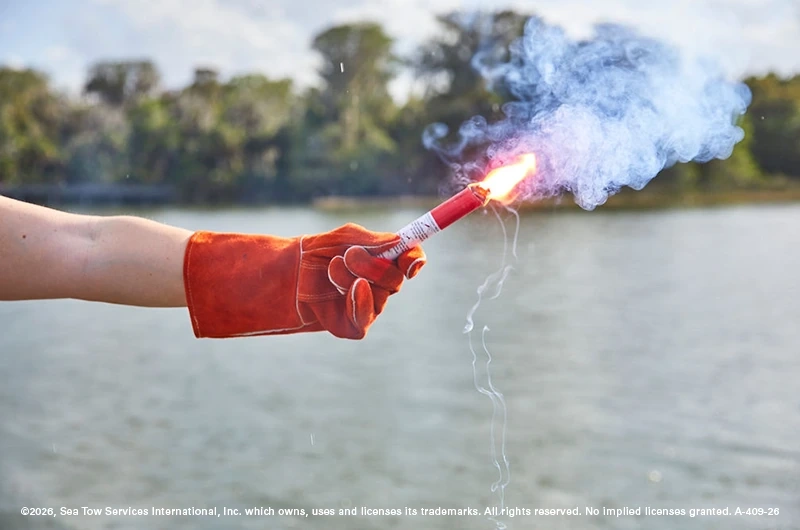
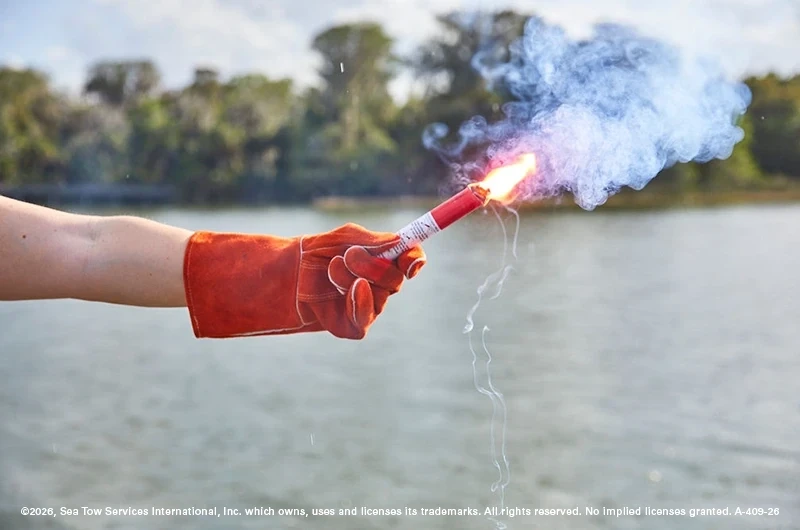
- Pyrotechnic Devices (Day and Night): Handheld red flares, aerial meteor signals, parachute flares, and orange smoke canisters. These devices rely on chemical reactions to produce high-intensity light, smoke, or physical projectiles.
- Electronic Devices (Night Only): Approved eVDSDs that flash the internationally recognized SOS distress pattern (three short, three long, three short). These must be carried in conjunction with an approved daytime signal (such as an orange flag) to satisfy 24-hour carriage requirements.
- Daytime Flags: Orange cloth flags featuring a black square and a black ball, which is the internationally recognized symbol for maritime distress.
| Signal Type | Operating Time | Primary Function | Advantages | Limitations |
|---|---|---|---|---|
| Handheld Red Flare | Night (and some Day) | Pinpoint location | Extremely bright, familiar to rescuers | Hot slag, single-use, expires |
| Aerial Meteor / Parachute | Day & Night | Wide-area alert | Visible from miles away, gains altitude | Requires careful aiming, wind drift |
| Orange Smoke Canister | Day Only | Position & wind direction | Highly visible against water/sky | Useless at night, produces smoke |
| Electronic VDS (eVDSD) | Night Only | Repeating SOS signal | Reusable, no expiration, safe | Requires batteries, needs day flag |
| Orange Distress Flag | Day Only | Passive daytime marker | Inexpensive, reusable, durable | Relies on line-of-sight and daylight |
Official Statements and Expert Guidance: Insights from Marine Rescue Authorities
Organizations dedicated to on-water assistance and maritime safety—such as Sea Tow and the U.S. Coast Guard Auxiliary—consistently emphasize that safety equipment is only as good as the operator’s familiarity with it.
The Distinction Between Routine Assistance and Grave Emergency
A recurring theme in professional marine rescue guidance is the proper triage of distress calls. Marine towing networks routinely field calls for disabled vessels, fouled propellers, and dead batteries. Experts stress that pyrotechnic flares and emergency rescue beacons must be reserved strictly for situations that threaten life or safety.
"A flare is a universal symbol of immediate life-threatening danger. When a boater fires a flare, it triggers an urgent, multi-agency emergency response that can pull resources away from other critical missions. For routine towing, mechanical breakdowns, or fuel runs, boaters should always utilize marine VHF radio channels, cellular communication, or dedicated assistance apps rather than pyrotechnics."
— Maritime Safety Directorate Spokesperson
Passenger Briefings and Equipment Accessibility
Another critical point emphasized by marine safety professionals is the accessibility of safety gear. Storing flares at the bottom of a locked lazarette or deep inside a cabin locker renders them useless during a rapid-onset emergency like an onboard fire or sudden capsizing.
Experts recommend conducting pre-departure safety briefings with all passengers aboard. Every person on the vessel should know:
- Exactly where visual distress signals and life jackets are stowed.
- How to operate electronic safety devices and fire extinguishers.
- The location of the marine VHF radio and how to initiate a Mayday call.
Future Outlook: Technological Advancements in Marine Distress Signaling
As maritime technology continues to advance, the landscape of visual and electronic distress signaling is undergoing a quiet revolution. While traditional pyrotechnic flares have served generations of mariners, their environmental impact, disposal challenges, and inherent fire risks are driving a shift toward smarter, cleaner alternatives.
The Rise of Advanced Electronic Signaling
Electronic visual distress signal devices are rapidly gaining market share among recreational boaters. Manufacturers are engineering eVDSDs with higher lumen outputs, longer battery life, and more robust, waterproof housings. These devices eliminate the hazards associated with burning chemical slag and remove the anxiety of expiration dates—though owners must still maintain fresh battery inventories.
Furthermore, integration between electronic lights and onboard navigation systems is improving. Future safety ecosystems may feature automated strobe activation linked to water-intrusion sensors or gyroscopic capsized-vessel detectors, broadcasting distress signals even if the crew is incapacitated.
Satellite Connectivity and Personal Locator Beacons (PLBs)
While EPIRBs and PLBs transmit radio frequencies to search-and-rescue satellites rather than producing light, their integration with modern distress planning is tightening. The advent of two-way satellite messengers and compact personal locator beacons allows solo sailors and small boaters to maintain global connectivity.
As these units shrink in size and drop in price, the modern distress signaling strategy is shifting from reactive visual shouting to proactive electronic communication, backed up by visual markers for the final rescue approach. Regulators and manufacturers continue to collaborate on updating standards to ensure these new tools seamlessly complement traditional VDS requirements, keeping waterways safer for everyone on the water.


