








Executive Overview
Los Angeles County’s public transportation network is experiencing a profound and sustained renaissance. Driven by strategic system expansions, targeted network optimizations, and a blockbuster calendar of international sporting events and cultural celebrations, the Los Angeles County Metropolitan Transportation Authority (LA Metro) has officially recorded its eighth consecutive month of year-over-year rail growth.
In July, the transit agency logged an impressive 25,847,617 total boardings. This figure represents a dramatic increase of nearly two million trips—or 8.79%—compared to the same period in 2025. This summer surge is not an isolated anomaly; rather, it serves as the continuation of a robust, long-term post-pandemic ridership recovery that is reshaping how residents and visitors navigate one of the world’s most sprawling metropolitan areas.
The engine powering this continuous growth is the agency’s rail network, which has benefited immensely from recent multi-billion-dollar infrastructure investments. New and extended rail lines are seamlessly connecting previously isolated communities, transforming cross-county commutes, and offering a reliable alternative to Southern California’s notoriously congested freeways. Simultaneously, LA Metro’s extensive bus network has posted steady gains, buoyed by enhanced corridor enforcement, schedule optimizations, and specialized event shuttles.
As Los Angeles prepares to host the world stage for upcoming monumental gatherings—culminating in the 2028 Olympic and Paralympic Games—the numbers from July 2025 and 2026 demonstrate that public transit in the Southland is not merely surviving, but actively scaling to meet the demands of a dynamic, modern metropolis.
Detailed Chronology of a Record-Breaking Summer
The trajectory of LA Metro’s 2026 fiscal year has been defined by cascading records, with each month building upon the operational successes and infrastructure milestones of the last. To understand the magnitude of July’s performance, one must examine the immediate historical context of the preceding months.
The Springboard: May and June 2026
The momentum leading into the mid-summer peak was established during a dynamic spring. In May 2026, the transit network received an immediate jolt from the opening of the initial phase of the D Line (Purple Line) Extension, which added three crucial new subway stations to the Westside. The impact was instantaneous: LA Metro reported a staggering 62% year-over-year increase in D Line ridership alone in May, pushing system-wide rail usage to its highest level in more than six years. Overall system ridership in May enjoyed a strong 9.5% year-over-year lift, marking the sixth consecutive month of positive rail growth up to that point.
This upward curve steepened considerably in June 2026. Metro recorded 26,265,480 total boardings during the month—roughly two million more than June 2025—representing a 9% year-over-year surge. Most notably, rail ridership skyrocketed by 21.8% in June, powered heavily by weekend leisure travelers and fans attending early summer concerts and sports fixtures across the county.

The July Peak: World Cups, Holidays, and High Demand
Building directly on this sustained spring momentum, July 2026 emerged as one of the most active months in the history of modern Los Angeles transit. The region transformed into a global hub of activity, playing host to major international World Cup matches, sprawling fan zones, and high-capacity public viewing parties. Combined with traditional Independence Day celebrations, major stadium concerts, and regional sporting events, the demand for high-capacity public transportation reached fever pitch.
Despite the logistical challenges inherent in moving millions of people through a decentralized mega-region, LA Metro’s system absorbed the demand with remarkable resilience. The agency recorded 25,847,617 boardings for the month of July, marking an 8.79% increase over July 2025.
Crucially, the temporal distribution of these trips revealed a healthy, balanced transit ecosystem. While weekday commuters continued to rely heavily on the system for professional travel, weekend leisure travel exploded. Saturday boardings across the entire system surged by 10.63% year-over-year to a daily average of 694,263 trips, while Sunday boardings rose 8.77% to average 597,114 trips. Weekday ridership maintained a formidable baseline as well, reaching an average of 903,446 daily boardings—a solid 7.41% increase compared to July 2025.
Supporting Context & Comprehensive Metrics
A granular analysis of LA Metro’s operational data underscores that the system’s growth is broad-based, touching every mode of transit, every corner of the county, and every day of the week.
Rail Network: The Undisputed Driver of Growth
While bus operations handle the largest absolute volume of passengers, the rail network has become the primary catalyst for percentage-based growth. In July 2026, LA Metro recorded 6,592,276 rail boardings. This represents an impressive 16.84% year-over-year increase, cementing an unbroken streak of eight consecutive months of rail ridership expansion.
The appetite for rail travel was particularly pronounced during weekends, signaling that residents are increasingly utilizing trains for recreation, dining, and cultural events rather than solely for the Monday-through-Friday morning commute. Saturday rail ridership leaped by 19.3% compared to July 2025, hitting a daily average of 191,365 boardings.
+------------------------------------------------------------------------+
|                      JULY 2026 RIDERSHIP METRICS                       |
+----------------------------------+-------------------------------------+
| Metric                           | Value / Change vs. July 2025        |
+----------------------------------+-------------------------------------+
| Total System Boardings           | 25,847,617 (+8.79%)                 |
| Total Rail Boardings             | 6,592,276 (+16.84%)                 |
| Total Bus Boardings              | 19,255,341 (+6.30%)                 |
| Weekday Average Boardings        | 903,446 (+7.41%)                    |
| Saturday System Average          | 694,263 (+10.63%)                   |
| Sunday System Average            | 597,114 (+8.77%)                    |
| Saturday Rail Average            | 191,365 (+19.30%)                   |
+----------------------------------+-------------------------------------+
Infrastructure Milestones Enabling the Surge
These quantitative gains are the direct dividend of strategic capital investments completed over the past twenty-four months. The network has undergone its most significant expansion generation:
- The LAX/Metro Transit Center (Opened 2025): This critical multimodal hub finally bridged the historical gap between Los Angeles International Airport and the county’s heavy and light rail networks, simplifying airport commutes for millions of travelers and aviation workers.
- The A Line Extension to Pomona: Expanding the reach of the nation’s longest light rail line further into the San Gabriel Valley, connecting suburban job centers directly to downtown Los Angeles and beyond.
- The D Line (Purple Line) Subway Extension: Opening its first phase of three new Westside stations in May 2026, this high-capacity heavy rail line unlocked dense urban corridors—including Miracle Mile and Beverly Hills—drastically cutting travel times across the city’s western core.
Bus Operations: Steady Expansion and Specialized Service
While rail captured the highest percentage gains, LA Metro’s bus network proved equally vital to the county’s mobility. Bus ridership expanded by 6.3% year-over-year in July, logging 19,255,341 boardings.
Much like the rail network, weekend bus usage outpaced weekday growth. Saturday bus boardings increased by 7.7% to average 502,898, while Sunday bus boardings rose 6.0% to 427,383.
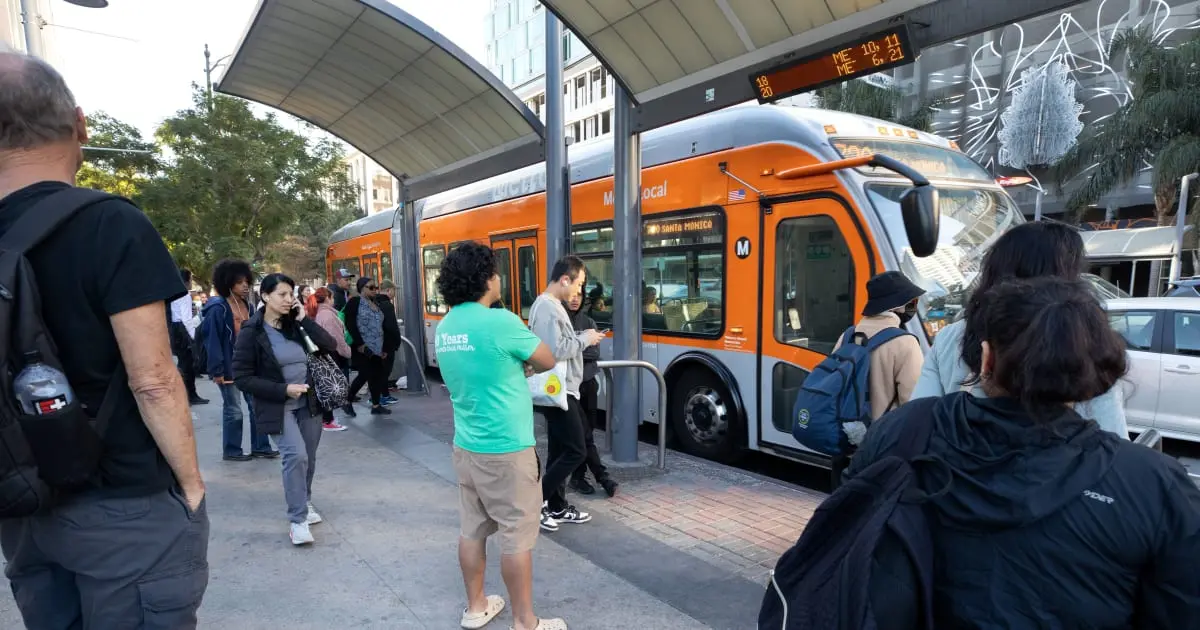
Specialized corridors bore the brunt of major event traffic. The J Line—a high-capacity Bus Rapid Transit (BRT) route connecting El Monte and Harbor City via Downtown Los Angeles—experienced a 7.6% increase in ridership as thousands of passengers utilized it to reach World Cup-related festivities. Notably, this figure does not even account for the 212,865 specialized rides delivered via LA Metro’s dedicated World Cup shuttle services directly to regional match venues, which the agency tracked and reported as a separate operational category.
To maintain this momentum, LA Metro has actively refined its network. Service adjustments implemented in June included comprehensive timetable revisions across dozens of bus lines and synchronized rail schedule modifications designed to optimize on-time performance, eliminate bottlenecks, and streamline modal transfers.
Official Insights and System Evolution
Behind the raw numbers lies a deliberate, data-driven philosophy of transit management. LA Metro leadership has repeatedly emphasized that modern ridership recovery requires more than just building tracks—it demands a holistic approach encompassing safety, cleanliness, scheduling reliability, and speed.
A cornerstone of this operational overhaul has been the agency’s aggressive focus on security and station hygiene. Recent independent transit reports and internal audits have highlighted significant strides made by LA Metro in addressing social issues across the system, including documented declines in unsanctioned encampments and transient activity on trains and platforms since 2024. By prioritizing a welcoming, secure environment, the agency has successfully wooed back "choice riders"—individuals who own automobiles but choose public transit for its convenience, cost-effectiveness, and environmental benefits.
Furthermore, collaboration with municipal partners has enhanced service velocity. Initiatives such as the partnership with the City of West Hollywood to advance smarter, automated bus lane enforcement have ensured that surface transit can bypass highway-style gridlock, keeping buses running on predictable, competitive schedules.
Future Outlook: The Road to 2028 and Beyond
As LA Metro digests its eighth consecutive month of rail growth and celebrates a banner summer of service, transit planners are already looking toward the horizon. The operational playbook developed during the summer of 2026—characterized by surge planning, enhanced digital wayfinding, multi-agency coordination, and real-time schedule adjustments—is serving as a dress rehearsal for an even grander challenge.
Los Angeles is fast approaching the ultimate test of its civic and transportation infrastructure: the 2028 Olympic and Paralympic Games.
The strategy currently yielding an 8.79% year-over-year jump in July 2026 forms the foundation of Metro’s ambitious "Twenty-Eight by ’28" initiative and broader long-range transportation plans. Additional rail extensions are slated to open in the coming years, further weaving together the San Fernando Valley, the Westside, the South Bay, and East Los Angeles.
With a modernized heavy and light rail network, an optimized bus fleet, proven capacity to manage international mega-events, and a steadily growing base of daily riders, LA Metro is fundamentally altering the civic identity of Los Angeles. No longer defined solely as a city of endless concrete and automobiles, Los Angeles is proving that world-class, high-capacity public transit can thrive in the American West—paving the way for a cleaner, more connected, and more mobile future.