








Executive Overview
For decades, the public transportation sector has grappled with an unforgiving operational paradox: the need to maximize passenger throughput while guaranteeing absolute physical safety at the threshold of the vehicle. Traditional transit bus door control systems have long relied on conventional electromechanical relays, rudimentary light curtains, ultrasonic sensors, and pressure-sensitive rubber door edges. While functional, these legacy mechanisms are notoriously binary. They often struggle with edge cases—such as crowds surging during peak rush hours, mobility devices navigating narrow portals, or stray items caught in closing thresholds—frequently resulting in false positives, unnecessary delays, and premature wear on physical components.
Enter Wabtec Corporation’s VaporVision, a sophisticated machine-vision and deep-learning doorway management system that seeks to fundamentally redefine how transit agencies and original equipment manufacturers (OEMs) approach bus ingress and egress. Spearheaded by veteran engineers Karl Kobel and Jim Ferro, VaporVision represents a philosophical shift in how artificial intelligence should be deployed within heavy-duty municipal infrastructure. Rather than chasing the hype cycles of generative AI, Wabtec has engineered a deterministic, purpose-built deep-learning model designed for one specific mission: interpreting passenger dynamics at the doorway in real-time, feeding precise contextual data to the door control unit, and logging granular diagnostic telemetry to streamline fleet maintenance.
This comprehensive report examines the engineering architecture, operational philosophy, diagnostic breakthroughs, and field flexibility of VaporVision. By exploring how Wabtec transitions the transit industry from reactive maintenance to proactive, data-driven fleet management, this article provides transit leaders and OEMs with an authoritative look at the future of mass-transit accessibility and safety.
Detailed Chronology: From Electromechanical Controls to Neural Networks
To understand the engineering leaps embodied by VaporVision, one must first trace the evolutionary trajectory of transit doorway technology over the last half-century.
The Electromechanical Era
In the early days of Karl Kobel’s 55-year engineering career, bus doors were governed by raw electromechanical switches, pneumatic cylinders, and hardwired relay logic. If a door encountered an obstruction, it relied on physical resistance. The motor would hit an electrical current spike, trip a circuit, and reverse. While durable in design, these systems were heavy, prone to mechanical drift, and lacked the nuance required to safely navigate crowded urban environments without subjecting passengers to uncomfortable—and occasionally hazardous—impact forces.
The Rise of Solid-State and Optical Sensing
As electronics matured, the industry adopted solid-state controls paired with optical infrared beams and safety edges. These additions reduced mechanical wear and introduced basic electronic sensing loops. However, they suffered from significant spatial blind spots. Infrared beams could be easily blocked or fooled by environmental factors like direct sunlight, dirt, and heavy precipitation. Moreover, their detection zones were strictly fixed, creating rigid "dead zones" where passengers could easily be missed by the safety logic, leading to pinched limbs or dragged passengers.
The Integration of Machine Vision and Deep Learning
The modern era of transit engineering—exemplified by Wabtec Bus Solutions—bridges the gap between physical hardware and advanced neural networking. Jim Ferro, control manager and leader of the VaporVision software team, notes that the system’s transition from conceptual R&D into full-scale production was driven by a desire to overcome the inherent physical limitations of single-point sensors.
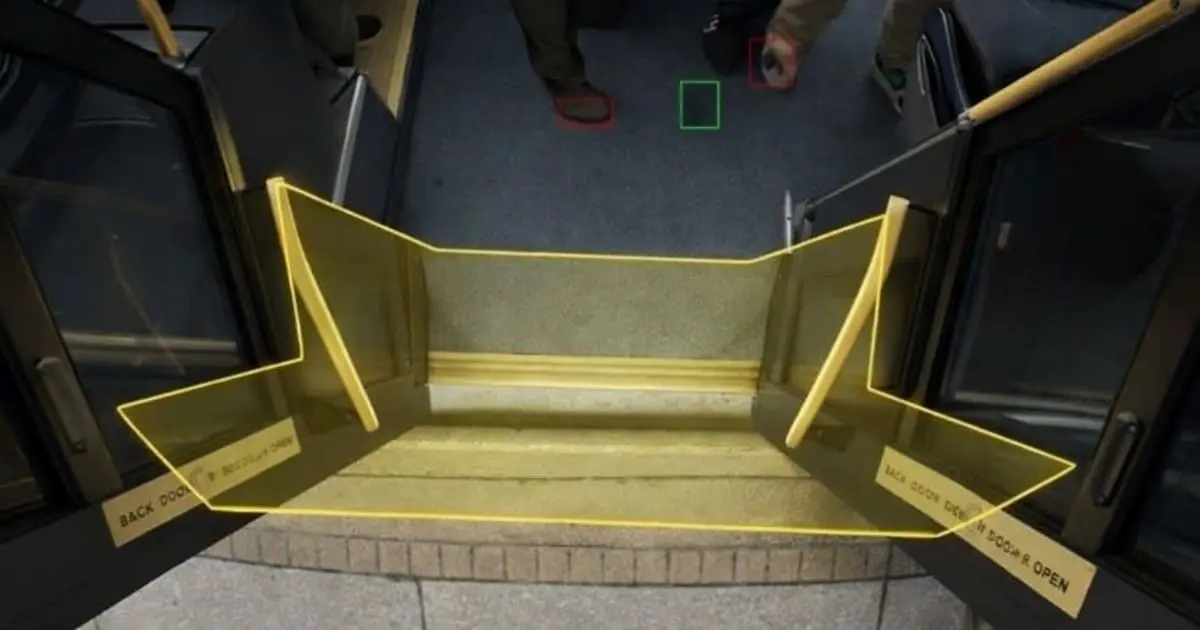
By mounting a wide-angle camera centrally above the door portal, Wabtec engineers achieved an unbroken 180-degree field of view. Instead of treating the doorway as a series of isolated tripwires, VaporVision processes the entire portal as a dynamic, evolving spatial environment. Deep-learning models trained on vast datasets of human movement classify passenger features, body parts, and personal belongings. These classifications are dynamically updated as the door transitions through its lifecycle: opening, holding, and closing. The result is a context-aware system that knows the difference between a deliberate passenger stepping off the bus and an accidental obstruction remaining in the threshold.
Supporting Context & Metrics: The Engineering Blueprint of VaporVision
To successfully deploy AI in a mission-critical transit environment, the technology must meet stringent performance, reliability, and security benchmarks. Wabtec designed VaporVision not as a fragile consumer gadget, but as an industrial-grade node capable of withstanding the harsh realities of municipal transit fleets.
Spatial Awareness and Dynamic Detection Zones
Traditional sensors operate on static logic. If an object breaks a beam, the door stops. VaporVision, conversely, utilizes configurable detection zones that morph and adapt based on the state of the door.
- When Opening: The system monitors for sudden surges or unexpected movements near the threshold, ensuring the door does not swing into an approaching passenger.
- When Fully Open: It tracks dwell times and passenger flow, keeping the portal clear without timing out prematurely.
- When Closing: The deep-learning model continuously evaluates whether a human form or appendage remains in the critical path, intelligently adjusting closure velocity or reversing before harmful contact is made.
This spatial intelligence dramatically slashes the frequency of false closures, keeping dwell times optimized and ensuring buses maintain their scheduled timetables across congested urban routes.
Comprehensive Diagnostic Logging and Video Capture
One of the most persistent headaches for transit maintenance yards is the "ghost fault"—an intermittent error reported by a driver that cannot be replicated once the vehicle is brought into the service bay. VaporVision addresses this by treating onboard diagnostics as a core operational requirement rather than an afterthought.
The system logs every single input, output, door-state alteration, object detection event, and system error. Furthermore, when a triggering event occurs, VaporVision’s configurable video recording system captures approximately four seconds of high-definition video before and after the event.
During early beta trials, this capability proved transformative. Technicians investigated a reported door malfunction by pulling the system logs and synced video footage. While the door had indeed retriggered, the visual evidence proved that sensitive bottom safety edges were properly activating due to passenger interference, rather than a system fault. This eliminated hours of diagnostic guesswork, allowing maintenance crews to zero in on the true root cause instantly.
Connectivity, Hardware Footprint, and Ruggedization
Modern transit buses are rolling local area networks (LANs). VaporVision integrates seamlessly into this ecosystem via multiple communication protocols:
- CAN Bus: Facilitates real-time communication with the existing bus control network and door actuators.
- Ethernet: Supports high-speed system setup, monitoring, and deep integration with onboard vehicle management networks.
- Wi-Fi: Empowers technicians to download logs, review diagnostic video, and update configurations wirelessly from the depot floor without needing to unbolt interior panels or access hard-to-reach wiring harnesses.
Despite its powerful computational capabilities, the physical hardware module is remarkably compact—significantly smaller than legacy multi-sensor arrays—making it exceptionally easy to install in both new OEM production lines and retrofit programs for existing fleets.
To guarantee survivability in the field, VaporVision has undergone rigorous testing against extreme thermal ranges, shock, vibration, electromagnetic susceptibility (EMS), electromagnetic emissions (EMI), and electrostatic discharge (ESD) under applicable SAE (Society of Automotive Engineers) standards. Additionally, the entire architecture was designed and audited in strict alignment with industry-standard Wabtec cybersecurity protocols, ensuring the onboard AI cannot be exploited as a vector for malicious network intrusion.
Official Statements and Industry Philosophy
The development of VaporVision highlights a vital philosophical divide in contemporary technology deployment: the difference between novelty AI and purpose-built engineering.
Karl Kobel, reflecting on his 55-year career, emphasizes that technology should always serve a practical, human-centric purpose.
"After 55 years in engineering, I have seen transit technology evolve from conventional electromechanical controls to connected systems capable of interpreting their surroundings. What began as a job opportunity has blossomed into a very exciting career."
Jim Ferro echoes this sentiment, stressing that technology must solve real-world problems at the vehicle’s edge.
"VaporVision is an integral part of the door control system that helps passengers enter and exit safely while adapting to variations in passenger movement. Our goal was to move the system from development into production by focusing squarely on protecting passengers, supporting easier ingress and egress, limiting unnecessary dwell time, and giving maintenance teams better information when something goes wrong."
Kobel and Ferro draw a hard boundary between VaporVision’s deterministic deep-learning framework and modern generative AI models. While generative AI models are designed for open-ended content creation and probabilistic text or image synthesis, VaporVision’s neural network is strictly bounded. It is trained for a single, well-defined operational task: recognizing relevant human and object features within a bus doorway and passing deterministic instructions to the door controller. It does not hallucinate, it does not generate external content, and it operates strictly within its designated safety envelope.
This distinction serves as a valuable operational framework for municipal transit leaders. When evaluating artificial intelligence, agencies should not be swayed by the "AI" marketing label. Instead, they must evaluate solutions based on tangible criteria:
- Defined Operational Utility: Does it solve a specific, painful operational bottleneck?
- System Integration: How seamlessly does it interface with legacy vehicle architecture?
- Environmental Adaptability: Can it survive harsh weather, electrical interference, and physical shock?
- Actionable Diagnostics: Does it make the lives of mechanics and fleet managers easier?
Future Outlook: The Next Generation of Connected Transit
As cities worldwide push toward smart mobility, autonomous public transit, and zero-emission electric bus fleets, the expectations placed on doorway infrastructure will only intensify. Electric buses, in particular, require rigorous energy management; auxiliary systems like pneumatic door cycles and auxiliary electronics draw precious kilowatt-hours from the main traction battery. By eliminating false door closures and optimizing dwell times, intelligent systems like VaporVision directly contribute to energy conservation and extended battery life across electric bus deployments.
Furthermore, the aggregation of anonymized doorway telemetry opens exciting avenues for predictive maintenance and transit analytics. As agencies scale machine-vision systems across entire fleets, machine learning algorithms can begin to predict component degradation before a failure occurs. By monitoring subtle changes in door motor resistance, closing times, and sensor trigger frequencies over months of operation, fleet managers can schedule preventative servicing during routine nightly maintenance windows, virtually eliminating mid-route breakdowns and service disruptions.
Conclusion
Wabtec’s VaporVision proves that the future of public transportation does not lie in flashy, ungrounded tech trends, but in the disciplined application of intelligent engineering. By combining a wide-angle optical view, deep-learning passenger classification, robust diagnostic logging, and flexible field connectivity, Wabtec has transformed the humble bus door from a mechanical liability into an active safety and data asset.
For transit agencies and OEMs navigating an increasingly complex urban landscape, machine vision is no longer just a luxury passenger-detection tool—it is the foundational cornerstone for safer operations, streamlined maintenance, and truly connected fleet management.