







Executive Overview
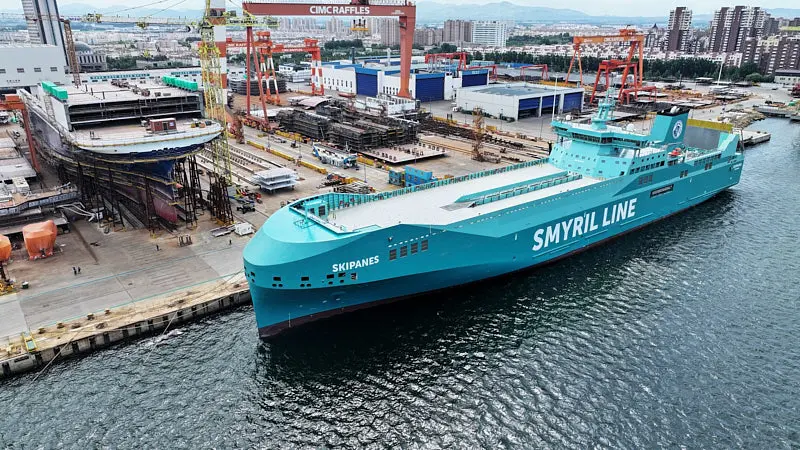
In a milestone transaction for North Atlantic maritime logistics, Faroese shipping company Smyril Line has officially taken delivery of its brand-new Roll-on/Roll-off (RoRo) freight vessel, M/V SKIPANES. Constructed by the CIMC Raffles shipyard in Yantai, Shandong Province, China, the vessel represents the first of a dual-ship order designed to overhaul the carrier’s primary freight corridors connecting Europe, the Faroe Islands, and Iceland.
The delivery of SKIPANES marks the culmination of an extensive design and procurement initiative aimed at boosting cargo capacity, enhancing operational reliability in extreme weather environments, and significantly lowering greenhouse gas (GHG) emissions per transported lane meter. As global shipping adapts to increasingly stringent environmental mandates from the International Maritime Organization (IMO) and the European Union’s Emissions Trading System (EU ETS), Smyril Line’s multi-million-euro fleet renewal initiative reflects a broader trend among regional short-sea operators toward modernizing tonnage for high-efficiency, multi-modal transport.
Following formal handover ceremonies at the Yantai shipyard, SKIPANES has commenced its long-haul delivery voyage from the East China Sea toward its intended operational theater in Northern Europe. The vessel is slated to integrate directly into Smyril Line’s established North Atlantic liner network, serving crucial import and export flows—most notably fresh seafood exports from the Faroes and Iceland, along with dry cargo, industrial components, and temperature-controlled consumer goods flowing from Continental Europe.
+-------------------------------------------------------------------------+
|                      SMYRIL LINE FLEET EXPANSION                        |
+-------------------------------------------------------------------------+
| Vessel Name          | M/V SKIPANES                                     |
| Shipbuilder          | CIMC Raffles Shipyard (Yantai, China)            |
| Ship Type            | Roll-on/Roll-off (RoRo) Freight Vessel          |
| Operational Theater  | North Atlantic / North Sea (Europe-Faroes-Iceland)|
| Project Milestone    | First of two custom RoRo sister ships delivered  |
| Strategic Objective  | Fleet renewal, carbon efficiency, trade growth  |
+-------------------------------------------------------------------------+
Detailed Chronology: From Strategic Blueprints to Delivery
The deployment of SKIPANES is the result of a multi-year effort by Smyril Line to address growing freight demand and aging tonnage in the North Atlantic cargo sector. The project timeline reflects a structured process of engineering adaptation, market assessment, and construction management across global maritime hubs.
+-------------------------------------------------------------------------+
|                           PROJECT TIMELINE                              |
+-------------------------------------------------------------------------+
|  [ Phase 1: Procurement & Design ]                                      |
|  • Strategic review identifies need for updated North Atlantic RoRo capacity |
|  • Contract signed with CIMC Raffles for two customized freight vessels |
|                                                                         |
|  [ Phase 2: Construction at Yantai ]                                    |
|  • Steel cutting & keel-laying milestones completed                     |
|  • Hull construction engineered for harsh-weather North Atlantic routes |
|  • Fitting out of advanced propulsion, power, and cargo systems         |
|                                                                         |
|  [ Phase 3: Trials & Verification ]                                     |
|  • Dockside commissioning and sea trials completed in China             |
|  • Vessel meets operational, environmental, and classification standards |
|                                                                         |
|  [ Phase 4: Formal Handover & Transit ]                                 |
|  • Official delivery ceremony at CIMC Raffles shipyard                 |
|  • Maiden delivery voyage begins from China to European waters           |
+-------------------------------------------------------------------------+
Procurement Strategy and Yard Selection
Driven by rising export volumes—particularly high-value farmed salmon from the Faroe Islands and wild-caught marine products from Iceland—Smyril Line sought to procure purpose-built freight vessels capable of maintaining strict schedules despite winter storms in the North Atlantic.
Following a tender process evaluating European and Asian shipbuilders, the company selected CIMC Raffles, a shipyard renowned for offshore construction and specialized commercial vessels. The contract, which included options for fleet expansion, mandated a design tailored to demanding sea states, fast turnarounds in port, and compliance with incoming European maritime regulations.
Hull Engineering and Yard Construction
The construction phase in Yantai saw close collaboration between Faroese naval architects, classification society surveyors, and CIMC Raffles’ engineering teams. Key construction highlights included:
- Structural Reinforcement: Integration of specialized structural steel framing to withstand heavy wave impacts characteristic of North Atlantic ocean transit.
- Propulsion Fitting: Installation of modern, fuel-efficient main engines mated to controllable pitch propellers designed to minimize fuel burn while providing maneuverability in constrained island harbors.
- Cargo System Integration: Layout of internal ramps, hoistable decks, and securing systems engineered to accelerate the loading and unloading of trailer freight, container chassis, and wheeled machinery.
Sea Trials and Official Delivery
Prior to handover, SKIPANES underwent sea trials in the North China Sea. These trials evaluated engine output, vessel maneuverability, emergency stops, speed-power curves, and airborne noise and vibration characteristics. Upon passing all classification parameters and meeting contract specifications, final delivery documentation was executed at Yantai.
With formal ownership transferred, the vessel was flagged, crewed, and cleared to commence its transit to Europe.
Supporting Context & Technical Metrics
North Atlantic Trade Route Logistics
Operating in the North Atlantic presents operational challenges distinct from standard Baltic or Mediterranean short-sea routes. Ships transiting between Denmark, the Faroe Islands, and Iceland must navigate high sea states, freezing temperatures, and localized storm systems year-round.
                        NORTH ATLANTIC FREIGHT CORRIDOR

     [ Iceland ] <===========> [ Faroe Islands ] <===========> [ Denmark / Europe ]
   (Seafood Exports)         (Seafood & Local Trade)         (Consumer & Industrial)
Smyril Line’s freight division acts as a critical life-line for island communities, transporting essential commodities north while carrying export cargo south to major European distribution networks.
- Southbound Cargo Flows: Dominated by fresh, refrigerated, and frozen seafood products (primarily Atlantic salmon and cod), which require reliable transit times and robust shore-power/reefer connections on board.
- Northbound Cargo Flows: Encompass dry groceries, building materials, automotive vehicles, heavy machinery, and industrial supplies vital for island infrastructure.
The introduction of SKIPANES expands Smyril Line’s overall cargo intake per sailing, allowing for lower operational overhead per trailer unit and reducing transport bottlenecks during peak harvesting sea seasons.
Operational Metrics and Technical Profile
While full technical parameters are kept proprietary by the owner and builder, vessels of this modern RoRo class typically incorporate key architectural and efficiency specifications:
| Technical Parameter | Engineering Feature & Operational Advantage |
|---|---|
| Cargo Loading System | High-capacity stern ramp with internal slope and ramp systems designed for rapid multi-deck loading of rolling freight. |
| Reefer Capability | High-density electrical power supply and distribution networks for refrigerated trailers (reefers), securing temperature-sensitive seafood exports. |
| Energy Efficiency Design Index (EEDI) | Hull optimization and energy-saving devices engineered to satisfy advanced IMO EEDI Phase 3 carbon intensity thresholds. |
| Environmental Features | Integrated exhaust gas cleaning systems (scrubbers) or selective catalytic reduction (SCR) units, alongside shore-power (cold ironing) connectivity for zero-emission port stays. |
| Seakeeping Design | Specialized bow form and fin stabilizers to reduce vessel motion, safeguarding trailer cargo against shift and damage during rough sea passages. |
The Evolving Role of Chinese Yards in RoRo Construction
The delivery of SKIPANES by CIMC Raffles underscores a shift in global shipbuilding dynamics. Historically, European short-sea operators relied on domestic European shipbuilders for specialized RoRo and RoPax tonnage. Over the past decade, Chinese yards—supported by industrial modernization programs—have captured a larger share of the global RoRo and RoPax newbuilding market.
CIMC Raffles’ successful completion of SKIPANES illustrates how Asian shipyards are combining cost advantages with high-end engineering capabilities to build specialized vessels that meet European environmental standards and operational requirements.
Official Statements and Industry Context
+-------------------------------------------------------------------------+
|                           KEY LEADERSHIP QUOTE                          |
+-------------------------------------------------------------------------+
|                                                                         |
|   "This marks a milestone in the company's history and an important     |
|    step in the development of our fleet."                               |
|                                                                         |
|   — Jens Meinhard Rasmussen, CEO of Smyril Line                         |
|                                                                         |
+-------------------------------------------------------------------------+
Speaking on the strategic timing of the delivery, Jens Meinhard Rasmussen, Chief Executive Officer of Smyril Line, underscored the broader transformational aspect of the SKIPANES project for the business:
"This marks a milestone in the company’s history and an important step in the development of our fleet," stated Jens Meinhard Rasmussen. "With the delivery of SKIPANES, we are renewing our infrastructure to ensure high service reliability for our customers across the North Atlantic, while taking meaningful steps to lower our environmental footprint per unit of cargo moved."
Industry analysts note that Smyril Line’s fleet expansion comes at a pivotal period for European logistics. Supply chains face pressure on multiple fronts:
- Regulatory Burden: The integration of maritime transport into the EU Emissions Trading System (EU ETS) as of January 2024 has placed a direct price on carbon emissions for vessels operating in or near European waters. Older, inefficient ships face escalating financial penalties, making new builds economically essential.
- Capacity Demand: Expanding aquacultural output in the Faroe Islands and Iceland requires larger, more reliable freight capacity to reach main European markets without delays that compromise shelf life.
- Fleet Resilience: Operating dedicated cargo RoRo ships alongside Smyril Line’s dual-purpose flagship—the cruise-ferry Norröna—allows the company to decouple seasonal passenger fluctuations from core year-round freight movements.
Future Outlook: Sister Ship Integration and Green Horizons
The arrival of SKIPANES is the first phase of Smyril Line’s current fleet investment program. The project outlook involves several strategic stages over the coming years:
+-------------------------------------------------------------------------+
|                        STRATEGIC FUTURE ROADMAP                         |
+-------------------------------------------------------------------------+
|                                                                         |
|  [ Step 1: Delivery Voyage ]                                            |
|  • SKIPANES transits from China to Northern Europe via key maritime     |
|    chokepoints.                                                         |
|                                                                         |
|  [ Step 2: Operational Integration ]                                    |
|  • Final outfitting, trials, and crew familiarization in home waters.   |
|  • Maiden commercial sailing on Europe-Faroes-Iceland route network.    |
|                                                                         |
|  [ Step 3: Delivery of Second Sister Ship ]                             |
|  • Sister vessel completion at CIMC Raffles.                            |
|  • Complete integration of the new dual-RoRo deployment scheme.        |
|                                                                         |
|  [ Step 4: Long-Term Decarbonization ]                                  |
|  • Evaluation of alternative low-carbon fuels and shore-power access    |
|    across primary destination ports.                                    |
|                                                                         |
+-------------------------------------------------------------------------+
1. Delivery Voyage and Maiden Commercial Service
SKIPANES is currently navigating its long-distance transit from Yantai to Europe. Upon arrival at its home operational base, the vessel will undergo final local commissioning, crew orientation, and regulatory clearances before entering active service. Its introduction will expand frequency and capacity across key port pairs, including Hirtshals (Denmark), Tórshavn (Faroe Islands), and Þorlákshöfn or Seyðisfjörður (Iceland).
2. Arrival of the Second Newbuild Sister Ship
The second RoRo vessel ordered from CIMC Raffles is undergoing final construction stages in China. Once delivered, the pair of sister ships will give Smyril Line a standardized, highly efficient cargo duo. Operating identical or near-identical sister ships streamlines maintenance schedules, spare-parts logistics, and crew rotation strategies across the fleet.
3. Decarbonization and Alternative Fuel Pathways
Beyond immediate gains in hydrodynamic efficiency and energy management systems, Smyril Line is evaluating long-term fuel transition strategies. As low-carbon fuels—such as e-methanol, green ammonia, or biofuels—become commercially viable and available in North European ports, the carrier’s modernized fleet provides a platform for integrating green propulsion technologies and retrofits over the coming decades.
Industry Impact
By combining expanded lane-meter capacity, reinforced hull designs, and advanced environmental engineering, the deployment of SKIPANES establishes a updated operational baseline for North Atlantic logistics. The asset purchase signals Smyril Line’s commitment to securing the supply chains of the Faroe Islands and Iceland while meeting the evolving economic and regulatory demands of European short-sea shipping.