








LONDON — In the wake of a devastating maritime tragedy that claimed two lives, marine safety investigators have released a comprehensive safety flyer targeted squarely at the recreational boating community. The advisory serves as a grim reminder of the unforgiving nature of the water and reinforces non-negotiable protocols regarding personal safety equipment—chiefly, the critical importance of wearing personal flotation devices (PFDs) at all times while underway.
The safety publication follows the formal investigation into the catastrophic allision of the rigid inflatable boat (RIB) Peaky Blinder, which violently collided with a navigation beacon in Portsmouth Harbour, England, on August 14, 2025. The incident, which resulted in dual fatalities, has sent shockwaves through the UK’s maritime community, prompting a rigorous re-examination of safety standards, situational awareness, and equipment usage among high-speed leisure craft operators.
Executive Overview
The safety flyer, published alongside the Marine Accident Investigation Branch’s (MAIB) full investigation report, provides a sobering breakdown of the circumstances leading up to the Portsmouth Harbour disaster. Designed specifically for the recreational boating sector—a community that has seen exponential growth in recent years—the document distills complex investigative findings into actionable lessons.
At its core, the advisory highlights a recurring, preventable vulnerability in maritime recreation: the failure to wear appropriate, properly fitted flotation gear. While commercial mariners operate under strict regulatory frameworks that mandate PFD usage, the recreational sector often relies on a culture of voluntary compliance. Incidents like the Peaky Blinder allision expose the lethal consequences of this disparity, proving that high-speed leisure vessels demand the same baseline safety discipline as commercial craft.
Maritime regulators, search and rescue organizations, and safety advocates are now using this high-profile case to campaign for a cultural shift across the UK coastline. By breaking down the anatomy of the Portsmouth Harbour crash, authorities hope to dismantle the complacency that too often accompanies recreational time on the water.
Detailed Chronology: The Peaky Blinder Incident
While the full technical findings are detailed within the primary MAIB investigation report, the sequence of events on August 14, 2025, underscores how quickly a leisure outing can transform into a catastrophe.
The Setting: Portsmouth Harbour
Portsmouth Harbour is one of the busiest and most complex waterways in the United Kingdom. Home to a major naval base, commercial ferry terminals, and a dense concentration of leisure craft, the harbor demands constant vigilance from every navigator. Tidal currents, commercial traffic, and a labyrinth of navigational aids create an environment where distraction or momentary disorientation can have fatal consequences.

The Allision
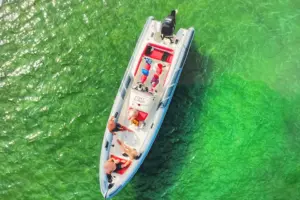
On the afternoon of August 14, the rigid inflatable boat Peaky Blinder was operating within the harbor confines. RIBs are prized by recreational and commercial users alike for their speed, maneuverability, and handling characteristics. However, these same attributes make them capable of sustaining high speeds that significantly reduce decision-making windows.
According to the official investigation, the Peaky Blinder was traveling at speed when it struck a solid navigation beacon head-on. The sudden deceleration of an allision—an impact between a moving vessel and a stationary object—is notoriously violent. The kinetic energy unleashed during the impact of the Peaky Blinder transferred devastating forces to both the vessel’s structure and its occupants.
The Fatal Outcome
The severity of the impact, combined with subsequent immersion in the water, led to two fatalities. Investigators emphasize that while the structural collision caused catastrophic trauma, the absence of adequately secured personal flotation devices critically undermined the occupants’ chances of survival in the immediate aftermath of the crash. The tragedy underscores that in high-energy marine accidents, survival often depends on surviving the initial impact and remaining afloat afterward, conscious or incapacitated.
Supporting Context & Metrics: The Perils of Recreational Boating
To understand the weight of the MAIB’s new safety campaign, one must examine the broader statistical landscape of recreational boating safety in the UK and internationally.
The Surge in Recreational Boating
Over the past decade, and particularly following shifts in leisure patterns catalyzed by the COVID-19 pandemic, participation in recreational boating has surged. RIBs, personal watercraft, and small motorboats have become increasingly accessible to the public. However, this democratization of the water has introduced a vast cohort of operators who may lack formal maritime training, comprehensive local knowledge, or an appreciation for maritime rules of the road.
The PFD Deficit
Data from maritime safety authorities consistently demonstrates that a significant percentage of drowning victims in recreational boating accidents were not wearing a lifejacket or PFD at the time they entered the water. Common excuses among leisure boaters include:
- Perceived Comfort: A belief that lifejackets are bulky, hot, or restrictive.
- Overconfidence: A misplaced faith in swimming ability or local weather conditions.
- Aesthetics: The notion that safety gear ruins the "look" of a day out on the water.
The Peaky Blinder incident serves as a tragic rebuttal to these assumptions. When a vessel strikes a stationary object at speed, occupants can be violently ejected into the water. Even an experienced swimmer rendered unconscious by an impact will drown within minutes without a buoyant device configured to keep their airways clear of the water. Modern automatic-inflating lifejackets are sleek, lightweight, and engineered for high mobility, removing traditional barriers to regular wear.
The Physics of Allisions
Unlike collisions between two moving vessels (where impact forces are partially mitigated by relative vectors), striking a fixed structure like a navigation beacon results in an instantaneous halt. A vessel traveling at 25 knots stopping dead against a concrete or steel beacon generates gravitational forces capable of throwing unbelted or unsecured passengers forward with lethal momentum. Safety flyers issued by the MAIB explicitly stress that speed management must be calibrated against environmental hazards, visibility, and vessel maneuverability.
Official Statements and Regulatory Response
The release of the safety flyer has drawn strong commentary from maritime officials, safety campaigners, and emergency responders, all unified in their call for heightened vigilance.
In a briefing accompanying the document release, a spokesperson for the Marine Accident Investigation Branch emphasized the preventative intent of the publication:
"Our investigations are not merely forensic exercises in apportioning retrospective understanding; they are vital educational tools designed to save lives. The loss of two lives in Portsmouth Harbour is a profound tragedy that reverberates deeply across the maritime community. Through this safety flyer, we are urging every recreational boater to look at their onboard safety culture, respect the hazards of our busy waterways, and make the wearing of personal flotation devices an absolute, non-negotiable habit."
Royal National Lifeboat Institution (RNLI) representatives have similarly echoed these sentiments, pointing out that search and rescue assets are frequently deployed to incidents where simple preventative measures could have drastically altered the outcome.
"We see time and again how the simple act of wearing a properly fitted lifejacket bridges the gap between a perilous situation and a survivable rescue," noted an RNLI water safety manager. "When you are thrown into cold water unexpectedly, cold water shock robs your body of its physical capabilities within seconds. You do not have time to reach for a lifejacket stowed in a locker. It must be worn."
Future Outlook: Fostering a Culture of Safety
As the recreational boating community looks toward future seasons on the water, the lessons of the Peaky Blinder allision must serve as a watershed moment for safety culture.
Educational Outreach and Accessibility
To ensure these critical safety lessons reach the widest possible audience, the MAIB has made the printable PDF version of the safety flyer freely available via official government publishing channels. Recognizing that digital accessibility is paramount, authorities have also provided direct channels for users of assistive technologies to request tailored formats via [email protected].
However, passive distribution of documents is only the first step. True cultural change requires active engagement from:
- Boating Clubs and Training Establishments: Integrating rigorous safety briefings, mandatory PFD policies on club vessels, and advanced boat-handling courses into standard curricula.
- Manufacturers and Retailers: Promoting integrated safety gear sales alongside vessel purchases, ensuring that buyers of high-performance RIBs are adequately equipped from day one.
- Peer-to-Peer Influence: Encouraging skippers to enforce a strict "no lifejacket, no departure" rule aboard their private vessels, effectively dismantling social resistance to safety equipment.
Conclusion
The tragedy in Portsmouth Harbour on August 14, 2025, stands as a stark reminder that the sea demands respect, preparation, and humility. The Peaky Blinder safety flyer is more than a bureaucratic document; it is a vital lifeline extended to every person who takes to the water for leisure. By internalizing its lessons—respecting fixed hazards, managing speed, and above all, wearing personal flotation devices—the recreational boating community can honor the memory of those lost by ensuring that such a preventable tragedy is never repeated.