



Executive Overview
The global offshore sector is undergoing a profound structural shift. As operators seek to balance the urgent demands of the energy transition with the operational realities of deepwater environments, the need for safe, efficient, and highly specialized marine technology has reached an all-time high. In response to these dual imperatives, MacGregor, a global leader in sustainable maritime cargo and load handling solutions, has expanded its offshore technology portfolio with two pioneering developments designed to redefine offshore logistics and carbon management.
The first innovation is a newly certified floating-to-floating (F2F) personnel transfer capability for its established Horizon gangway line. Having successfully secured DNV certification under the stringent DNV-ST-0358 standard, this motion-compensated system allows safe crew transfers between two vessels moving independently at sea. By eliminating the necessity of a fixed landing point, the technology unlocks unprecedented operational flexibility for floating offshore wind farms, Floating Production Storage and Offloading (FPSO) units, and offshore service fleets.
Parallel to this advancement in offshore logistics, MacGregor has introduced a cutting-edge Liquid Carbon Dioxide ($LCO_2$) Bow Transfer System (BTS). Engineered specifically for the burgeoning Carbon Capture, Utilization, and Storage (CCUS) market, the BTS enables the direct ship-to-well and ship-to-rig transfer of liquefied carbon dioxide. By bypassing the traditional requirement for costly intermediate onshore storage and conditioning infrastructure, this system promises to significantly lower the capital and operational expenditures associated with offshore carbon sequestration. Together, these technologies underscore MacGregor’s commitment to bridging legacy maritime engineering with the future of low-carbon offshore operations.
Detailed Chronology
The development of these two systems reflects a calculated, multi-year engineering effort, combining decades of field-proven maritime expertise with state-of-the-art simulation, material science, and regulatory collaboration.
[1970s] ─────────────────> [Early 2025] ───────────────> [Late 2025] ──────────────────> [Mid-2027]
First Bow Loading          Joined EU-funded             Successful DNV-ST-0358          Target for Prototype
Systems Developed          COREu Consortium             Certification for Horizon       Testing & Demonstration
(Oil & Gas Heritage)       & Initiated DNV Process      F2F Gangway System              of LCO2 BTS
The Horizon F2F Gangway Certification Path
The journey toward the Horizon gangway’s floating-to-floating certification culminated in a rigorous Sea Acceptance Test (SAT) conducted in late 2025. Prior to the physical sea trials, MacGregor’s engineering teams subjected the system to exhaustive hardware-in-the-loop (HIL) simulations to model the complex, multi-axial hydrodynamic interactions between two independent floating bodies.
Following the successful physical demonstration of the system’s real-time motion compensation capabilities in active sea states, DNV officially awarded the system certification under DNV-ST-0358—the premier standard for marine transfer systems. This milestone marks the commercial readiness of the F2F upgrade, which is now available for newbuild integrations and as a retrofitted upgrade for existing Horizon gangways currently in service.
The LCO2 Bow Transfer System Development Timeline
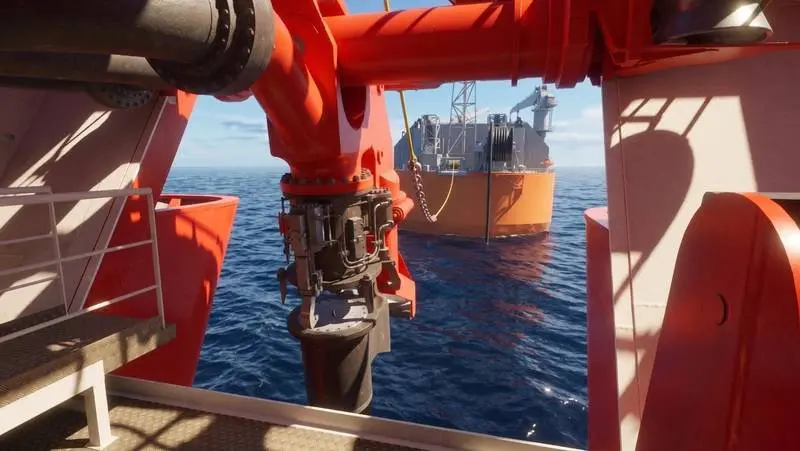
The engineering timeline for the $LCO_2$ Bow Transfer System is deeply rooted in MacGregor’s historic oil and gas legacy. The foundational architecture of the BTS is derived from the company’s pioneering Bow Loading System (BLS) technology, which has been deployed on shuttle tankers in the North Sea and other harsh environments since the 1970s.
- Technology Adaptation: Over several years, MacGregor engineers adapted this legacy technology to handle the unique thermodynamic properties of liquid carbon dioxide. Approximately 79% of the new BTS utilizes this field-proven BLS design, while the remaining 21% consists of newly engineered components specifically designed for cryogenic and high-pressure carbon handling.
- Material Testing: MacGregor partnered with SINTEF, one of Europe’s largest independent research organizations, to conduct specialized testing on elastomeric and polymeric seal materials under rapid gas decompression (RGD) and extreme sub-zero temperatures.
- Consortium Integration: In early 2025, MacGregor joined the EU-funded COREu research and innovation consortium. This initiative aims to establish a robust, transnational carbon transport and storage network across Europe.
- DNV Qualification Phase: Concurrently, MacGregor initiated a comprehensive technology qualification program with DNV. The process has recently completed its initial planning phase, which established the qualification basis, conducted thorough technology and threat assessments, and locked in the formal qualification plan.
- Future Milestones: The engineering roadmap is now geared toward prototype manufacturing, with full-scale physical testing and offshore demonstrations scheduled for mid-2027.
Supporting Context & Technical Metrics
Engineering the Horizon Floating-to-Floating Gangway
Transferring personnel between a vessel and a fixed offshore platform is a well-established practice. However, transferring personnel between two floating vessels—each reacting to wave, wind, and current forces with six degrees of freedom (roll, pitch, yaw, heave, surge, and sway)—presents an exponentially more complex engineering challenge.
            [Vessel A (Active DP)]                   [Vessel B (Independent Motion)]
                     │                                             │
                     ├───> [LiDAR Real-Time Telemetry] <───────────┤
                     │                 │                           │
                     │                 ▼                           │
             [Horizon Gangway] ──> [Active Motion] ────────> [Receiving Deck]
             (Base Connection)     [Compensation]            (No Fixed Landing)
To resolve this, MacGregor replaced the traditional docking head used for fixed structures with a purpose-designed, highly flexible landing flap at the gangway tip. This flap is designed to rest dynamically on the receiving vessel’s deck without securing to a rigid connection point.
The heart of the F2F system lies in its sensor suite and control algorithms:
- LiDAR-Based Relative-Motion Tracking: The system utilizes high-frequency Light Detection and Ranging (LiDAR) telemetry to scan the receiving vessel’s deck in real time.
- Predictive Motion Compensation: By feeding this spatial data directly into the gangway’s active motion-compensation controller, the system anticipates the differential movements of both vessels, adjusting the gangway’s length, luffing, and slewing angles instantaneously.
- Operational Efficiency: By facilitating safe transfers directly at sea, operators can perform crew changes and critical maintenance campaigns without requiring vessels to return to port, drastically reducing transit times, fuel consumption, and vessel emissions.
| Technical Parameter | Horizon F2F Gangway Spec |
|---|---|
| Regulatory Standard | DNV-ST-0358 (Floating-to-Floating Class) |
| Sensor Integration | Real-time LiDAR relative-motion tracking |
| Landing Interface | Purpose-designed flexible tip-flap (non-docking) |
| Compatibility | Newbuild integration or retrofittable to existing Horizon units |
| Target Applications | FPSOs, Floating Wind (FLIP/semi-sub), Drillships, SOVs |
Thermodynamics and Mechanics of the LCO2 Bow Transfer System
Transporting and injecting carbon dioxide offshore requires maintaining the fluid in a liquid state, which demands highly controlled pressure and temperature regimes. If the pressure drops too low, the $CO_2$ will transition into a solid state (dry ice) or gas, potentially causing catastrophic blockages, thermal shock, or structural failure of the transfer equipment.
       [Low/Med Pressure Architecture]             [High Pressure Architecture]
       ┌─────────────────────────────┐             ┌──────────────────────────┐
       │  • 30 to 60 Bar Pressure    │             │  • Up to 300 Bar Pressure│
       │  • Intermediate Conditioning│             │  • Direct Well Injection │
       └─────────────────────────────┘             └──────────────────────────┘
                      │                                         │
                      └───────────────────┬─────────────────────┘
                                          ▼
                             [Common System Capabilities]
                             • Temp limit: Down to -57°C
                             • Operational Wave Height: 5 to 6m Hs
                             • Maximum Water Depth: Up to 150m
To address these challenges, MacGregor’s BTS is engineered to support four distinct system architectures, categorized by their operational pressure envelopes:

- Low-to-Medium Pressure Operations (30 to 60 bar): Designed for transport between standard liquefied gas carriers and offshore storage or intermediate conditioning units.
- High-Pressure Operations (up to 300 bar): Specifically developed to facilitate direct reservoir injection from the carrier vessel through seabed swivels or disconnectable turrets, bypassing the need for any surface-level platform or intermediate storage.
To guarantee system integrity under these severe conditions, MacGregor and SINTEF subjected the critical seal materials to extreme testing protocols:
- Thermal Tolerance: The system is certified to maintain structural and sealing integrity at temperatures as low as $-57^circtextC$ (close to the triple point of carbon dioxide, $-56.6^circtextC$ at $5.18text bar$).
- Rapid Gas Decompression (RGD): The seals are designed to withstand sudden pressure drops without experiencing explosive decompression damage, a common failure mode in elastomeric seals exposed to high-pressure gaseous environments.
- Environmental Tolerances: The mechanical coupling and quick-connect/disconnect (QCDC) systems are designed to operate safely in harsh offshore environments, supporting operations in significant wave heights ($H_s$) of 5 to 6 meters and at water depths reaching up to 150 meters.
Official Statements and Industry Perspectives
The commercialization of these technologies has drawn significant attention from classification societies, offshore operators, and environmental researchers alike.
A senior technical authority from DNV, reflecting on the certification of the Horizon gangway, noted:
"The certification of MacGregor’s Horizon gangway under the DNV-ST-0358 standard represents a critical milestone in offshore safety. Transitioning from fixed-to-floating transfers to floating-to-floating operations introduces dynamic variables that require the highest levels of redundancy and sensor integration. MacGregor’s use of real-time LiDAR tracking and predictive compensation algorithms successfully met our stringent safety and reliability criteria, opening up new possibilities for offshore logistics."
Highlighting the strategic importance of the $LCO_2$ Bow Transfer System within the European energy transition, a representative from the COREu consortium commented:
"To achieve Europe’s ambitious decarbonization targets, we must establish scalable, cost-efficient carbon transport networks. MacGregor’s development of a direct ship-to-well $LCO_2$ transfer system is a major step forward. By leveraging decades of proven bow-loading expertise from the oil and gas sector and adapting it for cryogenic $LCO_2$, they are minimizing technical risk while dramatically simplifying the offshore injection infrastructure."
MacGregor’s offshore engineering division emphasized the market-ready nature of these solutions:
"Our focus has always been on delivering practical, field-proven engineering that addresses the immediate pain points of our customers. With the Horizon gangway’s F2F certification, we are giving vessel operators the ability to conduct offshore operations continuously, independent of port schedules. Simultaneously, our new $LCO_2$ Bow Transfer System provides the missing link in the CCS value chain, offering a safe, direct path from capture plant to subsea storage reservoir."
Future Outlook
The introduction of these technologies comes at a critical juncture for the maritime and offshore energy sectors. As offshore wind farms push into deeper waters where fixed-bottom foundations are no longer economically viable, the floating wind market is projected to grow exponentially over the next decade. This expansion will demand a massive fleet of Service Operation Vessels (SOVs) and fast crew boats capable of transferring technicians safely to floating wind turbines. MacGregor’s certified F2F Horizon gangway is positioned to become a critical enabling technology for this multi-billion-dollar market.
Concurrently, the global CCUS pipeline is expanding rapidly, driven by industrial decarbonization mandates and carbon pricing mechanisms such as the EU Emissions Trading System (ETS). However, the high capital cost of building onshore conditioning plants and dedicated pipeline infrastructure remains a major barrier to project final investment decisions (FIDs).
By providing a direct, ship-to-well offshore $LCO_2$ transfer capability, MacGregor’s BTS offers a viable alternative that can significantly shorten project development timelines and reduce capital expenditure.
                           [Industrial Capture Plant]
                                       │
                                       ▼
                             [LCO2 Carrier Vessel]
                                       │
                      ┌────────────────┴────────────────┐
                      ▼                                 ▼
         [Traditional CCS Route]             [MacGregor Direct Route]
         • Onshore Storage Facility          • Direct Ship-to-Well Transfer
         • Conditioning Plant                • Deepwater Injection (Up to 150m)
         • Dedicated Subsea Pipeline         • Capital Cost Reduced by ~30-40%
                      │                                 │
                      └────────────────┬────────────────┘
                                       ▼
                           [Subsea Storage Reservoir]
As MacGregor advances through its technology qualification program with DNV under the COREu framework, the industry will closely watch the scheduled mid-2027 prototype demonstrations. If successful, this system will pave the way for the world’s first commercial direct-injection carbon capture projects, transforming offshore shuttle tankers into active instruments of global decarbonization. By successfully repurposing oil and gas engineering heritage for the green transition, MacGregor is proving that the path to a sustainable maritime future is built on the foundations of proven engineering excellence.