






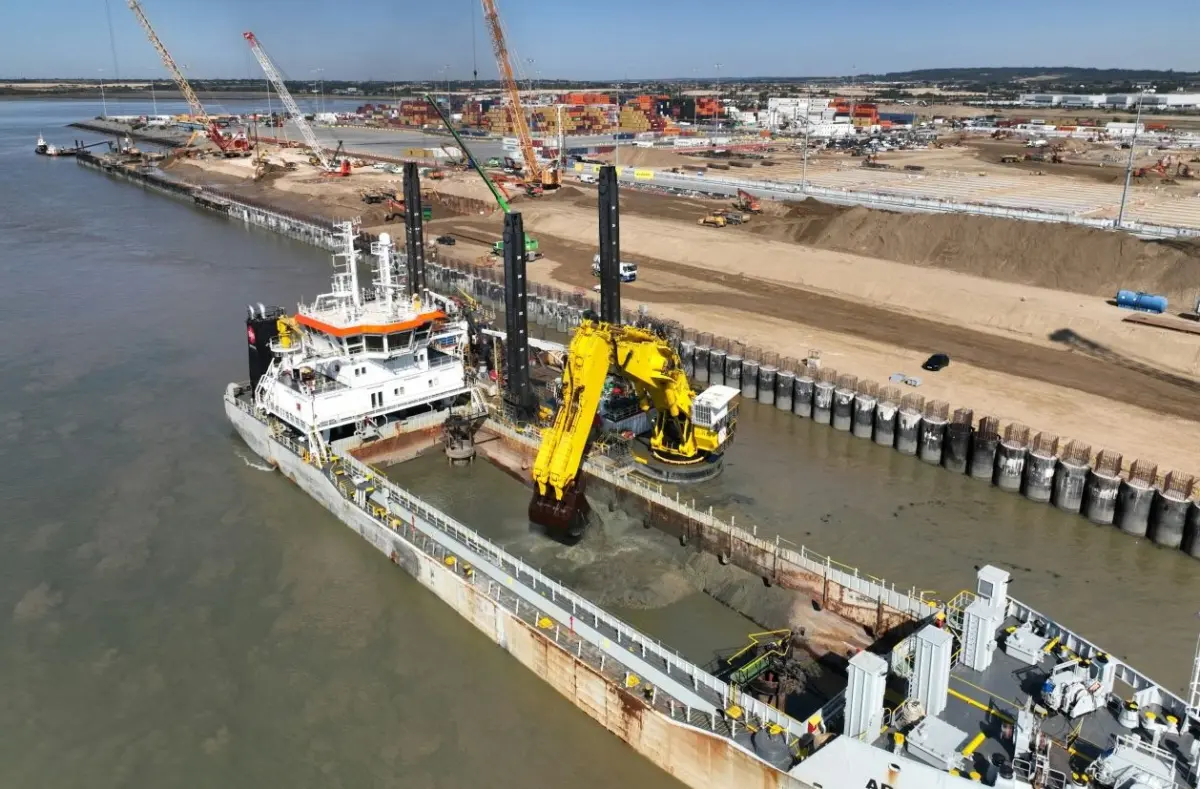
LONDON — In a milestone development for British maritime logistics and international trade infrastructure, main dredging operations have officially commenced at the London Gateway Berth 5 expansion project. Contractor McLaughlin & Harvey Ltd confirmed that the capital dredging campaign is now in full swing following a rigorous phase of civil engineering works, bringing DP World one step closer to cementing London Gateway’s status as the United Kingdom’s largest container port.
The commencement of dredging marks a pivotal transition for the multi-million-pound expansion initiative. With heavy marine plant now actively reshaping the riverbed along the Thames estuary, the project moves from structural land- and edge-based engineering toward the creation of the deep-water profiles essential for handling the world’s largest ultra-large container vessels (ULCVs).
Executive Overview: A Strategic Blueprint for UK Logistics
The ongoing expansion of Berth 5 is not merely a localized construction project; it is a critical pillar of the United Kingdom’s long-term supply chain resilience. As global shipping lines continue to scale up vessel sizes to achieve economies of scale, British ports face mounting pressure to adapt their nautical infrastructure. Shallow berths and constrained turning circles pose immediate bottlenecks to international commerce, risking supply chain delays and higher import-export costs.
DP World’s strategic investment in London Gateway directly addresses these systemic challenges. By extending the port’s deep-water handling capabilities, the project ensures that the UK can seamlessly accommodate the next generation of global container ships.
The scope of the Berth 5 project involves comprehensive marine civil engineering. Prior to the arrival of the specialist dredging fleet, engineering teams completed substantial subterranean and structural milestones, including the construction of a robust new quay wall, the installation of an intricate permanent anchoring system, and extensive backfilling operations. With these foundational elements securely in place, the project has now entered its most visible and dynamic phase: marine capital dredging.
Detailed Chronology: From Concept to Marine Excavation
The realization of Berth 5 is the culmination of years of strategic planning, environmental assessment, and precise civil engineering execution. While the announcement of the active dredging campaign represents the latest headline, the timeline of the development reveals the complex orchestration required to expand a modern, high-capacity container terminal.
1. Planning, Permitting, and Early Design
Long before heavy machinery touched the Thames estuary, DP World and its engineering partners engaged in comprehensive environmental impact assessments and spatial modeling. Expanding a major tidal port requires delicate navigation of regulatory frameworks, ensuring that marine ecosystems, local fisheries, and tidal flows are thoroughly protected. Once statutory approvals were secured, detailed engineering designs were finalized to integrate Berth 5 seamlessly into the existing terminal footprint.
2. Shoreline Engineering and Quay Wall Construction
The preliminary physical works on site focused heavily on terrestrial and edge-water civil engineering. McLaughlin & Harvey mobilized heavy plant to construct the robust new quay wall—the structural backbone of the future berth. This phase required precise driving of steel sheet piles and the installation of a heavy-duty permanent anchoring system designed to withstand the immense lateral loads exerted by backfilled soils and docked mega-vessels.
3. Backfilling and Ground Stabilization
Following the structural completion of the quay wall, extensive backfilling operations were executed. This process stabilized the landside infrastructure, creating a reinforced load-bearing platform capable of supporting massive ship-to-shore (STS) gantry cranes, heavy container-handling equipment (chassis, reach stackers, and automated stacking systems), and dense container storage stacks.
4. Mobilization of Dredging Assets and Current Operations
With the landside boundary secured and stabilized, the project transitioned to the marine environment. The arrival of a specialist backhoe dredger signaled the official start of the capital dredging campaign. Excavating material directly from the riverbed in front of the newly constructed quay wall, the dredging fleet is currently working around the clock to achieve the precise engineering depths and profiles required for deep-water shipping operations.
Supporting Context & Metrics: Engineering the Deep-Water Future
The technical specifications of the London Gateway Berth 5 expansion highlight the scale and complexity of modern port development. Capital dredging in a tidal river environment demands absolute precision, advanced hydrographic surveying, and specialized marine equipment.
The Role of Specialist Backhoe Dredgers
At the heart of the current campaign is a heavy-duty backhoe dredger. Unlike trailing suction hopper dredgers (TSHDs)—which are typically used for maintaining shipping channels and large-volume, loose-sediment removal—backhoe dredgers offer pinpoint excavation capabilities. Equipped with massive hydraulic arms and specialized rock-breaking or bucket attachments, these vessels are ideally suited for near-quay operations where precision is paramount.
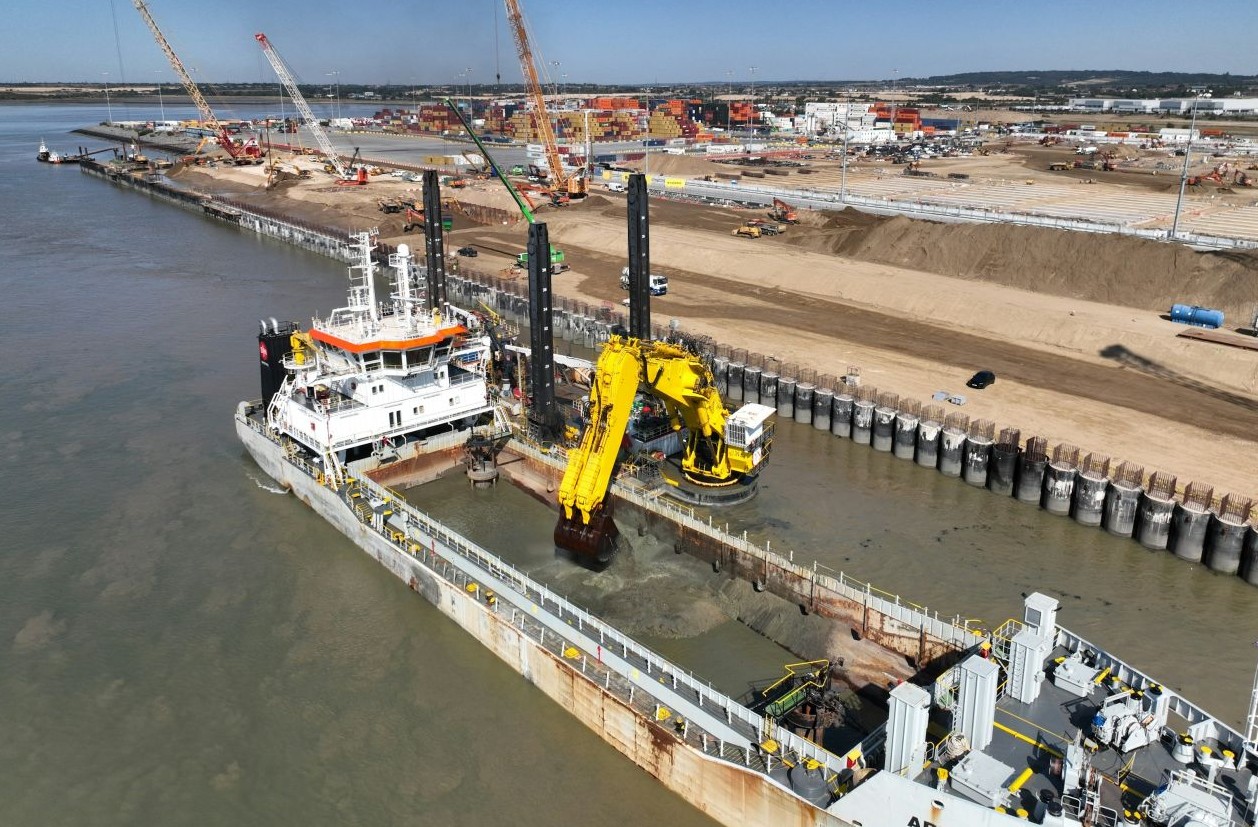
The backhoe dredger excavates compacted soils, clays, and historical riverbed strata directly adjacent to the newly driven quay wall. The extracted material is loaded onto hopper barges, which transport the sediment to licensed offshore disposal sites or, where feasible, beneficial reuse locations in accordance with strict environmental guidelines.
Overcoming Tidal and Environmental Variables
Dredging in the Thames estuary presents unique operational challenges. Strong tidal currents, fluctuating water levels, and strict environmental monitoring protocols dictate the rhythm of the work. Contractors must manage turbidity levels closely to prevent suspended sediments from negatively impacting local aquatic life. Real-time monitoring systems track water quality parameters continuously throughout the excavation footprint, ensuring strict compliance with Environment Agency and Port of London Authority (PLA) standards.
Economic and Logistical Metrics
- Port Scale: Upon completion of Berth 5, London Gateway is projected to surpass competing facilities to become the largest container port in the United Kingdom by capacity.
- Vessel Accommodation: The expanded berth is engineered to accommodate ultra-large container vessels (ULCVs) exceeding 24,000 TEU (Twenty-Foot Equivalent Units), ensuring the port remains future-proofed against ongoing trends in global shipbuilding.
- Supply Chain Integration: The project links directly into London Gateway’s expansive rail and road logistics hub, offering optimized intermodal connectivity to major distribution centers across the Midlands and the Southeast of England.
Official Statements and Industry Perspectives
The milestone has drawn positive reactions from key stakeholders across the British maritime, engineering, and logistics sectors, underscoring the collaborative effort driving the project forward.
Representatives for McLaughlin & Harvey emphasized the meticulous planning that enabled the transition into the marine excavation phase. In an official project update, the contractor noted that reaching this stage is a testament to the seamless coordination between civil engineering teams on land and marine specialists on the water. The successful completion of the quay wall and its complex anchoring systems has provided a stable platform for the heavy excavation work now underway.
Meanwhile, leadership at DP World has repeatedly highlighted London Gateway’s pivotal role in the UK’s post-Brexit trade strategy. By creating additional capacity close to London and the densely populated South East consumer market, the port reduces road freight miles, lowers carbon emissions, and builds a more agile, responsive supply chain network.
Industry analysts have similarly lauded the timing of the expansion. As global trade routes evolve and maritime supply chains seek greater redundancy and efficiency, ports that invest in deep-water infrastructure are exceptionally well-positioned to capture market share and attract premier global shipping alliances.
Future Outlook: The Road to Completion and Beyond
With the capital dredging campaign now active, attention turns toward the upcoming phases of the London Gateway Berth 5 expansion.
Over the coming months, the dredging fleet will continue profiling the riverbed until the target depths are fully achieved and verified via comprehensive hydrographic surveys. Parallel to the dredging operations, finishing works along the quay deck will commence, paving the way for the installation of advanced terminal operating systems, electrical infrastructure, and state-of-the-art container cranes.
Strategic Implications for the UK Economy
The completion of Berth 5 will fundamentally alter the competitive landscape of British port logistics. By increasing the UK’s aggregate deep-water handling capacity, the expansion alleviates structural vulnerabilities exposed by historical supply chain shocks. Shippers calling at London Gateway will benefit from faster turnaround times, reduced congestion, and direct access to multimodal transport corridors.
Furthermore, the expansion reinforces DP World’s long-term commitment to sustainable port operations. Modern container terminals incorporate energy-efficient lighting, electrified equipment, and optimized gate automation, ensuring that capacity growth is harmonized with corporate net-zero targets.
As the backhoe dredger continues its systematic excavation of the Thames riverbed, the London Gateway Berth 5 project stands as a clear signal of confidence in the future of British trade. When fully operational, the new deep-water berth will not only expand the physical boundaries of the port but will also secure the UK’s position as a premier gateway for international commerce in the decades to come.