





Executive Overview
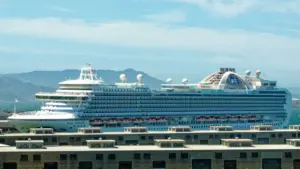
What began as a routine port call during a late-summer European voyage quickly escalated into a high-stakes maritime emergency on September 8, 2026. While docked at the historic Port of Le Havre, France, the 3,286-passenger cruise liner AIDAperla fell victim to severe, sudden weather conditions. Driven by aggressive wind gusts reaching approximately 35 miles per hour, the vessel’s forward mooring lines parted under immense strain.
The structural failure allowed the massive ship to break away from its designated berth, drifting backward into the concrete quay wall and creating a chaotic scene for both passengers on board and those enjoying shore excursions. The incident—captured in real-time by stunned onlookers and widely shared across social media platforms—resulted in the immediate disruption of port operations, the detachment of passenger gangways into the harbor, and an enforced temporary shutdown of local marine traffic.
Remarkably, despite the alarming visuals of dangling boarding infrastructure and a drifting mega-ship, no injuries were reported among passengers, crew members, or dockworkers. HAROPA PORT authorities, alongside emergency response teams and assisting tugboats, acted swiftly to stabilize the vessel. However, the operational repercussions of the breakaway event were immediate. AIDAperla was forced to cancel a scheduled stop in Zeebrugge, Belgium, while marine technicians, classification societies, and AIDA Cruises officials launched extensive safety assessments to clear the ship for continued navigation.
This comprehensive report examines the chronological sequence of the Le Havre incident, evaluates the meteorological and infrastructural factors at play, reviews official statements from port authorities and cruise operators, and outlines the broader itinerary and future outlook for the vessel and its passengers.
Detailed Chronology of Events
The Voyage and Arrival in France
The unfolding drama on September 8, 2026, was part of a standard 7-night Northern Europe itinerary operated by AIDA Cruises, a prominent brand under the Carnival Corporation umbrella. The voyage commenced on September 5, 2026, when AIDAperla pulled away from her homeport in Hamburg, Germany. After a smooth initial leg across the North Sea and the English Channel, the ship completed her first successful port call in Southampton, United Kingdom, on September 7.
By the morning of September 8, the vessel had crossed the English Channel once more to dock at the industrial and passenger hub of Le Havre, France. At the time of arrival, conditions appeared manageable, allowing passengers to disembark for organized and independent shore excursions throughout the historic port city and its surrounding Norman landmarks. Approximately 500 guests stepped ashore, anticipating a full day of sightseeing before an intended evening departure.
The Breakaway: 4:00 PM
The situation deteriorated rapidly mid-afternoon. According to historical meteorological data from Weather Underground and localized observations, a sudden atmospheric disturbance swept across the region, generating sustained high winds and aggressive gusts peaking near 35 miles per hour directly over the harbor.
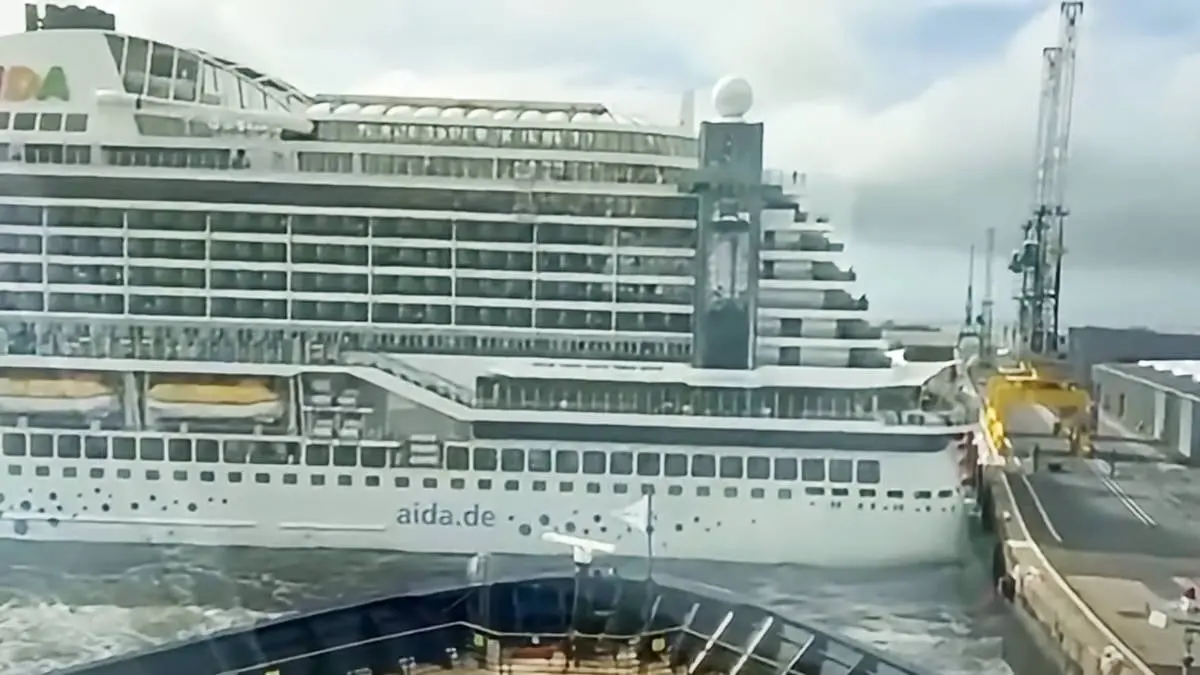
Around 4:00 p.m., the tremendous lateral wind pressure exerted against AIDAperla’s towering superstructure proved too much for the vessel’s forward mooring setup. Under the unbearable tension, the forward mooring lines parted simultaneously. Unmoored from the bow, the ship’s stern pivoted, and the vessel began drifting backward away from the berth.
Video footage captured by witnesses on the dock and onboard neighboring vessels documented the terrifying moments as the multi-thousand-ton ship drifted untethered. The momentum carried the stern of the vessel directly into contact with the concrete quay wall. The impact, though buffered by the ship’s hull design and fender systems, generated immediate structural strains across the dock interface.
Infrastructure Failure and Harbor Chaos
As the ship drifted away from the pier, the physical infrastructure connecting the vessel to the shore suffered catastrophic failures. Both forward and midship gangways were violently torn away from their mounting positions. Instead of remaining safely secured to the terminal, the heavy metal structures broke free, tumbling into the harbor waters to become hazardous floating obstructions.
Startled passengers and crew members looked on as one of the mangled gangways remained precariously hooked to the port side of the vessel, dangling vertically as the ship drifted.
German passengers onboard later described the surreal nature of the event. One witness, speaking to local media after the vessel was stabilized, remarked, "Our ship, AIDAperla, had this accident. We are still docked in Le Havre," emphasizing the shock felt by those relaxing on board when the ship suddenly shifted position.
The breakaway had an immediate ripple effect across the port. With a massive cruise ship drifting freely and debris blocking portions of the basin, HAROPA PORT authorities enacted emergency protocols. The port was temporarily closed to all navigation, halting the movement of other commercial and passenger vessels in the vicinity.
The Impact on Neighboring Ships
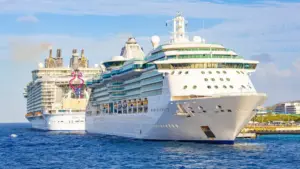
AIDAperla was not the only luxury liner navigating the challenging conditions at Le Havre that afternoon. TUI Cruises’ Mein Schiff 3 was also moored within the port facility during the meteorological event.
As wind gusts battered the harbor and AIDAperla drifted, port authorities were forced to deploy emergency measures to keep Mein Schiff 3 safely secured to her berth. Tugboats were dispatched to hold the vessel firmly against the pier, mitigating the risk of a secondary breakaway. Due to the restricted navigation channels, localized debris, and the ongoing emergency response surrounding AIDAperla, the departure of Mein Schiff 3 was delayed by approximately two hours as port controllers worked to restore order.
Stabilization and Reboarding
Recognizing the urgency of the situation, HAROPA PORT deployed a fleet of high-powered harbor tugboats to intercept AIDAperla. Maneuvering around the drifting vessel and the floating gangway debris, the tugs successfully brought the ship under control, pushing her back against the quay wall and holding her securely in place while new mooring lines were run ashore.
By early evening, stabilization efforts were well underway. At 9:22 p.m., HAROPA PORT issued an official operational update confirming that AIDAperla had been fully secured at her berth. With the vessel locked down and the harbor cleared of immediate navigation hazards, port authorities permitted safe passenger reboarding to resume. For the roughly 500 guests who had been stranded ashore during the port closure, the clearance brought immense relief, allowing them to return to the ship in an orderly, secure fashion.
Supporting Context & Metrics
Vessel Specifications: AIDAperla
To understand the dynamics of the Le Havre incident, it is essential to examine the physical scale of AIDAperla. Operated by AIDA Cruises, the ship is a hyper-modern floating resort designed to handle significant passenger volumes while navigating diverse European waters.
- Gross Tonnage: Approximately 125,572 GT
- Passenger Capacity: 3,286 (double occupancy), with a maximum capacity exceeding 4,300 including crew.
- Length: 300 meters (984 feet)
- Beam (Width): 37.6 meters (123 feet)
- Year of Delivery: 2017 (built by Mitsubishi Shipbuilding in Nagasaki, Japan)
- Superstructure Profile: Featuring expansive glassed-in beach clubs, outdoor activity decks, and a massive hull profile, the ship presents a significant "sail area" to crosswinds when docked broadside.
When winds reach gale-force or severe gusting thresholds in a constrained port basin, vessels with high sail profiles are exceptionally vulnerable if mooring arrangements—such as line tension, winch integrity, and bollard placement—are pushed beyond their design limits.
Meteorological Profile: Le Havre on September 8, 2026
Weather data retrieved from regional weather stations and historical records for Le Havre (Port of Le Havre / LFOH weather reporting station) on September 8 paint a clear picture of the environmental conditions that triggered the event:
- Wind Speeds: Sustained winds were notable throughout the day, with sudden convective gusts peaking at approximately 35 miles per hour (approx. 30 knots) during the mid-afternoon hours.
- Wind Direction: The vectors of the gusts exerted a perpendicular (broadside) force against vessels docked facing specific alignments within the basin, maximizing the physical leverage acting upon the mooring lines.
- Port Environment: Le Havre is a major tidal and commercial port situated at the mouth of the Seine River on the English Channel. While protected by massive breakwaters, inner basins can experience localized wind funnelling and dynamic currents during sudden meteorological shifts.
Official Statements and Damage Assessments
AIDA Cruises Response
In the wake of the incident, AIDA Cruises issued formal statements confirming that AIDAperla had made physical contact with the quay wall following the sudden failure of its forward mooring lines.
The cruise line prioritized safety above all else, announcing that a comprehensive, multi-layered inspection protocol had been initiated immediately. Specialized marine technicians, company representatives, and independent maritime authorities boarded the vessel to evaluate:
- Hull integrity along the stern and aft quarter where contact was made with the quay.
- Propulsion and steering systems to ensure no subsurface damage occurred during the drift.
- Mooring winches, deck fittings, and structural hardpoints to verify that future docking operations can be performed with absolute safety.
Classification Society Clearance
According to reports from prominent German shipping media (Ruhr24), visual and structural inspections by the ship’s crew and local surveyors were only the first step. Because AIDAperla suffered an unintended breakaway and hull-to-quay contact, international maritime law and corporate safety policies require formal clearance from the vessel’s responsible classification society before the ship is legally permitted to lift anchor and resume commercial voyages.
Classification societies (such as DNV, Lloyd’s Register, or Bureau Veritas) set and maintain technical standards for the design, construction, and survey of ships. A formal seaworthiness certificate must be reissued or endorsed following an allision (striking a stationary object) before the vessel can carry passengers back out to sea.
Future Outlook & Itinerary Adjustments
Immediate Itinerary Cancellations: The Zeebrugge Omission
The operational downtime required for structural inspections, regulatory sign-offs, and port clearance had an immediate, unavoidable impact on AIDAperla‘s current voyage schedule.
Originally, the itinerary dictated that AIDAperla would cast off from Le Havre at 8:00 p.m. on September 8, setting a direct course for Zeebrugge, Belgium, for a port call scheduled on September 9. However, due to the protracted delays caused by the breakaway, port closure, and mandatory technical assessments, this stop was rendered impossible.
AIDA Cruises officially cancelled the Zeebrugge port call, keeping the ship docked safely in Le Havre while inspections were finalized.
Resumption of Schedule: Rotterdam and Hamburg
Despite the disruption in Belgium, the remainder of the 7-night voyage remains largely intact, provided final classification clearance is granted without delay:
- Rotterdam, Netherlands: The subsequent scheduled port call in Rotterdam on September 10 remains on the books, with no alterations announced at the time of reporting.
- Return to Hamburg: AIDAperla‘s final return to her homeport of Hamburg, Germany, is still officially scheduled for September 12, 2026, marking the conclusion of the current 7-day sailing.
Implications for Back-to-Back and Combined Voyages
AIDA Cruises frequently structures its Northern European deployments around overlapping, combined itineraries, offering travelers the option to book back-to-back cruises for extended 14-night holidays.
The next standard 7-night embarkation is scheduled to depart from Hamburg immediately upon the ship’s return on September 12. This upcoming voyage is slated to take guests on an iconic Norwegian fjord cruise, visiting destinations such as Bergen, Nordfjordeid, Ålesund, and Stavanger, before returning to Hamburg on September 19.
Because many guests onboard the current sailing were booked on this subsequent voyage as part of a continuous 14-night holiday package, the swift resolution of the Le Havre incident and the preservation of the September 12 departure date are critical to maintaining traveler satisfaction and minimizing broader logistical headaches for AIDA Cruises’ customer service teams.
Conclusion
The dramatic events of September 8, 2026, at the Port of Le Havre serve as a striking reminder of the raw power of nature and the unpredictable challenges inherent in modern cruise operations. While the sight of AIDAperla breaking free from her moorings, losing gangways to the harbor waters, and drifting into a concrete quay wall generated understandable anxiety among passengers and online observers, the incident ultimately underscored the efficacy of modern maritime safety systems.
Thanks to rapid emergency interventions by HAROPA PORT authorities, skilled tugboat crews, and the vessel’s competent crew, the situation was neutralized swiftly and without a single reported injury. As AIDAperla completes her rigorous regulatory inspections and prepares to rejoin the maritime highway toward Rotterdam and Hamburg, the cruise line, port authorities, and industry analysts will undoubtedly review the data surrounding the Le Havre gusts to fortify future mooring protocols against the unpredictable whims of coastal weather.