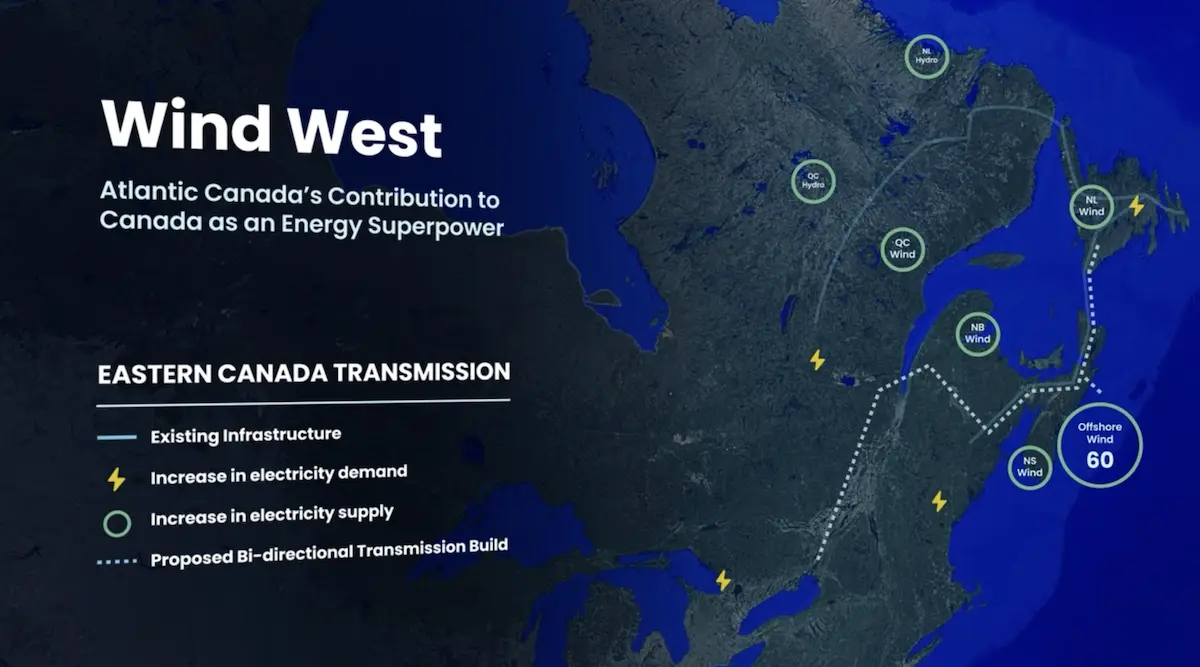
North America’s energy landscape is undergoing a profound geopolitical and infrastructural transformation. While domestic policy friction stalls renewable energy deployment within the United States, its northern neighbor is aggressively expanding the boundaries of cross-border clean energy integration. The Canadian province of Nova Scotia has formally unveiled plans for "Wind West," a massive, multi-gigawatt offshore wind development initiative designed to capture some of the strongest wind resources on the continent.
Boasting average wind speeds exceeding 11 meters per second and an estimated 62 gigawatts (GW) of total offshore generation potential, Wind West aims to produce energy volumes that vastly outstrip local provincial demand. This surplus is not slated to sit idle; it forms the cornerstone of a broader, multi-province grid-sharing strategy known as the Eastern Energy Partnership. By strengthening transmission pathways between Atlantic Canada and energy-starved markets in the northeastern United States—such as Massachusetts and New York—this initiative establishes a vital lifeline for regional decarbonization.
This cross-border energy bridge arrives at a critical juncture. Inside the United States, federal pushback against offshore and onshore wind under the Trump administration has created regulatory gridlock, prompting lawsuits from coastal states and forcing federal agencies to resort to unusual linguistic maneuvers, such as rebranding wind turbines as "aeromechanical energy systems." As American legal battles mount over federal lease buyouts and project delays, Canada’s proactive build-out of export-ready renewable infrastructure highlights a widening divergence in North American energy policy.
Detailed Chronology: Policy Friction, Cross-Border Accords, and Legal Battles
The convergence of Canadian renewable expansion and American energy policy friction has evolved through a rapid sequence of legislative, executive, and judicial actions over the past two years:
Early 2025 – Mid-2025: Following the return of the Trump administration, federal executive orders target wind energy generation. The Department of Defense is directed to conduct protracted "reviews" of pipeline-stage onshore wind farms, effectively stalling development. Simultaneously, the Department of the Interior initiates efforts to dismantle or buy out existing federal offshore wind leases along the Atlantic and Pacific coasts, culminating in controversial billion-dollar settlements with developers like TotalEnergies.
June 2025: Highlighting the viability of cross-border power corridors, the 1.25-gigawatt Champlain Hudson Power Express transmission line officially opens for commercial operation. The project successfully begins delivering hydropower from Quebec directly to New York City, satisfying up to 20% of the city’s peak electricity demand and proving the operational feasibility of large-scale international energy transfers.
February 5, 2026: Geopolitical cooperation deepens as Massachusetts Governor Maura Healey and Nova Scotia Premier Tim Houston formalize a Memorandum of Understanding (MOU). The agreement establishes a bilateral framework to co-develop offshore wind resources in the North Atlantic, explicitly targeting economic growth, job creation, and clean energy delivery to New England.
Late February 2026: The Government of Nova Scotia showcases the "Wind West" initiative as a premier investment opportunity among 20 strategic projects at the inaugural Canada Investment Summit in Toronto.
Spring 2026: State resistance to federal energy suppression intensifies. A coalition of state attorneys general from New York, Connecticut, Maine, Massachusetts, New Jersey, and Rhode Island files a federal lawsuit against the Department of the Interior challenging the legality of the TotalEnergies lease buyout. Concurrently, California Attorney General Rob Bonta and the California Energy Commission launch a separate legal challenge against the administration’s termination of the Golden State Wind lease.
Summer 2026: To navigate ongoing federal hostility toward renewable nomenclature, the U.S. Department of Energy (DOE) restructures its internal organization, merging solar and wind programs into the newly formed "Integrated Energy Systems Office" (IESO). Within this office, traditional wind turbines are officially designated as "aeromechanical energy systems" to circumvent political sensitivities.
Supporting Context & Metrics: The Scale of Wind West
The technical specifications of the Wind West initiative underscore its immense regional significance. According to the Government of Nova Scotia, the province’s offshore environments host annual average wind speeds ranging between 9 and 11 meters per second. These figures position Nova Scotia among the premier wind energy zones globally, offering capacity factors that rival or exceed conventional fossil-fuel generation facilities.
Capacity Factor Comparisons
Capacity factor measures a power plant’s actual electrical output over a given period compared to its potential output if operated continuously at full nameplate capacity.
Wind West Projected Capacity Factor: Up to 60%, driven by sustained, high-velocity marine winds.
U.S. Fossil Generation (Comparative Benchmark): Recent federal Energy Information Administration (EIA) data indicates that U.S. coal-fired power plants and high-efficiency combined-cycle natural gas plants typically achieve capacity factors ranging from the mid-30% to low-60% range, depending on seasonal demand fluctuations. Other fossil fuel sources frequently score significantly lower.
Phase I Production Metrics
Target Capacity: 5 gigawatts (GW) of offshore wind turbines in the initial deployment phase.
Annual Generation: Approximately 24 terawatt-hours (TWh) of electricity per year.
Local Impact: This initial output alone is roughly double Nova Scotia’s current peak provincial electricity demand, ensuring that the vast majority of generated power is available for export via regional interties.
Long-Term Potential: Total identified offshore sites are projected to host up to 62 GW of capacity, theoretically capable of supplying roughly 25% of Canada’s total nationwide electricity consumption.
Official Statements and Strategic Vision
The partnership between Atlantic Canada and New England is underpinned by mutual economic and environmental objectives. Proponents of the initiative emphasize that the integration of Canadian offshore wind into Northeastern U.S. markets will stabilize prices, enhance grid reliability, and foster cross-border supply chain investments.
In a joint statement released following the signing of the February 2026 Memorandum of Understanding, Nova Scotia Premier Tim Houston articulated the regional vision:
"I look forward to sharing this clean energy with Massachusetts, powering economic opportunities for the New England region, and creating thousands of jobs and billions in investment in Nova Scotia."
This sentiment is mirrored in the strategic blueprint of the Eastern Energy Partnership, a broader regional framework designed to interconnect the power grids of Quebec, New Brunswick, Newfoundland and Labrador, Nova Scotia, and Prince Edward Island. The initiative seeks to balance historical North-South energy corridors with a robust east-west transmission backbone.
The official Wind West strategic plan notes:
"Offshore wind from Nova Scotia can provide enormous quantities of clean energy, at stable prices, while diversifying supply, and boosting reliability for customers. And, in addition to Nova Scotia’s offshore wind, the Atlantic Provinces have other enormous resources to offer—in new and expanded hydro, in new nuclear, in onshore wind, geothermal, tidal and others."
Conversely, the domestic U.S. federal response has taken a uniquely bureaucratic path. The U.S. Department of Energy’s newly established Integrated Energy Systems Office (IESO) defends its pivot to technical terminology in official program documentation:
"IESO addresses challenges to the long-term reliability and performance of wind energy systems and promotes the recycling of end-of-life wind energy components."
While administration officials avoid explicit federal funding allocations for new wind deployments, state-level authorities continue to push back against lease cancellations through the judicial system, signaling a deep institutional fracture over the future of American energy infrastructure.
Future Outlook
The trajectory of North American energy markets over the remainder of the decade will likely be defined by the tension between domestic regulatory resistance in the United States and aggressive international cooperation to the north.
As Nova Scotia advances the engineering, environmental assessment, and stakeholder consultation phases for Wind West, the project serves as a physical manifestation of excess renewable capacity designed for export. With regional interties like the Champlain Hudson Power Express already operational and proving the reliability of international clean power delivery, the technical framework for importing Canadian offshore wind into New England is well-established.
However, significant hurdles remain. The ultimate success of exporting Wind West electricity to the United States will depend on the evolution of cross-border transmission infrastructure, the outcomes of ongoing federal courtroom battles regarding offshore lease integrity, and the political durability of state-level climate mandates in the Northeast. Should legal challenges succeed in unseating federal buyout policies, American coastal states may find themselves uniquely positioned to integrate Canadian offshore wind directly into their clean energy portfolios, cementing a multi-national grid alliance that bypasses federal opposition entirely.