





Executive Overview
In a move that underscores the accelerating convergence of commercial artificial intelligence and national security, Orca AI Defense—the newly established U.S. subsidiary of London-headquartered maritime technology pioneer Orca AI—has officially set up its first American outpost. By anchoring its operations within the Virginia Beach International Incubator, the company is positioning itself at the geographic and strategic heart of the world’s most dense naval and maritime defense ecosystem.
This expansion represents far more than a standard corporate relocation; it is a calculated play to transition a highly proven commercial technology into the demanding arena of military operations and homeland defense. Orca AI’s commercial platform has already achieved the coveted Technology Readiness Level 9 (TRL 9) status, operating on more than 1,500 commercial vessels worldwide and compiling an unprecedented database of over 120 million nautical miles of ocean-going data.
+-----------------------------------------------------------------------------+
|                          ORCA AI DEFENSE PROFILE                            |
+-----------------------------------------------------------------------------+
| Parent Company:        Orca AI (Headquartered in London, UK)                |
| U.S. Subsidiary:       Orca AI Defense                                      |
| New Location:          Virginia Beach International Incubator, Virginia, US |
| Technology Status:     TRL 9 (Technology Readiness Level 9)                 |
| Global Footprint:      1,500+ commercial vessels; 120M+ nautical miles      |
| Core Focus:            AI-powered situational awareness, dark vessel        |
|                        detection, automated collision avoidance             |
| Target Clients:        U.S. Navy, U.S. Coast Guard, port authorities,       |
|                        defense contractors, autonomous vessel OEMs          |
+-----------------------------------------------------------------------------+
By adapting its proprietary computer vision, sensor fusion, and real-time object-tracking algorithms for military use, Orca AI Defense aims to address some of the most pressing challenges in modern naval warfare and maritime domain awareness (MDA). From the detection of "dark vessels" evading traditional tracking systems to protecting littoral waters and supporting unmanned surface vessel (USV) fleets, the company’s technology is poised to redefine how national security organizations monitor, navigate, and defend contested waterways.
Detailed Chronology: From Eurosatory to the Hampton Roads Ecosystem
The path that brought Orca AI Defense to the shores of Virginia Beach was paved by deliberate economic matchmaking and a shared recognition of the urgent need for rapid defense technology integration.
   [ June 2026 ]
   Initial introduction at Eurosatory in Paris between Orca AI
   and Virginia Beach Economic Development (VBED).
         │
         ▼
   [ Summer–Fall 2026 ]
   Rigorous evaluation of U.S. defense hubs; VBED presents the
   strategic benefits of the Virginia Beach International Incubator.
         │
         ▼
   [ Winter 2026 ]
   Official announcement of Orca AI Defense establishing its first
   U.S. office as a tenant of the Virginia Beach International Incubator.
         │
         ▼
   [ 2027 and Beyond ]
   Rolling out pilot programs and strategic partnerships across the
   Hampton Roads defense, academic, and industrial ecosystem.
The Catalyst: Eurosatory 2026
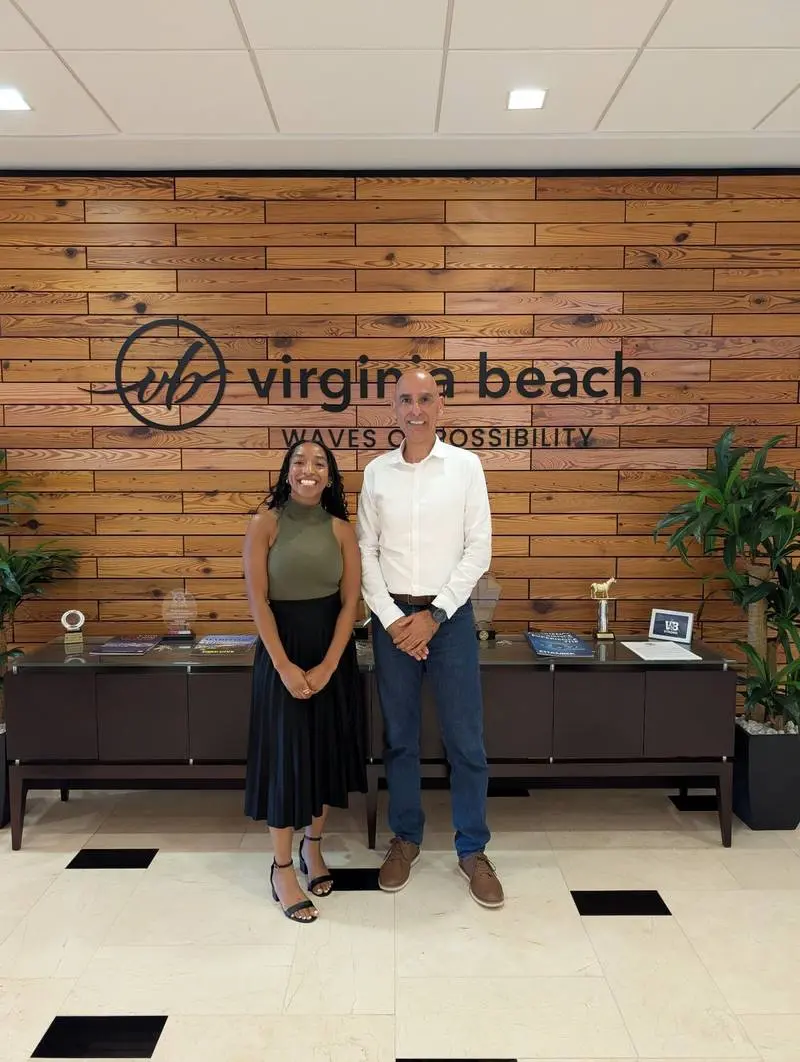
The genesis of this strategic relocation trace back to June 2026 at Eurosatory in Paris, France—one of the world’s premier land and airland defense and security exhibitions. It was here that representatives from the Virginia Beach Economic Development (VBED) authority, led by Business Development Manager Dominique DeBose, first connected with Alon Shantzer, Vice President of Business Growth for Orca AI Defense.
At the exhibition, the VBED team presented a compelling business case for Virginia Beach, highlighting its proximity to major military commands, its specialized business support infrastructure, and its unique soft-landing program for international businesses. For Orca AI, which was actively seeking the optimal gateway to enter the highly regulated and complex U.S. defense market, the pitch resonated immediately.
The Soft-Landing Infrastructure
Following the initial introduction in Paris, VBED mobilized its local resources to facilitate a seamless entry for the technology firm. Orca AI Defense was admitted into the Virginia Beach International Incubator, a specialized facility designed to help foreign-owned enterprises establish a physical presence in the United States while mitigating the high overhead and administrative complexities of international expansion.
By providing office space, localized market intelligence, networking opportunities, and direct pipelines to regional defense decision-makers, the incubator acts as an operational springboard. This setup allows Orca AI Defense to focus its immediate energy on adapting its core technology for military procurement pipelines, navigating federal compliance standards (such as ITAR and FedRAMP), and building out its domestic team.
Supporting Context & Metrics: The Dual-Use Imperative
The establishment of Orca AI Defense in Virginia Beach occurs at a critical juncture in global defense procurement. The U.S. Department of Defense (DoD) is actively shifting away from long-cycle, bespoke military-only hardware development in favor of "dual-use" technologies—commercial solutions that can be rapidly adapted, scaled, and deployed to meet urgent operational needs.
The Power of TRL 9 and 120 Million Miles of Data
In the defense sector, the Technology Readiness Level (TRL) scale is the benchmark for measuring technology maturity. Many promising defense startups struggle to cross the "valley of death"—the difficult transition from a prototype (TRL 4–6) to an operationally deployed system (TRL 9).
TRL 1-3: Basic Research & Concept Formulation
TRL 4-6: Laboratory & Simulated Environment Testing
TRL 7-8: Operational Demonstration & System Integration
TRL 9:   ACTUAL SYSTEM PROVEN THROUGH SUCCESSFUL MISSION OPERATIONS
         ▲
         │ (Orca AI's Commercial Platform Baseline)
Orca AI enters the U.S. defense market with an overwhelming advantage: its commercial platform is already at TRL 9.
- Operational Scale: Installed on over 1,500 commercial vessels, including ultra-large container ships, liquefied natural gas (LNG) carriers, and tankers.
- Data Moat: Powered by more than 120 million nautical miles of real-world operational data.
- Deep Learning Advantage: This vast library of maritime imagery, weather conditions, and sea states has trained Orca AI’s deep learning models to recognize, classify, and track targets with an accuracy level that is nearly impossible to replicate in a closed laboratory setting.
Combatting the Threat of "Dark Vessels"
One of the primary capabilities Orca AI Defense brings to the national security space is the automated detection of "dark vessels." In modern maritime security, a dark vessel is defined as a ship that deliberately turns off its Automatic Identification System (AIS) transponder to avoid detection. This tactic is routinely employed by state actors engaged in grey-zone warfare, smuggling syndicates, illegal fishing fleets, and vessels bypassing international sanctions (such as those carrying illicit oil shipments).
+-------------------------------------------------------------------------+
|                  HOW ORCA AI DEFENSE BYPASSES AIS EVASION               |
+-------------------------------------------------------------------------+
|  [ Dark Vessel ]                                                        |
|        │                                                                |
|        ├── (Disables AIS Transponder) ──> [ Traditional Radar/Radio ]   |
|        │                                        (Blind / No Data)       |
|        │                                                                |
|        └── (Emits Visual & Thermal Signature)                           |
|                    │                                                    |
|                    ▼                                                    |
|         [ Orca AI Sensor Array ]                                        |
|         - High-Res Optical Cameras                                      |
|         - Thermal Imaging / Infrared                                    |
|                    │                                                    |
|                    ▼                                                    |
|         [ Edge AI Computer Vision ]                                     |
|         - Instant Object Detection & Classification                     |
|         - Distance, Speed, & Trajectory Estimation                      |
|                    │                                                    |
|                    ▼                                                    |
|         [ Actionable Threat Alert Sent to Command Center ]              |
+-------------------------------------------------------------------------+
Traditional maritime surveillance relies heavily on AIS and radar. However, radar can be degraded by sea clutter, weather, and stealth designs, while AIS is easily manipulated. Orca AI Defense solves this vulnerability by utilizing a sophisticated payload of high-resolution optical and thermal cameras paired with edge-computed computer vision.
The system continuously scans the horizon, automatically detecting, identifying, and tracking any physical object in the water—regardless of whether it is broadcasting an AIS signal. By calculating the range, bearing, and relative speed of these targets in real time, the platform provides operators with an unblinking, automated layer of situational awareness that functions in zero-light, heavy rain, or dense fog.

The Strategic Value of the Hampton Roads Ecosystem
Virginia Beach’s location within the broader Hampton Roads metropolitan area is uniquely suited to Orca AI Defense’s strategic goals. The region represents the epicenter of American maritime power:
- Naval Station Norfolk: The world’s largest naval base, serving as the homeport for the U.S. Navy’s Atlantic Fleet.
- Joint Expeditionary Base Little Creek-Fort Story: The premier installation for the Army and Navy’s expeditionary and amphibious warfare training.
- U.S. Coast Guard District 5: Responsible for maritime safety, security, and law enforcement across a vast mid-Atlantic jurisdiction.
- Industrial and Academic Base: Home to world-class shipyards (such as Newport News Shipbuilding), defense contractors, and research universities specializing in autonomous systems, oceanography, and aerospace engineering.
By establishing its physical presence here, Orca AI Defense positions its leadership team within driving distance of key military acquisition officers, operational commanders, and technical partners.
Official Statements & Strategic Perspectives
The arrival of Orca AI Defense has been met with strong enthusiasm from both local economic development officials and the company’s executive leadership, highlighting the alignment of local economic goals with national security requirements.
Dominique DeBose, Business Development Manager for Virginia Beach Economic Development, emphasized the strategic fit of the company within the city’s growing defense technology portfolio:
"Our mission at VBED is to attract world-class innovators who can leverage our region’s unparalleled maritime assets while contributing to the local economy. Orca AI Defense is the perfect embodiment of this strategy. By choosing the Virginia Beach International Incubator as their launchpad, they gain immediate access to a highly specialized defense ecosystem, while our community benefits from the influx of cutting-edge artificial intelligence expertise. We are thrilled to support their growth as they work to make our oceans and our nation safer."
Alon Shantzer, Vice President of Business Growth for Orca AI Defense, articulated the company’s vision for adapting its proven commercial core for national defense applications:
"Entering the U.S. defense market requires more than just advanced technology; it requires proximity, trust, and deep collaboration with the end-user. The data-driven foundation we have built in the commercial sector—spanning millions of miles of ocean navigation—gives us an incredibly robust, reliable, and deployable product. In Virginia Beach, we have found the ideal home. The region’s dense concentration of Navy, Coast Guard, and port operations provides an unmatched environment for us to test, refine, and deploy our AI-powered situational awareness solutions. We look forward to building deep, lasting partnerships throughout the Hampton Roads ecosystem."
Future Outlook: The Autonomous Naval Revolution
As Orca AI Defense establishes its operational footing in Virginia Beach, its long-term roadmap aligns with some of the most significant shifts in naval doctrine. The U.S. Navy is currently undergoing a structural transformation, driven by the realization that maintaining global maritime dominance in contested environments will require a hybrid fleet composed of both manned and unmanned platforms.
+-------------------------------------------------------------------------+
|                  ORCA AI DEFENSE: FUTURE ROADMAP                        |
+-------------------------------------------------------------------------+
|                                                                         |
|  [ Phase 1: Localized Integration ]                                     |
|  - Stand up Virginia Beach operations.                                  |
|  - Secure federal defense certifications (ITAR, FedRAMP).               |
|                                                                         |
|  [ Phase 2: Regional Pilot Programs ]                                   |
|  - Launch proof-of-concept trials with local port authorities.          |
|  - Integrate situational awareness payloads onto local Coast Guard      |
|    and commercial security vessels.                                     |
|                                                                         |
|  [ Phase 3: Tactical Edge Deployment ]                                  |
|  - Partner with defense prime contractors.                              |
|  - Integrate Orca AI computer vision software into Navy USV             |
|    (Unmanned Surface Vessel) programs.                                  |
|                                                                         |
|  [ Phase 4: Full Autonomous Fleet Operations ]                          |
|  - Deploy standardized AI navigation & collision avoidance suites       |
|    across manned and unmanned joint-force maritime fleets.              |
|                                                                         |
+-------------------------------------------------------------------------+
Supporting the Unmanned and Autonomous Fleet
The Department of Defense’s "Replicator" initiative and the Navy’s focus on Unmanned Surface Vessels (USVs) and Unmanned Undersea Vessels (UUVs) demand highly reliable, low-power, edge-computed AI navigation systems. Autonomous vessels must be capable of navigating safely through congested shipping lanes, identifying potential threats, and complying with the International Regulations for Preventing Collisions at Sea (COLREGs) without requiring constant high-bandwidth communication with a remote operator.
Orca AI’s core competency lies precisely in this domain. Its algorithms are optimized to process complex visual and thermal data locally, at the "tactical edge," allowing autonomous vessels to make split-second navigation and safety decisions independently. By collaborating with defense contractors and autonomous systems manufacturers in the Hampton Roads area, Orca AI Defense is well-positioned to become the standard "brain" for the next generation of military USVs.
Enhancing Port Security and Infrastructure Protection
Beyond the high-seas naval mission, Orca AI Defense’s technology offers immediate utility for domestic port security. The Port of Virginia, located adjacent to Virginia Beach, is one of the busiest and most technologically advanced container ports on the U.S. East Coast. Protecting such critical infrastructure from asymmetric threats—such as small drone boats, divers, or low-profile watercraft—demands continuous, automated surveillance.
The company is actively exploring pilot programs that would integrate its sensor arrays and AI analytics into port security vessels and fixed pier-side infrastructure. By automating the detection of anomalous waterborne activities, the system can reduce the cognitive burden on security personnel, minimize false alarms, and ensure rapid, targeted responses to genuine security breaches.
Conclusion: A Strategic Win-Win
The expansion of Orca AI Defense into Virginia Beach represents a highly strategic alignment of technology, geography, and economic development. For the city of Virginia Beach, securing a high-growth AI defense company validates its investment in specialized international business attraction and reinforces its status as a hub for maritime innovation. For Orca AI Defense, the move provides the critical proximity, infrastructure, and regional relationships needed to transform its world-class commercial technology into a cornerstone of U.S. maritime national security. As autonomous operations and AI-driven surveillance become central to global naval strategy, the innovations developed and deployed from this new Virginia Beach office will likely reverberate across the global maritime stage for years to come.