








Executive Overview
As autonomous vehicles (AVs) transition from futuristic novelties to everyday urban infrastructure, cities across the United States are grappling with a complex policy puzzle: How do we integrate self-driving fleets without choking our streets in gridlock?
A recent joint study by urban planning advocacy group Open Plans and the Transportation Research Program at Hunter College sounded the alarm, arguing that AVs will inevitably generate excessive "deadheading"—the industry term for empty miles driven between passenger drop-offs and pick-ups. The report warned that New York City’s already strained street network could buckle under the weight of these ghost miles.
However, a closer look at the data reveals that this narrative relies on a flawed premise. By treating the sprawling, auto-centric density of California cities as a direct analogue to the unique, hyper-dense topography of New York City, the study overlooks critical operational mechanics. Urban mobility literature consistently demonstrates that deadheading is a function of demand density: when cars do not have to travel far to find their next fare, empty mileage plummets.
Yet, dismissing the Hunter College and Open Plans report entirely would be a mistake. The core anxiety it highlights is legitimate. More than a decade ago, the sudden, unregulated introduction of tens of thousands of app-based, personally owned for-hire vehicles (FHVs) caught urban planners flat-footed, creating a profound shock to the transportation system. While robotaxis operate under a fundamentally different economic and operational footprint than human-driven rideshare services, cities cannot afford to repeat the regulatory blind spots of the past.
Addressing this challenge requires a hard look at urban real estate’s most contested frontier: the curb. Through strategic curb management, intelligent vehicle staging, and proactive municipal policy—such as the newly established Office of Curb Management in New York City—urban centers can harness the transformative safety and accessibility benefits of AVs while keeping traffic congestion under control.
Detailed Chronology: The Evolution of AVs, Ride-Hailing, and Urban Policy
To understand the current debate over autonomous vehicles and traffic congestion, it is helpful to trace the timeline of modern urban transit disruptions and the policy responses that followed.
The Rideshare Shock (Early 2010s–2020)
- The Surge of For-Hire Vehicles: The rapid market penetration of companies like Uber and Lyft fundamentally altered urban transportation networks. Because these platforms relied on independent contractors rather than centralized fleets, they externalized the costs of downtime and empty driving onto individual drivers.
- The Resulting Gridlock: Without incentives to minimize empty miles, drivers routinely circled congested blocks waiting for pings. Studies later revealed that roughly 40 percent of all ride-hailing miles were driven empty, significantly compounding urban traffic congestion and reducing transit speeds.
The California Proof-of-Concept and Modeling (2022–2026)
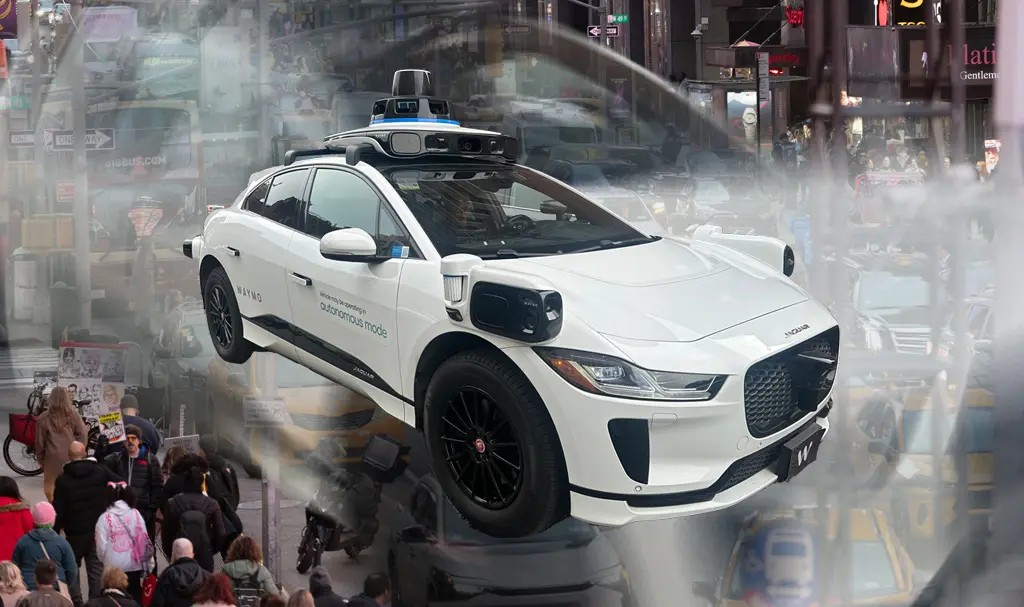
- Scaling Autonomous Fleets: As companies like Waymo successfully deployed commercial robotaxi fleets in dense West Coast markets like San Francisco, Los Angeles, and Phoenix, urban planners began studying their network impacts.
- The Staging Breakthrough: Recognizing the inefficiency of empty miles, researchers from the University of California, Berkeley, and the University of California, Irvine, modeled the effects of curbside vehicle staging. Their findings, published in leading transport economics journals, proved that allowing AVs to park or stage in designated zones between trips reduced Vehicle Miles Traveled (VMT) by more than 60 percent.
- The East Coast Pushback (July 2026): Open Plans and Hunter College released their report targeting New York City specifically, asserting that NYC’s spatial constraints make curbside staging impossible and predicting an insurmountable wave of AV deadheading.
Municipal Pivot to Curb Management (2026 and Beyond)
- New York’s Structural Reforms (April 2026): Responding to decades of mounting curbside chaos, New York City Mayor Zohran Mamdani established the Office of Curb Management within the NYC Department of Transportation. The office was tasked with modernizing how the city allocates its finite street space using meter systems, residential permits, and dynamic pricing models.
- Oakland’s Redesign Efforts (Late 2025–August 2026): Driven by intense community advocacy and safety data from Oakland’s High-Injury Network, the city initiated a major overhaul of Grand Avenue. The project deliberately prioritized bicycle, pedestrian, and transit infrastructure over private automobile storage—proving that cities are actively reclaiming street space for multi-modal use.
Supporting Context & Metrics: The Economics of Deadheading and Curb Real Estate
The debate over autonomous vehicle traffic impact often hinges on misunderstandings about fleet economics, vehicle efficiency, and urban geography.
The False Equivalence of Density
A fundamental flaw in projecting California-style AV impacts onto New York City is the assumption that geographic patterns are uniform. Urban transit literature establishes a direct correlation between demand density and deadheading.
In sprawling environments, an empty vehicle may have to travel significant distances to service a suburban or low-density urban request. In contrast, a hyper-dense environment like Manhattan or inner-ring Brooklyn features constant, overlapping trip demands. In such high-demand ecosystems, the distance between dropping off Passenger A and picking up Passenger B shrinks dramatically, naturally suppressing empty mileage.
Internalizing the Cost of Empty Miles
A crucial distinction separates traditional human-driven ridesharing from vertically integrated autonomous fleet operators:
- The Human-Driver Model: Traditional ride-hailing networks do not directly pay for the fuel, wear-and-tear, or time spent driving empty miles. Those costs are absorbed entirely by the human driver. Consequently, drivers have little structural protection against the inefficiencies of circling congested blocks.
- The Fleet Operator Model: Fully autonomous operators like Waymo bear the financial cost of every single empty mile driven. Unnecessary deadheading translates directly to higher operational expenditures, accelerated vehicle depreciation, increased energy consumption, and expanded risk exposure. Therefore, fleet operators share a powerful economic alignment with municipal planners: both want to minimize empty miles as aggressively as possible.
The Power of Curbside Staging
When AVs are not actively transporting passengers, what should they do? Allowing vehicles to circle continuously is inefficient and undesirable. However, the alternative—strategic curbside staging—yields dramatic efficiency gains.
According to research from UC Berkeley and UC Irvine, when AVs stage at the curb between rides, total empty miles plummet by more than 60 percent. Furthermore, these models account for moving empty AVs into secure off-street lots during overnight or low-demand periods.
| Curbside Allocation Strategy | Average Empty Mileage Impact | Commercial District Benefit |
|---|---|---|
| Continuous Circling / No Staging | High (Baseline ride-hail norms ~40%) | Zero commercial activation; increased gridlock |
| Decentralized Curbside Staging | Reduced by > 60% | 8x to 10x higher customer turnover for local businesses compared to private vehicle parking |
| Off-Street Lot Storage (Low Demand) | Optimized base-to-fleet flow | Zero impact on moving lanes; frees up overnight street cleaning |
As the data shows, a staged AV is far more economically and spatially productive than a privately owned vehicle sitting idle for 23 hours a day. While a private car stores itself in a single spot continuously, an AV utilizes the curb intermittently between executing dozens of passenger trips, bringing foot traffic directly to local storefronts.
Official Statements & Industry Perspectives
The conversation surrounding AV deployment and urban planning is evolving from adversarial friction into collaborative cross-sector problem-solving. Stakeholders from municipal agencies, advocacy groups, and the autonomous technology sector are increasingly finding common ground.
The Urban Planning Perspective: Open Plans and Hunter College
Urban advocates remain fiercely protective of public space. In their recent report, Open Plans and the Hunter College Transportation Research Program emphasized that New York City’s physical constraints leave little room for error:
"New York City’s constrained curb space makes staging infeasible, leaving AVs with little choice but to drive empty between trips."
While urban advocates view this through a lens of physical limits, technology leaders and progressive planners argue that the constraint is not physical—it is political and regulatory.
The Industry Perspective: Waymo’s View on Trade-Offs
Speaking from a dual perspective as an urban pedestrian advocate and an industry insider, practitioners emphasize that building an efficient transportation system requires honest assessments of trade-offs.
The Policy Development and Research Manager at Waymo noted in recent commentary:
"Whether it is bike or bus lanes, curb management, or parking, there is rarely a perfect solution. The conversation about how to most effectively deploy AVs is no different, and curb management is an important place to start… The curb isn’t constrained by the laws of physics; it’s constrained by policy."
Waymo’s current operational protocols reflect this philosophy. The company actively restricts its footprint by prioritizing off-street staging lots, limiting its operations to a single staged vehicle per block face, and programming vehicles to avoid cycling repeatedly through identical locations.
Municipal Leadership: New York’s New Frontier
Municipal leaders are matching these industry adjustments with systemic governance reforms. The creation of New York City’s Office of Curb Management under Mayor Zohran Mamdani represents a generational shift. By consolidating disparate parking, commercial loading, and transit rules into a unified strategy, the city is building the regulatory scaffolding necessary to manage modern mobility.
City officials are evaluating dynamic pricing, specialized loading zones, and expanded residential permit structures. These tools will ensure that whether a vehicle is driven by a human, parked by a resident, or operated autonomously, it contributes to the public good rather than community gridlock.
Future Outlook: Managing the Trade-Offs of Autonomous Mobility
Deadheading can never be reduced to absolute zero. Every form of transportation—from traditional yellow cabs and delivery vans to personal sedans and transit buses—generates some degree of repositioning mileage. Therefore, the central policy question facing twenty-first-century cities is not how to eliminate empty miles entirely, but rather: How many empty miles are we willing to accept in exchange for the safety, accessibility, and environmental benefits of autonomous vehicles?
The path forward depends on three critical pillars:
- Modernized Curb Regulation: Cities must establish clear, enforceable permitting frameworks for AV staging. By designating specific micro-zones for temporary vehicle holding, cities can prevent cars from circling while keeping moving lanes clear for emergency vehicles, buses, and cyclists.
- Data Transparency and Collaboration: Technology companies and municipal transportation departments must maintain open lines of data sharing. By understanding fleet movements in real-time, cities can dynamically adjust curb rules based on time of day, special events, and local congestion metrics.
- Prioritizing Multi-Modal Transit: Autonomous vehicles must not be allowed to cannibalize public transit or active transportation modes like walking and cycling. Instead, AVs should function as a first-mile/last-mile bridge that feeds high-capacity rail and bus networks.
New York City has already demonstrated its willingness to make bold, politically challenging transit decisions—evidenced by the groundbreaking implementation of congestion pricing and renewed crackdowns on street-cleaning compliance. By applying that same boldness to curb management, urban leaders can ensure that the arrival of autonomous vehicles enhances, rather than overwhelms, the streetscape.
Ultimately, cities, urbanists, and AV developers share a common cause: vibrant, safe, and navigable public spaces. Through proactive policy and intelligent design, the transition to autonomous mobility can help cities reclaim their streets for the people who live, walk, and work in them.