






Executive Overview
Across the vast expanses of the American West, the skeletal remains of the late 19th-century boom years linger as silent monuments to fleeting ambition. Crumbling stone foundations, weathered timber outbuildings, and lonely brick chimneys pierce the prairie sky, serving as reminders of an era when fortunes were amassed overnight and vanished just as quickly. Among the most fascinating, yet frequently overlooked, relics of this turbulent period sits perched upon a bluff overlooking the Little Missouri River in western North Dakota: the Chateau de Mores.
This 26-room, red-roofed summer home and hunting lodge stands as the physical embodiment of a grand, albeit short-lived, industrial experiment. Built in 1883 by a flamboyant French aristocrat—Antoine-Amédée-Marie-Vincent Manca de Vallombrosa, universally known as the Marquis de Mores—the estate was the administrative and domestic heart of a vertically integrated meatpacking empire. For a few heady years, this remote corner of the Dakota Territory buzzed with the frantic energy of eastern capital meeting raw western enterprise.
Today, the Chateau de Mores State Historic Site offers travelers, historians, and road-trippers a remarkably preserved portal into the colorful, high-stakes world of 1880s frontier capitalism. Maintained by the State Historical Society of North Dakota, the property retains a staggering collection of original family furnishings, personal effects, and structural integrity. Far from a mere dusty museum, the site functions as a tangible window into a classic boom-and-bust narrative—one intricately intertwined with the early biography of future U.S. President Theodore Roosevelt.

This comprehensive investigative report examines the historical arc of the Marquis de Mores’ North Dakota enterprise, the architecture and curation of the surviving estate, the logistical and economic forces that led to its rapid collapse, and its contemporary significance as a premier cultural and heritage tourism destination within the American Badlands.
Detailed Chronology
1883: The Arrival of the Aristocrat
The saga of the Chateau de Mores began in the spring of 1883, when the 25-year-old Marquis de Mores stepped off the newly extended Northern Pacific Railway into the rugged, untamed landscape of the Dakota Badlands. Born into French nobility and possessed of immense wealth through his marriage to Medora von Hoffman—the daughter of a prominent Wall Street banker—the Marquis was not content with the leisurely pursuits of the European elite. He envisioned a radical disruption of the American meat industry.
At the time, cattle raised on open-range ranches across the West were typically driven or shipped live to major urban stockyards in Chicago, Kansas City, or Omaha for slaughter. The Marquis recognized massive inefficiencies in this model: cattle lost significant weight during grueling rail transits, resulting in lower meat quality and higher shipping overhead. His revolutionary solution was simple in concept yet audacious in execution: slaughter the cattle directly on the western range, dress the carcasses locally, and transport the fresh beef in refrigerated railway cars directly to eastern consumer markets.
To anchor this bold enterprise, the Marquis founded a company town on the banks of the Little Missouri River, naming it Medora in honor of his wife. He immediately set to work purchasing vast tracts of land, constructing a massive slaughterhouse capable of processing up to 150 beef carcasses a day, establishing a stagecoach line, and laying the groundwork for a sprawling cattle ranching empire.

1883–1885: Construction of the Chateau and Industrial Expansion
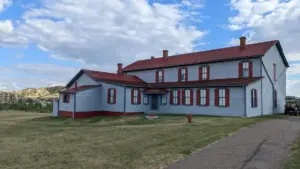
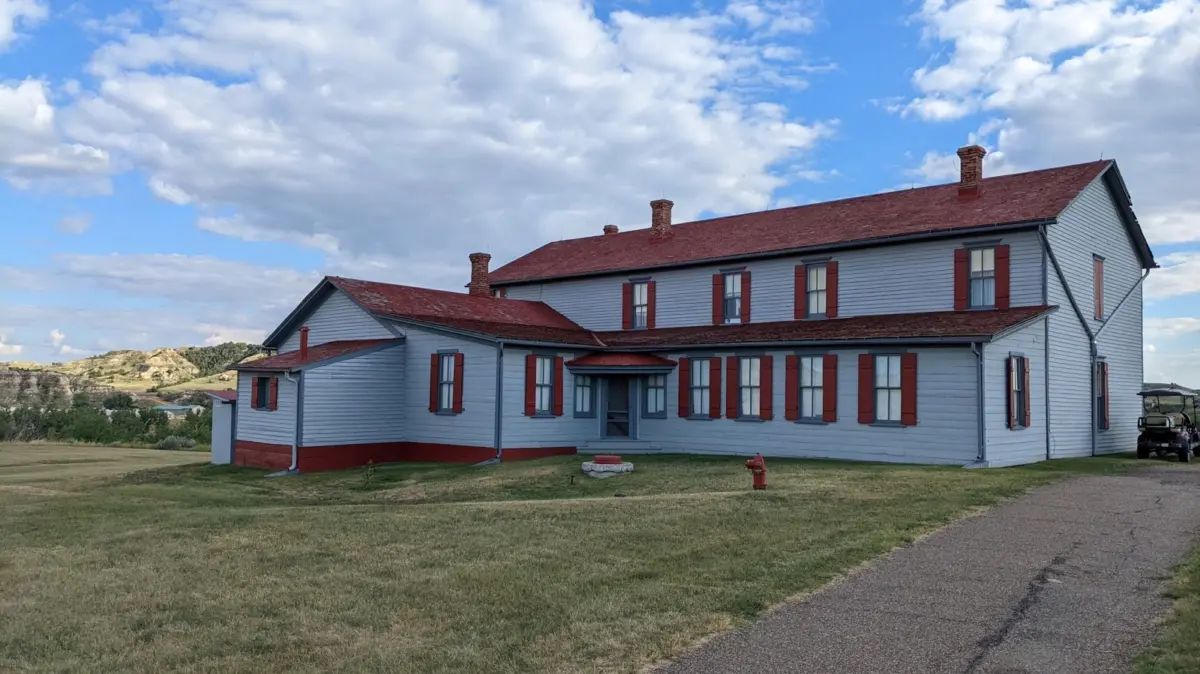
To house himself, his sophisticated New York-bred wife, and their high-society guests, the Marquis commissioned the construction of a magnificent two-story, 26-room framed residence on the bluffs overlooking Medora. Completed in the summer of 1883, the structure was designed as a summer home and hunting lodge, combining French architectural sensibilities with American frontier pragmatism. Featuring a striking red roof, expansive wraparound porches, and elegant interior appointments, the home stood in sharp, dramatic contrast to the crude sod houses and rough-hewn shanties of the surrounding frontier settlement.
Simultaneously, the industrial infrastructure of Medora expanded at a breakneck pace. The Marquis formed the Northern Pacific Refrigerating Company, constructed icehouses to harvest winter ice from the river for summer cooling, built a network of cattle ranches, and even attempted to secure exclusive contracts with western cattlemen. During these peak years, Medora hummed with industrial activity. Freight wagons groaned under the weight of goods, cowboys navigated the dusty streets, and the town briefly vied to become the economic epicenter of the western Dakota Territory.
It was during this exact window, in the autumn of 1883, that a grieving young New York assemblyman named Theodore Roosevelt arrived in the Badlands to hunt bison. Roosevelt and the Marquis de Mores would cross paths, establishing a complex relationship defined by mutual respect, competitive frontier business dealings, and shared ideological commitments to the development of the West, even as their personalities pulled them in distinct directions.
1886: The Great Collapse
Despite its innovative premise and aggressive capital investment, the Marquis’s meatpacking empire was built on precarious economic foundations. By 1886, a convergence of hostile market forces and operational miscalculations brought the enterprise to its knees.
- The Chicago Cartel: The entrenched meatpacking barons of Chicago—who controlled the nation’s stockyards, distribution networks, and rail rebates—viewed the young French upstart as a direct threat. They waged a fierce price war, systematically undercutting the Marquis’s wholesale beef prices in eastern markets until his profit margins evaporated.
- Cattle Shortage and Harsh Winters: The open-range cattle industry in the Dakota Territory was notoriously vulnerable to environmental extremes. Severe blizzards and overgrazing depleted herds, leading to a critical shortage of suitable range cattle for slaughter. Furthermore, local ranchers were often reluctant to sell exclusively to the Marquis, preferring traditional trailing methods to Chicago markets.
- Logistical Hurdles: Transporting refrigerated meat reliably across thousands of miles of 19th-century rail infrastructure proved far more technologically and logistically challenging than anticipated, resulting in costly spoilage.
By the summer of 1886, the Northern Pacific Refrigerating Company was insolvent. The slaughterhouse operations were permanently shuttered, and the Marquis de Mores quietly packed up his family and returned to Europe, leaving behind a mountain of debt, a stunned local populace, and an extraordinary monument to transient ambition. Shortly after their departure, a catastrophic fire swept through the abandoned meatpacking plant, reducing the industrial complex to ashes—leaving behind only its towering brick chimney as a silent sentinel on the riverbank.
Supporting Context & Metrics
To fully understand the magnitude of the Chateau de Mores and its surrounding enterprise, it is vital to examine the quantitative and historical metrics that define the site:
- Geographic Footprint: The Chateau de Mores State Historic Site encompasses approximately 121 acres, preserving not only the primary residence but also the surrounding bluff landscape, native prairie flora, and archaeological remnants of the estate’s auxiliary buildings (including stables, carriage houses, and employee quarters).
- Architectural Specifications: The Chateau spans 26 rooms across two primary levels. Built primarily of wood frame construction with board-and-batten siding, the home was remarkably advanced for its remote location, featuring custom millwork, imported European wallpapers, and specialized heating and ventilation systems.
- Industrial Capacity: At peak operations, the Marquis’s Medora meatpacking plant could process up to 150 beef carcasses daily, supported by an army of local butchers, teamsters, hide processors, and rail yard workers.
- Artifact Preservation Rate: Unlike many historic properties that rely heavily on period-accurate reproductions, the Chateau de Mores boasts an exceptionally high concentration of original family artifacts. Approximately 80% to 90% of the furnishings, tableware, clothing, books, and artwork currently on display inside the home belonged directly to the de Mores family during their residency in the 1880s.
- Visitor Metrics and Accessibility: Located within the city limits of Medora, North Dakota—directly adjacent to the South Unit of Theodore Roosevelt National Park—the historic site attracts tens of thousands of visitors annually. The Interpretive Center operates year-round, while interior tours of the Chateau are conducted seasonally from May through September.
Official Statements
Preservationists, historians, and cultural resource managers emphasize the irreplaceable value of the Chateau de Mores in interpreting the broader narrative of American westward expansion and industrialization.
State Historical Society of North Dakota Spokesperson:
"The Chateau de Mores is much more than just a wealthy European’s hunting lodge in the middle of nowhere; it is a physical textbook on the fragile nature of frontier enterprise. The fact that the family left in such haste, and that subsequent caretakers respected the historical integrity of the home, has gifted modern America with an extraordinarily rare time capsule. When visitors walk through these doors, they are stepping directly into the summer of 1884. Every wine bottle, every piece of china, and every open journal on a desk tells a story of ambition, elegance, and eventual heartbreak."
Cultural Historian and Heritage Tourism Analyst:
"In the late 19th century, the Dakota Badlands were viewed primarily as a place of extraction—mined for gold, timber, or beef. The Marquis de Mores attempted to industrialize that extraction on an unprecedented scale. His failure was not merely a personal financial loss; it was a defining moment that demonstrated the immense power of corporate monopolies in Chicago against independent western innovators. Preserving the Chateau ensures that this crucial economic battleground is never forgotten by travelers traversing the modern American West."
Local Medora Heritage Guide:
"People come to Medora primarily for Theodore Roosevelt National Park or the famous Medora Musical, but when they step onto the porch of the Chateau de Mores and look out over the Little Missouri River, their entire perspective shifts. They realize that this landscape was once a bustling theater of global finance, aristocratic ambition, and gritty frontier survival. The brick chimney standing across the river isn’t just a pile of old masonry—it’s a monument to a dream that dared to challenge the industrial giants of the gilded age."
Future Outlook
As heritage tourism continues to evolve, the Chateau de Mores State Historic Site remains a cornerstone of western North Dakota’s cultural economy. Looking toward the future, state preservation officials, park administrators, and regional tourism boards are implementing strategic initiatives to enhance visitor engagement, improve structural conservation, and deepen educational outreach.
Conservation and Structural Integrity
Given the harsh climatic shifts characteristic of the North Dakota Badlands—featuring scorching summer temperatures and sub-zero winter gales—maintaining a 140-year-old wooden structure is a continuous challenge. Recent conservation grants and specialized architectural assessments have focused on mitigating wood rot, stabilizing the original foundation piers, protecting fragile antique textiles from UV degradation, and upgrading climate-control monitoring systems within the main house and the year-round Interpretive Center.
Enhanced Educational Programming
The popular "History Alive!" living history program—running on weekends from June through August—continues to be a vital draw for cultural tourists. Plans are underway to expand these dramatic monologues, incorporating newly transcribed archival letters, shipping manifests, and diary entries from contemporary accounts of Medora residents, ranch hands, and visiting dignitaries. Furthermore, digital integration projects, including virtual 3D interior tours and interactive mobile mapping of the greater Medora industrial zone, aim to make the site accessible to educators and students nationwide.
Integration with Regional Tourism Corridors
The future of the Chateau de Mores is inextricably linked to the broader appeal of western North Dakota. Located approximately a two-hour drive from Bismarck along Interstate 94, Medora serves as a primary hub for travelers exploring Theodore Roosevelt National Park, hiking the scenic Boicourt Trail, or marveling at the eccentric roadside installations of the nearby Enchanted Highway. Collaborative marketing efforts between state parks, local hospitality groups, and national park services are positioning Medora not merely as a roadside stop, but as a multi-day destination for history buffs, nature enthusiasts, and cultural explorers.
Ultimately, the Chateau de Mores stands as a testament to the enduring human drive to conquer the frontier. Long after the cattle drives have ceased and the industrial smoke of the 19th century has cleared, the red-roofed chateau on the bluff continues to guard the stories of the Badlands—inviting every passing traveler to pause, reflect, and step back into a brilliant, fleeting moment in American history.