











Executive Overview
Public transit agencies stand at a monumental crossroads. Every single day, modern metropolitan transit networks generate tidal waves of operational data. From the real-time telemetry of electric bus fleets and light rail vehicles (LRVs) to complex automated fare collection systems, dynamic scheduling platforms, and omnichannel customer service applications, millions of distinct data points are captured continuously. Yet, despite this unprecedented abundance of information, a frustrating systemic paradox persists: when a transit director, operations manager, or maintenance chief urgently needs an answer to a straightforward operational question, the process remains agonizingly slow.
For decades, accessing vital system insights has required an archaic ritual. A query must be submitted to an overextended IT department or specialized data analytics team. Analysts must then manually extract, clean, and combine data from fragmented, proprietary vendor databases. Days—sometimes weeks—later, a static report is finally delivered. By the time this intelligence lands on a decision-maker’s desk, the operational crisis it was meant to resolve has long since passed. The core vulnerability of contemporary public transportation is no longer a lack of information; rather, it is the crippling inability to access, connect, and interpret that information at the speed of modern operations.
To achieve genuine operational agility and meet the escalating expectations of urban commuters, transit authorities must break free from vendor lock-in and proprietary data silos. The path forward requires establishing a unified, standardized transit data mart anchored in open standards such as the General Transit Feed Specification (GTFS) and GTFS-Realtime (GTFS-RT). When paired with the transformative capabilities of conversational artificial intelligence (AI), this architectural shift converts raw, disconnected data into instant, actionable intelligence. By allowing leaders to query their entire operational ecosystem using natural, conversational language, transit agencies can abandon reactive firefighting and usher in a new era of proactive, data-driven stewardship.
Detailed Chronology of the Transit Data Evolution
To understand how public transportation arrived at its current technological juncture, it is helpful to examine the historical evolution of data management within the industry. The transformation from paper schedules to predictive, AI-driven conversational analytics spans several distinct eras of technological adoption.
Phase I: The Analog and Disconnected Era (Pre-2000s)
For much of the 20th century, transit operations were managed through localized, disconnected mechanisms. Bus schedules were printed on paper, vehicle locations were tracked via analog two-way radios, and maintenance logs were handwritten on clipboards in depot yards. Information sharing across departments—such as linking schedule adherence directly to vehicle maintenance records—was a manual, labor-intensive process that occurred on a weekly or monthly retrospective basis.
Phase II: The Siloed Digital Boom (2000s–2010s)
As transit agencies modernized, they rapidly adopted digital enterprise software, but they did so in functional isolation. Different departments procured specialized software vendors to solve immediate, localized problems:
- Computer-Aided Dispatch and Automatic Vehicle Location (CAD/AVL) systems were installed to track vehicles in real time.
- Enterprise Resource Planning (ERP) and asset management software were deployed to handle procurement, payroll, and maintenance tracking.
- Scheduling and rostering platforms were introduced to optimize driver shifts and route mapping.
- Automated Fare Collection (AFC) networks digitized ticketing and revenue collection.
While these systems dramatically increased digital data generation, they created rigid technological silos. Because these proprietary platforms were never designed to communicate fluidly with one another, agencies frequently suffered from conflicting versions of operational reality. A scheduling software package might indicate optimal on-time performance, while the CAD/AVL system revealed severe bunching, and the fare collection data told an entirely different story about passenger boarding bottlenecks.
Phase III: The Open Standards Revolution and GTFS Adoption (2010s–2020s)
A major turning point arrived with the widespread adoption of open-data standards pioneered by transit innovators and tech platforms. The General Transit Feed Specification (GTFS), originally developed to help agencies publish static schedules for journey planners, established a universal data grammar. Its evolution into GTFS-Realtime (GTFS-RT) allowed agencies to broadcast live vehicle positions, trip updates, and service alerts in a standardized format.
This standardization proved that disparate software could share a common language. However, while open standards successfully fed consumer-facing mobile apps and journey planners, internal transit agency management systems lagged behind. Internal decision-makers were still forced to rely on traditional, rigid Business Intelligence (BI) tools like Tableau or Power BI. While these dashboards offered powerful visualizations, they remained constrained by pre-built queries, failing to meet the spontaneous, complex information needs of executive leadership.

Phase IV: The Conversational AI Paradigm (2026 and Beyond)
Today, the transit industry is entering its most disruptive and promising phase yet: the integration of Generative AI and natural-language interfaces. By combining a centralized, open-standard data mart with large language models (LLMs) fine-tuned for transit operations, agencies are bridging the gap between raw data storage and human inquiry. Transit leaders can now converse directly with their enterprise data systems, bypassing complex SQL queries and rigid BI dashboards to receive trusted, narrative-driven answers in seconds.
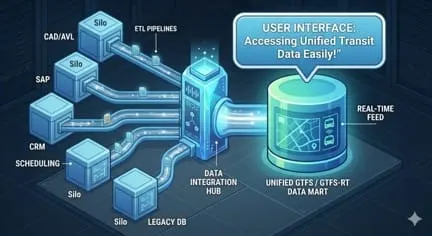
[Legacy Silos: SAP, CAD/AVL, Scheduling, AFC]
                       │
                       ▼
         [Standardized ETL Pipelines]
                       │
                       ▼
    [Central Transit Data Mart (GTFS / GTFS-RT)]
                       │
                       ▼
       [Natural-Language Conversational AI]
                       │
                       ▼
  [Instant Actionable Insights for Transit Leadership]
Supporting Context & Metrics: The Cost of Fragmented Data
The urgency driving this technological shift is underscored by growing operational pressures across urban mobility networks. Public transit agencies face mounting ridership expectations, fluctuating post-pandemic commute patterns, aging physical infrastructure, and persistent workforce shortages. In this high-stakes environment, data latency is a direct threat to agency efficiency and public trust.
The Problem of Data Latency
Industry studies and operational audits consistently reveal that traditional data retrieval methods within large-scale public agencies impose severe operational delays:
- Report Generation Lag: In agencies relying on traditional IT data-pull requests, the average turnaround time for a non-standard operational report ranges from 3 to 10 business days.
- Cross-Departmental Friction: Over 65% of mid-to-large-sized transit agencies report that maintenance, operations, and customer service teams operate with conflicting metrics due to siloed software architectures.
- Missed Intervention Windows: Operational anomalies—such as recurring transfer bottlenecks at major multi-modal hubs—often persist unchecked for weeks because analysts lack the bandwidth to perform ad-hoc root-cause analyses across disparate datasets.
Breaking Down the Silos via a Unified Data Mart
To overcome these inefficiencies, progressive agencies are implementing centralized Transit Data Marts. Rather than attempting fragile, custom-built integrations between every legacy enterprise application, agencies normalize incoming streams from SAP, CAD/AVL, scheduling, and fare systems into a vendor-neutral, relational data model.
By grounding this model in GTFS and GTFS-RT protocols, agencies create a single source of truth. Operational, maintenance, workforce, and financial performance metrics are harmonized. For the first time, the traditional operational walls that separate bus divisions from light rail operations begin to dissolve, allowing for enterprise-wide visibility and holistic asset management.
Natural Language as the New Business Intelligence
Building a centralized repository solves the data storage and normalization challenge, but democratizing access requires a quantum leap in user interface design. Traditional BI tools are powerful, but they possess an inherent limitation: they can only answer questions that developers anticipated when designing the dashboard. If a transit director asks a novel question that falls outside pre-programmed parameters, the analytics team must build a new report from scratch.
Conversational AI fundamentally alters this dynamic. By deploying secure, enterprise-grade natural-language interfaces powered by Generative AI, agencies empower non-technical leaders to query complex databases using everyday language. The AI engine acts as an intelligent translation layer:
- It interprets the user’s plain-language question (e.g., "Which routes experienced the highest rate of early departures during the morning peak over the last month, and what were the primary scheduling assumptions?").
- It maps the query to the underlying relational data model.
- It retrieves the relevant datasets across maintenance, scheduling, and AVL records.
- It synthesizes the findings into clear narratives, charts, or tabular outputs within seconds.
Practical Applications Across the Enterprise
The true power of conversational intelligence in public transit is best understood through its practical, everyday applications across various functional departments.
1. Auditing Operator Performance and Schedule Adherence
When monitoring schedule adherence, transit supervisors often struggle to isolate systemic scheduling flaws from individual operator variance. With a conversational data mart, an operations manager can instantly query historical GTFS-RT data correlated with rostering records. The system can instantly surface specific trips, routes, and operators associated with chronic early departures, automatically cross-referencing them against traffic congestion logs and recovery-time assumptions built into the master schedule.
2. Optimizing Multi-Modal Connections
Seamless transfers are vital for maintaining high ridership on interconnected urban networks. When commuter complaints spike regarding missed connections between light rail arrivals and feeder bus routes, transit planners traditionally have to commission multi-week observational studies. Using conversational AI, a planner can ask: "Show me all instances where northbound Blue Line trains arrived more than three minutes late, resulting in a missed connection with the Route 42 bus over the past quarter." The AI compiles the telemetry data and pinpoints recurring transfer failures, enabling rapid timetable adjustments.
3. Enhancing Fleet Reliability and Maintenance Lifecycles
Unplanned vehicle breakdowns are among the most costly disruptions an agency can face. By consolidating Enterprise Resource Planning (ERP) maintenance logs, warranty data, and real-time onboard diagnostics into the centralized data mart, fleet managers gain unprecedented visibility. A maintenance director can converse with the system to generate complete incident lifecycle reports: "Which bus series has experienced the highest frequency of door-mechanism failures following routine 15,000-mile servicing?" The AI instantly cross-references parts inventory, mechanic notes, and mileage logs to reveal operational bottlenecks and defective part batches.
4. Unifying Agency Health and Cross-Departmental Metrics
The benefits of conversational data accessibility ripple across every tier of an agency:
- Human Resources: Workforce managers can seamlessly compare daily operator absenteeism rates against spare-board availability and overtime expenditures.
- Customer Service: Representatives can instantly validate passenger complaints by querying telemetry and operational logs during live customer interactions.
- Executive Leadership & Finance: Chief Financial Officers can link service delivery performance and on-time reliability directly to cost-per-passenger-mile and farebox recovery metrics in real time.
Official Statements and Industry Perspective
As the transportation sector grapples with digital transformation, industry leaders are increasingly vocal about the necessity of shedding legacy technology models in favor of open, agile architectures.
"Public transit agencies generate enormous volumes of data every day, yet answering a simple operational question often remains a slow and frustrating process," notes Steve Lassey, Chief Executive Officer of Strada 360. "The challenge is not a lack of information. It is the inability to access and connect information quickly. By moving beyond proprietary vendor silos, establishing unified transit data marts based on open standards, and deploying conversational AI tools, agencies can transform raw data into actionable intelligence."
Industry analysts echo this sentiment, emphasizing that the future competitiveness of public transportation depends on shedding bureaucratic data bottlenecks. In an era where ride-hailing services and micro-mobility options offer instant, app-driven agility, public transit authorities must match that operational responsiveness behind the scenes. Empowering transit directors and planners with instant, conversational data access is no longer a futuristic luxury—it is an operational necessity.
Future Outlook: A Pragmatic Roadmap for Transit Modernization
The transition toward conversational intelligence and unified data marts cannot happen overnight, but the roadmap is clear. To successfully modernize operations without disrupting ongoing public service, transit agencies must adopt a deliberate, phased implementation strategy:
- Mandate Open Standards: Procurement policies must require all future software vendors—whether providers of CAD/AVL, fare collection, or ERP systems—to support open data standards like GTFS and GTFS-RT, ensuring native data portability and preventing future vendor lock-in.
- Build Secure ETL Pipelines: Agencies must invest in robust, secure Extract, Transform, Load (ETL) pipelines that continuously ingest, clean, and normalize data from legacy silos into a centralized Transit Data Mart.
- Deploy Governed Enterprise AI: Conversational AI tools must be deployed under strict data governance, cybersecurity, and privacy controls. Ensuring data integrity, role-based access permissions, and algorithmic transparency is paramount when handling sensitive operational and workforce records.
- Cultivate Data Culture: Technology is only as effective as the people using it. Agencies must invest in internal training programs to help managers, supervisors, and planners embrace natural-language query tools, shifting organizational culture from reactive reporting to proactive analysis.
Conclusion
The future of public transportation will not be defined by which agency collects the most data. In an increasingly complex urban mobility landscape, the true differentiator will be an agency’s ability to democratize that information. By embracing open data standards, unifying fragmented silos into centralized data marts, and deploying intuitive conversational AI, public transit leaders can finally ask any operational question—and receive an immediate, trusted answer.