






Executive Overview
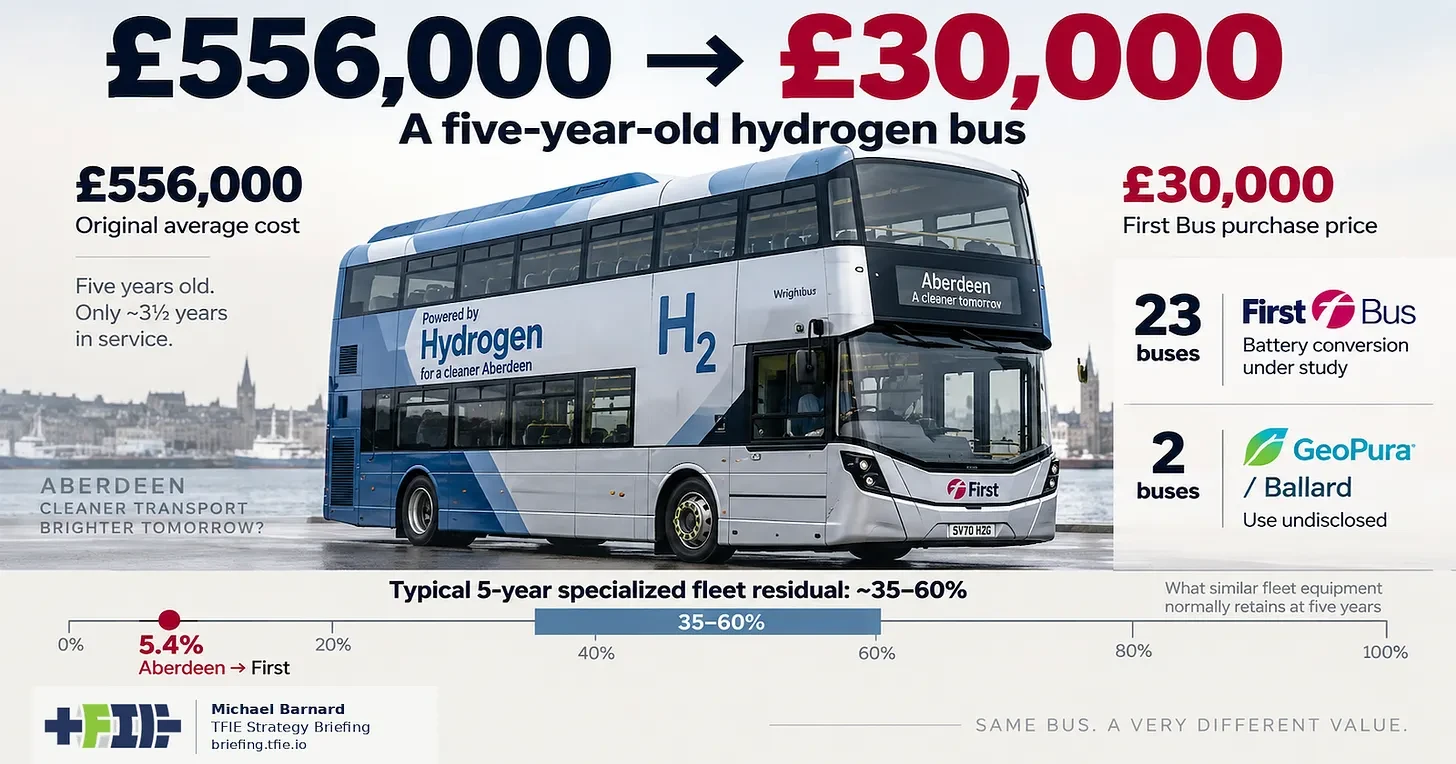
In the rapidly evolving landscape of municipal zero-emission transit, ideological projections of green fleets often crash violently against economic reality. A stark illustration of this dynamic is unfolding in Scotland, where Aberdeen City Council is offloading its entire municipal fleet of hydrogen double-decker buses to commercial transit operator First Bus for a nominal £30,000 per vehicle.
For a fleet originally commissioned just five years ago at an average price tag of £556,000 per bus—funded by roughly £13.9 million in total public expenditure—this sale price represents a staggering depreciation. First Bus is acquiring these vehicles at just 5.4% of their original acquisition cost.
Crucially, these are not dilapidated, legacy diesel buses reaching the end of a grueling 15-year lifecycle. Entering service in 2021, these Wrightbus StreetDeck Hydroliners logged barely three and a half years of actual revenue operation before persistent hydrogen-supply bottlenecks sidelined them permanently. Rather than existing as a theoretical exercise in spreadsheet depreciation, this transaction offers the clean-transportation sector a rare, hard market test for used fuel-cell commercial vehicles.
As First Bus prepares to take delivery of the 23-bus fleet in staged rollouts through 2028, the industry faces an unvarnished truth: without a liquid secondary market for aging hydrogen infrastructure, these specialized vehicles possess almost zero commercial appeal in their current form. The real value, it appears, lies not in the fuel cell, but in the underlying chassis—and what it might cost to rip out the hydrogen systems and convert them into battery-electric vehicles.
Detailed Chronology: From Municipal Pride to Stranded Assets
To understand how a multi-million-pound green initiative was reduced to a distressed asset sale, one must trace the timeline of Aberdeen’s ambitious hydrogen push.
2020–2021: The Hydrogen Dawn
Aberdeen positioned itself as a pioneer in the European hydrogen economy, leveraging its oil and gas heritage to brand itself as the "Energy Capital of Europe." In 2020 and 2021, the city council proudly introduced a flagship fleet of 25 Wrightbus StreetDeck Hydroliners. Touted as a monumental leap forward for municipal decarbonization, the project was designed to showcase how fuel-cell technology could power heavy-duty urban mass transit.
The capital outlay was immense. Funded through a mix of council budgets and government grants, the total expenditure hit approximately £13.9 million, translating to roughly £556,000 per bus. For a brief window, the buses plied Aberdeen’s streets, emitting only water vapor and drawing widespread acclaim from environmental advocates and policy-makers alike.
2024–2025: The Infrastructure Bottleneck
The unraveling was swift. Despite the technical competence of the buses themselves, the supporting ecosystem proved economically and logistically fragile. Chronic issues plaguing regional hydrogen supply chains, production economics, and reliable refueling infrastructure began to mount.

As fueling costs spiked and operational reliability plummeted, maintaining the hydrogen fleet became financially untenable for the council and its operating partners. By mid-decade, the vast majority of the fleet was parked, transforming a cutting-edge transit solution into a high-profile stranded asset.
2026: The Market Test
Faced with mounting maintenance overheads and zero operational utility, Aberdeen City Council took the unusual step of openly testing the secondary market. A confidential council briefing obtained by local media revealed that the city received four separate bids. These included proposals to take the buses off the council’s hands for free, as well as a symbolic bid offering £1 per vehicle.
First Bus—the incumbent commercial operator that had run the Hydroliners since their inception—stepped forward with a bid of £30,000 per bus for 23 of the remaining vehicles. Rather than a sign of predatory pricing by a dominant buyer, the response from the broader market confirmed a grim reality: virtually no buyers existed who were willing or able to operate these specialized assets under existing hydrogen constraints.
Supporting Context & Metrics: The Economics of Stranded Assets
The Aberdeen transaction provides a vital baseline metric for transit agencies and transport economists attempting to price the residual value of early-generation alternative fuel vehicles.
[Original Acquisition Cost: £556,000] ──> [Operational Lifespan: ~3.5 Years] ──> [Secondary Market Bid: £30,000 (5.4%)]The Residual Value Reality Check
Publicly funded clean-transportation programs routinely model vehicle depreciation using linear amortization schedules or optimistic forecasts of long-term asset residual value. However, the Aberdeen case study underscores a distinct market failure: technological obsolescence combined with localized infrastructure failure destroys residual value almost overnight.
When capital assets rely on hyper-specific supply chains (such as regional green hydrogen production and specialized high-pressure refueling stations), the failure of that infrastructure strips the vehicle of its operational utility. If a buyer cannot fuel the bus, the asset’s market value collapses to the salvage value of its raw materials and chassis components.
Comparative Fleet Metrics
- Total Fleet Size: 25 Wrightbus StreetDeck Hydroliners originally purchased.
- Fleet Transferred: 23 vehicles acquired by First Bus.
- Original Unit Cost: ~£556,000.
- Final Acquisition Unit Cost: £30,000.
- Depreciation Magnitude: 94.6% loss in nominal value over 3.5 years of active service.
- Staged Delivery Schedule:
- 7 vehicles scheduled for transfer by March 2027.
- 16 vehicles scheduled for transfer during the 2027–28 financial year.
Official Statements and Institutional Perspectives
The transaction has sent ripples through the European public transport sector, prompting careful reflection from municipal leaders, commercial operators, and industry analysts.
Municipal and Operator Stance
While Aberdeen City Council has maintained discretion regarding the internal deliberations of the buyout, internal briefing documents emphasize the imperative of cutting ongoing liability and recovering some measure of public value from a failed operational model. For the council, offloading the fleet at £30,000 per vehicle brings an end to storage liabilities and transfers the burden of asset repurposing to a private operator equipped to handle it.

First Bus, meanwhile, has approached the acquisition through a strategic lens of operational pragmatism. Having managed the vehicles since they rolled off the assembly line in 2021, First Bus possesses an unmatched dataset regarding the structural integrity, maintenance history, and wear-and-tear of the Wrightbus StreetDeck chassis.
Industry Analyst Commentary
Market analysts specializing in green transition economics have noted that the Aberdeen sale serves as a cautionary tale for transit authorities rushing into nascent fuel-cell mandates without securing long-term, cost-competitive fuel supply agreements.
Industry observers point out that the transaction effectively unbundles the vehicle into two distinct components: the specialized hydrogen drivetrain (which has proven to have a negative or zero secondary market value) and the underlying bus body and chassis (which retains utility if it can be re-engineered).
Future Outlook: The Battery-Electric Repower Gamble
The most critical chapter of this narrative is yet to be written. First Bus is not acquiring 23 hydrogen buses to perpetuate a hydrogen strategy; rather, the operator is drawing up comprehensive plans to overhaul and repower the vehicles for battery-electric operation.
[Hydrogen Drivetrain Removal]
       │
       ▼
[Chassis & Body Retention]
       │
       ▼
[Battery Integration & Thermal Management] ──> [Battery-Electric Fleet Deployment]
The Engineering Hurdles of Repowering
While technically feasible, converting a fuel-cell bus into a battery-electric vehicle is far from a simple "plug-and-play" swap. Although a hydrogen fuel-cell bus already utilizes electric traction motors, a successful battery conversion presents severe engineering challenges:
- Weight Distribution and Axle Loads: Fuel cell systems, hydrogen storage tanks, and batteries have vastly different mass profiles and spatial footprints. Engineers must carefully manage weight distribution to ensure the buses comply with legal axle load limits.
- Structural Modifications: Removing high-pressure hydrogen storage tanks (typically mounted on the roof or rear) and integrating several hundred kilowatt-hours of heavy battery packs requires significant structural reinforcement of the frame.
- Auxiliary Systems and Controls: Thermal management systems, HVAC integration, high-voltage wiring harnesses, and software controls must be completely re-engineered to interface with a standard battery-electric architecture.
- Certification and Warranties: Achieving regulatory compliance, safety certifications, and commercial warranties for a heavily modified, custom-repowered fleet demands rigorous testing.
Why First Bus is Uniquely Positioned
Despite these daunting hurdles, First Bus is arguably the best-positioned transit operator in the United Kingdom to undertake this gamble:
- Deep Institutional Knowledge: First Bus has maintained these exact vehicles since new, eliminating the learning curve regarding chassis wear and mechanical baseline conditions.
- Existing Infrastructure: The company’s King Street depot in Aberdeen already features rapid DC charging infrastructure, established through previous green investments.
- Proven Repowering Experience: First Bus has already demonstrated a commitment to fleet repowering. The operator previously invested £12.7 million in 36 electric buses in Aberdeen—including 24 new Wrightbus battery-electric double-deckers and 12 internal-combustion buses converted to battery-electric. Furthermore, First Bus was the pioneer customer for Wrightbus’s specialized "NewPower" conversion program.
The Broader Implications for Clean Transport
The outcome of First Bus’s repowering initiative will carry profound implications for the global transit industry:
- Scenario A (Success): If First Bus successfully converts the fleet into reliable, economical battery-electric workhorses, Aberdeen will have demonstrated a viable "salvage pathway" for stranded hydrogen assets. However, this outcome would not validate the long-term resale value of hydrogen buses as fuel-cell vehicles. Instead, it would prove that value can only be salvaged by stripping out the hydrogen apparatus entirely.
- Scenario B (Failure): If the conversion economics prove unviable even under these highly favorable conditions—where donor vehicles cost a mere £30,000 and the operator possesses pre-existing charging infrastructure and repowering expertise—the outlook for other stranded hydrogen fleets becomes bleak.
For now, the used-vehicle market has delivered its verdict: a specialized green transit asset that commanded over half a million pounds five years ago is valued at the price of a modest family car when its operating ecosystem collapses. All eyes now turn to First Bus’s workshops to see if engineering ingenuity can resurrect a fleet left behind by the march of transit technology.