



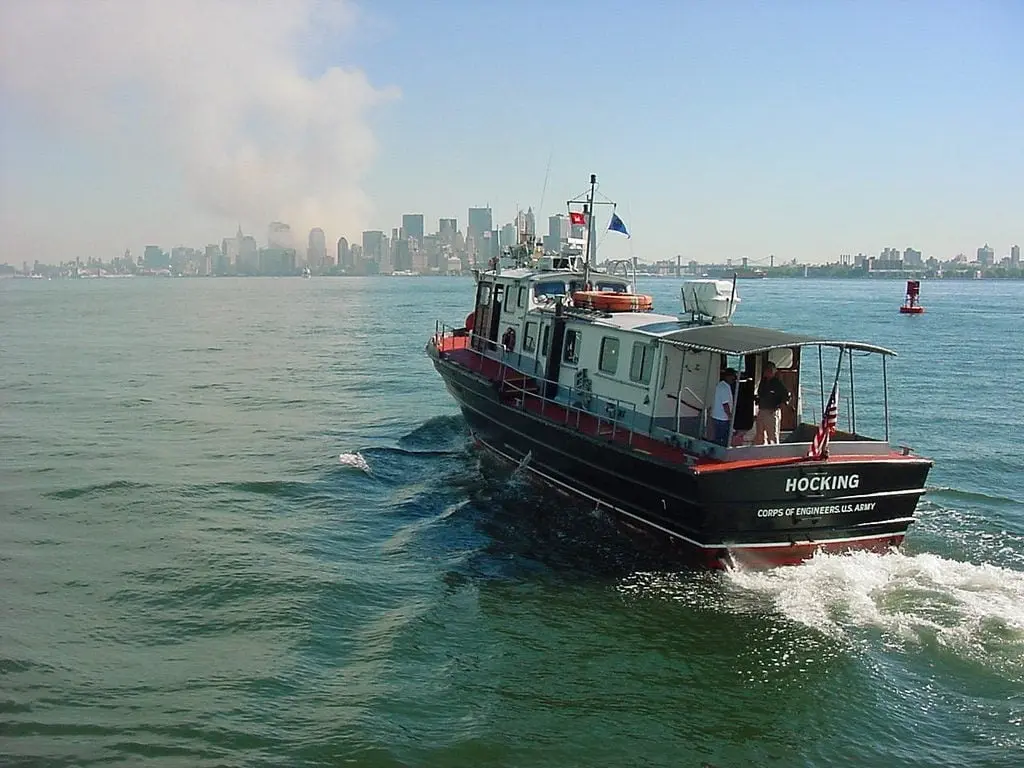
Executive Overview: A Quarter-Century of Remembrance
On September 11, 2026, the United States marked the 25th anniversary of the terrorist attacks that reshaped the modern world. Amid the solemn commemorations held across the nation, a profound tribute was paid to a group of civilian heroes whose actions on that fateful day constituted one of the most remarkable, yet frequently overlooked, chapters of American history.
U.S. Maritime Administrator Stephen Carmel issued a national address honoring the merchant mariners, tugboat captains, ferry operators, and recreational boaters who engineered the largest waterborne evacuation in human history. In the span of just nine hours on September 11, 2001, an impromptu flotilla of civilian vessels rescued nearly 500,000 people trapped at the southern tip of Manhattan.
With all bridges, tunnels, and subway lines abruptly severed, the water became the sole avenue of escape for a terrified, soot-covered population fleeing the collapse of the World Trade Center towers. Responding to a spontaneous call from the U.S. Coast Guard for "all available boats," hundreds of mariners steered their vessels directly into an active disaster zone.
Twenty-five years later, the Maritime Administration (MARAD) has reaffirmed the critical importance of these civilian crews, highlighting not only their historic bravery but also the ongoing national security mandate to maintain a robust, resilient domestic maritime workforce.
Detailed Chronology: The Day the Harbor Answered the Call
To understand the magnitude of the 9/11 boatlift, one must examine the rapid, chaotic sequence of events that unfolded on the waters surrounding Manhattan on Tuesday morning, September 11, 2001.
+-----------------------------------------------------------------------------+
|                     CHRONOLOGY OF THE 9/11 WATER EVACUATION                 |
+-----------------------------------------------------------------------------+
|  08:46 AM -- American Airlines Flight 11 strikes the North Tower.           |
|  09:03 AM -- United Airlines Flight 175 strikes the South Tower.           |
|  09:21 AM -- Port Authority closes all bridges and tunnels in NYC area.      |
|  09:59 AM -- The South Tower collapses; massive dust cloud blankets area.   |
|  10:20 AM -- USCG issues historic broadcast: "All available boats..."       |
|  10:28 AM -- The North Tower collapses; thousands flee to the seawalls.     |
|  11:00 AM -- Hundreds of civilian vessels form an organized rescue fleet.   |
|  07:00 PM -- Evacuation concludes; ~500,000 civilians moved to safety.      |
+-----------------------------------------------------------------------------+
The Immediate Aftermath of the Attacks
At 8:46 AM, American Airlines Flight 11 struck the North Tower of the World Trade Center. Seventeen minutes later, United Airlines Flight 175 struck the South Tower. As the scale of the unfolding tragedy became clear, local authorities scrambled to secure the city. By 9:21 AM, the Port Authority of New York and New Jersey closed all bridges and tunnels to vehicular and pedestrian traffic, effectively locking down the island of Manhattan.
When the South Tower collapsed at 9:59 AM, followed by the North Tower at 10:28 AM, a colossal, suffocating cloud of pulverized concrete, asbestos, and ash rolled through the canyons of Lower Manhattan. Tens of thousands of panicked citizens fled southward, running until they reached the water’s edge at Battery Park, the Hudson River Park, and the East River piers. They were trapped, with a wall of toxic smoke behind them and deep harbor waters in front of them.
"All Available Boats": The Call to Action
Recognizing that a massive humanitarian catastrophe was unfolding on the seawalls, the U.S. Coast Guard’s Vessel Traffic Service (VTS) and local harbor pilots took decisive action. At approximately 10:20 AM, Lieutenant Michael Day of the U.S. Coast Guard issued a historic, open-channel radio broadcast across New York Harbor:
"All available boats… This is the United States Coast Guard. Anyone wanting to help with the evacuation of Lower Manhattan, report to Governor’s Island."
The response was instantaneous. The call did not go to a mobilized military reserve, but to the everyday working class of the New York waterfront.
Shuttling Through the Ash: The Nine-Hour Rescue
Within minutes of the broadcast, the waters of New York Harbor churned with activity. Tugboats, municipal ferries, Staten Island Ferries, private sightseeing vessels (such as the Circle Line), dinner cruise boats, water taxis, and private yachts altered course and headed toward the billowing black smoke rising from Manhattan.
      [ Hudson River ]                      [ East River ]
             |                                    |
             v                                    v
     +---------------+                    +---------------+
     |  NY Waterway  |                    |  Tugboats &   |
     |  Ferries &    |                    | Private Craft |
     | Private Yachts|                    |               |
     +-------+-------+                    +-------+-------+
             |                                    |
             +-----------------+------------------+
                               |
                               v
                     [ LOWER MANHATTAN ]
                    (Battery Park & Piers)
                               |
            +------------------+------------------+
            |                                     |
            v                                     v
    [ To New Jersey ]                     [ To Brooklyn / SI ]
Conditions on the water were perilous. The thick dust cloud had drifted over the harbor, reducing visibility to near-zero in several areas. Navigating by radar and sheer instinct, captains pushed their bow sprits directly against the concrete seawalls of Battery Park and the pier edges.
Deckhands, often with no safety gear or protective masks, reached into the dust to pull passengers aboard. Some vessels were so overloaded that their gunwales sat mere inches above the waterline. Over the next nine hours, this impromptu armada operated continuously, loading passengers, crossing the Hudson and East rivers to drop them off in New Jersey, Brooklyn, Staten Island, and Queens, and immediately returning to Manhattan for more.
Supporting Context & Metrics: Quantifying the Miracle
The scale of the September 11 boatlift is difficult to comprehend without comparing it to historical military evacuations and analyzing the metrics of the response.
A Comparative Feat: Dunkirk vs. Manhattan
The most common historical point of comparison for the 9/11 boatlift is the Miracle of Dunkirk (Operation Dynamo) in 1940. During World War II, a fleet of naval vessels and civilian "little ships" evacuated Allied soldiers trapped on the beaches of France.
While Dunkirk remains an iconic symbol of maritime rescue, a side-by-side metric comparison reveals the extraordinary efficiency of the New York Harbor response:
| Metric | Operation Dynamo (Dunkirk) | The 9/11 Manhattan Boatlift |
|---|---|---|
| Active Duration | 9 Days (May 26 – June 4, 1940) | 9 Hours (approx. 10:00 AM – 7:00 PM) |
| Total Evacuated | ~338,226 Allied Soldiers | ~500,000 Civilians |
| Planning Time | Several days of military preparation | Zero (Spontaneous, ad-hoc response) |
| Vessels Involved | ~850 military and civilian craft | ~150 to 500 civilian/commercial vessels |
The Manhattan boatlift succeeded because of the high density of commercial maritime traffic in New York Harbor and the unparalleled maneuvering skills of local captains, who routinely docked in tight spaces under high-current conditions.
The Composition of the Flotilla
A diverse array of vessels participated in the evacuation, demonstrating the versatility of the harbor’s commercial fleet:
- Commuter Ferries: Vessels from NY Waterway and the Staten Island Ferry served as the heavy lifters. NY Waterway alone evacuated more than 150,000 people. A single Staten Island Ferry, designed to carry thousands, transported massive crowds on every run.
- Tugboats: Usually used to guide massive container ships, tugboats from companies like McAllister Towing and Moran Towing docked at the seawalls. Because tugboats sit low in the water, they were highly accessible for civilians climbing down from high concrete barriers.
- Historic & Municipal Vessels: The retired 1931 fireboat John J. Harvey, which had been preserved as a historic museum piece, was quickly re-commissioned by its volunteer crew. It assisted in firefighting efforts at Ground Zero, pumping water for days after the city’s water mains were severed, while also participating in early evacuations.
Preserving the Narrative: The "BOATLIFT" Documentary
For nearly a decade after the attacks, the story of the waterborne evacuation remained largely in the shadow of the massive land-based rescue operations. To preserve this vital history, the short documentary film "BOATLIFT: An Untold Tale of 9/11 Resilience" was released for the 10th anniversary in 2011.
Narrated by Academy Award-winning actor Tom Hanks, the documentary features firsthand accounts from the captains, deckhands, and Coast Guard officers who coordinated the effort. The film highlights how the maritime community bypassed bureaucratic hurdles to execute a flawless rescue operation without a single serious injury or casualty.
Official Statements: Honoring the Unsung Heroes
In his address marking the 25th anniversary, U.S. Maritime Administrator Stephen Carmel emphasized that the actions of the mariners on September 11, 2001, epitomized the highest traditions of the American merchant marine.
+-----------------------------------------------------------------------------+
| "They delivered hope. They delivered courage. They delivered the best of     |
|  America. Twenty-five years later, their legacy endures as a living         |
|  testament to the strength of our maritime community."                      |
|                                                                             |
|  -- Stephen Carmel, U.S. Maritime Administrator (September 11, 2026)        |
+-----------------------------------------------------------------------------+
Administrator Carmel’s Tribute
"When our Nation was attacked and thousands were trapped in Lower Manhattan, the Coast Guard issued a call across New York Harbor for ‘all available boats’ to assist in the evacuation," Carmel stated. "And merchant mariners delivered."
Carmel reflected on the sheer courage required to steer a vessel into the thick dust cloud of Manhattan when the nature of the attack was still unknown:
"Civilian mariners steered into an active disaster zone, often with little information about what was happening ashore or what they would encounter when they arrived. Through the chaos, they delivered hope. They delivered courage. They delivered the best of America."
The Generational Legacy of the Harbor
A particularly moving aspect of the 25th-anniversary address was Carmel’s acknowledgment of the generational transition occurring within the maritime industry. Today, many of the young deckhands and captains working in New York Harbor and across the nation are the sons and daughters of the mariners who responded on September 11.
"Some of the sons and daughters of the mariners who served on September 11 have since entered the industry themselves," Carmel noted. "Their service stands as a living testament to the example set on 9/11 and to the enduring strength of our maritime community. We will never forget what you delivered for our Nation."
Future Outlook: Disaster Resilience and the Modern Merchant Marine
As the maritime industry looks toward the next quarter-century, the lessons of the 9/11 boatlift remain central to discussions surrounding national security, emergency management, and infrastructural resilience.
Integrating Maritime Assets into Modern Emergency Protocols
The spontaneous success of the 9/11 boatlift fundamentally altered how federal and municipal agencies view maritime assets in disaster planning. Prior to 2001, evacuation drills for major metropolitan areas focused almost exclusively on land-based transit: subways, buses, highways, and bridges.
Today, emergency response agencies like the Federal Emergency Management Agency (FEMA) and the U.S. Coast Guard have integrated commercial ferry systems and tugboat networks directly into regional evacuation plans. New York City, San Francisco, Seattle, and Boston have developed specific maritime evacuation protocols, recognizing that in the event of an earthquake, terrorist attack, or catastrophic infrastructure failure, waterways remain the most reliable transit corridors.
       [ CRISIS EVENT: LAND INFRASTRUCTURE COMPROMISED ]
                              |
            +-----------------+-----------------+
            |                                   |
            v                                   v
   [ Land-Based Bottlenecks ]         [ Maritime Alternatives ]
   * Gridlocked highways              * Uncongested waterways
   * Severed bridge connections       * Scalable vessel capacity
   * Disabled subway systems          * Flexible landing zones
            |                                   |
            +-----------------+-----------------+
                              |
                              v
             [ WATERBORNE EVACUATION ACTIVATED ]
Sustaining America’s Domestic Maritime Strength
While the 25th anniversary of 9/11 is a time for solemn reflection, industry leaders are also using the milestone to advocate for the preservation of the domestic maritime workforce.
The U.S. Merchant Marine faces significant modern headwinds, including:
- Workforce Shortages: A critical shortage of qualified mariners threatens both commercial operations and national security sealift capabilities.
- Fleet Modernization: The need to transition to cleaner, more efficient vessels while maintaining the rugged reliability required for emergency response.
- Regulatory Support: The ongoing necessity of statutory frameworks like the Jones Act, which requires that vessels transporting goods between U.S. ports be built, owned, and operated by United States citizens. Proponents argue that without a strong domestic fleet protected by such legislation, the nation would lack the vessels and skilled mariners needed to respond to future domestic crises.
Twenty-five years after the towers fell, the legacy of the 9/11 boatlift stands as an unassailable proof of concept. When the nation’s land-based systems failed, the water provided a path to safety. The civilian mariners who answered the call proved that a country’s security relies not only on its military forces, but also on the courage, resourcefulness, and dedication of its everyday working mariners.