







Executive Overview
The aviation sector stands at one of the most critical crossroads in its century-long history. Responsible for roughly 2.5% of global carbon dioxide emissions, commercial aviation faces an existential imperative: decarbonize rapidly or face severe regulatory penalties, escalating carbon taxes, and public alienation. Yet, unlike ground transportation, which is rapidly transitioning to battery-electric architectures, commercial flight cannot easily escape the laws of physics. High-density, liquid energy storage is non-negotiable for long-haul routes, making Sustainable Aviation Fuel (SAF) the industry’s single most viable pathway to net-zero emissions by 2050.
Despite this consensus, the commercial aviation industry has continuously stumbled over a stubborn hurdle: a crippled, underdeveloped supply chain. While airlines are eager to make public commitments and sign forward-purchase agreements, the volume of SAF produced globally remains a microscopic fraction of total jet fuel consumption.
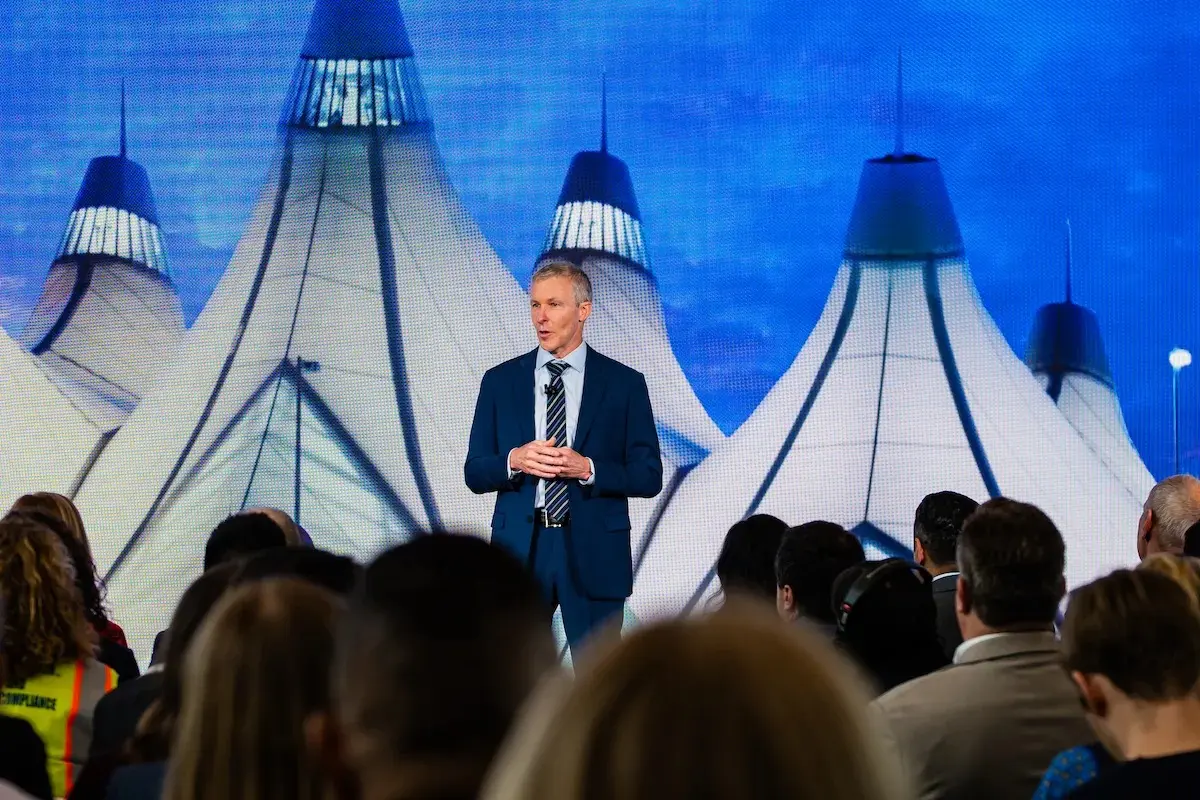
Enter Scott Kirby, the outspoken CEO of United Airlines. During a high-profile fireside chat with Ryan Warner of Colorado Matters at the Denver Performing Arts Complex, Kirby cut through industry greenwashing to address the hard truths of the transition. He pointed to an unexpected yet abundant domestic resource—corn and soy currently cultivated for biodiesel—as a bridge to scale SAF production.
However, Kirby’s vision goes beyond mere agricultural adaptation. He is calling for robust, strategic government intervention to solidify the nascent market. At the same time, he did not shy away from controversy, launching a pointed critique of Europe’s regulatory framework, which he argues relies too heavily on punitive mandates rather than market-stimulating incentives.
This deep dive examines Kirby’s alarming personal awakening to climate change during his days as an Air Force Academy cadet, the escalating environmental crisis unfolding in the American West, the mechanics of leveraging agricultural feedstocks, and the geopolitical battlegrounds of global aviation policy.
Detailed Chronology: From Air Force Cadet to Airline Reformer
The 1980s: Early Warnings at the Air Force Academy
To understand Scott Kirby’s vocal stance on climate change, one must look back to his formative years. Long before environmentalism became a standard corporate marketing pillar, Kirby was confronting the hard data of climatology.
During his time as a cadet at the United States Air Force Academy in the 1980s, Kirby first encountered predictive models concerning global warming. While many corporate leaders of his generation viewed environmental science through a skeptical or peripheral lens, Kirby absorbed the grim trajectories mapped out by mid-1980s researchers.

"And I can remember reading in the ’80s, the forecasts were there’s going to be less snow on the Western Slope and the Colorado River’s going to go dry," Kirby recounted on stage in Denver.
Those decades-old projections were not abstract academic exercises; they were terrifyingly accurate prophecies of the environmental collapse currently playing out across the American West.
The Present-Day Reality: The Western Slope as a Climate Epicenter
Kirby’s historical anecdotes quickly give way to present-day ecological trauma. The Western Slope of Colorado—alongside three neighboring Utah counties—has emerged as one of the most aggressive climate hotspots on the entire North American continent.
According to climate data, this region has warmed by more than 2 degrees Celsius above pre-industrial levels, a rate roughly double the global average. This severe warming has triggered a catastrophic feedback loop within the Colorado River basin. As temperatures rise, evaporation rates accelerate, rainfall patterns become erratic, and winter snowpacks on the Rocky Mountains shrink significantly. The result is a severely depleted Colorado River, threatening the water and energy security of tens of millions of Americans.
This crisis was starkly illustrated this summer, when critical federal reservoirs—most notably Lake Powell and Lake Mead—hovered dangerously close to dead pool levels. For an airline executive whose operational lifeblood depends on stability, these local weather and hydrological anomalies are not distant theoretical risks; they are immediate threats to economic stability, infrastructure resilience, and the very viability of modern civilization.
United’s Pivot: Moving Beyond PR to Capital Deployment
Armed with this early awareness and the visible impacts of climate change in his airline’s backyard, Kirby has pushed United Airlines to adopt a more aggressive sustainability stance than most of its legacy competitors.
Rather than relying entirely on carbon offsets—which Kirby and many other scientists have increasingly dismissed as corporate greenwashing—United has focused on direct technological intervention. Through the pioneering UAS Ventures fund, United has invested directly in SAF producers, electric aircraft startups, and carbon capture technology.
Yet, as Kirby frequently admits, ambition continually crashes against the hard rock of supply chain reality. The airlines want to buy SAF, but the refineries simply are not producing it at scale.
Supporting Context & Metrics: The SAF Supply Chain Crisis
The Math of Aviation Decarbonization
To grasp the magnitude of the SAF challenge, one must examine the numbers. The global commercial airline fleet consumes roughly 90 to 100 billion gallons of jet fuel annually during normal operating years. In contrast, total global SAF production hovers around 600 million gallons annually—representing less than 1% of total demand.
Global Jet Fuel vs. SAF Production (Approximate Annual Volumes)
[████████████████████████████████████████] Global Jet Fuel Demand (~100 Billion Gallons)
[ ] Current Global SAF Production (~600 Million Gallons - <1%)
For United Airlines alone, fulfilling its ambitious pledge to reach net-zero emissions by 2050 without relying on unverified offsets requires billions of gallons of low-carbon fuel over the coming decades. The economic and logistical chasm between current production capacities and future requirements is the defining crisis of modern aviation.
The Corn and Soy Solution: Redirecting Biodiesel Feedstocks
During his discussion in Denver, Kirby highlighted a pragmatic, albeit controversial, pathway to bridging this supply gap: redirecting the corn and soy crops currently utilized for biodiesel production toward the aviation sector.
Currently, a significant portion of American agricultural output—particularly corn-derived ethanol and soybean oil—is processed into biodiesel for ground transportation. However, ground transportation is undergoing a rapid, multi-decade technological transition toward electrification. Passenger cars, delivery vans, and increasingly heavy-duty trucks are swapping internal combustion engines for lithium-ion battery packs.
Kirby’s argument rests on a forward-looking economic logic:
- Ground transport electrification is reducing the long-term necessity of crop-based biodiesel for cars and trucks.
- Aviation, meanwhile, remains heavily constrained, with no viable battery-electric alternative for transcontinental or transoceanic routes in the foreseeable future.
- Therefore, agricultural feedstocks currently tied up in biodiesel production should be systematically reallocated toward the production of Sustainable Aviation Fuel.
By pivoting these existing supply chains, the agricultural and energy sectors could instantly unlock massive volumes of feedstock, giving nascent SAF refineries the predictable input volumes they desperately need to scale operations.
The Hurdle of Scalability and Land Use
Of course, Kirby’s proposed solution is not without its critics. Environmental groups have long raised valid concerns regarding the land-use efficiency, carbon intensity, and food-versus-fuel dynamics of crop-based biofuels. Scaling corn and soy production for aviation risks driving up food prices, incentivizing land-clearing, and triggering unintended land-use carbon emissions if not strictly regulated.
Kirby acknowledges these complexities but maintains that perfection must not become the enemy of progress. Without an immediate, intermediate feedstock bridge like corn and soy, the aviation industry will remain trapped in fossil-fuel dependency while waiting for next-generation power-to-liquid (PtL) fuels or cellulosic ethanol technologies to mature.
Official Statements and Industry Perspectives
Scott Kirby on Government Support and Market Incentives
A central theme of Kirby’s address in Denver was the absolute necessity of robust government intervention to establish a functioning SAF market. Unlike traditional jet fuel, which benefits from a mature, century-old extraction, refining, and distribution infrastructure, SAF is burdened by a severe "green premium." Producing SAF is significantly more expensive than pumping conventional crude oil, making it difficult for airlines to purchase it voluntarily without sacrificing financial competitiveness.
"We want more government support to firm up the industry," Kirby asserted, emphasizing that private capital alone cannot bear the upfront capital expenditure required to build hundreds of advanced biorefineries.
Kirby has consistently advocated for policies modeled after the U.S. Inflation Reduction Act (IRA), which introduced blender’s tax credits and investment tax credits for low-carbon fuels. These financial mechanisms help compress the price differential between fossil jet fuel and SAF, providing the long-term price certainty that investors and project developers require to break ground on multi-billion-dollar facilities.
Kirby’s Critique of European Regulatory Overreach
While Kirby welcomes government intervention, he draws a sharp line regarding how governments choose to regulate. During his remarks, he didn’t hold back in his criticism of Europe’s approach to aviation decarbonization.
While the European Union has implemented ambitious policies—such as the ReFuelEU Aviation initiative, which imposes strict mandates requiring fuel suppliers to blend increasing percentages of SAF at EU airports—Kirby argues that Europe has put the cart before the horse.
Kirby openly criticized Europe’s regulatory strategy, characterizing it as a punitive framework built on mandates rather than market-stimulating incentives.
According to Kirby, simply ordering airlines to buy a product that does not exist in sufficient quantities—while penalizing them for failing to meet arbitrary targets—does nothing to solve the underlying supply chain bottleneck. Instead of forcing compliance through punitive fines and mandates, Kirby contends that governments should focus on subsidizing production, de-risking capital investments, and scaling the physical infrastructure of supply. Without adequate supply, mandates simply drive up ticket prices, strain airline balance sheets, and create market distortions without achieving meaningful, structural carbon reductions.
Future Outlook: The Road to 2050
As the commercial aviation sector looks toward its legally and morally binding net-zero targets for 2050, the path forward remains fraught with technological, financial, and geopolitical obstacles.
1. Technological Evolution Beyond Agro-Fuels
While agricultural feedstocks like corn and soy offer an immediate bridge, the long-term future of SAF must transcend traditional crops. The industry is already investing in next-generation feedstocks, including:
- Municipal Solid Waste (MSW): Diverting household trash from landfills and converting it into liquid hydrocarbons.
- Agricultural and Forestry Residues: Utilizing corn stover, wood chips, and agricultural waste products that do not compete with food production.
- Power-to-Liquids (PtL): Capturing atmospheric carbon dioxide and combining it with green hydrogen generated via electrolysis from renewable electricity.
However, all of these advanced pathways face steep technological and economic hurdles, requiring years of research, development, and massive capital deployment before they can achieve cost parity with fossil fuels.
2. The Geopolitical Race for Clean Energy Dominance
The debate over SAF is also a proxy war for global industrial leadership. As the United States and the European Union deploy differing policy mixes—the U.S. favoring tax credits and market-based incentives, and Europe favoring strict regulatory mandates—aerospace and energy companies are making multi-billion-dollar bets on where to build the refineries of the future.
If U.S. policy successfully de-risks domestic production through mechanisms like those championed by executives like Kirby, America could become the dominant global exporter of sustainable aviation fuel, securing energy independence and industrial jobs for decades to come. Conversely, mismanaged policies could cause the West to fall behind in the race for clean energy technologies, ceding ground to global competitors.
3. The Ultimate Test for Leadership
Scott Kirby’s warnings in Denver serve as both a sobering reality check and a call to action. The climate crisis is no longer a distant threat analyzed by cadets in 1980s classrooms; it is an active economic and ecological disruption evidenced by the drying basin of the Colorado River and the strained capacity of Western reservoirs.
For the aviation industry, survival requires moving past empty corporate pledges and confronting the gritty realities of industrial supply chains, agricultural policy, and international regulatory alignment. Whether leaders like Kirby can successfully navigate these turbulent skies will determine not only the future profitability of United Airlines, but the very possibility of sustainable human flight in a warming world.